Minneapolis Neighborhood
Willard - Hay
A residential North Minneapolis neighborhood where Willard Park anchors community life, where the blocks between Penn Avenue and Theodore Wirth Park hold some of the most affordable homeownership in the city, and where diverse families build lives that are richer and more complicated than the zip code suggests.
№ 85 of 87 · Near North community · Last updated: October 2026 · A complete neighborhood guide
From the western edge of Willard - Hay, you can see the tree canopy of Theodore Wirth Park — 740 acres of urban wilderness that starts just across Xerxes Avenue. It is one of the most beautiful approaches to a park in Minneapolis. On a fall afternoon, the colors are extraordinary — the oaks and maples along the parkway turning gold and red while the steady blocks of houses behind you continue their quiet business of being a neighborhood. A man rakes leaves in his yard. Two kids ride bikes in circles on the sidewalk. A woman carries groceries from her car to her front door. The scene is unremarkable, which is precisely what makes it remarkable — because in a part of the city that has been marked by crisis for so long, the ordinary business of daily life is its own kind of accomplishment.

What is Willard - Hay, Minneapolis?
Willard - Hay is a residential neighborhood in North Minneapolis, bounded roughly by Olson Memorial Highway to the south, West Broadway to the north, Penn Avenue North to the east (stepping out to Irving Avenue north of Plymouth), and Xerxes Avenue and Theodore Wirth Park to the west. Home to about 8,900 residents, it occupies the western tier of the Northside — a quieter, more residential area than the neighborhoods farther east along Broadway Avenue and the commercial corridors.
The neighborhood sits between Near North to the east and the Golden Valley city line to the west, with Harrison to the south and Jordan to the north. Its position against Theodore Wirth Park gives Willard - Hay an asset that most North Minneapolis neighborhoods do not share — direct access to the largest park in the Minneapolis system.
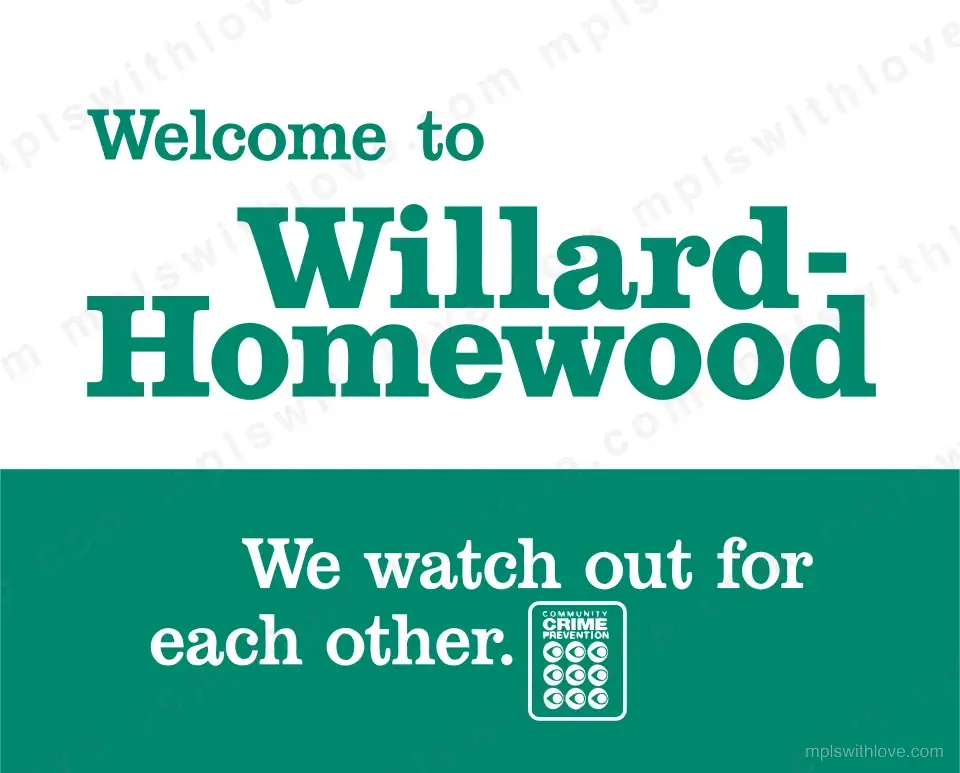
Willard - Hay Neighborhood Sign
Willard - Hay, Minneapolis — Key Stats (2025–2026)
- Residents (2020 Census)
- ~8,900
- Median home sale price (2025 data)
- $267K
- Era most homes were built
- 1900s–1940s
- Black residents (2020–24 ACS)
- 44%
- Main north–south street and commercial corridor
- Penn Ave N
- Drive to downtown Minneapolis
- 12 min
- Walk Score (Oct 2026)
- 54
- Bike Score (Oct 2026)
- 70
Willard - Hay History & Origins
Willard - Hay developed in the early twentieth century, as houses filled the blocks out to Xerxes Avenue, the city's western edge. The name comes from two neighborhood elementary schools: Willard, named for the reformer Frances Willard, and Hay, named for the diplomat John Hay. In the 1910s and 1920s the North Side's Jewish community, shut out of much of the rest of Minneapolis by restrictive covenants and discrimination, moved west along Plymouth Avenue, and Homewood — the subdivision between Plymouth and Oak Park avenues, accepted by the city in 1909 — became the enclave of its more prosperous families.
After World War II, housing and jobs opened up for Jewish families more readily than for Black families. The Jewish community moved on, mostly to St. Louis Park and the other western suburbs, and after the Plymouth Avenue unrest of July 1967 the last Jewish businesses, synagogues, and institutions followed. Willard - Hay became a largely African American neighborhood, and later decades brought Southeast Asian and Latino families as well.
Disinvestment affected Willard - Hay as it did all of North Minneapolis. In Homewood, where many houses had fallen behind on upkeep, residents formed the Willard Homewood Organization in the late 1960s and ran their own rehabilitation program with the city's housing authority, keeping the area single-family through the urban renewal years. The housing stock aged and some properties deteriorated, but many blocks maintained stable homeownership. The proximity to Theodore Wirth Park, while underutilized, remained a latent asset that distinguished Willard - Hay from neighborhoods without significant green space access.
Living in Willard - Hay
Willard - Hay is quieter than many North Minneapolis neighborhoods. The blocks between Penn Avenue and the park are primarily residential — single-family homes on small to mid-sized lots, with front porches, detached garages, and the mature trees that are one of North Minneapolis's underappreciated features. The neighborhood does not have a bustling commercial life; Penn Avenue provides some services on its east side, but most shopping and dining requires leaving the neighborhood.
What Willard - Hay has instead is a residential stability that anchors daily life. Many blocks have long-term homeowners who have invested decades in their properties and their community. The Willard-Hay neighborhood organization has been active in advocating for the community's interests, and block clubs on many streets provide the ground-level organizing that holds neighborhoods together.
Willard Park, near the center of the neighborhood, and North Commons Park, on the east side, provide gathering space that is central to community life. Youth programming, sports leagues, and community events at the North Commons rec center create the intergenerational connections that make a neighborhood more than a collection of houses. In summer, the parks are a hub — kids playing, families gathering, the organized and spontaneous mixing that defines neighborhood life at its best.
The diversity of Willard - Hay is genuine. Black residents are the largest group — about 44 percent, according to Census estimates — and about three in ten residents are white, with Latino and Asian families making up much of the rest. The diversity adds cultural texture but also creates the same bridging challenges that all multicultural neighborhoods navigate.
Willard - Hay Food, Drink & Local Spots
Willard - Hay is primarily residential and does not have a significant food or dining scene within its boundaries. The neighborhood's commercial options are concentrated along Penn Avenue on the east side and in nearby corridors. Residents rely on Broadway Avenue to the north and east, and on grocery stores and restaurants outside the immediate neighborhood.
What's Nearby
Penn Avenue, running north–south through Willard - Hay's east side, provides limited commercial services — small stores, takeout spots, and neighborhood services. The corridor has not achieved the commercial density of Broadway Avenue but serves basic needs.
Broadway Avenue, which forms the neighborhood's northern edge and runs east toward the river, provides the closest concentration of restaurants and food businesses. Soul food, Somali restaurants, and community-oriented businesses serve the North Minneapolis community.
While not a food destination, Theodore Wirth Park provides picnic areas and seasonal concessions. The park's proximity makes it a natural extension of neighborhood life — a place for family gatherings that might include food brought from home or grilled on park facilities.
Parks & Outdoors Near Willard - Hay
Park access is Willard - Hay's strongest suit. The combination of North Commons' community facilities and Theodore Wirth Park's natural expanse gives residents recreational options that rival any neighborhood in the city.
Willard Park and North Commons
Willard Park is a small park on Queen Avenue with a ball field, a basketball court, a playground, and a wading pool. The neighborhood's recreation center is at North Commons Park, on the east side, and provides year-round programming for youth and adults, including sports leagues, after-school activities, and community events. The Park Board is renovating and expanding that community center and rebuilding the park's water park, with construction scheduled to finish in 2027. The two parks are the social center of the neighborhood — the places where community happens most naturally.
Theodore Wirth Park
Theodore Wirth Park, the largest park in the Minneapolis system at about 740 acres, borders Willard - Hay to the west. The park offers hiking and mountain biking trails, a golf course, Wirth Beach on Wirth Lake, cross-country ski trails, the Eloise Butler Wildflower Garden and Bird Sanctuary, and extensive natural areas. For Willard - Hay residents, this extraordinary resource is accessible by walking across Xerxes Avenue.
The relationship between North Minneapolis neighborhoods and Theodore Wirth Park has been improving through intentional work by the Park Board and community organizations. Better trail connections, programming designed for Northside residents, and efforts to make the park feel welcoming to all have begun to address a historical disconnect between the park and its closest neighbors.
Willard - Hay Schools
Willard - Hay is served by Minneapolis Public Schools. Nearby options include North Minneapolis elementaries and North High School (grades 9–12), just outside the neighborhood in Near North; MPS assigns schools by address, so check the district's school finder for a specific house. The schools face the challenges common to North Minneapolis education — the achievement gap, resource constraints, and the effects of concentrated poverty on educational outcomes.
Many families use the district's open enrollment system to access magnet programs and schools in other parts of the city. Charter schools provide additional options. Community-based organizations and faith communities offer supplemental educational support, after-school programs, and mentoring.
Willard - Hay Real Estate & Housing
Willard - Hay's housing market is affordable by Minneapolis standards: the median sale price was $267,000 in 2025, up from $251,500 a year earlier, according to Minneapolis Area REALTORS, against a citywide median of $350,000. The housing stock is predominantly older frame houses and bungalows from the 1900s through 1940s. Conditions vary by property and by block, with well-maintained owner-occupied homes alongside properties that show the effects of age and limited investment.
What Your Money Buys
Minneapolis Area REALTORS counted 90 sales in 2025, few of them condos, and homes sold a little faster than in the city as a whole — 46 days on market, against 55 citywide. Below the median, you'll find smaller homes needing updating; above it, well-maintained three-bedroom homes, recently rehabbed properties, and new construction. The combination of affordable housing and proximity to Theodore Wirth Park is genuinely unique — there is no comparable price-to-park-access ratio elsewhere in Minneapolis.
Getting Around Willard - Hay
Willard - Hay is primarily car-oriented, with a Walk Score of 54 and a Bike Score of 70. The residential character and limited commercial options mean that most daily needs require leaving the neighborhood. Downtown Minneapolis is approximately twelve minutes by car.
Metro Transit bus routes serve the area along Penn Avenue and Plymouth Avenue, providing connections to downtown and the broader transit network. The flat terrain and Theodore Wirth Parkway make cycling practical, and the park's trail system provides recreational riding options. The Luce Line Trail connects through the area to the western suburbs.
Street parking is readily available on residential blocks. Highway access via I-94 and Highway 55 provides reasonable connectivity for car commuters.
What's Changing: The Honest Version
Willard - Hay shares the tensions that affect all of North Minneapolis, experienced through the lens of a residential neighborhood that is close to extraordinary natural assets but far from the investments that would maximize their value to the community.
Park Equity and Access
The proximity to Theodore Wirth Park should be Willard - Hay's defining advantage, but the relationship between the park and the neighborhood has historically been underdeveloped. Better trail connections, more programming for Northside residents, and infrastructure improvements along the parkway are ongoing. The broader question — why the neighborhoods closest to the city's best park have received the city's least investment — is a question about equity that extends well beyond park policy.
Housing Investment
Willard - Hay's housing stock is aging, and the gap between well-maintained and deteriorated properties is visible. Community development organizations have produced some new affordable housing, but the scale of need exceeds the scale of investment. The challenge is familiar: attracting enough investment to stabilize and improve the housing stock without triggering price increases that push out the families who have maintained the neighborhood through its hardest years.
Commercial Corridor Development
Penn Avenue, Willard - Hay's main north–south street, has been the focus of corridor planning and community visioning. The goal is a more vibrant commercial corridor that provides the goods, services, and gathering spaces that the neighborhood needs. Progress has been slow but incremental, and community engagement in the planning process has been strong. The question is whether the vision will be backed by the investment needed to make it real.
Willard - Hay FAQ
Is Willard - Hay a good neighborhood in Minneapolis?
Willard - Hay is a neighborhood with affordable housing, access to Theodore Wirth Park, an active community organization, and a diverse population. It faces the challenges common to North Minneapolis — higher crime rates, commercial gaps, and long-term disinvestment — but also has stable blocks with committed homeowners and genuine community bonds. For people seeking affordability and park access, Willard - Hay has real assets.
Is Willard - Hay, Minneapolis safe?
Willard - Hay's crime rates are elevated compared to citywide averages, consistent with the broader North Minneapolis pattern. Safety varies by block, with some blocks quite stable and others facing more challenges. The Willard-Hay neighborhood organization has been active on public safety issues, and block clubs provide grassroots safety infrastructure on many streets.
What is Willard - Hay, Minneapolis known for?
Willard - Hay is known for Willard Park and the North Commons recreation center, its proximity to Theodore Wirth Park, affordable housing, and a diverse residential community. The neighborhood occupies the western tier of North Minneapolis, out to Theodore Wirth Park and the Golden Valley line, giving it a quieter, more residential character than neighborhoods closer to the commercial corridors.
How much do homes cost in Willard - Hay, Minneapolis?
Housing prices in Willard - Hay are among the more affordable in Minneapolis: the median sale price was $267,000 in 2025, up from $251,500 in 2024, according to Minneapolis Area REALTORS, against a citywide median of $350,000. This makes homeownership accessible for buyers priced out of most other city neighborhoods. Rehabbed and new-construction homes can reach higher price points.
Where exactly is Willard - Hay in Minneapolis?
Willard - Hay is in North Minneapolis, roughly bounded by Olson Memorial Highway (Highway 55) to the south, West Broadway to the north, Penn Avenue North to the east (the line steps out to Irving Avenue north of Plymouth), and Xerxes Avenue and Theodore Wirth Park to the west. It sits west of Near North, with Jordan to the north and Harrison to the south.
Is Willard - Hay close to Theodore Wirth Park?
Yes — Willard - Hay's western edge, along Xerxes Avenue, borders Theodore Wirth Park, and Theodore Wirth Parkway runs along its northwest side, giving direct access to the park's 740 acres of trails, woodland, golf course, beach, and recreational facilities. This proximity to the city's largest park is one of Willard - Hay's most significant assets.
What schools serve Willard - Hay, Minneapolis?
Willard - Hay is served by Minneapolis Public Schools. Nearby elementary options include North Minneapolis community schools, and North High School (grades 9–12) is just outside the neighborhood in Near North. MPS assigns schools by address, so check the district's school finder for a specific house. Families also use open enrollment, magnet programs, and charter schools to access additional educational options.
What is the Willard-Hay neighborhood organization?
The Willard-Hay neighborhood organization has been an active advocate for the community, working on issues including public safety, housing quality, park access, and commercial corridor development. The organization provides a vehicle for resident engagement and has pushed for equitable investment in the neighborhood.
What Willard - Hay Knows
Willard - Hay knows what it is like to live in a neighborhood that the rest of the city drives past on the way to the park. Theodore Wirth is right there — one of the great urban parks in America — and the people who live closest to it are the people with the least access to the city's resources. That irony is not lost on Willard - Hay residents, and it is not something they accept quietly. The neighborhood organization pushes for better park connections, better infrastructure, better services, and the basic dignity of being treated as a community that matters.
What Willard - Hay also knows is how to build a life with what is available. The houses are affordable. The park is beautiful. The neighbors look out for each other. The block clubs function. The rec center serves the kids. None of this makes the news. All of it makes a neighborhood. And for the families who call Willard - Hay home, the calculation is clear: this is a place where they can own a home, raise their children, and live with a kind of community support that wealthier neighborhoods often talk about but rarely achieve.

Keep exploring