Minneapolis Neighborhood
East Isles
The lake neighborhood that walks to everything — where Lake of the Isles' eastern shore meets the energy of Uptown, and a quiet residential enclave gets to have it both ways.
№ 22 of 87 · Bde Maka Ska-Isles community · Last updated: October 2026 · A complete neighborhood guide
There is a stretch of Lake of the Isles Parkway East where, on a June evening, you can stand on the sidewalk and see the sunset reflected in the lake to your left, hear laughter from a patio restaurant on Hennepin Avenue two blocks to your right, and watch a great blue heron lift off from the island directly in front of you. This is East Isles in a single frame: a neighborhood that lives in the space between the city and the lake, borrowing the best of both without fully belonging to either. The streets are quiet. The homes are handsome. Uptown is a short walk east. The lake trail is right there. It is a remarkably good deal, geographically speaking, and the neighborhood knows it.

What is East Isles, Minneapolis?
East Isles is a compact residential neighborhood in Southwest Minneapolis, occupying the land between the eastern shore of Lake of the Isles and Hennepin Avenue. It is bounded by West 22nd Street to the north, Hennepin Avenue to the east, West Lake Street to the south, and Lake of the Isles to the west. About 3,700 people live here — a small population that reflects the neighborhood's modest geographic footprint.
What makes East Isles distinctive is its position. To the west, Lake of the Isles and the Chain of Lakes trail system provide world-class outdoor recreation. To the east, Hennepin Avenue and the Uptown commercial district provide restaurants, bars, shops, and groceries within walking distance. Very few Minneapolis neighborhoods can credibly claim both lakeside living and genuine urban walkability. East Isles can, and that combination is the core of its appeal. The housing stock is more varied than neighboring Kenwood — a mix of single-family homes, duplexes, condos, and well-maintained apartment buildings — giving the neighborhood a more diverse economic and demographic texture than the mostly single-family lakeside neighborhoods to the south and west.
East Isles Neighborhood Sign
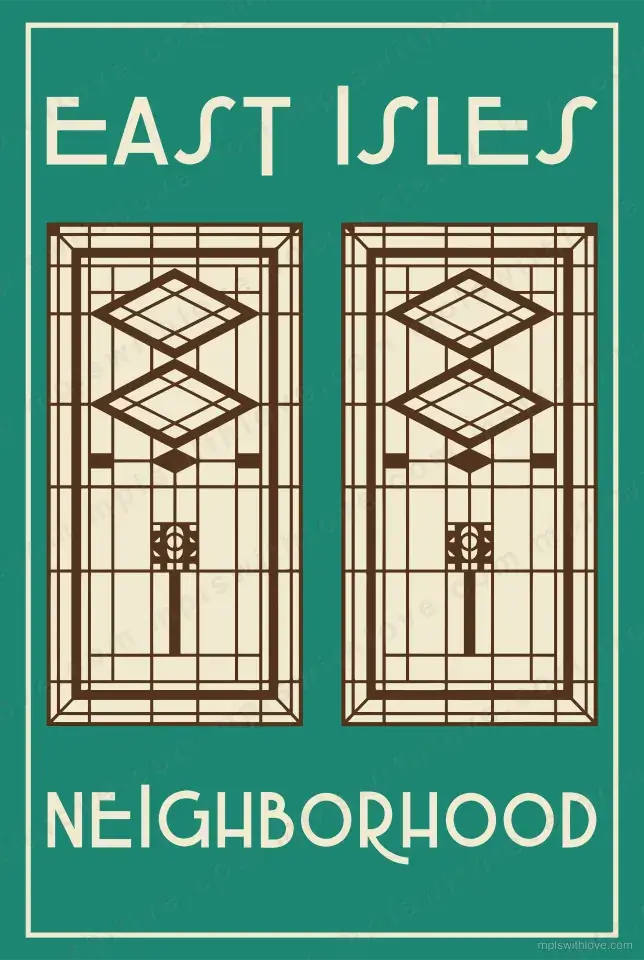
East Isles, Minneapolis — Key Stats (2025–2026)
- Residents (2020 Census)
- ~3,700
- Median sale price, homes and condos (2025 data)
- $340K
- Days on market (2025 data)
- 135 days
- Lake of the Isles on the western border
- 1 lake
- Era most homes were built
- 1900–1930
- Drive to downtown Minneapolis
- 10 min
- Walk Score (Oct 2026)
- 90
- Bike Score (Oct 2026)
- 91
East Isles History & Origins
The land along the eastern shore of Lake of the Isles, like the lake itself, was part of the ancestral homeland of the Dakota people. Mdewakanton Dakota lived near these lakes and wetlands for hundreds of years before the treaties of 1851, which forced the Dakota to cede nearly all their land in Minnesota, opened the area to European-American settlement.
Development of the East Isles area accelerated in the early 1900s, as the Minneapolis Park Board dredged and reshaped Lake of the Isles, work it did in stages between 1889 and 1911. Before the dredging, the lake was shallow and marshy — more wetland than lake in places. The Park Board transformed it into the elegant, island-dotted lake that exists today, constructing the parkway and establishing the parkland that would make lakeside lots extraordinarily desirable. Houses on the east side's parkway went up roughly a decade before many on the west (Kenwood) side, and the east side took on a somewhat different character: more apartment construction and a closer relationship to the commercial activity on Hennepin Avenue.
The years from about 1900 to 1930 were the primary building era. Grand single-family homes went up along the parkway, most of them by 1915. Smaller houses, duplexes, and, from about 1910, brick apartment buildings filled in the rest, with the apartments concentrated along Hennepin and The Mall. This mixed housing stock distinguished East Isles from the more exclusively single-family neighborhoods to the west and south. During the Depression some of the largest houses were razed or divided into rooming houses, especially near Hennepin, but demand for single-family homes continued into the 1950s.
Living in East Isles
East Isles has the feel of a neighborhood that is slightly more aware of its good fortune than it needs to be — and that awareness is mostly justified. The daily routine here is enviable: walk the lake loop in the morning, grab coffee on Hennepin, bike to work downtown via the Kenilworth Trail, pick up groceries at Kowalski's on the way home. The friction between domestic life and urban convenience, which defines so many neighborhood trade-offs in Minneapolis, barely exists here.
The residential streets between the lake and Hennepin are shaded, quiet, and well-maintained. The housing mix — single-family homes alongside apartments and condos — creates a population that is more age-diverse and lifestyle-diverse than the family-dominated neighborhoods to the south. Young professionals, couples without children, empty nesters, and retirees live alongside families with kids. This variety gives East Isles a slightly more urban, slightly less insular atmosphere than Linden Hills or Kenwood.
The East Isles Neighborhood Association is active and well-organized, coordinating neighborhood events, planning advocacy, and the popular Uptown Farmers Market. Community engagement is strong but tends toward the pragmatic — East Isles residents show up for zoning hearings and park board meetings, not necessarily for block parties. The vibe is progressive, educated, and environmentally conscious, consistent with the broader Southwest Minneapolis character.
East Isles Food, Drink & Local Spots
East Isles keeps its commercial blocks to its Hennepin and Lake Street edges, which put dozens of restaurants, cafes, and shops within an easy walk. The neighborhood shares Uptown's commercial infrastructure with Lowry Hill East while maintaining residential calm on its interior streets.
Within & Adjacent to East Isles
The Uptown commercial district along Hennepin Avenue and Lake Street — which meet at East Isles' southeast corner — provides a full range of dining, shopping, and entertainment options. Restaurants, bars, boutiques, and service businesses are all within walking distance of most East Isles addresses.
2440 Hennepin Ave. S. A locally owned upscale grocery store on Hennepin Avenue, on the East Isles side of the street. High-quality produce, a strong prepared foods section, and a wine selection that draws from across the neighborhood. The most convenient grocery option for East Isles residents.
A seasonal farmers market led by the East Isles Neighborhood Association with seven other neighborhood groups, held on summer Thursday evenings — in 2026 at Mozaic Plaza, Lagoon and Girard, just across Hennepin in Lowry Hill East. Local produce, baked goods, artisan vendors, and live music draw neighbors out after work. Smaller than the big Minneapolis markets, but the community atmosphere is the point.
The stretch of Hennepin between Lake Street and 22nd Street — East Isles' front door — is one of the most active commercial corridors in Minneapolis. Restaurants range from casual to upscale, with strong representation of Thai, Vietnamese, Indian, and New American cuisines. Bars and live music venues provide nightlife that East Isles residents can walk to and walk home from.
1513 W. Lake Street. A polished neighborhood restaurant just across Lake Street from East Isles, in East Bde Maka Ska. Seasonal menus, craft cocktails, and a warm atmosphere. Popular for date nights and special occasions without the drive downtown.
Parks & Lakes Near East Isles
East Isles' outdoor access rivals any neighborhood in the city. The lake trail system is literally at the doorstep, and the connections to the broader Chain of Lakes and Grand Rounds network make this one of the most recreation-rich neighborhoods in Minneapolis.
Lake of the Isles
Lake of the Isles is East Isles' western boundary and its primary recreational asset. The 2.8-mile paved loop encircling the lake is one of the most popular walking and running routes in Minneapolis — scenic, shaded, and accessible year-round. The two islands in the lake support bird habitat and add visual charm. In winter, the lake freezes for cross-country skiing and skating. East Isles residents access the lake trail directly from their streets, making it an extension of their daily routine rather than a destination requiring a drive.
Bde Maka Ska & the Chain of Lakes
Bde Maka Ska is a short walk or bike ride south via the connecting parkway. The largest lake in the Chain of Lakes, it offers beaches, kayak and paddleboard rentals, and the busiest trail loop in the city on summer evenings. From East Isles, the entire Chain of Lakes — Bde Maka Ska, Lake Harriet, Cedar Lake, and Lake of the Isles — is accessible on a continuous trail system. A morning run can easily cover two or three lakes without crossing a major road.
Smith Triangle Park & Neighborhood Green Space
Smith Triangle Park, at Hennepin Avenue and West 24th Street, provides a small neighborhood green space on the Hennepin side of the neighborhood. The park system along the lakefront — managed by the Minneapolis Park Board — offers benches, picnic areas, and informal gathering spaces that East Isles residents use as everyday extensions of their yards. The Minneapolis Sculpture Garden and Walker Art Center are also accessible to the north, via the trails through Kenwood.
East Isles Schools
Nearby Minneapolis Public Schools include Kenwood Elementary School (K–5), across the lake in Kenwood. Assignment depends on the address, so check the district's school finder for a specific house.
For middle school, Anwatin Middle School is nearby in Bryn Mawr. Southwest High School serves much of Southwest Minneapolis for grades 9–12 — an International Baccalaureate World School with strong academics.
The proximity to Hennepin Avenue and Uptown provides access to several private and alternative school options. The Blake School, Breck School, and Minneapolis's network of magnet schools are all accessible within a short drive. East Isles families tend to be well-informed about their educational options and actively engaged in school communities.
East Isles Real Estate & Housing
East Isles has a more varied housing stock than most lakeside neighborhoods in Minneapolis, and that variety translates to a wider range of price points. The median sale price was $340,000 in 2025, according to Minneapolis Area REALTORS — just under the city's $350,000 and far below neighboring Kenwood's $1,005,000 — but that reflects the mix: about two-thirds of the 49 sales were condos, and the median was $535,000 a year earlier. Units took 135 days on average to sell, against 55 citywide.
What Your Money Buys
The housing stock in East Isles falls into several categories. Single-family homes along the lake parkway are the most expensive — large Colonials, Tudors, and Prairie-influenced designs from the early 1900s through the 1920s, selling far above the neighborhood median. Interior blocks feature a mix of smaller single-family homes, duplexes, and converted properties, typically priced between the two. Condos and co-ops in the neighborhood's apartment buildings — many of which are mid-century or early 20th-century brick buildings — provide the entry points, and they make up most of what sells.
This mix is part of East Isles' identity. Unlike Kenwood, where the housing stock is almost exclusively large single-family homes, East Isles accommodates a range of household types and budgets. A young professional buying a condo and a family buying a four-bedroom colonial can both call themselves East Isles residents. That diversity — modest by the standards of more urban neighborhoods but notable for lakeside Minneapolis — contributes to the neighborhood's vitality.
Getting Around East Isles
East Isles is one of the most walkable and bikeable neighborhoods in Southwest Minneapolis. The Walk Score of 90 reflects genuine pedestrian access to groceries, restaurants, and daily errands via Hennepin Avenue. The Bike Score of 91 is just as high, driven by the lake trails, the Kenilworth Trail, and on-street bike infrastructure.
Metro Transit bus routes on Hennepin Avenue provide frequent service to downtown Minneapolis and points south toward Uptown and Lake Street. The METRO E Line, the rapid bus that replaced Route 6 on Hennepin in December 2025, comes every 10 to 12 minutes through most of the day. Biking to downtown takes approximately 15–20 minutes via the Kenilworth Trail or the Hennepin Avenue route.
A car is less necessary here than in most Minneapolis neighborhoods. Groceries, dining, entertainment, and transit are all within walking distance. For commuting to the suburbs, St. Paul, or the airport, a car remains practical, but daily life in East Isles can be genuinely car-optional — a claim that only a handful of Minneapolis neighborhoods can make honestly.
What's Changing: The Honest Version
East Isles is a stable, desirable neighborhood, but it faces pressures common to the inner ring of Southwest Minneapolis — along with a few specific to its geography and character.
Uptown's Evolution & Spillover
East Isles' proximity to Uptown is both its greatest amenity and its most persistent source of tension. Uptown has been in transition for years — commercial vacancy, changing retail dynamics, and the loss of some anchor businesses have altered the character of the Hennepin/Lake corridor. Some East Isles residents feel that Uptown's challenges — increased visible homelessness, occasional property crime, and the uncertain future of commercial spaces — have affected the eastern edge of their neighborhood. Others argue that Uptown remains vibrant and that East Isles benefits from the urban energy next door, even when that energy is messy. The tension is between wanting the convenience of proximity to a commercial district and wanting that district to feel safe and thriving.
Density & Development Pressure
East Isles already has more density than most Southwest Minneapolis neighborhoods, thanks to its historic apartment buildings and condo conversions. The Minneapolis 2040 Plan has opened the door to additional density — triplexes on formerly single-family lots, potential small apartment buildings along transit corridors. Some residents welcome this as a way to add housing in a desirable, walkable location. Others worry about the impact on the neighborhood's scale, parking, and residential character. The debate is more nuanced here than in exclusively single-family neighborhoods, because East Isles has always been mixed — but the question of how much more density is appropriate remains unresolved.
Affordability & Access
East Isles is more economically accessible than Kenwood or the lakefront blocks of Linden Hills, but its houses are still expensive by Minneapolis standards. The condo market provides some entry points. The neighborhood is predominantly white — about four in five residents, by Census estimates — and upper-middle-class, a pattern shared across Southwest Minneapolis but worth naming honestly. The people who can afford to live between a lake and Uptown are, by definition, a narrow slice of the city's population.
East Isles FAQ
Is East Isles a good neighborhood in Minneapolis?
Yes — East Isles is one of the most desirable neighborhoods in Minneapolis, combining lakeside living with walkable access to Uptown's restaurants, shops, and nightlife. It offers a quieter, more residential alternative to adjacent Lowry Hill East while maintaining excellent walkability.
Is East Isles, Minneapolis safe?
East Isles is one of the safer neighborhoods in Minneapolis. Violent crime is uncommon. Property crime — vehicle break-ins and bike theft, particularly near the lake — occurs at moderate rates. The neighborhood's proximity to the busier Uptown commercial district means some spillover activity, but the residential streets themselves are generally quiet and secure.
What is East Isles, Minneapolis known for?
East Isles is known for its location on the eastern shore of Lake of the Isles, its elegant mix of single-family homes and well-maintained apartment buildings, and its exceptional walkability to Uptown and the Chain of Lakes. It occupies a sweet spot between urban convenience and lakeside tranquility.
How much do homes cost in East Isles, Minneapolis?
East Isles' median sale price was $340,000 in 2025, according to Minneapolis Area REALTORS — just under the city's $350,000, with about two-thirds of the 49 sales condos. The figure swings with the mix of what sells; in 2024 it was $535,000. Larger single-family homes, especially on the parkway, sell well above the median. The neighborhood's housing stock includes more condos and apartments than most Southwest Minneapolis neighborhoods, providing a wider range of price points.
Is East Isles walkable?
Very much so — East Isles has a Walk Score of 90, among the highest in Southwest Minneapolis. The neighborhood is within walking distance of Uptown's commercial district on Hennepin Avenue and Lake Street, the Chain of Lakes trail system, and multiple grocery options. The Bike Score of 91 reflects outstanding trail connectivity.
What schools serve East Isles, Minneapolis?
Assignment depends on the address, so check the Minneapolis Public Schools school finder for a specific house. Nearby MPS schools include Kenwood Elementary School (K–5), across the lake, and Anwatin Middle School in Bryn Mawr. Southwest High School, an International Baccalaureate World School, serves much of Southwest Minneapolis for grades 9–12. Private options including Blake and Breck are accessible nearby.
Where exactly is East Isles in Minneapolis?
East Isles is in Southwest Minneapolis, bounded roughly by West 22nd Street to the north, Hennepin Avenue to the east, West Lake Street to the south, and Lake of the Isles to the west. It borders Lowry Hill to the north, Lowry Hill East (the Wedge) to the east, East Bde Maka Ska to the south, Kenwood across the lake to the west, and Cedar - Isles - Dean to the southwest.
What is the difference between East Isles and Kenwood?
East Isles and Kenwood share Lake of the Isles but have distinct characters. Kenwood is larger, wealthier, and more purely residential — with no commercial district and larger estate-style homes. East Isles is more compact, more walkable to urban amenities, and has a more diverse housing stock that includes apartments and condos alongside single-family homes. East Isles feels like a city neighborhood; Kenwood feels like a retreat.
Is East Isles a good place to raise a family?
East Isles works well for families, particularly those who value urban walkability and lake access. The schools are solid, the parks are excellent, and the proximity to Uptown provides family-friendly restaurants and activities. It is more compact than some Southwest Minneapolis family neighborhoods — yards are smaller and there is more apartment and condo density — so families seeking large lots and suburban-style space may prefer neighborhoods farther south.
How far is East Isles from downtown Minneapolis?
East Isles is approximately 10 minutes from downtown Minneapolis by car via Hennepin Avenue. Bus routes on Hennepin provide frequent transit service to downtown. Biking to downtown via the Kenilworth Trail or the Hennepin Avenue bike lane takes roughly 15–20 minutes. The proximity to downtown is a significant advantage over neighborhoods farther into Southwest Minneapolis.
What Makes East Isles Irreplaceable
East Isles solves a problem that most neighborhoods cannot: how to live on a lake and walk to dinner. In Minneapolis, lakeside neighborhoods tend to be quiet, residential, and car-dependent. Urban neighborhoods tend to be dense, commercial, and far from water. East Isles occupies the narrow strip where these two worlds overlap — close enough to Uptown to hear the Friday night energy, close enough to the lake to hear the geese at dawn. The neighborhood is small enough that everyone recognizes the same dog walkers on the Isles loop, and connected enough that you never feel isolated.
It is not the grandest lakeside neighborhood — Kenwood has bigger homes and Linden Hills has a stronger village identity. It is not the most urban — Lowry Hill East and South Uptown have more density and nightlife. But East Isles does not need to be the most of anything. It needs only to be what it is: a beautiful, walkable, lake-adjacent neighborhood that lets you live in the city without giving up the water. That combination is harder to find than it sounds, and the people who find it tend to hold on.

Keep exploring