Minneapolis Neighborhood
West Maka Ska
The quiet side of the busiest lake in Minneapolis — condos and apartments along the western shore and around Lake Street and Excelsior Boulevard, a private golf course behind them, and the lake out front.
№ 83 of 87 · Bde Maka Ska-Isles community · Last updated: October 2026 · A complete neighborhood guide
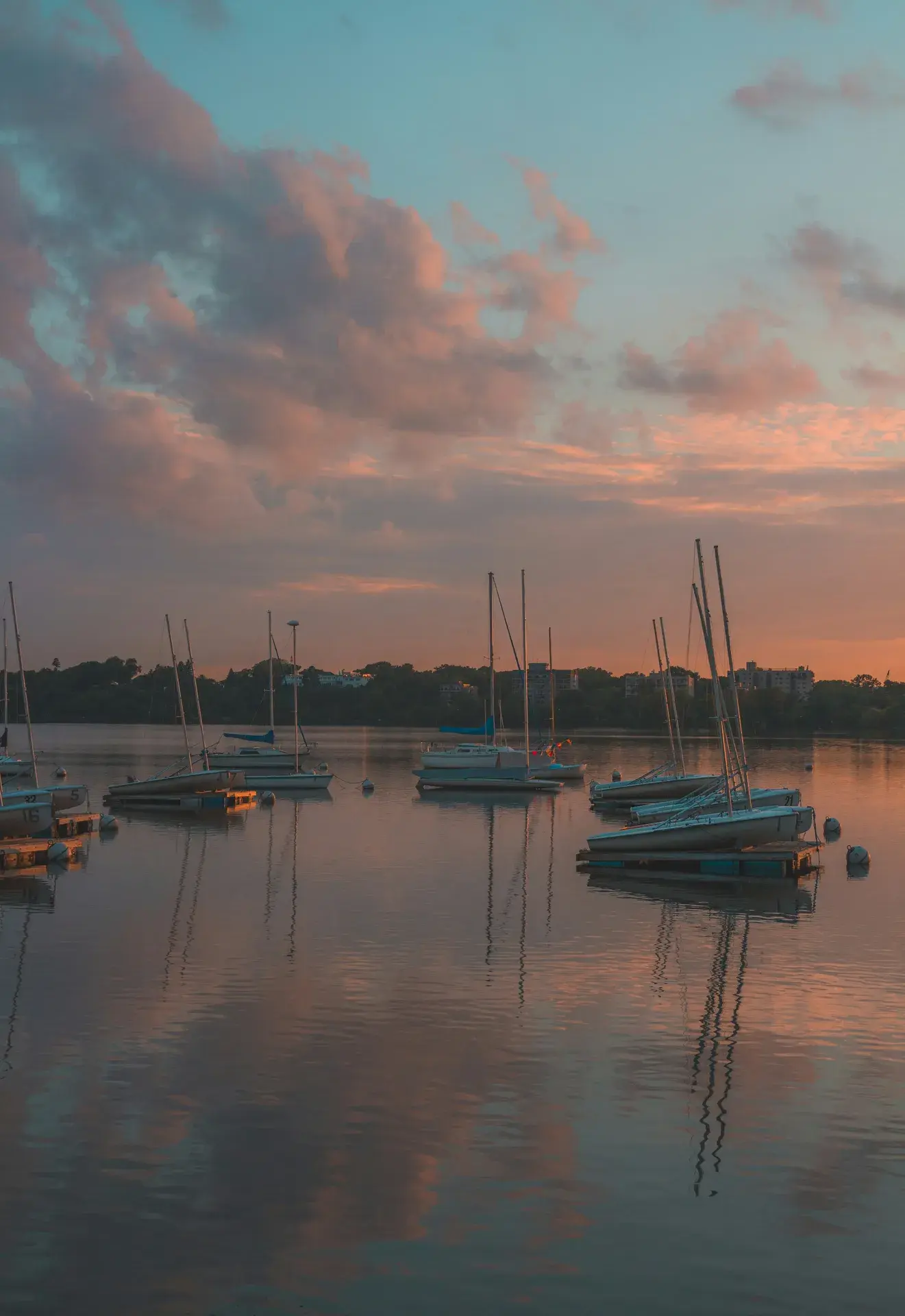
The western shore of Bde Maka Ska is the quiet side. On a summer evening, when 32nd Street Beach on the east shore is packed and the Uptown-adjacent paths are a human traffic jam of rollerbladers, joggers, and stroller-pushers, the west side of the lake feels like a different body of water. The path is less crowded. Condominium buildings and, farther south, a short row of houses look out over the parkway. Sailboats tilt in the distance. Back from the water, around Lake Street and Excelsior Boulevard, West Maka Ska is something else: apartment buildings, a Whole Foods, and the western end of the B Line.
What is West Maka Ska, Minneapolis?
West Maka Ska is a residential neighborhood in Southwest Minneapolis, taking in the western part of Bde Maka Ska (formerly Lake Calhoun) and the land west of it. It is bounded roughly by West Lake Street and the Cedar - Isles - Dean neighborhood to the north, the middle of the lake to the east, West 36th Street to the south, and France Avenue South and the St. Louis Park line to the west. About 2,600 residents live here, most of them in condominium and apartment buildings, and the private Minikahda Club golf course takes up about half the neighborhood's land.
The neighborhood's identity is defined by the lake. Bde Maka Ska — at roughly 400 acres, the largest lake in the Minneapolis Chain of Lakes — provides the recreational and scenic anchor that makes the neighborhood what it is, and about half of it lies inside West Maka Ska. But the west shore's character is distinct from the busier eastern shore and East Bde Maka Ska, across the water toward Uptown. West Maka Ska's shopping is one cluster along Excelsior Boulevard just south of Lake Street, anchored by a Whole Foods. The parkway's southern stretch and a few side streets hold the neighborhood's older houses, shaded by mature trees.
West Maka Ska Neighborhood Sign
As far as we can tell, West Maka Ska doesn’t have a neighborhood welcome sign — at least, nobody has documented one that we can find. If you’ve seen one, tell us where it is — we’d love to be wrong about this.
West Maka Ska, Minneapolis — Key Stats (2025–2026)
- Residents (2020 Census)
- ~2,600
- Median condo sale price (2025 data)
- $223K
- Days on market (2025 data)
- 156 days
- Bde Maka Ska & Lake Harriet nearby
- 2 lakes
- Era most homes were built
- 1960s–80s
- Drive to downtown Minneapolis
- 15 min
- Walk Score (Oct 2026)
- 70
- Bike Score (Oct 2026)
- 81
West Maka Ska History & Origins
Dakota people lived around Bde Maka Ska — "White Earth Lake" in the Dakota language — long before European-American settlement. In 1829 the Dakota leader Cloud Man established a farming village, Heyáta Othúŋwe, beside the lake, with seed and tools from the Indian agent Lawrence Taliaferro at Fort Snelling. It was there that the missionaries Samuel and Gideon Pond worked out an alphabet for writing the Dakota language. In 1839, to avoid ongoing conflict with the Ojibwe, the village moved to Oak Grove, in what is now Bloomington.
By 1823 the lake had been named Lake Calhoun, after John C. Calhoun, then Secretary of War and later Vice President, who was an aggressive defender of slavery. That name stood until January 2018, when the state approved the Park Board's push to restore Bde Maka Ska — a decision that went through legal challenges before the Minnesota Supreme Court settled them in its favor in May 2020. The renaming restored the Dakota name and removed the honor given to Calhoun.
The western shore started out as a resort. Louis Menage's Lake Side Park, where the Minikahda Club stands today, never drew the wealthy buyers it was meant for, and the land was replatted in 1891. The Minikahda Club was founded in 1898 with nine holes. Much of the shore was swamp; by 1900 only five houses stood just north of the club, and the parkway along the west shore was built on land made by dredging the lake, finished by 1925. The neighborhood's surviving houses mostly date from before 1930. Most of its housing came later, though: condominium buildings on the parkway from the late 1930s through the 1980s, apartment complexes in the 1960s and 1970s, and a new wave of apartments near Lake Street since 2013.
Living in West Maka Ska
Living in West Maka Ska means living with the lake as a daily companion. Morning routines include lake-loop runs and dog walks along the parkway. Summer evenings involve paddleboarding, swimming at Thomas Beach just over the line in Linden Hills, or watching the sailboats from a lawn chair. Winter brings cross-country skiing on the frozen lake and fat-tire biking on the plowed paths. The lake is not a weekend destination — it is the front yard, shared with the city but experienced with a proprietary familiarity that comes from daily use.
Most residents rent. Of roughly 1,370 households, about six in ten rent, half are one person living alone, and adults 25 to 34 are the largest age group, according to Minnesota Compass (2020–2024). They live mostly in the apartment complexes and towers south of Lake Street and in the condominium buildings on the parkway. The few streets of houses — Ivy Lane, Zenith Avenue, West 32nd Street, and the parkway's southern stretch — are shaded, quiet, and well-maintained.
Day-to-day errands run through the strip on Excelsior Boulevard: the Whole Foods, a Caribou, a sushi bar, a burger place. Community mostly happens on the lake trail. It is a neighborhood for people who want the lake out the door and the city a bus ride away.
West Maka Ska Food, Drink & Local Spots
West Maka Ska's shops and restaurants are concentrated in one cluster along Excelsior Boulevard just south of Lake Street, around the Calhoun Commons shopping center and its Whole Foods. More shops sit just across Lake Street in Cedar - Isles - Dean. Beyond that, dining and shopping happen in the surrounding neighborhoods, all easily accessible by bike or short drive.
In the Neighborhood
The anchor of Calhoun Commons at 3060 Excelsior Boulevard, and the neighborhood's grocery store. Whole Foods still calls this store Lake Calhoun. Open daily.
Sushi and a long pan-Asian menu at 3070 Excelsior Boulevard, in Calhoun Commons. Happy hour runs 3 to 6 p.m. every day, and again from 9:30 p.m. to close every night but Sunday.
My Burger's shop at 3100 Excelsior Boulevard, near Lake Street, with its own parking lot. The company calls it its Uptown location. Open daily, 11 a.m. to 10 p.m.
The neighborhood's coffee shop, in Calhoun Commons at 3044 Excelsior Boulevard.
A museum of electricity in life at 3537 Zenith Avenue South, near the neighborhood's southern edge, founded by pacemaker pioneer Earl Bakken. Interactive exhibits, a medicinal garden, and a collection of historic artifacts. Closed Mondays.
A Short Ride Away
The Linden Hills commercial district, in the neighborhood just to the south — Tilia, Sebastian Joe's, Wild Rumpus, and dozens of independent shops — is a short drive or bike ride along the lake.
Parks & Lakes Near West Maka Ska
Outdoor recreation is West Maka Ska's main draw. The lake, the trails, and the park system are not amenities adjacent to the neighborhood — about half the lake is inside it, and daily life here is organized around access to water and green space.
Bde Maka Ska
Bde Maka Ska is the largest lake in the Minneapolis Chain of Lakes — roughly 400 acres of water encircled by a 3.1-mile paved path. Its three swimming beaches are all just outside the neighborhood line: 32nd Street Beach on the east shore, North Beach on the north shore, and Thomas Beach on the south shore in Linden Hills. Wheel Fun Rentals rents canoes, kayaks, and paddleboards at the lake's northeast corner. Sailboats — from small dinghies to larger keelboats — are a defining visual feature of the lake from May through September. In winter, the lake freezes for cross-country skiing, skating, and ice fishing. The 3.1-mile loop is one of the busiest recreational trails in the city on summer evenings, though the western stretch tends to be less congested than the eastern side near Uptown.
Lake Harriet & the Chain of Lakes
Lake Harriet is a short bike ride south, connected to Bde Maka Ska by a parkway trail through William Berry Park. The lake — with the Bandshell on its Linden Hills side and the Rose Garden off its northeast shore in East Harriet — is accessible on the trail system. From West Maka Ska, the entire Chain of Lakes is available by trail: Lake Harriet to Bde Maka Ska to Lake of the Isles to Cedar Lake.
The Midtown Greenway
The Midtown Greenway begins at West Maka Ska's northern edge, a few blocks east of France Avenue, where it meets the Cedar Lake LRT Regional Trail, and runs east just north of Lake Street — a mostly below-grade, car-free bike and pedestrian trail that connects the Chain of Lakes to the Mississippi River. For commuters, the Greenway is a transformative piece of infrastructure — a fast, safe route to downtown Minneapolis and beyond. For recreational riders, it extends the lake trail network eastward across the city. The Kenilworth Trail branches north from it just across Lake Street.
West Maka Ska Schools
There are no public schools inside West Maka Ska. Minneapolis Public Schools assigns elementary, middle, and high schools by home address, so families should check the district's school finder for a specific property rather than relying on the neighborhood name.
Private school options accessible from West Maka Ska include the Blake School (with campuses in Hopkins and Minneapolis), Breck School, and various Montessori and parochial programs.
West Maka Ska Real Estate & Housing
Because almost everything that sells here is a condominium, West Maka Ska's median sale price is lower than the lake would suggest: $222,500 in 2025, according to Minneapolis Area REALTORS (which still reports the neighborhood as West Calhoun), down from $269,000 in 2024 and below the $350,000 citywide median. Twenty-five homes sold in 2025, and 88 percent of them were condos or townhouses. They didn't sell fast: cumulative days on market averaged 156, and sellers received 94.9 percent of their original list price.
What Your Money Buys
In City Assessor sales records for 2023 through 2025, the middle half of condo sales fell between about $175,000 and $365,000. Units in the newer condominium buildings at 3150, 3200, and 3220 on the parkway have sold for roughly $450,000 to more than $1 million; the late-1930s buildings just north of them mostly sell for under $300,000. Houses rarely change hands: the Assessor recorded 14 single-family sales from 2021 through 2025, from $430,000 on West 32nd Street to $2.3 million on the parkway.
Houses are the exception here. Most of the neighborhood's homes are in condominium buildings along the parkway and Excelsior Boulevard, built between the late 1930s and the 1980s, and in apartment complexes in the blocks south of Lake Street, built in the 1960s and 1970s or since 2013. There are only about 50 houses and duplexes, most of them built before 1930, on the parkway's southern stretch and a few short side streets, with mature trees providing shade and privacy.
Getting Around West Maka Ska
West Maka Ska's Walk Score of 70 reflects the neighborhood's split personality: excellent walkability for recreation (the lake is right there) and limited walkability for daily errands (one commercial cluster, on Excelsior Boulevard). The Bike Score of 81 is strong, driven by the lake trails, the Midtown Greenway, and the Cedar Lake LRT Regional Trail.
Beyond that strip and the shops across Lake Street, most dining and shopping means a short drive or bike ride to Linden Hills or Uptown, or a bus ride east on Lake Street.
The METRO B Line starts here: its western terminal, Lake & France Station, sits at the neighborhood's northwest corner, and buses run east on Lake Street through Uptown and across the river to Union Depot in downtown St. Paul, every 10 to 15 minutes for most of the day. The Green Line Extension's West Lake Street station is under construction inside the neighborhood; the Metropolitan Council says the extension opens June 12, 2027. Downtown Minneapolis is approximately 15 minutes by car, and MSP International Airport roughly 20. Biking to downtown via the Midtown Greenway or the Kenilworth Trail takes approximately 20–25 minutes. About 92 percent of households have at least one car, but only about 54 percent of workers drive to work; nearly 40 percent walk, bike, work from home, or get there some other way, according to Minnesota Compass (2020–2024).
What's Changing: The Honest Version
West Maka Ska is a stable, desirable neighborhood, but it shares the broader tensions of Southwest Minneapolis — and has a few of its own.
The Name & the Identity Question
The renaming of Lake Calhoun to Bde Maka Ska eventually changed the neighborhood's name as well. While the lake's name was tied up in court, the neighborhood council surveyed residents: at first about half wanted no change, and the rest split between West Maka Ska and West Lake, after the light-rail station now under construction. Support for a change grew as more renters and younger residents answered. In July 2020 the council asked the city for West Maka Ska, and the City Council approved it that October. "West Calhoun" hasn't disappeared — the Minneapolis Area REALTORS market reports still use it, and real estate listings sometimes use both names.
Lake Health & Climate Pressure
Bde Maka Ska faces environmental pressures common to urban lakes in Minnesota: stormwater runoff, invasive species, algal blooms during warm summers, and the long-term effects of climate change on water temperature and quality. Beaches are closed from time to time over water quality. The Minneapolis Park Board manages the lake actively, but the reality is that a lake this heavily used, in an urban setting, requires constant intervention to remain healthy. For a neighborhood whose identity and property values are tied to the lake, water quality is not an abstract environmental issue — it is a direct threat to what makes the neighborhood work.
Growth & Affordability
West Maka Ska has been adding housing. City Assessor records show a 185-unit apartment building on Chowen Avenue in 2013, new buildings on West 31st Street in 2019 and 2020, and three more near Lake Street in 2021 and 2022, including a nine-story building on Excelsior Boulevard. That hasn't made it cheap: the median rent was about $1,635 in 2020–2024, and 43 percent of renter households were cost-burdened, according to Minnesota Compass. About 72 percent of residents are white.
West Maka Ska FAQ
Is West Maka Ska a good neighborhood in Minneapolis?
For a lot of people, yes. West Maka Ska (called West Calhoun until 2020) puts most of its residents within a short walk of Bde Maka Ska, with a Whole Foods, the METRO B Line, and the lake trails close at hand. Most of its homes are condominiums and apartments, and about six in ten households rent.
Is West Maka Ska, Minneapolis safe?
West Maka Ska has a reputation as one of the quieter parts of the city, but crime numbers change from year to year, and the City of Minneapolis publishes neighborhood-level crime data on its website. As around all the lakes, don't leave anything visible in a parked car.
What is the difference between West Maka Ska and East Bde Maka Ska?
West Maka Ska is on the western side of Bde Maka Ska and has a quieter character. Most of its homes are in condominium and apartment buildings near Lake Street and Excelsior Boulevard, and the Minikahda Club's private golf course covers about half its land. East Bde Maka Ska is on the eastern side of the lake, closer to Uptown and Hennepin Avenue.
How much do homes cost in West Maka Ska, Minneapolis?
The median sale price was $222,500 in 2025, according to Minneapolis Area REALTORS, which still lists the neighborhood as West Calhoun — below the $350,000 citywide median, because 88 percent of the 25 homes sold were condos or townhouses. Units in the newer condo buildings on the parkway have sold for roughly $450,000 to more than $1 million, and the few houses that changed hands from 2021 through 2025 sold for $430,000 to $2.3 million, according to City Assessor sales records.
Is West Maka Ska walkable?
Moderately. West Maka Ska has a Walk Score of 70, reflecting good access to the lake and parks but limited walkable commercial options. The neighborhood's own shopping is one cluster along Excelsior Boulevard near Lake Street, with a Whole Foods, a coffee shop, and a few places to eat, plus more shops just across Lake Street. For most other shopping and dining, residents drive or bike to Linden Hills or Uptown, or take the B Line east. The Bike Score of 81 is strong, driven by the lake trails and Midtown Greenway access.
What schools serve West Maka Ska, Minneapolis?
There are no public schools inside West Maka Ska. Minneapolis Public Schools assigns schools by home address, so check the district's school finder for a specific property. Private options in the area include the Blake School and Breck School.
Where exactly is West Maka Ska in Minneapolis?
West Maka Ska is in Southwest Minneapolis, bounded roughly by West Lake Street to the north, the middle of Bde Maka Ska to the east, West 36th Street to the south, and France Avenue South to the west. It borders Cedar - Isles - Dean to the north, East Bde Maka Ska (across the lake) to the east, Linden Hills to the south, and the suburb of St. Louis Park to the west.
Why is the neighborhood called West Maka Ska?
The neighborhood takes its name from its position on the western shore of Bde Maka Ska (formerly Lake Calhoun). The Park Board voted in 2017 to restore the lake's Dakota name, and the Minnesota Supreme Court settled the legal challenge in May 2020. That July the neighborhood council asked the city to rename the neighborhood, which had been West Calhoun, and the City Council approved West Maka Ska in October 2020. Some residents and real estate listings still use 'West Calhoun.'
Is West Maka Ska a good place to raise a family?
It can be, but most households here aren't families: about two-thirds are not family households, and half are one person living alone, according to Minnesota Compass (2020–2024). What families do get is the lake, the trails, and Thomas Beach just over the line in Linden Hills. There are no public schools inside the neighborhood, so check school assignments by address.
What Makes West Maka Ska Irreplaceable
West Maka Ska is not the neighborhood that people name first when they talk about Minneapolis. It does not have a famous bookstore or a renowned restaurant. What it has is position — about half of the city's largest lake, connected by trails to the rest of the Chain of Lakes, with a grocery store, the end of the B Line, and a light-rail station under construction at its back door. The neighborhood's great advantage is being close to everything — Uptown, Linden Hills, downtown, the entire Chain of Lakes — while the west shore stays the quiet side of the lake.
It has trade-offs. Rents aren't cheap, the lake trail is crowded on summer evenings, and the biggest piece of land in the neighborhood is a private golf club. But for the renters in the buildings off Lake Street, the condo owners on the parkway, and the runners training for the marathon on the Bde Maka Ska path — this neighborhood delivers a version of urban life that is difficult to match and impossible to fake.

Keep exploring