Minneapolis Neighborhood
Northrop
Tucked along Minnehaha Creek in south Minneapolis — where residential calm meets creek-side walking trails, and a small neighborhood proves that you don't need a reputation to be a good place to live.
№ 61 of 87 · Nokomis community · Last updated: October 2026 · A complete neighborhood guide
Minnehaha Creek runs along the southern edge of Northrop like a slow, quiet sentence that takes its time reaching the period. In summer, the water moves gently under a canopy of cottonwoods and silver maples, and the paved trail alongside it carries joggers, dog walkers, and parents pushing strollers — all of them moving at a pace that matches the creek rather than the city. A block north, the houses begin — tidy ramblers and bungalows on streets where the biggest evening sound is a screen door closing. This is Northrop, a neighborhood in south Minneapolis that most people drive through on their way to somewhere else. The people who live here consider that drive-through quality a feature, not a bug.

What is Northrop, Minneapolis?
Northrop is a residential neighborhood in south Minneapolis, bounded roughly by East 42nd Street to the north, Cedar Avenue to the east, Minnehaha Creek to the south, and Chicago Avenue to the west. With approximately 4,500 residents, it is a mid-sized neighborhood defined by quiet residential streets, single-family homes, and its position along one of the most beloved natural corridors in the city.
The neighborhood has little commercial activity. There are only a handful of restaurants and shops within Northrop's boundaries. What it offers is mostly residential: well-maintained homes, safe streets, creek access, and the kind of neighborhood stability that comes from a community where homeownership is the norm and long-term residency is common. It is a neighborhood that earns its appeal through quiet reliability rather than visible excitement.
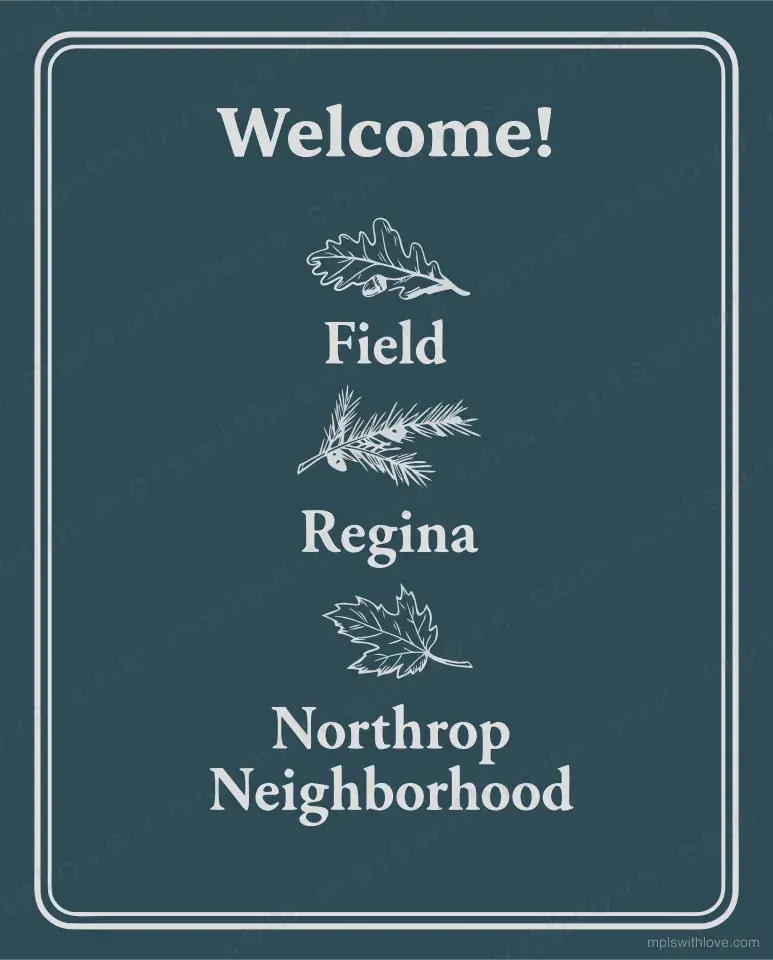
Northrop Neighborhood Sign
Northrop, Minneapolis — Key Stats (2025–2026)
- Residents (2020 Census)
- ~4,500
- Median home sale price (2025 data)
- $400K
- Median rent, all units (2020–24 ACS)
- $1,477
- Walk Score (Oct 2026)
- 69
- Bike Score (Oct 2026)
- 85
- Transit Score (Oct 2026)
- 46
- Renter-occupied homes (2020–24 ACS)
- 17%
- Minnehaha Creek frontage (approx.)
- 0.9 mi
Northrop History & Origins
Like neighboring Field and Regina, Northrop takes its name from a local school — the old Northrop School on East 46th Street, which was named for Cyrus Northrop, the second president of the University of Minnesota, who served from 1884 to 1911.
Before European settlement, this area was part of the Dakota homeland. Minnehaha Creek, which defines the neighborhood's southern boundary, was an important waterway for the Dakota long before it became a recreational amenity for city residents.
Development came in the early to mid-20th century as Minneapolis expanded southward. Most of the houses standing today were built before 1940 — modest homes on quiet streets within the city limits. The neighborhood has stayed almost entirely residential since it was first built up.
Living in Northrop
Northrop is a neighborhood of domestic routines. The mornings start with garage doors opening and cars backing out of driveways. The afternoons bring kids home from school, walking or biking on streets with minimal traffic. The evenings are for gardens, grills, and walks along the creek. It is not a neighborhood where a lot happens publicly — the life here is centered on homes and families and the quiet pleasures of residential stability.
The housing stock is almost entirely single-family — bungalows, ramblers, and some Cape Cods, most of them built before 1940. The homes are modest in size but well-maintained, reflecting a community of homeowners who take pride in their properties. Yards are small but cared for, and the tree canopy — mature elms, maples, and oaks — gives the streets a shaded, settled quality that newer developments can't replicate.
The creek is the neighborhood's soul. Properties along Northrop's southern boundary face Minnehaha Creek across the parkway, and the paved trail alongside it is the primary recreational amenity. In summer, the creek corridor is lush and green, alive with birdsong and the gentle sound of water. In fall, it blazes with color. In winter, it's a cross-country skiing and snowshoeing corridor. It is a daily amenity that shapes the quality of life here in ways that are hard to overstate.
Neighboring Field to the west and Hale to the south share the quiet residential character, creating a broad swath of south Minneapolis that functions as a cohesive, family-oriented zone.
Northrop Food, Drink & Local Spots
Northrop has little commercial activity within its boundaries. For food, drink, and shopping, residents rely mostly on nearby corridors and commercial nodes.
Nearby Options
Chicago Avenue, Northrop's western boundary, offers restaurants, groceries, and services along a well-trafficked north-south corridor. Options include independent restaurants, small groceries, and chain establishments.
The 50th and Nicollet commercial node, a short drive or bike ride west, offers one of south Minneapolis's most established shopping and dining districts — restaurants, bakeries, boutiques, and services in a walkable cluster.
Parks, Culture & Outdoors Near Northrop
Northrop's outdoor amenities center on Minnehaha Creek and its connection to the broader Minneapolis park system.
Minnehaha Creek Trail
Minnehaha Creek runs along Northrop's entire southern boundary, and the paved trail alongside it is the neighborhood's defining recreational asset. The trail extends west to Lake Harriet and east to Minnehaha Falls and the Mississippi River, providing one of the best cycling and walking corridors in Minneapolis. Many Northrop residents use the trail for daily exercise, bike commuting, and weekend recreation.
McRae Park
The neighborhood park offers a playground, open green space, and sports facilities. It serves as the community's gathering space — a place for youth sports, summer barbecues, and the informal socializing that holds a neighborhood together.
Lake Nokomis
Lake Nokomis sits just southeast of Northrop, within a 5-10 minute bike ride from most of the neighborhood, via the creek trail or surface streets. The lake's beach and trails extend the neighborhood's outdoor options significantly.
Chain of Lakes
The Minnehaha Creek trail connects Northrop to the Chain of Lakes — Lake Harriet, Bde Maka Ska, Lake of the Isles — via a continuous, car-free route. Lake Harriet, the nearest, is within a 20-25 minute bike ride, making the lakes a practical weekend destination.
Northrop Schools
Elementary school assignment in Northrop depends on the address, so check with Minneapolis Public Schools before settling on a specific house.
Nearby district high schools include Roosevelt High School, east of the neighborhood on 28th Avenue South near 40th Street; the district's school finder shows the assignment for a specific address. The Minneapolis Public Schools open enrollment system allows families to access magnet and specialty programs across the district.
Northrop Real Estate & Housing
Northrop's housing market is stable and family-oriented. The stock is almost entirely single-family homes, and turnover is relatively low — people buy here and stay.
Buying in Northrop
Northrop's median sale price was $400,250 in 2025, up from $390,000 a year earlier, according to Minneapolis Area REALTORS. Creek-adjacent homes command premiums, as do homes with significant updates. The housing stock is mostly two-to-three- bedroom homes, most of them built before 1940. Buyers should expect competition: homes that sold in 2025 averaged 19 days on the market and went for about 102 percent of their original list price.
Rental Market
Rental options are limited in Northrop, as the neighborhood is predominantly owner-occupied — Census estimates put renter-occupied homes at about 17 percent. Available rentals are typically in duplexes or occasionally in single-family homes, and the estimated median rent is about $1,480 a month, with a wide margin of error.
Getting Around Northrop
Northrop is only somewhat walkable. The Walk Score of 69 reflects the residential character — there is not a lot within walking distance commercially. The Bike Score of 85 reflects good cycling infrastructure, particularly the Minnehaha Creek trail, which makes bike commuting practical and pleasant.
Bus service is available on Chicago Avenue, the neighborhood's western boundary, and on Bloomington Avenue and 46th Street, which cross it. The METRO D Line on Chicago is one of the most frequent routes in the Metro Transit system, providing good north-south connectivity to downtown.
Driving access is straightforward. I-35W is accessible via crosstown routes, and the street grid connects to major east-west corridors. Street parking is abundant and free — one of the advantages of living in a low-density residential area.
What's Changing: The Honest Version
Northrop is one of the most stable neighborhoods in Minneapolis. The changes here are gradual and measured.
Rising Home Prices
Home prices have been climbing, driven by demand for family-friendly neighborhoods with creek access. The entry point for buying in Northrop has moved upward, and the neighborhood is becoming less accessible for first-time buyers and young families on moderate incomes.
Aging Housing Stock
Most homes in Northrop were built before 1940. While many have been updated, the cost of maintaining and modernizing aging homes is a practical consideration for current owners and prospective buyers. Roofs, furnaces, windows, and electrical systems all reach end-of-life on a timeline that many Northrop homes are approaching.
Creek Flooding
Minnehaha Creek flooding is an occasional concern for creek-adjacent properties, and extreme rainfall events are becoming more frequent. Homebuyers near the creek should investigate flood history, insurance requirements, and watershed district mitigation efforts.
Northrop FAQ
Is Northrop a good neighborhood in Minneapolis?
Northrop is a solid residential neighborhood in south Minneapolis, offering safe streets, well-maintained homes, Minnehaha Creek access, and a stable community. It's ideal for families and anyone seeking quiet city living. The trade-off is limited walkable commercial options and a low profile that means most Minneapolitans haven't heard of it.
Is Northrop safe?
Northrop is one of the safer neighborhoods in Minneapolis, with crime rates below the city average. Violent crime is rare, and property crime is modest compared to denser neighborhoods. It's a neighborhood where families feel comfortable letting kids play outside and where walking at night is not a concern.
How much does it cost to live in Northrop?
Northrop's median sale price was $400,250 in 2025, up from $347,250 in 2021, according to Minneapolis Area REALTORS — above the citywide median of $350,000, though well below the lakes neighborhoods to the west. Rental options are limited: Census estimates put renter-occupied homes at about 17 percent.
Where exactly is Northrop in Minneapolis?
Northrop is in south Minneapolis, bounded roughly by East 42nd Street to the north, Cedar Avenue to the east, Minnehaha Creek to the south, and Chicago Avenue to the west. It sits north of the creek, across Chicago Avenue from the Field and Regina neighborhoods.
What schools serve Northrop?
School assignment depends on the address, so check the Minneapolis Public Schools school finder for a specific house. Nearby district high schools include Roosevelt High School, east of the neighborhood on 28th Avenue South near 40th Street.
Is Northrop walkable?
Moderately. Northrop is primarily residential, so walkability for commercial needs is limited. For recreational walking, it's excellent — Minnehaha Creek trail is the southern boundary, and neighborhood streets are pleasant for walking year-round. For shopping and dining, you'll need to access nearby commercial corridors.
How close is Northrop to Minnehaha Creek?
Minnehaha Creek forms Northrop's southern boundary. Most homes in the neighborhood are within a 15-minute walk of the creek trail, and the homes along Minnehaha Parkway face directly onto the creek corridor. It's one of the neighborhood's defining amenities.
Is Northrop good for families?
Very much so. Safe streets, creek access, parks, and a housing stock of single-family homes with yards make Northrop well-suited for families with children. The neighborhood has a strong family orientation, and many residents have raised children here.
How is Northrop different from Diamond Lake or Field?
Northrop, Diamond Lake, and Field are all quiet residential neighborhoods in south Minneapolis with similar character. Northrop's distinguishing features are its Minnehaha Creek frontage and McRae Park. The differences are subtle — these are neighborhoods that share a vibe more than they compete with each other.
What Makes Northrop Worth Knowing
Northrop doesn't have a brand. It doesn't have a signature restaurant, a beloved park that defines its identity, or a community controversy that puts it in the news. What it has is Minnehaha Creek along its southern edge, well-maintained homes on quiet streets, neighbors who know each other, and the kind of stability that comes from a community where people buy houses and raise families and stay.
In a city that increasingly values novelty and visibility, Northrop is a quiet argument for the value of the unremarkable. Not every neighborhood needs to be discovered or celebrated. Some neighborhoods just need to work — to provide safe homes, natural beauty, and the daily peace that allows people to build lives. Northrop does that, and it does it well, and the people who live here know it even if nobody else does.

Keep exploring