Minneapolis Neighborhood
Diamond Lake
Wedged between I-35W, Cedar Avenue, and Highway 62 on the city's southern edge, Diamond Lake is one of those south Minneapolis neighborhoods that barely registers on the city's consciousness — a quiet, deeply residential pocket where families buy houses and stay for decades, where the parks do the heavy lifting, and where the lake the neighborhood is named for is small enough that most people don't know it exists.
№ 17 of 87 · Nokomis community · Last updated: October 2026 · A complete neighborhood guide
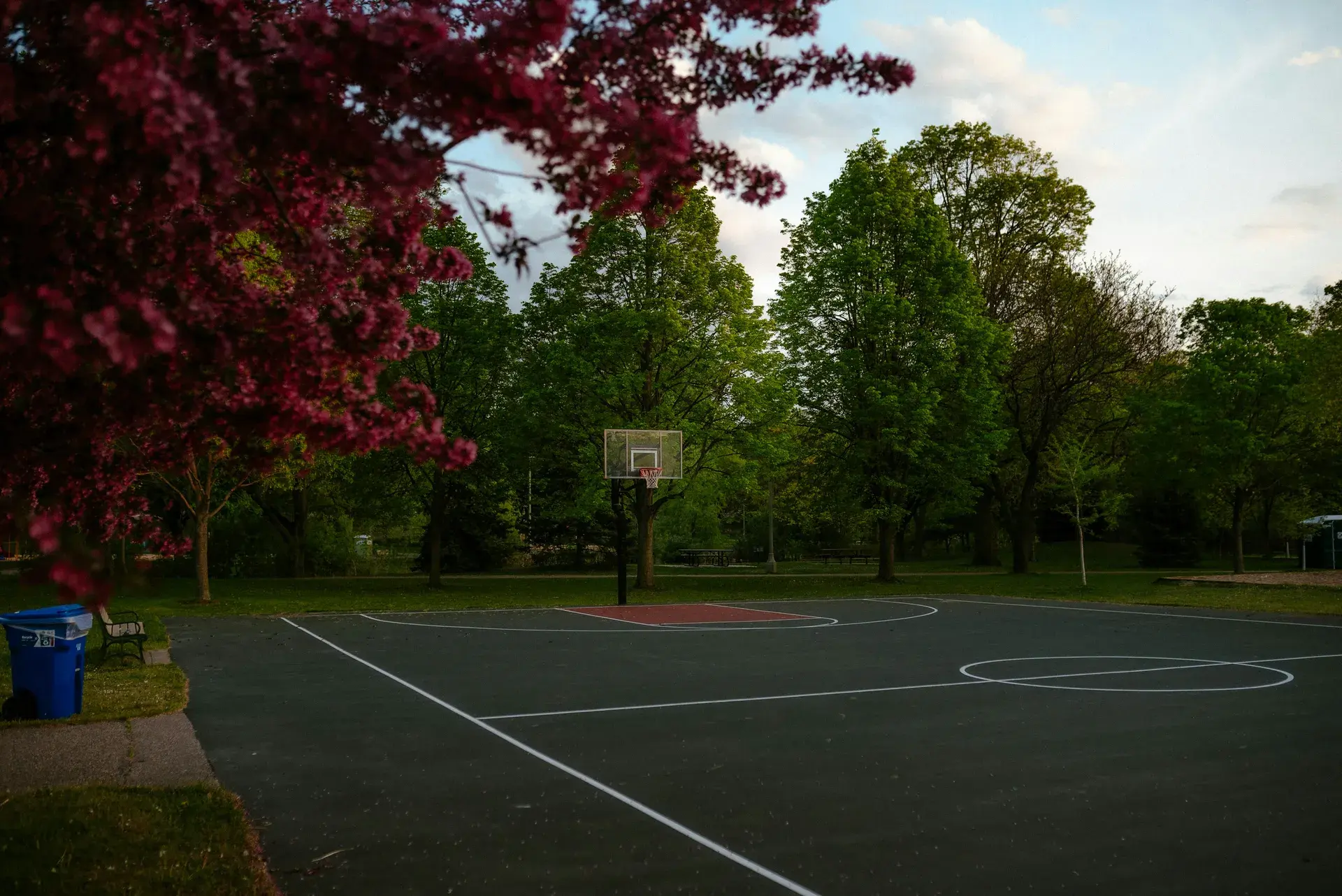
There's a moment on a Sunday morning in May when Pearl Park is exactly what a neighborhood park should be. The playground has a few kids and a parent scrolling a phone on the bench. The ball field is empty but mowed, waiting for Tuesday's little league game. Someone is walking a slow loop around the path with a coffee and a dog who stops at every tree. The rec center is closed — it's Sunday — but through the windows you can see the signs for next week's youth programming taped to the inside of the glass. South of the park, across Diamond Lake Road, the neighborhood spreads out in a grid of bungalows and Cape Cods and the occasional ranch house, their yards deep and their trees tall enough to make the streets feel like corridors through a canopy. A garage door opens. A sprinkler starts. Someone is washing a car in a driveway with the unhurried attention of a person who has nowhere to be and is completely fine with that. This is Diamond Lake — a neighborhood so quiet that describing it feels almost redundant, because the description is the same as the experience: houses, park, trees, lake, calm. That's it. That's everything.
What is Diamond Lake, Minneapolis?
Diamond Lake is a residential neighborhood on the southern edge of Minneapolis, in the Nokomis community, bounded roughly by Diamond Lake Road and East 55th Street to the north, Cedar Avenue (and, south of 58th Street, the city limit) to the east, Highway 62 to the south, and I-35W to the west. It covers about one square mile and is home to about 5,700 residents. To the north lie Page and Hale. To the west, across I-35W, Windom; to the east, across Cedar, Wenonah. To the south, across the Crosstown, the suburb of Richfield begins.
The neighborhood takes its name from Diamond Lake — a small body of water near Pearl Park that, in the grand tradition of Minneapolis lake naming, oversells itself slightly. Diamond Lake is more pond than lake, a modest body of water surrounded by parkland that serves as a quiet green space rather than a recreational destination. If you're imagining Lake Harriet or Lake Nokomis, stop. Diamond Lake is the introvert of the Minneapolis lake family — small, quiet, and perfectly content to be overlooked.
The neighborhood surrounding the lake matches its temperament. Diamond Lake is deeply, almost exclusively residential — a grid of single-family homes on deep lots, with mature trees forming a canopy over side streets that carry almost no through-traffic. There is no commercial center and no restaurant row. What there is, instead, is a neighborhood that has perfected the art of being ordinary in the best possible sense: solid houses, good parks, strong schools nearby, prices a step below Hale's and Page's, and the kind of quiet that feels like a luxury in a city that keeps getting louder.
Diamond Lake is often grouped with its neighbors Hale and Page under the umbrella of the Hale-Page-Diamond Lake community association — a practical acknowledgment that these three small, similar neighborhoods share enough DNA to organize together. The differences between them are geographic rather than characterological: Diamond Lake is the southern piece, with Page and Hale side by side across its northern border, and the three share nearly identical housing stock, demographics, and quality of life.
Diamond Lake Neighborhood Sign
Diamond Lake, Minneapolis — Key Stats (2025–2026)
- Residents (2020 Census)
- ~5,700
- Median home sale price (2025 data)
- $470K
- Days on market (2025 data)
- 26 days
- Neighborhood area
- 1.0 sq mi
- Era most homes were built
- 1930s–50s
- Drive to downtown or MSP airport
- 12–18 min
- Walk Score (Oct 2026)
- 51
- Bike Score (Oct 2026)
- 68
Diamond Lake History & Origins
Before European settlement, this land was Dakota homeland — part of the vast territory centered around Bdote, the sacred confluence of the Mississippi and Minnesota Rivers. The small lake that gives the neighborhood its name was part of this landscape — one of the many small bodies of water that dotted the prairies and woodlands of what is now south Minneapolis.
European settlement on this far southern edge of Minneapolis came relatively late, and for a long time most of it wasn't Minneapolis at all. It was Richfield until the late 1920s, when the city annexed a strip of Richfield along its southern edge and all of Diamond Lake came inside the city limits. The Park Board's records describe most of the land around the lake as swamp and lowland. In 1923, Clarke's Diamond Lake Realty offered to donate land around the lakes for parks, probably hoping parks would lift the value of its other lots, and the board accepted in 1925. This was the southern frontier of Minneapolis's urban expansion — the last blocks to be built before the city gave way to the first-ring suburb of Richfield.
The neighborhood's residential development happened primarily between the 1930s and the 1950s. The earlier homes, mostly from the 1930s, cluster in the northern portion of the neighborhood, closer to Diamond Lake Road and 55th Street. The later homes — Cape Cods, ranches, and the occasional split-level from the 1940s and 1950s — occupy the southern blocks closer to Highway 62. This north-to-south chronology gives Diamond Lake a subtle gradient: the houses get newer as you move south, reflecting the city's southward expansion over three decades.
Pearl Park — the neighborhood's anchor, though it sits just over the line in Page — took shape during this development period. Named for Pearl Lake, the small lake that was filled in to make it, the park was built up in 1936 and 1937 by federal work-relief crews using fill from the airport, and the Park Board credited that early work with a quick rise in home building nearby. The recreation center followed in 1968, and over the decades Pearl Park went from a filled-in lake bed to a genuine civic institution — the place where neighbors became a neighborhood.
The lake itself never got the same treatment. It had nearly dried up in the 1920s, and park superintendent Theodore Wirth wanted to dredge it and put a beach on the north shore, the way the board had reshaped Lake Nokomis. Instead the city made it a storm-water reservoir, and the Depression ended the money. In 1936 the Park Board bought 72 acres around and including the lakes for $1,035, but later plans for parking lots, tennis courts, and ball fields along the shore were never built. Since the late 1970s the board has managed Diamond Lake as wildlife habitat instead.
Diamond Lake's history since mid-century is a history of stability — remarkable in its consistency and unremarkable in its events. I-35W and the Crosstown were built along its edges, not through it. No commercial decline hollowed out a main street (there was no main street to hollow out). The houses aged, the trees grew, the families turned over gradually, and the neighborhood maintained its character through the simple persistence of people who liked living here and saw no reason to change. This continuity is Diamond Lake's most defining historical feature — not a dramatic story, but a durable one.
Living in Diamond Lake
Living in Diamond Lake is an exercise in contentment — or boredom, depending on your temperament. The neighborhood offers little in the way of entertainment, dining, shopping, or cultural activity within its borders. What it offers, instead, is the preconditions for a peaceful domestic life: a quiet street, a solid house, a deep yard, a park within walking distance, the creek trail a short ride north, and neighbors who mind their own business in the Midwestern sense of the phrase — meaning they'll help you move a couch but won't ask why you're rearranging the living room.
The neighborhood is heavily family-oriented. Young families buy here for the same reasons they buy in Hale and Kenny: the schools are strong, the park has programming, and the streets are safe enough that kids can play outside without constant supervision. Older homeowners — some of whom have been here since the 1970s or 1980s — anchor the blocks with the kind of institutional memory that gives a neighborhood continuity. The turnover is gradual: someone retires, sells to a young family, and the cycle begins again.
Pearl Park is the center of community life. The rec center runs youth sports, after-school programs, community events, and fitness classes. The playground fills with kids after school. The ball fields host little league in summer. The ice rink draws families in winter. If Diamond Lake has a town square, Pearl Park is it — the one place where the neighborhood congregates and recognizes itself as a community rather than a collection of individual households.
The lake and the parkland around it add a natural dimension that purely interior neighborhoods lack, and Minnehaha Creek is just beyond Page and Hale to the north. The creek trail provides a corridor that connects west toward the Chain of Lakes and east toward Minnehaha Falls. On a Saturday morning in June, the trail is full of joggers, dog walkers, and families on bikes — a shared amenity that gives Diamond Lake residents access to one of the best urban trail systems in the country without paying lakeside prices.
The demographic mix has diversified modestly over the past two decades. Diamond Lake remains predominantly white and homeowning, but the neighborhood has become more varied than it was a generation ago — younger families from different backgrounds moving in as older residents move out. The change is gradual enough that it doesn't feel like a transformation, but it's visible in the school enrollment, the park usage, and the faces on the block.
Diamond Lake Food, Drink & Local Spots
Diamond Lake is not a food neighborhood, with one famous exception. The interior is residential, and the commercial presence is limited to a few corners on Chicago, Cedar, and Portland. Here's what's inside the lines, and what's close.
The Go-To Spots
5800 Cedar Ave. S., at 58th Street on the neighborhood's east edge. Open since 1928, when it started as a speakeasy, and one of the two south Minneapolis bars that claim to have invented the stuffed-cheese burger — the 5-8 spells it Juicy Lucy, with the i. The one place in Diamond Lake that draws people from across the metro.
5600 Cedar Ave. S., on the Diamond Lake side of Cedar at 56th. An independent Italian place since 1987 — big New York–style pies, pasta, hoagies, and gelato in a dining room covered in murals.
Across I-35W to the west, in Windom. The various businesses along south Nicollet are within biking distance. This is Diamond Lake's borrowed restaurant row.
5353 Nicollet Ave. S., in Tangletown, just across I-35W from Diamond Lake's northwest corner. An urban garden center, open year-round, with plants, pottery, and garden art.
At the Lake Nokomis main beach, in Keewaydin, a little over half a mile north of Diamond Lake's northeast corner. Seasonal lakeside dining with a patio — the successor to the beloved Sandcastle. A summer destination for Diamond Lake families who want to combine a lake outing with lunch.
6014 Portland Ave. S., near 60th Street. A treats-only DQ — not a destination, just the kind of functional summer stop that keeps a neighborhood from being entirely self-contained.
The Grocery Reality
Kowalski's Parkview Market, at 56th and Chicago across from Todd Park, is the neighborhood's grocery store — 12,000 square feet, open since 2002 and remodeled in 2022 with a bigger deli and a café. It's walkable from the northern blocks. For a bigger run, the nearest large store is the Cub on Nicollet, just across I-35W in Windom, and from most of the neighborhood you're driving. This is the most car-dependent aspect of daily life in Diamond Lake, and it's worth factoring in if car-free living is a priority.
Parks & Outdoors in Diamond Lake
Diamond Lake's outdoor access is its strongest amenity — a combination of the lake itself, Todd Park, Solomon Park on the southeast edge, Pearl Park just across Diamond Lake Road, Lake Nokomis and Minnehaha Creek nearby, and connections to the broader Minneapolis park system.
Pearl Park
Pearl Park, just across Diamond Lake Road in Page, is Diamond Lake's anchor — a 29-acre park that serves as the neighborhood's recreation center, gathering place, and green space. The park includes a recreation center with year-round programming, a playground, ball fields (baseball and softball), basketball courts, a wading pool, and open green space. Winter brings an ice skating rink that draws families from the surrounding blocks. The rec center runs youth sports leagues, after-school programs, summer day camps, and community events. Pearl Park is the reason Diamond Lake feels like a community — it's the one place where the neighborhood's residents come together regularly.
Diamond Lake (The Actual Lake)
Yes, there is an actual Diamond Lake. No, it's not what you're picturing. Diamond Lake is a shallow lake ringed by cattails, wetland, and woods, situated just south of Pearl Park in the neighborhood's northwest part. It's about 55 acres of water inside a 73-acre park, with a fishing pier and paved walking paths but no beach. The Park Board pitches it mainly to birders: migratory waterfowl stop here, and the board suggests looking for them by canoe in summer or on snowshoes in winter. For a body of water that gives an entire neighborhood its name, Diamond Lake is remarkably unassuming — which, if you've been paying attention, is entirely consistent with the neighborhood's character.
Todd Park & Solomon Park
Todd Park, at 56th and Chicago, is the neighborhood's own ballpark — 13 acres with baseball and softball fields, a tennis court, a playground, and a walking path. It was a swamp when the Park Board accepted it in 1948; before it was named for George Todd, a park commissioner from 1957 to 1963, people called it East Diamond Lake Park. Edward C. Solomon Park, along the southeast edge south of 58th Street, is something else: 45 acres of fields, hills, wetland, and a small pond, most of it on Metropolitan Airports Commission land just outside the city limit, assembled in a 2004 land swap and long-term lease with the commission. There's an archery range at 58th and 15th, and the Park Board notes that a bald eagle has nested in the park.
Minnehaha Creek
Minnehaha Creek runs a short bike ride north of Diamond Lake, along the far side of Page and Hale, providing a green corridor with walking and biking trails. The creek trail connects east toward Lake Nokomis and Minnehaha Falls, and west toward the Chain of Lakes — putting Diamond Lake residents within biking distance of some of the best urban parkland in the country. The creek itself varies seasonally: high and flowing in spring, often reduced to a trickle by late summer. The corridor provides shade and green space.
Lake Nokomis & Beyond
Lake Nokomis touches Diamond Lake's northeast corner, about 0.8 miles from the middle of the neighborhood — an easy bike ride or walk on neighborhood streets. The lake offers beaches, a 2.7-mile loop trail, fishing, and winter activities. For Diamond Lake residents, Nokomis functions as the "big lake" — the one you bike to when you want a swim or a longer walk. The broader Minneapolis park system, including the Chain of Lakes and Minnehaha Falls, is accessible via the interconnected trail network. The outdoor access from Diamond Lake — despite its modest profile — is genuinely excellent.
Diamond Lake Schools
Schools are a significant draw here: about a third of Diamond Lake households include children, by Census estimates, compared with about one in five citywide.
No public school sits inside the neighborhood, and the assignment depends on exact address. Nearby Minneapolis Public Schools include Windom Elementary (K–5), just across I-35W, and Hale (K–2) and Field (3–5) elementary schools to the north. The middle and high schools that serve this part of the city include Anthony and Justice Page middle schools, Southwest High School — an International Baccalaureate World School — and Washburn High School. Boundaries change, so check the district's school finder for a specific address.
Southwest High School's IB program, performing arts offerings, and college-prep rigor make the school a genuine asset for the Diamond Lake families assigned to it. The school draws from across Southwest and south Minneapolis, creating a student body that's more diverse than the individual neighborhoods it serves.
Families also access Minneapolis's magnet school system for specialized programs, and private options include Minnehaha Academy and various faith-based schools.
Diamond Lake Real Estate & Housing
Diamond Lake is the less expensive way into this corner of south Minneapolis — a neighborhood where you get solid housing stock, good park access, strong schools, and proximity to creek and lake trails for less than you'd pay in Hale or Page. The median sale price was $470,000 in 2025, according to Minneapolis Area REALTORS — well above the $350,000 citywide median, but below Hale ($505,050) and Page ($550,000).
Homes sell at a steady pace — 71 sales in 2025, averaging 26 days on the market, with sellers getting a little more than their original asking price on average. Buyers have some time to decide.
What Your Money Buys
At the entry level, below the median, you're looking at smaller bungalows or Cape Cods with original features — one bathroom, a compact kitchen, maybe an unfinished basement. These homes are functionally solid but cosmetically dated. Around the median, you get a well-maintained three-bedroom home with updates — a remodeled kitchen, replacement windows, a finished basement or a deck. Well above it, you're into larger homes, significant renovations, or the occasional new construction.
The housing stock spans the 1930s through the 1950s, with a mix of Craftsman bungalows, Cape Cods, and modest ranch homes. The lots are generous — deep backyards are standard, and the lot widths give the houses room to breathe. Most homes are single-family and owner-occupied. The architectural style is humble but honest: real plaster walls, hardwood floors under the carpet, foundations built to last. These are houses that were designed to be lived in, not admired, and they do that job well.
The most desirable blocks are around the lake itself and up toward Lake Nokomis at the northeast corner, for the ambient benefit of living near water. The blocks near Pearl Park are also sought after for their proximity to the rec center and green space.
Getting Around Diamond Lake
Diamond Lake earns a Walk Score of 51 — technically walkable but practically car-dependent for most daily needs. The neighborhood is almost entirely residential, and its few shops and restaurants sit on a handful of corners along Chicago, Cedar, and Portland. Pearl Park is walkable from the northern blocks, and the Minnehaha Creek trail is a short ride north, but most commercial life requires leaving the neighborhood.
The Bike Score of 68 reflects reasonable cycling infrastructure and trail connections. The Minnehaha Creek trail is the primary cycling asset — it connects east to Lake Nokomis and Minnehaha Falls, west to the Chain of Lakes, and provides a pleasant car-free corridor through south Minneapolis. Closer in, the Nokomis–Minnesota River trail runs along the neighborhood's southeast edge on its way south. For residents who bike regularly, Diamond Lake's trail access compensates somewhat for its lack of walkable commercial options.
For car-based commuting, Diamond Lake is well-positioned. Downtown Minneapolis is 12–18 minutes depending on traffic. Highway 62 (the Crosstown) runs along the neighborhood's southern edge, providing access to I-35W, the western suburbs, and MSP airport (roughly 15 minutes). I-35W runs along the west edge, and Portland Avenue and, across the freeway, Nicollet Avenue provide north-south routes to downtown. Most Diamond Lake residents drive for their commute, and parking in the neighborhood is easy — residential streets are uncrowded.
Transit is decent for a neighborhood this residential. The METRO D Line, Metro Transit's rapid bus line, stops at Chicago and 56th and at Portland and 60th on its way downtown. Route 14 runs down Chicago, across 60th Street, and down Bloomington Avenue; Route 5 reaches Chicago and 56th; and Route 18 runs on Nicollet just across I-35W. Still, the stops require walking several blocks from much of the neighborhood's interior, and the nearest Blue Line light rail station on Hiawatha Avenue is more than two and a half miles northeast — too far for a convenient walk, but bikeable. Diamond Lake is, honestly, a car neighborhood — and most residents have made peace with that reality.
What's Changing in Diamond Lake
Diamond Lake's tensions are low-grade and familiar — the same set of slow-moving pressures that affect most stable residential neighborhoods in south Minneapolis.
The Affordability Squeeze
Diamond Lake's relative affordability is its primary competitive advantage — and it's gradually eroding. As buyers get priced out of the lake neighborhoods and Southwest Minneapolis, demand in Diamond Lake and its neighbors increases. The median sale price went from $390,000 in 2021 to $470,000 in 2025, a 20 percent rise, according to Minneapolis Area REALTORS. That already puts Diamond Lake above Kenny ($436,238) and alongside Armatage ($460,000), the neighborhoods where "affordable Southwest Minneapolis" gradually became just "Southwest Minneapolis." It's still cheaper than Hale and Page next door, and that gap is the neighborhood's real selling point.
Car Dependence
The lack of walkable commercial options is a genuine limitation for residents who want to reduce their car dependence. Diamond Lake is a difficult neighborhood to live in without a car, and as climate consciousness and lifestyle preferences shift toward walkability and transit, this limitation becomes more significant. The neighborhood's residential purity is both its charm and its constraint — the same absence of commercial activity that keeps the streets quiet also means that, unless you live near 56th and Chicago, you're often driving to buy milk.
Aging Infrastructure
Houses built in the 1930s through the 1950s require ongoing maintenance, and the costs of maintaining 80-year-old plumbing, wiring, and foundations add up. The city's infrastructure — streets, sewer lines, water mains — is similarly aging, and the pace of municipal maintenance doesn't always keep up with the pace of deterioration. For homeowners on tight budgets, the combination of rising property taxes and increasing maintenance costs creates financial pressure that's real even if it's not dramatic.
Demographic Homogeneity
Diamond Lake is predominantly white and predominantly homeowning — about four in five residents are white and about four in five homes are owner-occupied, by Census estimates — a demographic profile that reflects historical patterns, housing costs, and the self-reinforcing dynamics of neighborhood reputation. The neighborhood has diversified modestly over the past two decades, but it remains less diverse than Minneapolis as a whole. This homogeneity limits the neighborhood's cultural richness and raises questions about access and inclusion that the community grapples with in the same way most Southwest and south Minneapolis neighborhoods do — earnestly, but without easy answers.
Diamond Lake FAQ
Is Diamond Lake a good neighborhood in Minneapolis?
Yes. Diamond Lake is a quiet, stable, family-oriented neighborhood with good park access (Todd Park and the parkland around the lake, with Pearl Park just across Diamond Lake Road), proximity to Lake Nokomis, and housing that costs less than in neighboring Hale and Page. It's not exciting — it's not trying to be. It's a neighborhood for people who want the basics done well.
Is Diamond Lake, Minneapolis safe?
Diamond Lake is one of the safer neighborhoods in south Minneapolis. Violent crime is uncommon. Property crime rates are comparable to other quiet residential neighborhoods — vehicle break-ins and package theft occur but are not pervasive. The neighborhood's deeply residential character and quiet side streets contribute to an overall sense of calm.
Is there actually a Diamond Lake?
Yes, though it might not match your expectations. Diamond Lake is about 55 acres of shallow water ringed by cattails and wetland, located just south of Pearl Park in the northwest part of the neighborhood. It's not a swimming lake or a destination lake. There's a fishing pier and a paved path, and the Park Board pitches it mainly as a birding spot. If you're imagining Lake Harriet, recalibrate significantly.
How much do homes cost in Diamond Lake?
The median home sale price in Diamond Lake was $470,000 in 2025, according to Minneapolis Area REALTORS, up from $385,000 in 2023. That's well above the $350,000 citywide median but below its northern neighbors, Hale ($505,050) and Page ($550,000). Seventy-one homes sold in 2025, the same as in 2024.
Where exactly is Diamond Lake in Minneapolis?
Diamond Lake is on the southern edge of Minneapolis, in the Nokomis community, bounded roughly by Diamond Lake Road and East 55th Street to the north, Cedar Avenue (and, south of 58th Street, the city limit) to the east, Highway 62 to the south, and I-35W to the west. It borders Page and Hale to the north, Windom across I-35W to the west, Wenonah across Cedar to the east, and the suburb of Richfield to the south across the Crosstown.
What schools serve Diamond Lake?
No public school sits inside Diamond Lake, and the assignment depends on address. Nearby Minneapolis Public Schools include Windom Elementary (K–5), just across I-35W, and Hale (K–2) and Field (3–5) elementary schools to the north. The middle and high schools that serve this part of the city include Anthony and Justice Page middle schools, Southwest High School — an IB World School — and Washburn High School. Check the district's school finder for a specific address.
Is Diamond Lake walkable?
Modestly. Diamond Lake earns a Walk Score of 51 — the neighborhood is almost entirely residential, and its shops sit on a few corners along Chicago, Cedar, and Portland. Daily errands require a car or bike for many addresses. The Bike Score of 68 reflects decent connections to the Minnehaha Creek trail and the broader south Minneapolis bike network.
What is Pearl Park?
Pearl Park is Diamond Lake's primary park — technically in Page, just across Diamond Lake Road from the north end of the lake. It's a well-maintained neighborhood park with a recreation center, playground, athletic fields, basketball courts, and open green space. The rec center runs year-round programming for youth and adults. In winter, the park maintains an ice skating rink. The Park Board lists Pearl as the recreation center for Diamond Lake's own parks — Todd, Solomon, and the lake — and Pearl Park serves as the gathering place and community anchor for Diamond Lake and its neighbors.
How is Diamond Lake different from Hale?
Diamond Lake and Hale are adjacent neighborhoods with very similar character — quiet, residential, and family-oriented. The main geographic difference: Diamond Lake is to the south, below 55th Street, with the lake itself in its northwest part and Highway 62 along its southern edge; Hale is to the north, between Chicago and Cedar avenues, with Minnehaha Creek along its northern edge and Lake Nokomis to the east. The differences are subtle enough that many residents think of them as a single area.
How far is Diamond Lake from Lake Nokomis?
Lake Nokomis touches Diamond Lake's northeast corner, near 55th Street and Cedar Avenue. From the middle of the neighborhood, around Chicago Avenue and 58th Street, the nearest shoreline is about 0.8 miles northeast — an easy bike ride and a reasonable walk. Hale, to the north, sits closer to the lake. Diamond Lake residents use Nokomis for recreation but are less oriented toward the lake than the neighborhoods immediately surrounding it.
What Makes Diamond Lake Worth Knowing
Diamond Lake is the kind of neighborhood that disappears into its own competence. The park works. The houses are solid. The lake provides a green edge. The schools nearby are strong. The streets are quiet enough that you can hear birds in the morning and crickets at night — sounds that feel almost rural until you remember you're fifteen minutes from downtown Minneapolis. Nothing about Diamond Lake is designed to attract attention, and that's not a failure of imagination. It's a choice.
In a city where neighborhoods increasingly define themselves through commercial activity, cultural scenes, and brand identity, Diamond Lake persists as a place where the identity is simply residential. People live here. They raise families, maintain their homes, use the park, bike to the creek, and go about the business of ordinary life without any particular need for the rest of the city to notice. That's either boring or beautiful, depending on what you're looking for. Diamond Lake knows which one it is, and it's not interested in convincing anyone otherwise.

Keep exploring
Diamond Lake appears in
- Best Neighborhoods for Families
- Best Neighborhoods for First-Time Homebuyers
- Best Minneapolis Neighborhoods for Schools
- Best Ramen
- Best Thai Food
- Most Underrated Neighborhoods