Minneapolis Neighborhood
Page
A small piece of south Minneapolis — residential blocks between Minnehaha Creek and Diamond Lake, and a tight-knit community that proves a neighborhood doesn't need to be big to matter.
№ 62 of 87 · Nokomis community · Last updated: October 2026 · A complete neighborhood guide
Page is the kind of neighborhood that gets flattened by statistics. Pull up a data dashboard and you'll see numbers that tell a story of comfort — high home prices, low crime, high median incomes, the kind of figures that make outsiders assume there is nothing more to say. What the numbers don't capture is how much of neighborhood life runs through a single park. Page is a small neighborhood in the Nokomis area of south Minneapolis. It is prosperous in ways that are easy to read off a spreadsheet and close-knit in ways that are impossible to see from a car.

What is Page, Minneapolis?
Page is a small residential neighborhood in the Nokomis area of south Minneapolis, bounded roughly by Minnehaha Creek to the north, Chicago Avenue to the east, Diamond Lake Road and East 55th Street to the south, and I-35W to the west. With approximately 1,700 residents, it is one of the smaller neighborhoods in the city, occupying a compact patch of residential blocks between the creek and Diamond Lake, with Pearl Park at its center.
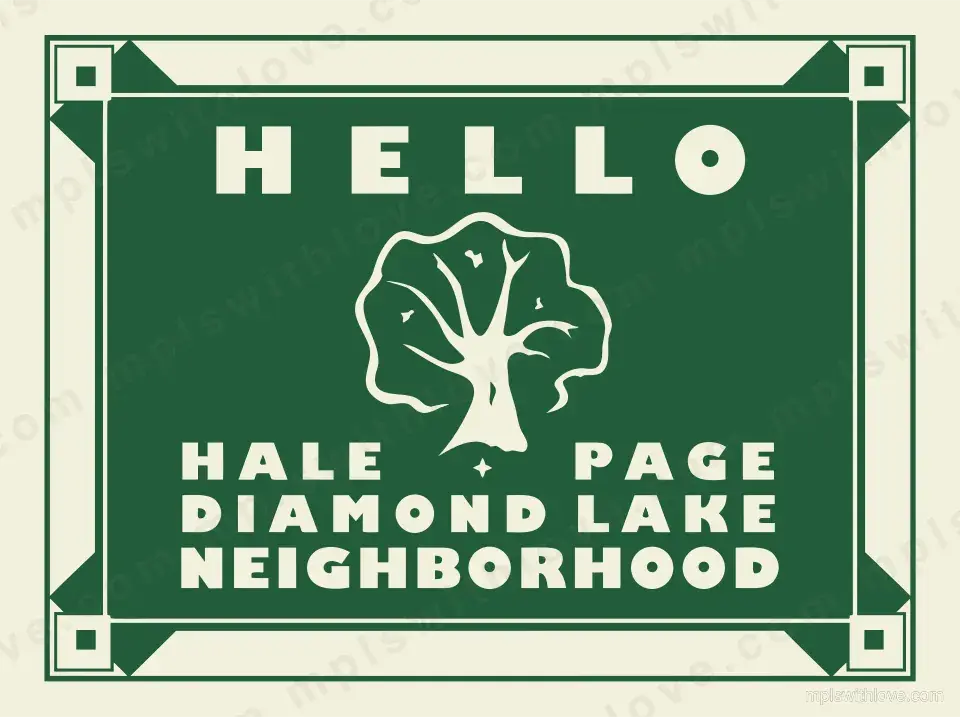
The neighborhood is predominantly white and mostly owner-occupied, and more than a third of its households include children. Home prices sit well above the Minneapolis median. Page shares much of its identity with Hale and Diamond Lake: one neighborhood association and one neighborhood sign cover all three.
Page Neighborhood Sign
Page, Minneapolis — Key Stats (2025–2026)
- Residents (2020 Census)
- ~1,700
- Median home sale price (2025 data)
- $550K
- Neighborhood area
- 0.3 sq mi
- Walk Score (Oct 2026)
- 64
- Bike Score (Oct 2026)
- 80
- Transit Score (Oct 2026)
- 51
- Renter-occupied homes (2020–24 ACS)
- 6%
- Residents of color (2020–24 ACS)
- 19%
Page History & Origins
Page's history is tied to two lakes, one of which no longer exists. Before European settlement, this land was part of the Dakota homeland. Development came in the first half of the 20th century as Minneapolis grew south, and most of the houses standing today were built before 1940. Like Hale next door, Page takes its name from its old elementary school — the Page School, which was named for the editor and diplomat Walter Hines Page and closed in 1982.
Like much of south Minneapolis, Page was built in the era of racial covenants. From the 1910s until they were outlawed, covenants written into property deeds barred anyone who was not white from buying or living in homes across large parts of south and southwest Minneapolis. Mapping Prejudice, the University of Minnesota project that has catalogued them, has found more than 70 on lots in Page, most of them written into deeds in the Park Avenue Terrace addition in 1937 and 1938. The neighborhood remains predominantly white today.
The park at the center of the neighborhood has its own history. Pearl Park is named for Pearl Lake, which once occupied the site. In the 1930s, federal work-relief crews filled in the lake with dirt from the airport and built a skating rink, ball fields, and tennis courts on top of it. The park's current recreation center was dedicated in December 1968.
The institutions that hold Page together today are mostly shared ones: the Hale-Page-Diamond Lake Community Association, the Pearl Park recreation center, and the kind of neighborhood networks that build up when people stay for decades. That continuity is as much a part of Page's history as the covenants in its deeds.
Living in Page
Page is a neighborhood of houses on regular city lots, most built before 1940 — some fully updated, others showing their age. The streets are quiet, and the overall feel is of a settled residential neighborhood that has been home to families for the better part of a century.
The community here is tight-knit in the way that small, settled neighborhoods tend to be. People know each other — about a quarter of households have been here since before 1990, according to Census estimates. Pearl Park's recreation center staff work with the Hale-Page-Diamond Lake Community Association on events like Frost Fest, Earth Day, and Picnic in the Park.
Page is less diverse than the city as a whole. About four in five residents are white, according to recent Census estimates, and the neighborhood skews toward families — roughly a quarter of residents are under 18.
Neighboring Hale to the east and Diamond Lake to the south share Page's sign, its neighborhood association, and much of its character.
Page Food, Drink & Local Spots
Page's commercial options are limited within the neighborhood itself — it is almost entirely residential.
Chicago Avenue
Chicago Avenue, Page's eastern boundary, provides most of the nearby commercial access: a few businesses along the avenue itself, a bigger cluster a few blocks north at 48th Street, across the creek, and Kowalski's small Parkview Market just south at 56th Street, in Diamond Lake.
Parks, Culture & Outdoors Near Page
Page is small, but it has a full-size park inside its boundaries and water on two sides — Minnehaha Creek to the north and Diamond Lake to the south.
Pearl Park
Pearl Park, at the center of the neighborhood, covers about 29 acres and provides a recreation center, a playground, a wading pool, ball fields, tennis and pickleball courts, and skating and hockey rinks in winter. It serves as a gathering point for the surrounding community, hosting youth sports and neighborhood events year-round.
Minnehaha Creek
Minnehaha Creek forms Page's northern edge, with Minnehaha Parkway and its regional trail running alongside. The parkway follows the creek west toward Lake Harriet and east toward Lake Nokomis and Minnehaha Falls, which makes it one of the most useful recreational assets available to Page residents — for walking, running, biking, and simply getting out of the house.
Diamond Lake
Diamond Lake Park, along Page's southern edge, wraps around a shallow lake ringed by wetlands and woods — about 73 acres, most of it water. There is no beach, just a fishing pier, but the Park Board calls it a great birding spot all year round.
Page Schools
Page has no school inside its boundaries, but several sit close by.
Hale Elementary, which teaches kindergarten through second grade, is a few blocks east in Hale, and Justice Page Middle School and Washburn High School are across I-35W in Tangletown. School assignment depends on exact address, so families should check with Minneapolis Public Schools.
The Minneapolis Public Schools open enrollment system allows families to access programs citywide.
Page Real Estate & Housing
Page is well above the Minneapolis median on price. The housing prices reflect the neighborhood's strengths — Pearl Park, the creek, quiet streets — and how rarely homes here come up for sale.
Buying in Page
The median sale price was $550,000 in 2025, up from $500,000 in 2024, according to Minneapolis Area REALTORS — against $350,000 citywide. Only 14 homes sold all year, so a single sale can move the number. Condition varies, and most houses here were built before 1940, so buyers should inspect carefully and budget for potential renovations.
Rental Market
Rentals are scarce: Census estimates put renter-occupied homes at about 6 percent of the neighborhood. Housing quality varies, and tenants should be attentive to building condition and landlord responsiveness.
Investment and Development
New construction is rare in a neighborhood this built-out. Census estimates count only about 5 percent of Page's homes as built since 2010.
Getting Around Page
Page has moderate transit connectivity. The METRO D Line runs along Chicago Avenue, Page's eastern edge, with a station at 52nd Street, connecting to downtown Minneapolis and to the Blue Line light rail at the Mall of America. Route 5 also runs on Chicago, and the Route 156 express runs along Diamond Lake Road. The Transit Score of 51 reflects decent but not exceptional service.
Biking is practical, with relatively flat terrain and connections to the broader Minneapolis bike network. The Minnehaha Parkway Regional Trail runs along the creek at the northern edge of the neighborhood.
Driving is the primary transportation mode for most residents. Downtown Minneapolis is about five miles north. I-35W runs along the western edge, connecting to the broader metro. Street parking is generally available without difficulty.
What's Changing: The Honest Version
Page faces fewer pressures than much of Minneapolis, but it isn't standing still. The questions here are mostly about price, and about who gets to buy into a neighborhood where so few homes come up for sale.
Crime and Safety
Crime is not a major concern here. Minneapolis police data for 2025 lists 64 incidents in Page — one of the lowest totals of any neighborhood in the city — and most were property crimes: theft, vandalism, and about a dozen burglaries. Violent crime is rare.
Rising Prices
Page's median sale price rose 10 percent in 2025, from a starting point already far above the citywide median. With so few sales, the yearly numbers bounce around, but the gap with the rest of the city doesn't. Buying into Page takes a substantial budget, and that shapes who the neighborhood's next generation of residents will be.
Pearl Park's Next Chapter
Pearl Park's master plan, approved in 2016 after two years of community engagement, is meant to guide outdoor improvements at the park for 20 to 30 years. In a neighborhood with the park at its center, how that plan gets carried out matters to nearly everyone.
Page FAQ
Is Page a good neighborhood in Minneapolis?
Page is a small, quiet, mostly owner-occupied neighborhood in the Nokomis area of south Minneapolis. It has Pearl Park at its center, Minnehaha Creek along its northern edge, Diamond Lake at its southern edge, and many long-term residents. The trade-offs are home prices well above the city median and very little commerce inside the neighborhood itself. For people who value parks, quiet streets, and community, Page has genuine strengths.
Is Page, Minneapolis safe?
Page's crime rates are well below the Minneapolis average. Minneapolis police data for 2025 lists 64 incidents in the neighborhood — one of the lowest totals in the city — and most were property crimes such as theft, vandalism, and burglary. Violent crime is rare.
How much does it cost to live in Page?
Page is well above the Minneapolis median on price. The median home sale price was $550,000 in 2025, according to Minneapolis Area REALTORS, against $350,000 citywide — and only 14 homes sold all year. Rentals are scarce: Census estimates put renter-occupied homes at about 6 percent of the neighborhood.
Where exactly is Page in Minneapolis?
Page is a small neighborhood in the Nokomis area of south Minneapolis. It is bounded roughly by Minnehaha Creek to the north, Chicago Avenue to the east, Diamond Lake Road and East 55th Street to the south, and I-35W to the west. It borders Field across the creek to the north, Hale across Chicago Avenue to the east, Diamond Lake to the south, and Tangletown across I-35W to the west.
What schools serve Page?
No school sits inside Page itself. The closest are Hale Elementary, a kindergarten-through-second-grade school a few blocks east in Hale, and Justice Page Middle School and Washburn High School, across I-35W in Tangletown. School assignment depends on exact address, so check with Minneapolis Public Schools. The open enrollment system allows families to access programs citywide.
Is Page walkable?
Moderately. Chicago Avenue along the eastern edge provides the closest commercial access, with a bigger cluster a few blocks north at 48th Street and a small Kowalski's grocery just south at 56th Street, in Diamond Lake. The Walk Score of 64 reflects decent but not outstanding pedestrian access. Some daily needs can be met on foot, but a car or bike extends options significantly.
What is the Nokomis area of Minneapolis?
Nokomis is one of Minneapolis's eleven official communities, in the southern part of the city. It includes eleven neighborhoods: Page, Hale, Diamond Lake, Field, Regina, Northrop, Ericsson, Keewaydin, Wenonah, Morris Park, and Minnehaha. Lake Nokomis itself is about a mile east of Page's center.
How did Pearl Park get its name?
Pearl Park is named for Pearl Lake, which once occupied the site. In the 1930s, federal work-relief crews filled in the lake with dirt hauled from the airport, then built a skating rink, ball fields, and tennis courts on it. The park's current recreation center was dedicated in December 1968.
What Makes Page Worth Knowing
Page is easy to miss. It is one of the smaller neighborhoods in Minneapolis, and it shares its sign and its neighborhood association with Hale and Diamond Lake. The metrics that real estate websites use to rank neighborhoods — prices, crime stats, Walk Scores, median incomes — tell a story that is accurate but incomplete. They measure what a neighborhood costs without capturing what it has: a creek along one edge and a lake at the other, a park built on the bed of a filled-in lake, and blocks of pre-war houses where about a quarter of the households have been in place since before 1990.
Page's appeal is quiet — no commercial strip, no destination, just houses, a park, and water on two sides. The people who live here have built something steady around those things: rec center events at Pearl Park, a neighborhood association shared with their neighbors, and the habit of staying put. For a neighborhood this small, that is a lot.

From the shop
Made for people who love it here.
From Minneapolis, With Love - Large Tote Bag
Keep exploring