Minneapolis Neighborhood
Keewaydin
Quiet blocks near the lake — where Keewaydin Park anchors a residential neighborhood that feels like a suburb forgot it was in Minneapolis, and Lake Nokomis is a short walk away.
№ 37 of 87 · Nokomis community · Last updated: October 2026 · A complete neighborhood guide
On a Tuesday evening in July, the only sounds on a Keewaydin side street are a sprinkler hitting the sidewalk, a kid calling from a backyard, and — if you listen carefully — the distant splash of someone jumping off the dock at Lake Nokomis, six blocks west. This is a neighborhood that measures its quality of life in silence, in the absence of things that bother you rather than the presence of things that excite you. The houses are tidy. The yards are mowed. The lake is close enough to walk to but far enough that you don't deal with beach traffic. Keewaydin is Minneapolis for people who want to live in Minneapolis but don't need Minneapolis to remind them of it every day.

What is Keewaydin, Minneapolis?
Keewaydin is a quiet, predominantly residential neighborhood in far south Minneapolis, bounded roughly by Minnehaha Parkway to the north, 34th Avenue South to the east, East 54th Street to the south, and Cedar Avenue to the west. With about 3,400 residents at the 2020 Census, it is smaller than most Minneapolis neighborhoods, and its character is defined by what's in and around it: Lake Nokomis on its west side, Minnehaha Creek to the north, Keewaydin Park near its south end, and the kind of tree-canopied residential streets that people picture when they imagine the best version of urban family life.
Keewaydin is overwhelmingly owner-occupied single-family homes — modest but well-maintained bungalows, ramblers, and Cape Cods built primarily in the 1920s through 1950s. There is almost no commercial activity within the neighborhood itself, which is both its appeal and its limitation. You live here for the quiet, the parks, the lake, and the schools. You go elsewhere for restaurants, shopping, and nightlife.
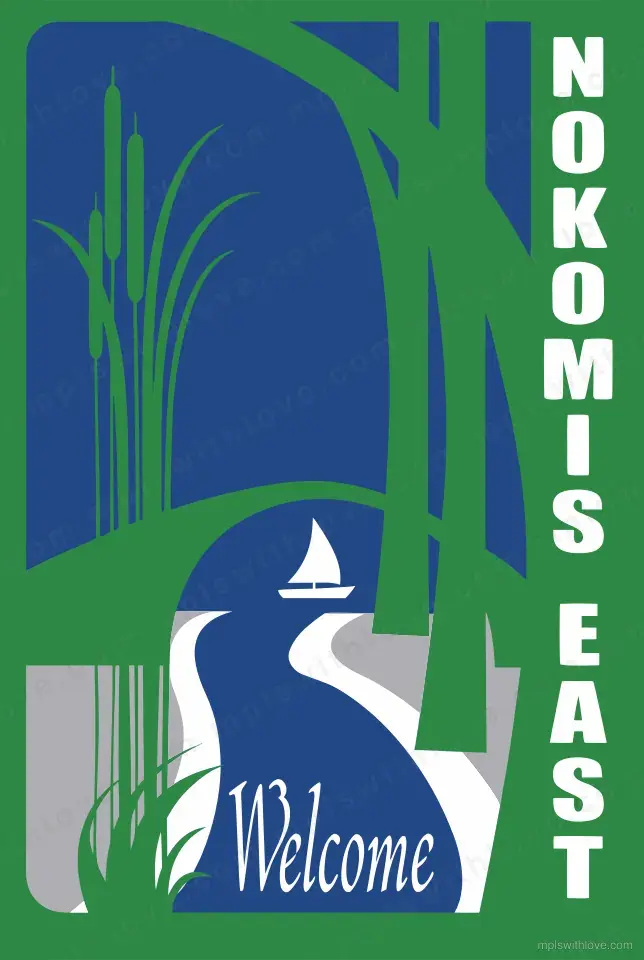
Keewaydin Neighborhood Sign
Keewaydin, Minneapolis — Key Stats (2025–2026)
- Residents (2020 Census)
- ~3,400
- Median home sale price (2025 data)
- $404K
- Median rent, all units (2020–24 ACS)
- $1,696
- Walk Score (Oct 2026)
- 64
- Bike Score (Oct 2026)
- 68
- Transit Score (Oct 2026)
- 47
- Renter-occupied homes (2020–24 ACS)
- 9%
- Parks within or bordering the neighborhood
- 4
Keewaydin History & Origins
The name Keewaydin comes from the Ojibwe word for the north wind, by way of Longfellow's The Song of Hiawatha, in which Keewaydin is the Northwest Wind, “the Home Wind.” The Park Board gave the name to Keewaydin Park in 1928. Before European settlement, this land was part of the homeland of the Dakota people, and the Nokomis East Neighborhood Association notes that the area was a major Native American gathering place until the late 1800s.
Development came relatively late to this part of Minneapolis. While neighborhoods closer to downtown were built up in the 1880s and 1890s, the housing that defines Keewaydin today was built primarily between the 1920s and 1950s, with one building boom in the 1920s and another in the 1940s, helped by the area's streetcar routes and rail lines and, after World War II, by returning veterans who needed homes. The result is a remarkably consistent building stock — modest single-family homes on regular lots, built for young families of moderate means.
The neighborhood has remained residentially stable for decades. Families stayed, maintained their homes, and passed the benefits of stability forward. The result is a neighborhood that feels settled in a way that many urban areas do not.
Living in Keewaydin
Living in Keewaydin means living in a neighborhood where the rhythms are seasonal and domestic. In summer, the pull is toward the lake — Lake Nokomis, just blocks to the west, with its swimming beach, walking trails, and the particular quality of light that comes off the water on a July evening. In winter, the neighborhood goes inward — kids skate on the rink at Lake Nokomis, cross-country skiers track through the creek corridor, and the streets are quiet in the way that only cold weather can make a city street quiet.
The housing stock is predominantly single-family homes — bungalows, ramblers, and Cape Cods with two or three bedrooms, a garage, and a yard. Most were built between the 1920s and 1950s, and the best of them have been updated while keeping the original character. The neighborhood is overwhelmingly owner-occupied, which gives it a stability and continuity that rental-heavy neighborhoods lack. People buy here and stay.
The social life of Keewaydin revolves around the school, the park, and the lake. The Keewaydin campus of Lake Nokomis Community School is a genuine neighborhood school — the kind of place where parents know each other. The park hosts youth sports, playground time, and the informal gathering that happens when neighbors share green space.
Neighboring Hale across Cedar to the west shares a piece of the lake, while Wenonah to the south shares the quiet residential feel and the lake's south end. All three are part of the city's Nokomis community.
Keewaydin Food, Drink & Local Spots
Keewaydin itself has very little commercial activity — beyond a coffee shop and a beach restaurant by the lake, it is residential. For most food, drink, and shopping, residents head to nearby corridors and neighboring commercial nodes.
Nearby Options
Located near Lake Nokomis, this is the closest coffee shop for most Keewaydin residents — a casual spot with good coffee and lake-adjacent vibes.
Near the Nokomis beach area, The Painted Turtle (successor to Sandcastle) serves burgers, tacos, and drinks with lake views. It's the closest thing to a neighborhood restaurant for Keewaydin residents.
The commercial stretch along 34th Avenue South, on the neighborhood's east edge, includes small restaurants, coffee shops, and services that serve the surrounding residential areas.
Chicago Avenue to the west offers a broader range of restaurants, groceries, and services, including chains and independent spots accessible by a short drive or bike ride.
Parks, Culture & Outdoors Near Keewaydin
Parks and outdoor access are Keewaydin's strongest amenities. The neighborhood takes in most of Lake Nokomis on its west side and runs up to Minnehaha Creek on the north, making it one of the best-situated neighborhoods in Minneapolis for outdoor recreation.
Keewaydin Park
The neighborhood's namesake park sits toward the south end of the community, offering a playground, sports fields, and open green space. It's the kind of neighborhood park that functions as the community's backyard — a place where kids play after school, where families gather on summer evenings, and where the neighborhood comes together.
Lake Nokomis
Lake Nokomis is Keewaydin's most significant natural amenity, accessible within a 5-10 minute walk from most parts of the neighborhood. The lake offers a swimming beach (one of the city's best), a 2.7-mile walking/biking trail, fishing, kayaking, and the particular pleasure of watching the sun set over the water on a summer evening. In winter, the lake supports cross-country skiing, ice fishing, and skating.
Minnehaha Creek
Minnehaha Creek runs along Keewaydin's northern edge, providing a greenway corridor that runs from Lake Harriet east to Minnehaha Falls and the Mississippi River. The creek trail is popular for walking, biking, and — in the spring melt — canoeing. It connects Keewaydin to the broader Minneapolis park system and provides a natural buffer between the neighborhood and the city to the north.
Keewaydin Schools
The Keewaydin campus of Lake Nokomis Community School, at 5209 30th Avenue South, is the neighborhood's public elementary and one of its most important community institutions. It serves grades 2 through 5; kindergarten and first grade are at the school's Wenonah campus on 23rd Avenue South. The school is a significant draw for families considering Keewaydin.
The district's boundary maps put Keewaydin in the attendance areas for Sanford Middle School and Roosevelt High School; check the district's school finder for a specific house. Open enrollment provides other options across the district.
Keewaydin Real Estate & Housing
Keewaydin's housing market is defined by stability. The overwhelming majority of housing is owner-occupied single-family homes, and turnover is low — people buy here and stay for decades. When homes do come on the market, they attract strong interest from families seeking good schools, safe streets, and lake proximity.
Buying in Keewaydin
The median sale price was $403,500 in 2025, up from $335,000 in 2021, according to Minneapolis Area REALTORS, and homes moved fast — 17 days on market on average, against 55 citywide. Condition and updates are the primary price differentiators. The best-located homes — those closest to the lake — command premiums. The housing stock is mostly two-to-three-bedroom bungalows and ramblers from the 1920s to 1950s. Updated homes with modern kitchens and bathrooms sell at the top of the market; original-condition homes offer entry points for buyers willing to invest in renovations.
Rental Market
Rental options are limited in Keewaydin, as the housing stock is predominantly owner-occupied. The few available rentals are mostly upper or lower units in duplexes, and Census estimates put the median rent at about $1,700, above the city's $1,371. If you're looking to rent in this area, you may need to expand your search to neighboring areas with more rental housing.
Getting Around Keewaydin
Keewaydin is a car-oriented neighborhood by Minneapolis standards. The Walk Score of 64 reflects the fact that while the neighborhood is pleasant for walking, there is very little within walking distance besides parks, the lake, and the school. For commercial needs — groceries, restaurants, shopping — most residents drive or bike to nearby corridors.
Biking is practical and popular, particularly in warmer months. The Bike Score of 68 reflects good cycling infrastructure, including connections to the Lake Nokomis trail, Minnehaha Creek trail, and surface street bike lanes. Many residents commute to downtown by bike via the Minnehaha corridor in under 30 minutes.
Bus service is available on 28th Avenue and 34th Avenue South but is less frequent than in denser neighborhoods. The Transit Score of 47 reflects limited but functional public transit. Most households in Keewaydin own at least one car, and the neighborhood is designed around that reality — garages, driveways, and easy street parking are standard.
What's Changing: The Honest Version
Keewaydin faces fewer dramatic tensions than many Minneapolis neighborhoods. The changes here are incremental rather than transformational.
Rising Prices
Home prices have been rising — the median sale price went from $335,000 in 2021 to $403,500 in 2025, according to Minneapolis Area REALTORS — driven by demand for family-friendly neighborhoods with good schools and lake access. The neighborhood is becoming less affordable for first-time buyers, and the entry point that once made Keewaydin accessible to middle-income families is climbing upward. This is a citywide trend, but it matters here because affordability has been part of Keewaydin's appeal.
Density Debates
Minneapolis's 2040 Plan, which eliminated single-family-only zoning citywide, has generated discussion in Keewaydin about the potential for duplexes and triplexes on streets that have been exclusively single-family for decades. So far, the impact has been minimal — few new multi-unit buildings have been proposed — but the debate reflects broader tensions about growth, density, and neighborhood character that are playing out across Minneapolis.
Climate and Infrastructure
Minnehaha Creek flooding has been an occasional concern for properties near the northern boundary. Climate change is increasing the frequency of extreme rainfall events, and the creek corridor — while beautiful — can pose challenges during heavy storms. The Minneapolis Park Board and watershed district are working on resilience measures, but creek-adjacent homebuyers should be aware of the risk.
Keewaydin FAQ
Is Keewaydin a good neighborhood in Minneapolis?
Keewaydin is an excellent choice for families and anyone seeking quiet, residential living near Lake Nokomis. It has low crime, well-maintained homes, good parks, and a strong sense of community. It lacks the walkable commercial districts and nightlife of denser neighborhoods, which is exactly why many people choose it.
Is Keewaydin safe?
Keewaydin is one of the safer neighborhoods in Minneapolis, with crime rates well below the city average. Property crime is the most common concern, as it is citywide, but violent crime is rare. It's a neighborhood where kids play outside, people walk at night, and the biggest safety concern is usually a coyote sighting near the lake.
How much does it cost to live in Keewaydin?
Keewaydin's median sale price was $403,500 in 2025, according to Minneapolis Area REALTORS — above the citywide median of $350,000. Rental units are limited — about nine in ten occupied homes are owner-occupied — and Census estimates put the median rent at about $1,700. It's more affordable than lakeside neighborhoods to the west but pricier than Phillips or Powderhorn.
Where exactly is Keewaydin in Minneapolis?
Keewaydin is in far south Minneapolis, bounded roughly by Minnehaha Parkway to the north, 34th Avenue South to the east, East 54th Street to the south, and Cedar Avenue to the west. Most of Lake Nokomis lies inside it, and Minnehaha Creek runs along its north edge.
What schools serve Keewaydin?
The Keewaydin campus of Lake Nokomis Community School, located within the neighborhood at 5209 30th Avenue South, serves grades 2–5; kindergarten and first grade are at the Wenonah campus on 23rd Avenue South. The district's boundary maps put Keewaydin in the attendance areas for Sanford Middle School and Roosevelt High School. Check the district's school finder for a specific house.
Is Keewaydin walkable?
Moderately. Keewaydin is primarily residential, so walkability depends on what you need. The neighborhood is excellent for walking to parks, the lake, and schools. For shopping, dining, and services, you'll likely need to drive or bike to nearby commercial corridors on Chicago Avenue or 34th Avenue.
How close is Keewaydin to Lake Nokomis?
Very close. Most of Lake Nokomis sits inside Keewaydin's boundary, on its west side, within a 5-10 minute walk from most parts of the neighborhood. The lake's beach, trails, and parkland are a defining amenity for Keewaydin residents.
Is Keewaydin good for families?
Keewaydin is one of the best family neighborhoods in Minneapolis. It has a neighborhood elementary school, excellent parks, low crime, safe streets for kids to bike and play, and proximity to Lake Nokomis. The housing stock — mostly single-family homes with yards — is designed for family living.
What Makes Keewaydin Worth Knowing
Keewaydin is the kind of neighborhood that doesn't generate headlines or trend on social media. It is a place where families buy homes and stay for decades, where the elementary school is a genuine community institution, where the lake is close enough to walk to after dinner and the park is where the kids go after school. It is not exciting in the way that Uptown or Northeast are exciting. It is stable in the way that very few urban neighborhoods manage to be.
What you get in Keewaydin is what a lot of people say they want but can't always find within city limits: quiet streets, good schools, safe parks, and neighbors who wave. The trade-off is that you'll drive for most commercial needs and you won't find the cultural density that defines Minneapolis's more celebrated neighborhoods. For many families, that trade-off is exactly the point.

From the shop
Made for people who love it here.
From Minneapolis, With Love - Tote Bag
Keep exploring