Minneapolis Neighborhood
Minnehaha
Named for the falls next door — a quiet, mostly owner-occupied neighborhood of older houses between 34th Avenue and Hiawatha Avenue, just across the highway from Minnehaha Falls.
№ 55 of 87 · Nokomis community · Last updated: October 2026 · A complete neighborhood guide
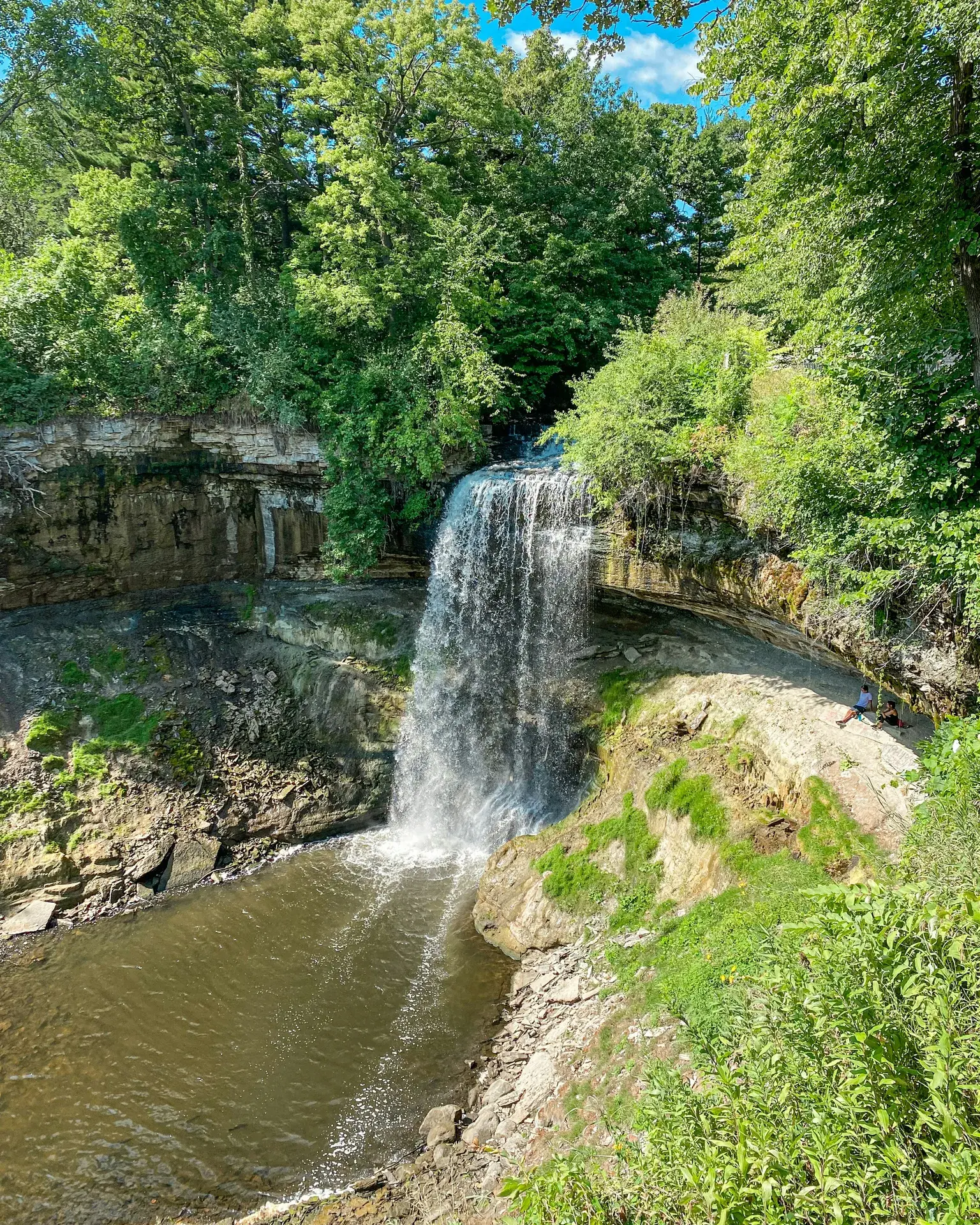
In spring, when the snow melts fast and the rain comes heavy, Minnehaha Falls roars. You can hear it from the parking lot — a sound that doesn't belong in a city, the sound of 53 feet of water dropping off a limestone ledge into a gorge lined with cottonwoods and oaks. Tourists line up at the overlook with their phones. Kids press against the railing. The mist reaches the walkway. And then you turn around and walk back up the hill, across Hiawatha Avenue to the light rail station and the houses beyond it, and you remember that this isn't a state park — the falls have neighbors. The falls are the headline. The neighborhood is the story.
What is Minnehaha, Minneapolis?
Minnehaha is a neighborhood in south Minneapolis, bounded roughly by Minnehaha Parkway to the north, Hiawatha Avenue (Highway 55) to the east, East 54th Street to the south, and 34th Avenue South to the west. It covers approximately 0.6 square miles and had about 4,300 residents at the 2020 Census. The neighborhood is part of the Nokomis community and borders Ericsson to the north, Hiawatha to the east, Keewaydin to the west, and Morris Park to the south, with the city's southern limit along the eastern stretch of 54th Street.
The neighborhood's name comes from Minnehaha Creek and Minnehaha Falls — the 53-foot waterfall just across Hiawatha Avenue. The word "Minnehaha" comes from Dakota words for water and for falling or curling — literally, a waterfall. The creek crosses the neighborhood's north end on its way to the falls; the falls themselves and most of the regional park around them sit just over the line in Hiawatha.
Two other neighbors shape the area: the Minneapolis VA Medical Center, a veterans' hospital campus a short way south, past 54th Street and outside the city limits, and the Blue Line light rail, which runs along Hiawatha Avenue on the eastern edge and stops at 50th Street/Minnehaha Park, inside the neighborhood. The VA hospital has been on that land since 1927; the Blue Line arrived in 2004.
By the numbers, Minnehaha is a settled, mostly owner-occupied place. Census estimates for 2020–2024, via MN Compass, count about 2,100 households; four in five own their homes, and the median household income is about $88,000. Nine in ten residents were living in the same home a year earlier.
Minnehaha Neighborhood Sign
Minnehaha, Minneapolis — Key Stats (2025–2026)
- Residents (2020 Census)
- ~4,300
- Median home sale price (2025 data)
- $321K
- Days on market (2025 data)
- 26 days
- Neighborhood area
- 0.6 sq mi
- Era most homes were built
- 1900s–40s
- Drive to downtown Minneapolis
- 15 min
- Walk Score (Oct 2026)
- 59
- Bike Score (Oct 2026)
- 66
Minnehaha History & Origins
Long before European settlement, the Dakota considered Minnehaha Falls an important place where all could gather in peace. The forced removal of the Dakota in the 1850s and 1860s pushed them out of the area, but the falls remain.
Minnehaha Falls was already drawing tourists in the 1840s and 1850s. Henry Wadsworth Longfellow's 1855 poem "The Song of Hiawatha" — which features Minnehaha as a character (and names the falls, though Longfellow never visited them) — made the site nationally famous. Minneapolis bought the land for the state in 1889, making it one of the first state parks in the country; the Minneapolis Park Board has run it from the beginning, and it is now Minnehaha Regional Park.
The neighborhood's own landmark has a stranger history. The land that is now Longfellow Gardens, at the north end of the neighborhood along the creek, was once Robert "Fish" Jones's Longfellow Zoological Gardens, a private zoo that got most of the Park Board's animals in 1907 and offered camel rides and lion-taming shows; the Park Board took full possession of the land in 1936. Jones also built himself a replica of Longfellow's Cambridge house there. It served as a branch library from 1937 and was later moved east of Hiawatha Avenue when the highway was rebuilt.
Much of the residential neighborhood is older: Census estimates put about half its homes before 1940, with most of the rest built after 1970. Just south, past 54th Street, a veterans' hospital opened on former Fort Snelling military land in March 1927; the Minneapolis VA Medical Center still occupies the site.
The Blue Line light rail, which opened in 2004 along Hiawatha Avenue, brought modern transit infrastructure to the neighborhood's eastern edge. The 50th Street station, inside the neighborhood, and the 46th Street station a short way north in Ericsson provide direct connections to downtown, the airport, and Bloomington.
Living in Minnehaha
Living in Minnehaha means living on quiet residential blocks with a highway along one side and a regional park just past it. About 80 percent of residents are white and about 4 percent were born outside the U.S., according to Census estimates published by MN Compass. About a third of adults 25 and older hold a graduate or professional degree, and about one in five households includes children.
The housing stock is mostly older single-family homes, with newer construction mixed in — about half the homes date from before 1940, and more than a third from after 1970. The blocks next to Hiawatha Avenue live with the highway's noise and traffic; the blocks toward 34th Avenue and the parkway are farther from it. The contrast within the neighborhood is real — a quiet, tree-lined block along the parkway can feel like a different world from a noisy intersection near the light rail station.
Along the eastern stretch of 54th Street the city ends. The land past it, in the unorganized territory around Fort Snelling, holds the VA Medical Center campus and the VA Medical Center light rail station.
The park is the shared backyard, even though most of it sits across Hiawatha Avenue. On a Sunday afternoon in July it fills up — families grilling, kids in the wading pool, joggers on the trail, tourists at the falls.
Minnehaha Food, Drink & Local Spots
Minnehaha's dining scene is thin — the neighborhood is mostly residential, and its businesses cluster on 34th Avenue around 50th Street, at the west edge.
The Go-To Spots
On 34th Avenue at 50th Street. An old-school neighborhood bar and restaurant alongside a ten-lane bowling alley, pouring beer from its sister pub, Town Hall Brewery.
On 34th Avenue at 50th Street. The neighborhood grocery, owned by brothers Neil and Adam Oxendale. Neil started working at the same spot under earlier owners at 15, in 1993, and bought the business in 2007. Its parking lot hosts the vendor market during Nokomis Days.
Just across Hiawatha Avenue, inside Minnehaha Regional Park in neighboring Hiawatha. A seasonal, outdoor seafood restaurant that draws crowds from across the Twin Cities. The fish tacos, the po' boys, the location overlooking the creek — it's one of the best warm-weather dining experiences in Minneapolis. Lines are long on weekends. Worth it.
Also Worth Knowing
The 34th Avenue strip is shared with Keewaydin, across the street. On the first weekend of August, the Nokomis East Business Association runs Nokomis Days — sidewalk sales and parking-lot parties along the avenue. For anything else, the Blue Line runs to downtown.
Parks & Outdoors in Minnehaha
Minnehaha's outdoor access is about as good as it gets in Minneapolis, even though most of it sits just over the neighborhood line.
Longfellow Gardens
Longfellow Gardens, at 3933 East Minnehaha Parkway, is the exception: the Park Board lists it in the Minnehaha neighborhood. It's a formal garden, completed in 2005, that sits on a land bridge over Hiawatha Avenue, with an arbor, walking paths, and native plantings along the creek. Peak season is June through September.
Minnehaha Regional Park & Falls
Minnehaha Regional Park, which sits mostly across Hiawatha Avenue in neighboring Hiawatha, is a 167-acre park centered around Minnehaha Falls — a 53-foot waterfall where Minnehaha Creek drops off a limestone ledge into a gorge that opens toward the Mississippi River. The falls are spectacular in spring and early summer when water volume is high, and dramatic in winter when they freeze into a curtain of ice. The park includes walking and biking paths, picnic areas, a wading pool, playgrounds, a disc golf course, the Sea Salt Eatery, and a handful of historic buildings — the John H. Stevens House, the 1875 Princess Depot, and the Longfellow House.
Mississippi River Gorge
The Mississippi River passes just beyond the neighborhood's southeastern tip, below the bluffs of Minnehaha Regional Park. Past the falls, the creek runs down through the glen to meet the river, and the river gorge connects to the broader Mississippi River trail system.
Minnehaha Creek Trail
The Minnehaha Parkway trail follows the creek for about five miles across south Minneapolis, from Lake Harriet to 36th Avenue South — right at the Minnehaha neighborhood's northern edge — and the falls are a short way beyond. Biking and walking the creek trail from the lakes to the falls and then down to the river is one of the great urban outdoor experiences in the Midwest.
Minnehaha Schools
Minnehaha is served by Minneapolis Public Schools, but no public school building sits inside the neighborhood. The closest is Lake Nokomis Community School, which splits its grades between two campuses: Wenonah (kindergarten and first grade) at 5625 23rd Avenue South, in Wenonah, and Keewaydin (grades 2–5) at 5209 30th Avenue South, in Keewaydin.
That may change. In September 2026 the district proposed a round of school consolidations, and all three of its plans would combine the two Lake Nokomis campuses at Keewaydin as a K–5 school. The school board is expected to vote Nov. 10, with changes taking effect in the 2027–28 school year.
Middle and high school assignments depend on the address. The district's school finder is the place to check a specific house.
Minnehaha Real Estate & Housing
Minnehaha is priced below the Minneapolis median. The median sale price was $321,000 in 2025, according to Minneapolis Area REALTORS, against $350,000 citywide, on 82 sales. That's up from $299,900 in 2021 but down from a 2023 high of $343,000.
The housing stock is predominantly single-family homes, about half of them built before 1940, with newer construction mixed in; about one in five 2025 sales were townhouses or condos. Four in five households own their homes, according to Census estimates.
Homes sell faster than in the city as a whole — 26 days on market on average in 2025, against 55 citywide, with sellers getting 101 percent of their original list price.
Getting Around Minnehaha
Minnehaha earns a Walk Score of 59 — moderately walkable, with shops on 34th Avenue at the west edge but limited walkable amenities within the residential core. The Bike Score of 66 reflects the trail connections — the Minnehaha Parkway trail along the north edge, the Mississippi River trails past the falls, and the broader south Minneapolis bike network.
The Blue Line light rail is Minnehaha's major transit asset. The 50th Street/Minnehaha Park station, inside the neighborhood, and the 46th Street station a short way north in Ericsson provide direct service to downtown Minneapolis, MSP International Airport (three stops south), and the Mall of America. This transit connectivity is a genuine differentiator — few south Minneapolis neighborhoods have rail access this direct.
By car, downtown is about 15 minutes, and the airport is even closer. Hiawatha Avenue (Highway 55) provides a direct route north-south, though it functions more as a highway than a neighborhood street. The highway's presence is a trade-off — fast car access at the cost of noise and a hard edge between the neighborhood and the park.
What's Changing: The Honest Version
Minnehaha doesn't change fast. The things worth watching are mostly at its edges.
Prices
The median sale price climbed from $299,900 in 2021 to $343,000 in 2023, then eased to $321,000 in 2025, according to Minneapolis Area REALTORS. Sales picked up in 2025 — 82 closed sales, 12 percent more than the year before — and homes still went for slightly over their original asking price.
Hiawatha Avenue as Divider
Hiawatha Avenue (Highway 55) is both a transit corridor and a barrier. The light rail runs along it, providing valuable connectivity. But the highway also divides the neighborhood from the Hiawatha neighborhood and the park to the east, creates noise and pollution for adjacent blocks, and makes pedestrian and bicycle crossing dangerous in some locations. The trade-off between transit access and livability is a daily reality for residents on the eastern edge.
The Dog Park
The Minnehaha off-leash dog park, entered from 54th Street and Hiawatha Avenue at the neighborhood's southeast corner, is on its way out: the Park Board says the off-leash area is being decommissioned.
Minnehaha FAQ
Is Minnehaha a good neighborhood in Minneapolis?
Yes, especially if you want quiet residential blocks next door to one of the best park assets in the city — Minnehaha Falls and Minnehaha Regional Park, just across Hiawatha Avenue. The neighborhood has its own Blue Line station, a small business strip on 34th Avenue, and prices below the city median: $321,000 in 2025, against $350,000 citywide, according to Minneapolis Area REALTORS.
Is Minnehaha, Minneapolis safe?
Minnehaha is a quiet, mostly residential neighborhood, and like anywhere in Minneapolis, conditions vary block by block. For current numbers, the Minneapolis Police Department's crime dashboard breaks incidents down by neighborhood.
What is Minnehaha, Minneapolis known for?
Minnehaha takes its name from Minnehaha Falls and Minnehaha Creek. The falls and most of Minnehaha Regional Park sit just across Hiawatha Avenue in the Hiawatha neighborhood; Minnehaha itself holds Longfellow Gardens, on a land bridge over Hiawatha Avenue, and the 50th Street/Minnehaha Park light rail station. On 34th Avenue near 50th Street it has Town Hall Lanes and Oxendale's Market.
How much do homes cost in Minnehaha, Minneapolis?
The median sale price in Minnehaha was $321,000 in 2025, according to Minneapolis Area REALTORS, against $350,000 for Minneapolis as a whole. That's up from $299,900 in 2021 but down from $343,000 in 2023. About one in five 2025 sales were townhouses or condos.
Where exactly is Minnehaha in Minneapolis?
Minnehaha is in south Minneapolis, part of the Nokomis community, bounded roughly by Minnehaha Parkway to the north, Hiawatha Avenue (Highway 55) to the east, East 54th Street to the south, and 34th Avenue South to the west. It sits near the southeastern corner of the city, between Lake Nokomis and Minnehaha Falls.
Is Minnehaha Falls actually in the Minnehaha neighborhood?
No, though it's close. Minnehaha Falls sits just across Hiawatha Avenue in the Hiawatha neighborhood, and most of Minnehaha Regional Park lies there too; only a sliver of the park falls inside Minnehaha's boundary. The neighborhood takes its name from the falls and the creek, which crosses its north end on the way to them.
What is the Minneapolis VA Medical Center?
The Minneapolis VA Medical Center is the Veterans Affairs hospital on former Fort Snelling land just south of Minnehaha, past 54th Street and outside the city limits. The VA says the hospital there opened in March 1927; its main building today took its first patients in 1988. The Blue Line's VA Medical Center station is one stop south of 50th Street/Minnehaha Park.
Can you take the light rail from Minnehaha?
Yes. The Blue Line (METRO) runs along Hiawatha Avenue on Minnehaha's eastern edge, with the 50th Street/Minnehaha Park station inside the neighborhood and the 46th Street station a short way north in Ericsson. The Blue Line connects to downtown Minneapolis, MSP International Airport (three stops south), and the Mall of America, making Minnehaha one of the better transit-connected neighborhoods in south Minneapolis.
Who lives in Minnehaha?
Census estimates for 2020–2024, published by MN Compass, count about 4,100 residents in roughly 2,100 households. About 80 percent of residents are white and about 4 percent were born outside the U.S. Four in five households own their homes, and the median household income is about $88,000.
Is Minnehaha a good place to raise a family?
About one in five Minnehaha households includes children, according to MN Compass. Families get the Minnehaha Parkway trail along the north edge and Minnehaha Regional Park across Hiawatha Avenue. No public school sits inside the neighborhood; the nearest is Lake Nokomis Community School, whose two campuses are in Keewaydin and Wenonah, and Minneapolis Public Schools has proposed combining them. The trade-offs are highway noise along Hiawatha and a small commercial strip.
What Makes Minnehaha Worth Knowing
Minnehaha has something just across Hiawatha Avenue that most neighborhoods in any city would kill for: a 53-foot waterfall cascading through a limestone gorge into a tree-lined glen that opens onto the Mississippi River. The neighborhood itself is quieter than its namesake — blocks of older houses between 34th Avenue and the highway, a bowling alley and a grocery store at 50th Street, a garden built on a bridge over Hiawatha, and a light rail station three stops from the airport.
It's not perfect. The highway runs the length of its east side, and the commercial life is thin. But the combination of park access, transit, and prices still below the city median makes Minnehaha worth a close look.

From the shop
Made for people who love it here.
From Minneapolis, With Love - Large Tote Bag
Keep exploring