Minneapolis Neighborhood
University of Minnesota
Nearly 58,000 students, a Big Ten campus that spans the Mississippi, Stadium Village's game-day energy, the Green Line humming through it all — this is not a neighborhood in the conventional sense, but it shapes Minneapolis more than most that are.
№ 77 of 87 · University community · Last updated: October 2026 · A complete neighborhood guide
On a Saturday in October, the light rail pulls into the Stadium Village station and disgorges a crowd wearing maroon and gold. Huntington Bank Stadium rises ahead — 50,000 seats, a roofline that catches the autumn sun, and the faint sound of the marching band warming up inside. The sidewalks along Washington Avenue are a river of people: alumni in letter jackets that haven't fit right since the nineties, students in oversized jerseys carrying tallboys in koozies, families with kids on shoulders, all of them moving toward the stadium with the gravitational pull that college football exerts on a Big Ten campus. A few blocks away, a graduate student in a lab coat is crossing the street to the Molecular and Cellular Biology building, utterly indifferent to the spectacle. Both of these things are the University of Minnesota. Both are happening at the same time.
What is the University of Minnesota Neighborhood, Minneapolis?
The University of Minnesota neighborhood is, first and foremost, a campus — the main campus of the University of Minnesota-Twin Cities, one of the largest public research universities in the country, with nearly 58,000 students enrolled in fall 2025 and a physical plant that occupies a significant portion of Minneapolis's east bank riverfront. As a city-designated neighborhood, it encompasses most of the campus itself and the immediately surrounding blocks, creating a district that is more institutional than residential, more transient than settled, and more defined by the rhythms of the academic calendar than by the patterns of permanent community life.
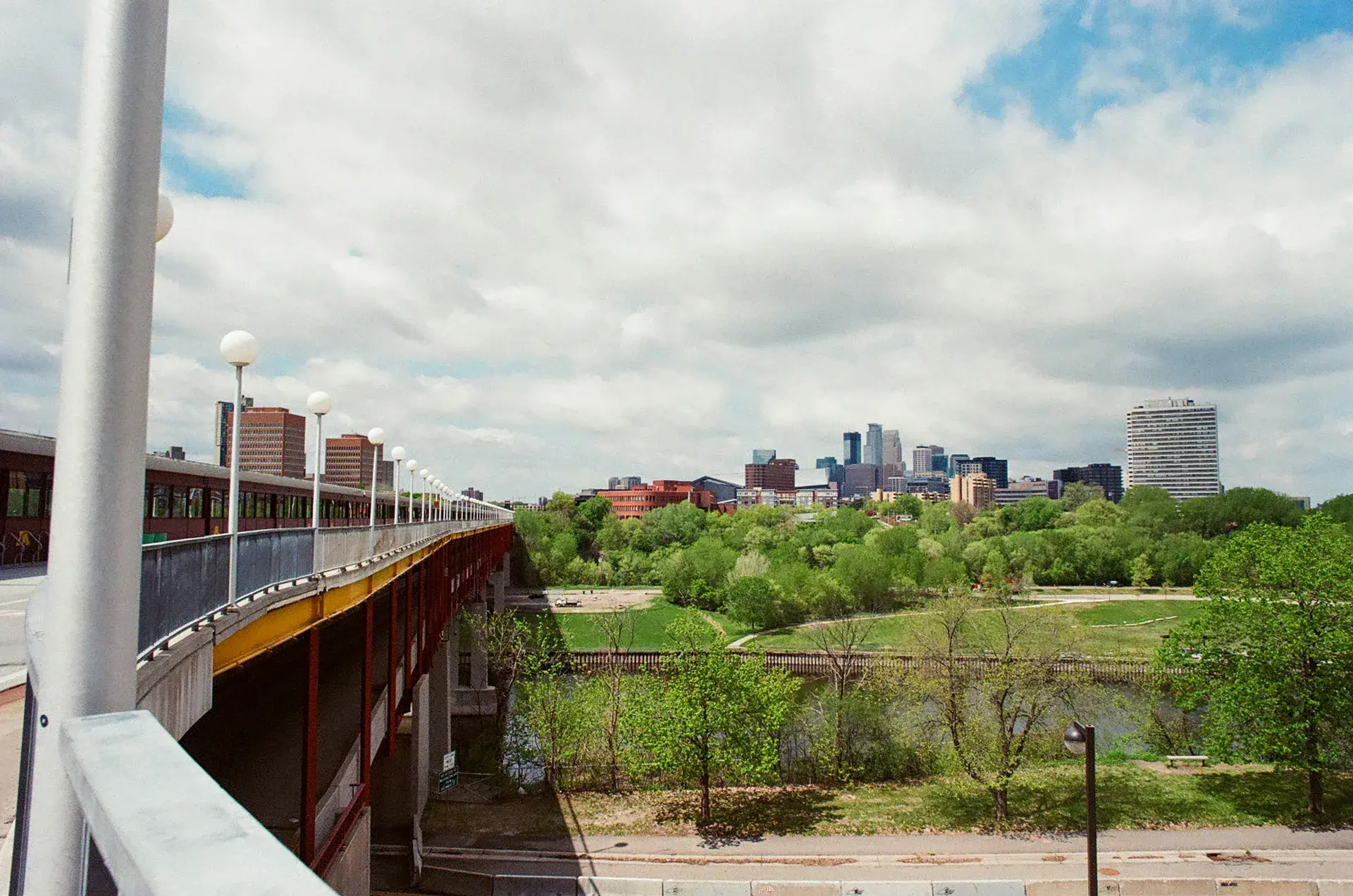
The neighborhood straddles the Mississippi River — the East Bank holds most of the academic buildings, dormitories, libraries, and Huntington Bank Stadium (just across Oak Street in Prospect Park), while the West Bank (up to 19th Avenue South, the line with Cedar-Riverside) houses the Carlson School of Management, the Law School, and other professional programs. The Washington Avenue Bridge connects the two banks and carries the Green Line light rail, making it one of the most trafficked pedestrian and transit corridors in the state.
The 2020 Census counted about 7,100 residents within the neighborhood boundaries, but the daily population during the academic year is many times that, as students, faculty, staff, and visitors move through the campus. This creates a neighborhood that is extraordinarily dense and active from September to May and noticeably quieter in summer — a seasonal oscillation that defines every aspect of life here, from restaurant traffic to parking availability to the ambient noise level on a Wednesday night.
University of Minnesota Neighborhood Sign

University of Minnesota, Minneapolis — Key Stats (2025–2026)
- Residents (2020 Census)
- ~7,100
- Twin Cities campus enrollment (fall 2025)
- ~58,000
- Median rent, all units (2020–24 ACS)
- $1,517
- Renter-occupied homes (2020–24 ACS)
- 91%
- Year the University of Minnesota was chartered
- 1851
University of Minnesota History & Origins
Before European settlement, the land that is now the University of Minnesota campus was part of the homeland of the Dakota people. The Mississippi River corridor here — between St. Anthony Falls and the river gorge — was a landscape of bluffs, hardwood forest, and river bottomland that held deep significance for the Mdewakanton Dakota. The river itself was a highway, a food source, and a spiritual presence.
The University of Minnesota was chartered in 1851, seven years before Minnesota became a state — making the university older than the state it serves. Its first permanent building, Old Main, stood on the east bank in what is now the campus's historic Knoll area. Early construction was modest, and the university was forced to close after the financial panic of 1857, deep in debt. It stayed closed through the Civil War until 1867, when regent John S. Pillsbury helped reopen it and win its designation as the state's land-grant institution.
Growth through the late 19th and early 20th centuries transformed the campus from a small collection of buildings into a major research university. The Mall — the central green space on the East Bank, anchored by Northrop Auditorium — grew out of Cass Gilbert's classically inspired 1907 campus plan and became the campus's architectural signature. Buildings from this era, including Walter Library, Folwell Hall, and Pillsbury Hall, established the collegiate aesthetic that persists alongside later modernist and contemporary additions.
The West Bank campus took shape beginning in 1962, when the university crossed the river into the Cedar-Riverside neighborhood with the Washington Avenue Bridge and its first West Bank buildings. Much of what went up in that first wave is plain, utilitarian brick and concrete, a stark contrast to the East Bank's older buildings.
Huntington Bank Stadium (originally TCF Bank Stadium) opened in 2009, bringing Gopher football back to campus after nearly three decades at the Metrodome. The stadium marked a significant reinvestment in the campus's physical relationship to the surrounding city.
Living in the University Area
Living in the University of Minnesota neighborhood means living inside an institution. The campus is the neighborhood — its buildings, its grounds, its schedule, its population are the defining features of daily life. This is not a neighborhood where you retreat from the city into residential calm. This is a neighborhood where the city is a university, and the university is everything.
For students — who constitute the vast majority of the neighborhood's population — this is the point. The proximity to classes, libraries, labs, and social life is the entire proposition. The apartment complexes along Washington Avenue and University Avenue are purpose-built for student living: furnished units, per-bedroom leases, study lounges, rooftop decks, and the kind of amenities (pools, fitness centers, game rooms) that appeal to twenty-year-olds and mystify everyone else.
For the small number of non-student permanent residents, life in the University neighborhood requires a tolerance for noise, transience, and the particular energy of a college campus. The neighborhood is loud on weekend nights. Parking is challenging during the school year. The commercial options are heavily skewed toward student tastes and budgets, and rents run above the city median. But the transit access is excellent, and the cultural offerings of a major research university (lectures, performances, museums, sporting events) are available daily.
Adjacent neighborhoods offer the residential stability that the University area lacks. Prospect Park to the east provides a genuine residential community with strong neighborhood identity. Marcy-Holmes to the north includes Dinkytown, which functions as an extension of campus culture. These neighborhoods absorb much of the student overflow and provide the housing diversity that the campus core does not.
University of Minnesota Food, Drink & Local Spots
The food and drink scene around the University of Minnesota is calibrated to serve a population of nearly 58,000 students and the staff and faculty who work alongside them. This means an abundance of fast-casual options, a concentration of chain and local restaurants in Stadium Village, and a bar scene that peaks on Thursday through Saturday nights during the academic year. The quality varies — some places have been feeding students for decades with genuine craft, while others exist solely because of proximity and foot traffic.
Stadium Village
Washington Avenue SE on both sides of Oak Street, the line with Prospect Park. The district offers a dense concentration of restaurants, cafes, and bars serving the campus community. Options range from pho to pizza to burritos to Korean barbecue, with most places priced for student budgets. The quality floor is higher than you might expect — competition among this many restaurants in this small an area forces a baseline competence. The quality ceiling is also present in a few places that transcend the student-dining category.
Dinkytown (Technically Marcy-Holmes)
Dinkytown — the commercial district along 4th Street SE, technically in Marcy-Holmes but functionally part of campus life — offers additional dining, drinking, and shopping options. The district has served U of M students for over a century and has a character distinct from Stadium Village: more independent businesses, more late-night options, and a grittier, less corporate feel. Al's Breakfast, a 14-seat diner that has been serving eggs and pancakes since 1950, is a Minneapolis institution.
Campus Dining
The university operates dining facilities across campus, ranging from dining halls in the dormitories to food courts and cafes in academic buildings. Coffman Memorial Union, the main student union on the East Bank, houses multiple food vendors and serves as a social hub. The quality of campus dining has improved significantly in recent years, with the university investing in variety, sustainability, and options that go beyond the traditional institutional model.
Parks & Outdoors Near the University of Minnesota
The University of Minnesota campus provides substantial green space and outdoor access within its boundaries, supplemented by the Mississippi River corridor that defines the campus's western and southern edges.
The Mall & Campus Green Spaces
The Mall — the classically planned central green space stretching from Northrop Auditorium toward the river — is the campus's primary outdoor gathering space. On warm days during the academic year, it fills with students studying, throwing frisbees, and engaging in the organized optimism of student organizations tabling for causes. The Mall is technically not a park, but it functions as one of the best urban green spaces in Minneapolis. Other campus green spaces — the Knoll area, the Scholars Walk, various plazas and courtyards — contribute to a surprisingly verdant campus given its urban setting.
Mississippi River
The Mississippi River gorge along the campus's western edge provides dramatic natural scenery and trail access. The river trail system connects the campus to the Stone Arch Bridge, Minnehaha Falls, and the broader Grand Rounds network. The Washington Avenue Bridge offers one of the most striking river crossings in the city — walking or biking across in October, with the gorge canopy in full color below, is one of those experiences that justifies attending a university in Minnesota despite the climate.
Weisman Art Museum
The Frederick R. Weisman Art Museum, designed by Frank Gehry and perched on a bluff overlooking the river, is both a cultural institution and an outdoor landmark. Its stainless steel exterior — a cascade of reflective surfaces that change character with the light and weather — is one of the most photographed structures in Minneapolis. The museum's collection and programming are excellent, but even from outside, the building is a piece of public art that contributes to the campus's visual identity.
Schools & the University
The University of Minnesota-Twin Cities is the defining educational institution of this neighborhood — and one of the defining institutions of the state. With nearly 58,000 students enrolled in fall 2025, it is one of the largest public universities in the country, offering programs across every major academic and professional discipline. The Carlson School of Management, the Medical School, the College of Science and Engineering, the Law School, and the Humphrey School of Public Affairs are among its most prominent programs.
Research is a core mission. The University of Minnesota is a member of the Association of American Universities and ranks among the top public research institutions in the country. Annual research expenditures exceed $1 billion, funding work in medicine, agriculture, engineering, and the sciences that has global impact. The research enterprise is also the neighborhood's largest employer, supporting thousands of faculty, staff, and graduate students.
K-12 education is not a significant factor in this neighborhood, as the permanent residential population is small and overwhelmingly composed of adults — only about 1 percent of households include children, by Census estimates. The few families with school-age children rely on Minneapolis Public Schools, including schools in nearby Prospect Park and Marcy-Holmes; assigned schools depend on the address, so check the district's school finder for a specific address. The University also operates a child development center that serves the children of students and staff.
University of Minnesota Real Estate & Housing
The housing market in the University of Minnesota neighborhood is dominated by the rental market, with about 91 percent of homes renter-occupied, by Census estimates. This is a student housing market, and it operates by different rules than the rest of Minneapolis.
Student Housing
University dormitories house a significant portion of first-year students, with residence halls offering traditional dorm rooms, suite-style living, and apartment-style units. Beyond the dorms, private student housing has proliferated along Washington Avenue and University Avenue — large, purpose-built apartment complexes with per-bedroom leases, furnished units, and amenity packages designed to attract students. Census estimates put the median rent across all units at about $1,517 a month, above the citywide $1,371, and many of the newer buildings price by the bedroom rather than the unit.
The Investment Market
The University area is an active market for real estate investors. Multi-family properties near campus generate consistent rental income from the university's steady enrollment. National student housing developers have built several large complexes in the past decade, and local investors own portfolios of smaller properties — duplexes, triplexes, and small apartment buildings — throughout the surrounding streets. Owner-occupancy is rare — about 2 percent of homes, by Census estimates.
New Construction
The Green Line corridor and Stadium Village have attracted significant new construction, much of it student-oriented apartment buildings with ground-floor retail. These developments have added density and commercial activity to the area but have also raised concerns about affordability, as new buildings often price above the older housing stock. The result is a two-tier market: newer, amenity-rich buildings at premium prices and older, less polished buildings at lower rents, with students sorting between them based on budget and preference.
Getting Around the University of Minnesota
The University of Minnesota neighborhood has among the best transit access in Minneapolis, anchored by the Green Line light rail, which runs through campus along Washington Avenue with stops at West Bank, East Bank, and Stadium Village. The Green Line provides direct connections to downtown Minneapolis (10 minutes), downtown St. Paul (about 35 minutes), and the neighborhoods along University Avenue. The Blue Line is accessible via transfer at downtown stations, connecting to MSP Airport and the Mall of America.
Bus service supplements the light rail, with multiple Metro Transit routes serving the campus area. The university also operates its own campus connector bus system, providing free service between the East Bank, West Bank, and St. Paul campus. Few parts of Minneapolis are as well served, with rail, bus, and campus transit converging in a compact area.
Biking is excellent, thanks to the campus's bike infrastructure, the river trails, and the flat-to-moderate terrain. The university provides bike parking, repair stations, and connections to the city's bike network. Walking is the primary mode for on-campus trips, with the compact campus core accessible on foot within 15 to 20 minutes.
Driving is the least practical mode in the University area. Parking is expensive, limited, and heavily regulated. The university operates parking ramps and surface lots, but competition for spaces is intense during the academic year. Most students and staff who live nearby find that transit, biking, or walking is faster and cheaper than driving and parking, and about half of households have no car at all, by Census estimates. For trips outside the campus area, the freeway system (I-35W, I-94) is accessible within minutes.
What's Changing at the University of Minnesota
The University of Minnesota neighborhood is shaped by institutional decisions more than market forces. The university's master plan, enrollment trends, research funding, and capital investment priorities drive the physical and demographic evolution of the area in ways that are more planned (if not always more predictable) than the organic development patterns of other neighborhoods.
The Green Line's impact continues to unfold. The light rail has catalyzed development along Washington Avenue and Stadium Village, bringing new apartment buildings, commercial spaces, and pedestrian traffic to corridors that were previously dominated by parking lots and institutional buildings. This densification is generally positive — it adds life and amenities to the campus area — but it also raises questions about the balance between student housing and other uses, the affordability of new construction, and the impact on adjacent residential neighborhoods.
The university's relationship with its surrounding neighborhoods remains a live issue. Expansion over the decades has reshaped the neighborhoods around it, most visibly on the West Bank, where the campus crossed into Cedar-Riverside in the 1960s. Current university planning emphasizes a more collaborative approach, but the institution's size and resource base create an inherent power imbalance that neighborhoods navigate carefully. How the university grows — and whether that growth serves the broader community or only the institution — is a defining question for the neighborhoods that share its borders.
University of Minnesota FAQ
Is the University of Minnesota neighborhood good for non-students?
The University of Minnesota neighborhood is overwhelmingly oriented toward students and university staff. Non-student residents exist but are a small minority. If you are not affiliated with the university, you may find the neighborhood's seasonal rhythms (empty in summer, crowded during the academic year), the student-heavy demographics, and the institutional character less appealing than adjacent neighborhoods like Prospect Park, Marcy-Holmes, or Cedar-Riverside, which offer more diverse community compositions while still being close to campus.
Is the University area safe?
Safety on and around the University of Minnesota campus is a nuanced topic. The university maintains its own police department (UMPD), which patrols the campus and surrounding area. Property crime — bike theft, car break-ins, package theft — is common in any high-density student area. More serious crimes, including assault and robbery, occur periodically, particularly in transitional areas between campus and surrounding neighborhoods, along the Green Line corridor, and in isolated areas late at night. The university publishes a Clery Act report annually with crime statistics. Standard urban precautions apply, and awareness of surroundings is important, particularly after dark.
What is Stadium Village?
Stadium Village is the commercial district along Washington Avenue SE near Huntington Bank Stadium (the university's football venue). The area features restaurants, bars, shops, and student-oriented businesses that serve the campus community. On game days — particularly football Saturdays in fall — Stadium Village transforms into a massive tailgating and entertainment zone. Between games, it functions as a student commercial district with a mix of fast-casual restaurants, coffee shops, and services.
What is the difference between the East Bank and West Bank?
The University of Minnesota's Minneapolis campus is divided by the Mississippi River. The East Bank is the larger section, containing most of the academic buildings, libraries, dormitories, Huntington Bank Stadium, and the main campus mall. The West Bank, across the river where the neighborhood meets Cedar-Riverside, houses the Carlson School of Management, the Humphrey School of Public Affairs, the Law School, and several liberal arts departments. The two banks are connected by the Washington Avenue Bridge, which carries both pedestrian/bicycle traffic and the Green Line light rail.
Is Dinkytown part of the University neighborhood?
Dinkytown is technically part of the Marcy-Holmes neighborhood, not the University of Minnesota neighborhood. However, it functions as an extension of campus and is deeply connected to university life. The commercial district along 4th Street SE — with its bookstores, restaurants, bars, and shops — has served U of M students for over a century. The distinction is administrative rather than experiential; for practical purposes, Dinkytown and the campus are intertwined.
How much does it cost to live near the University of Minnesota?
The University area is a renter's market. Census estimates put the median rent across all units at about $1,517 a month, above the citywide $1,371, with newer student-oriented buildings at the higher end. University dormitory rates vary by room type and meal plan. The area around Stadium Village and along the Green Line corridor has seen significant new apartment construction, most of it targeting students with per-bedroom pricing models. Buying property in the neighborhood is rare — about 91 percent of homes are renter-occupied, by Census estimates, and only about 2 percent are owner-occupied.
Where exactly is the University of Minnesota neighborhood?
The University of Minnesota neighborhood encompasses the main campus of the University of Minnesota-Twin Cities on the east bank of the Mississippi River. It is bounded roughly by the river to the south and west, Oak Street and Prospect Park to the east, Marcy-Holmes along University Avenue and 15th Avenue SE to the north, and the rail corridor, with Como beyond, at its northern tip. It also crosses the river to take in the core of the West Bank campus, the blocks between the river and 19th Avenue South north of 4th Street; the rest of the West Bank falls within the Cedar-Riverside neighborhood boundaries.
What is the Green Line?
The Green Line is the Metro Transit light rail line that connects downtown Minneapolis to downtown St. Paul, running through the University of Minnesota campus along Washington Avenue. The line has multiple stops on campus — West Bank, East Bank, and Stadium Village — making it the primary transit connection for students and staff. The Green Line opened in 2014 and has significantly improved transit access for the university community, providing direct connections to both downtowns and the neighborhoods along University Avenue in St. Paul.
What happens to the neighborhood in summer?
The University of Minnesota neighborhood undergoes a dramatic seasonal shift. During the academic year (September through May), the area is crowded, energetic, and noisy — tens of thousands of students move through the campus daily. In summer, enrollment drops significantly, many students leave, and the neighborhood becomes noticeably quieter. Businesses in Stadium Village and the surrounding commercial areas see reduced traffic. Summer session maintains some activity, but the difference between a September Wednesday and a June Wednesday is stark.
Can you tailgate at Huntington Bank Stadium?
Yes. Tailgating is a major tradition at Gopher football games, with designated areas around Huntington Bank Stadium and in nearby parking lots filling hours before kickoff. The Stadium Village commercial district contributes to the game-day atmosphere with bars and restaurants that cater to the pre- and post-game crowd. The tailgating culture is significant — on a home football Saturday, the area around the stadium hosts tens of thousands of people, and the energy is palpable blocks away.
What the University of Minnesota Means to Minneapolis
The University of Minnesota is not just a neighborhood — it is an institution that shapes the entire city. Nearly 58,000 students are enrolled on the campus, bringing energy, ideas, economic activity, and the particular chaos of young adulthood to a stretch of the Mississippi that has been a center of education since before Minnesota was a state. The research labs produce breakthroughs that make national news. The athletic programs fill stadiums and dominate sports pages. The graduates stay and build careers, or they leave and carry Minneapolis with them. No other single institution has a comparable impact on the city's identity, economy, and self-image.
As a place to live, the University neighborhood is not for everyone — it is loud, transient, institutionally dominated, and oriented around a population that is, by definition, passing through. But for the four or five years that students are here, it is formative in ways that are difficult to overstate. The friendships made in a cramped apartment off Washington Avenue, the late-night study sessions in Walter Library, the first time seeing the Mississippi from the Washington Avenue Bridge in October — these are experiences that attach to place, and the place is this one. Minneapolis did not build the University of Minnesota; in many ways, the University of Minnesota built Minneapolis.

From the shop
Made for people who love it here.
From Minneapolis, With Love - Large Tote Bag
Keep exploring