Minneapolis Neighborhood
Mid - City Industrial
The industrial corridor that most Minneapolis residents drive through without noticing — a rail-defined wedge of warehouses, commercial operations, and working land that sits between Northeast, Como, and the city limit and connects them to nothing except the economy.
№ 53 of 87 · University community · Last updated: October 2026 · A complete neighborhood guide
You have driven through Mid-City Industrial and you do not know it. On your way up Stinson Boulevard or Johnson Street, between the university neighborhoods and Northeast, you passed through a few blocks where the streetscape changed — the houses and trees gave way to chain-link fencing, loading docks, and buildings with no windows facing the street. You barely registered the transition. The radio kept playing. The light turned green. You were through it in ninety seconds and back in a neighborhood that looked like a neighborhood. That strip of industrial land you crossed without noticing? That was Mid-City Industrial. It does not mind being ignored. It has work to do.
What is Mid-City Industrial, Minneapolis?
Mid-City Industrial is an industrial district on the eastern edge of Minneapolis, a wedge of rail lines and industrial parcels between I-35W and East Hennepin Avenue that separates the residential neighborhoods of Northeast from those around the University of Minnesota. With a few hundred residents — most of them in old industrial buildings converted to lofts — it is a neighborhood in the administrative sense only. In practice, it is a working zone of warehouses, commercial operations, and light industrial businesses that serves the broader city's economy from a position of geographic marginality and social invisibility.
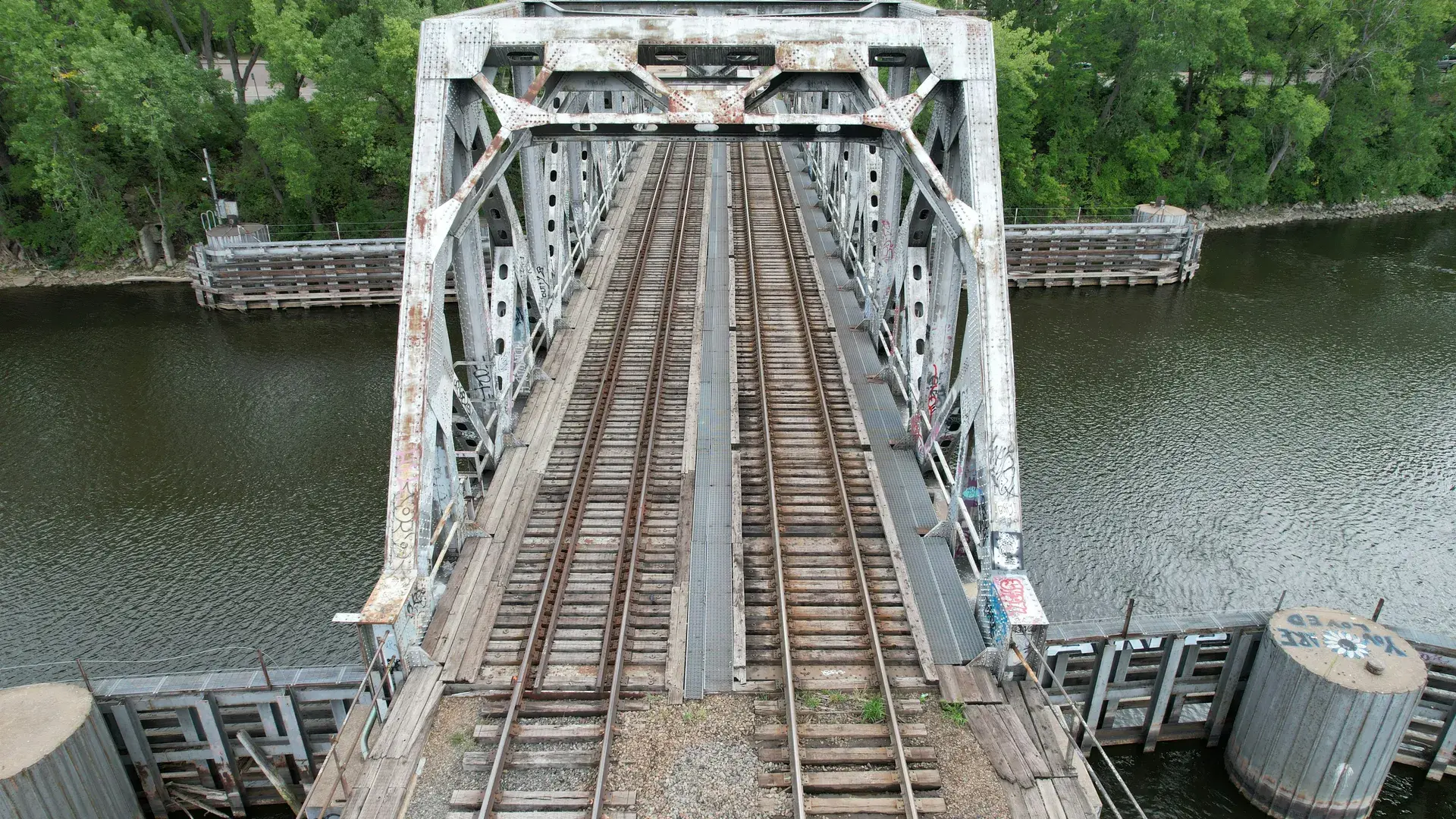
The district is organized along the rail corridors that cut across this part of Minneapolis. These corridors — still active for freight — created a strip of industrial land that separates residential neighborhoods from each other and provides the space, vehicle access, and zoning flexibility that industrial and commercial businesses require.
Mid-City Industrial borders three neighborhoods — Como across East Hennepin Avenue, and Beltrami and Northeast Park across I-35W. Where the district meets Como along East Hennepin Avenue, the contrast is stark — one block is a tree-lined street with houses and kids on bicycles; the next is a fenced storage yard with a semi-truck idling at a loading dock. These transitions are among the most abrupt in the city, and they define the experience of both the industrial district and the neighborhoods that surround it.
Mid - City Industrial Neighborhood Sign
As far as we can tell, Mid-City Industrial doesn’t have a neighborhood welcome sign — at least, nobody has documented one that we can find. If you’ve seen one, tell us where it is — we’d love to be wrong about this.
Mid - City Industrial, Minneapolis — Key Stats (2025–2026)
- Residents (2020 Census)
- ~440
- Median home sale price (minimal residential)
- N/A
- Median rent, all units (2020–24 ACS)
- $1,630
- Primary land use designation
- Industrial
- Defining geographic feature
- Rail corridor
Mid-City Industrial History & Origins
Mid-City Industrial began filling in around World War I. The early anchors were the Northwestern Terminal Company, two long brick buildings put up in 1919 and 1920 to house small manufacturers and distributors and ship their freight out by rail; a Cream of Wheat plant, built on Stinson Boulevard in 1928; and Glidden Paint and other manufacturers along East Hennepin Avenue. Scott-Atwater, by the early 1940s the second-largest outboard motor maker in the country, had its plant here; the building is now a Target sortation center.
Much of the central and eastern part of the district was a gravel quarry that John Wunder began digging in 1903. Once it closed, the land filled with the big warehouses and distribution buildings that sit there now.
Mid-City Industrial Character & Land Use
The character of Mid-City Industrial is purely functional. The buildings are industrial — warehouses, manufacturing facilities, commercial garages, and storage buildings constructed for utility rather than appearance. The streetscape is truck-oriented — wide roads, limited signalization, loading zones, and the general infrastructure of freight movement. Sidewalks exist on some streets but are not the primary design consideration.
The businesses that operate here range from long-established industrial operations to newer tenants who have found value in the affordable, flexible space. Food production and processing facilities, building supply operations, auto repair and body shops, metalworking and fabrication, and various commercial services occupy the buildings. Some creative businesses and maker spaces have also moved in, attracted by the same qualities that attract traditional industrial tenants: big spaces, reasonable rents, and neighbors who do not complain about noise.
The rail lines remain active, carrying freight through the corridor. The sound of train horns is the district's most distinctive auditory feature and a reminder that this land is still doing what it was designed to do. For the residential neighborhoods that border Mid-City Industrial, the train horns are a familiar background sound — part of the texture of life in Como and Northeast that new residents discover and longtime residents no longer hear.
Mid-City Industrial Food & Local Spots
Mid-City Industrial does not have a restaurant scene. The exception worth knowing is UP Coffee Roasters, which roasts on site and runs a café at 1901 Traffic Street NE, near the district's southern edge. Otherwise, workers in the district bring lunches or drive to the commercial corridors in surrounding neighborhoods. The dining options along Central Avenue on the far side of Beltrami, in Dinkytown beyond Como, and the broader Northeast restaurant scene are all accessible within a short drive. The scarcity of dining within the district is consistent with its industrial function — the buildings are for work, not for eating.
Parks & Outdoors Near Mid-City Industrial
Mid-City Industrial has no parks within its boundaries. The closest are just across I-35W in the Northeast Park neighborhood: Ridgway Parkway, and Northeast Athletic Field Park, with ballfields, tennis courts, a playground, and the Jim Lupient Water Park.
Parks in the surrounding residential neighborhoods — Northeast Park, Como, and others — provide the green space and recreational facilities that the industrial district does not. For workers in Mid-City Industrial, a lunch break walk to a nearby park is possible but requires crossing the boundary between industrial and residential landscapes — a transition that is as much psychological as physical.
Mid-City Industrial Schools
Mid-City Industrial does have a school: Northeast College Prep, a K–8 public charter school at 300 Industrial Boulevard NE, near the Como edge. Families in the surrounding neighborhoods otherwise use Minneapolis Public Schools options in Northeast and Southeast Minneapolis.
Mid-City Industrial Real Estate
The real estate market in Mid-City Industrial is commercial and industrial. Properties consist of warehouse buildings, manufacturing facilities, commercial garages, and industrial lots. Values reflect the industrial zoning, building condition, and environmental status. The housing that does exist — about 170 units by the Census Bureau's estimate, most of them rented — is in converted industrial buildings.
If major transit or other public investment ever came to this part of the city, the land values in and around Mid-City Industrial could shift significantly, making conversion to mixed-use or residential development more economically attractive. For now, the market remains industrial, with properties trading on the basis of their current use rather than speculative future value.
For businesses seeking industrial or commercial space inside Minneapolis, Mid-City Industrial offers affordable rents and good vehicle access. The location — between Northeast and the university neighborhoods, with I-35W along its northern edge — is a practical advantage for businesses that serve the local market.
Getting Around Mid-City Industrial
Mid-City Industrial is primarily car-dependent, reflecting its industrial character. Metro Transit buses run on the main streets — Route 30 on Broadway, Route 25 on Stinson Boulevard, Route 4 on Johnson Street, and Route 61 on East Hennepin Avenue — but service on the industrial side streets is limited.
The paved Northeast Diagonal Trail cuts across the district's northwest corner. Beyond that, cyclists can get through, but the industrial streets are not particularly bike-friendly.
Vehicle access is the primary mode, with the road network providing connections to Interstate 35W along the district's northern edge, Highway 280 just over the city line to the east, and the broader metro. The streets within the district accommodate truck traffic, and parking is generally available in the informal, unstructured way that characterizes industrial areas.
What's Changing in Mid-City Industrial
The biggest open question in Mid-City Industrial is underground. In March 2022 the EPA added the Southeast Hennepin Area Groundwater and Vapor site to the Superfund National Priorities List — a plume of trichloroethylene in the shallow groundwater and soil vapor under much of this district and the neighboring part of Como. The suspected sources are the work that built the place: a foundry, outboard motor manufacturing, metal finishing, dry cleaning, and the old gravel pit. The contamination was first found more than two decades before the EPA listing.
Beyond the cleanup, the question is the one every close-in industrial district faces — whether the land stays industrial or gets pulled toward housing and mixed use. A few buildings have already gone that way, like the Cream of Wheat plant and the old Glidden Paint building on East Hennepin. Most of the district has not.
Mid - City Industrial FAQ
Is Mid-City Industrial a residential neighborhood?
Not meaningfully. Mid-City Industrial has a few hundred residents but functions primarily as an industrial and commercial district. The character of the area is defined by warehouses, commercial operations, and rail infrastructure rather than housing. The residences that exist are mostly in former industrial buildings converted to lofts, like the old Cream of Wheat plant on Stinson Boulevard — pockets of housing within an industrial landscape rather than a residential community.
Where is Mid-City Industrial in Minneapolis?
Mid-City Industrial occupies a wedge of land on the eastern edge of Minneapolis, in the city’s University community, roughly bounded by I-35W to the north and west, East Hennepin Avenue to the south, and the city limit to the east, where Lauderdale and Roseville begin. It sits between Northeast Minneapolis and the Como neighborhood near the University of Minnesota, functioning as a buffer zone defined by its industrial land use. BNSF tracks cut diagonally across its western end, and the Minnesota Commercial Railway runs along its eastern edge.
What kinds of businesses are in Mid-City Industrial?
Mid-City Industrial hosts a diverse mix of commercial and industrial businesses. Warehousing and distribution operations, building supply companies, auto repair and body shops, metalworking and fabrication, food production and processing facilities, and various commercial services occupy the area. Some creative businesses and maker spaces have also established operations here, drawn by the affordable rents and flexible spaces that industrial buildings provide.
Is Mid-City Industrial safe?
Mid-City Industrial is a low-traffic area outside of business hours. During the workday, when businesses are operating, the area is functional and unremarkable from a safety perspective. After hours and on weekends, the district is largely empty, with limited lighting and pedestrian traffic. Property crime — break-ins, theft from businesses, vehicle-related crime — is the primary concern.
Are there environmental concerns in Mid-City Industrial?
Industrial districts by definition carry environmental legacies, and Mid-City Industrial is no exception. Some parcels have contamination histories from manufacturing processes, petroleum storage, and industrial waste. Environmental assessment and remediation are governed by state and city regulations, and the costs of cleanup can significantly affect property values and redevelopment potential. In March 2022 the EPA added the Southeast Hennepin Area Groundwater and Vapor site — a plume of trichloroethylene under much of this district and the neighboring part of Como — to the Superfund National Priorities List. The Minnesota Pollution Control Agency maintains records on sites with known contamination.
What neighborhoods border Mid-City Industrial?
Mid-City Industrial borders three neighborhoods: Como to the south, across East Hennepin Avenue, and Northeast Park and Beltrami across I-35W to the north and west. To the east it runs to the city limit, with Lauderdale and Roseville beyond. The industrial district functions as a buffer between residential areas, with I-35W providing a physical separation that is both a boundary and a transportation infrastructure. The adjacent residential neighborhoods are significantly different in character — tree-lined streets, single-family homes, neighborhood commercial nodes — from the industrial landscape of Mid-City.
Will Mid-City Industrial become residential?
Conversion of Mid-City Industrial to residential or mixed-use development is possible but faces significant challenges. The active rail lines that define the corridor would need to be relocated or accommodated, environmental remediation of contaminated parcels would be required, and the city's interest in maintaining industrial employment land provides a policy counterweight to market pressure. For now, the district remains industrial.
What Mid-City Industrial Does for Minneapolis
Mid-City Industrial is the kind of place that a city needs but rarely thinks about. The warehouses store the materials that contractors use to build the houses in Northeast. The auto shops fix the cars that residents of Como drive to work. The distribution centers move the goods that end up on shelves across the metro. None of this is glamorous. None of it makes a neighborhood guide exciting to read. But it is the infrastructure of daily life, and it occupies land inside the city because proximity matters for the businesses that serve the city's physical needs.
The rail corridor that defines Mid-City Industrial has been moving freight through Minneapolis for over a century, and the businesses that line it have been doing the work that cities require for nearly as long. Whether that work continues here — or gets pushed to the exurban fringe, as it has in so many American cities — is a question about what kind of city Minneapolis wants to be. A city that makes and moves and fixes things needs places to do those things. Mid-City Industrial is one of those places. It is not asking for appreciation. It is asking to be left alone long enough to keep working.

Keep exploring