Minneapolis Neighborhood
Prospect Park
A Minneapolis neighborhood where a century-old water tower shaped like a witch's hat watches over hilly streets, professors' homes sit alongside massive new apartment blocks, the Green Line delivers you to two downtowns, and the tension between preservation and transformation plays out on every block.
№ 65 of 87 · University community · Last updated: October 2026 · A complete neighborhood guide
On a Saturday afternoon in late September, a woman is walking her dog up the steep slope of Seymour Avenue SE, leaning into the grade the way you lean into a hill in San Francisco or Duluth — not Minneapolis. Because Minneapolis is flat. Everyone knows that. Except here, in this wedge of a neighborhood tucked between the University of Minnesota and the river, the land does something unexpected: it rises. It climbs to a modest summit where a water tower built in 1913 stands with a steep conical roof that looks, unmistakably, like a witch's hat. The woman reaches the top, pauses at Tower Hill Park, and takes in the view — the downtown skyline to the west, the river gorge falling away to the south, the sprawl of the university campus below. Behind her, a six-story apartment building that didn't exist three years ago glints in the afternoon light. Below her, a 1920s Craftsman bungalow sits behind its original stone retaining wall. This is Prospect Park in 2026 — a neighborhood where the past and future are not just coexisting but physically stacked on top of each other, arguing about the view.
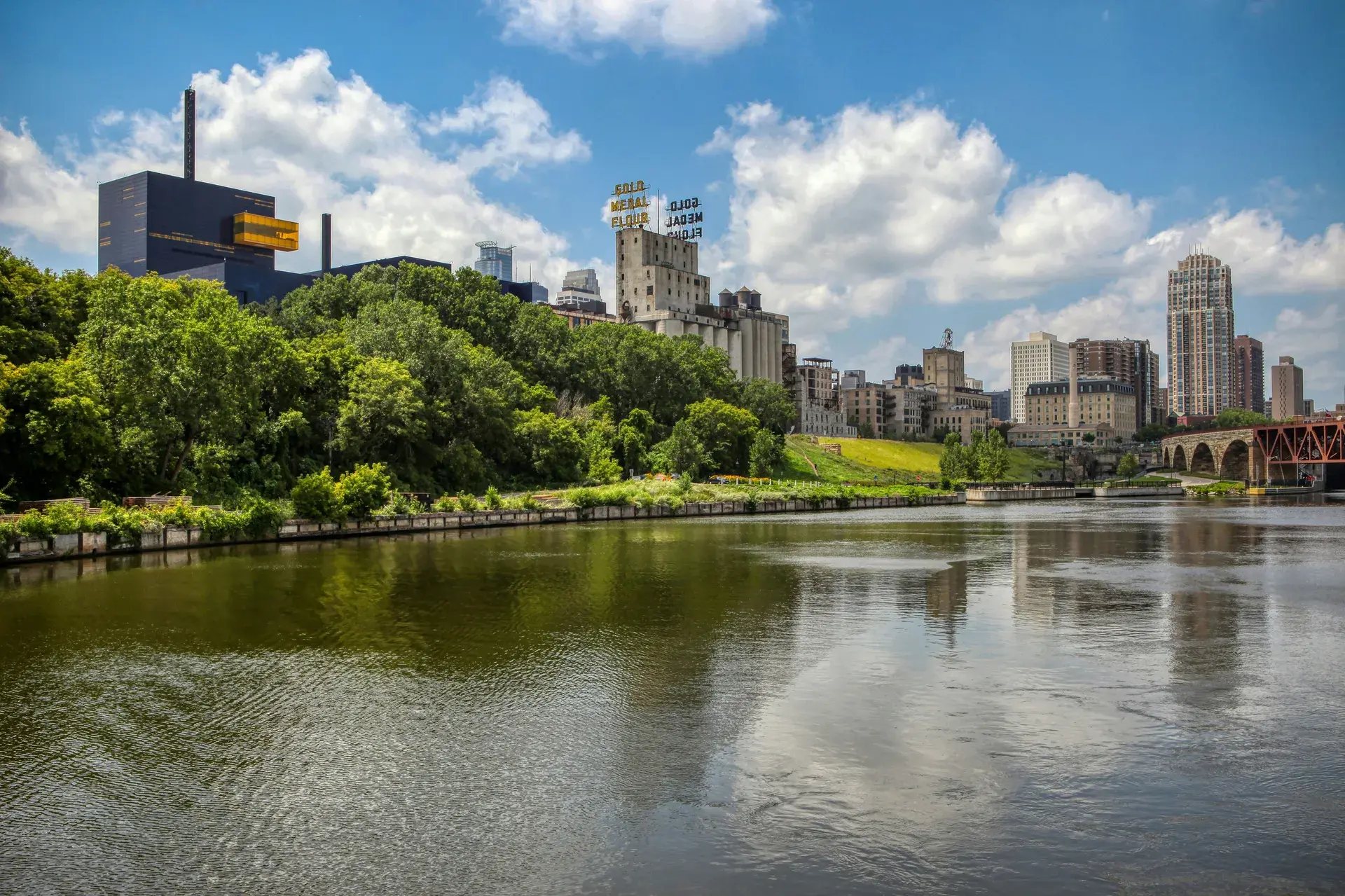
What is Prospect Park, Minneapolis?
Prospect Park is a residential neighborhood in Southeast Minneapolis, officially known as Prospect Park - East River Road. It is roughly bounded by the BNSF railroad tracks to the north, the St. Paul city line to the east, the Mississippi River and East River Parkway to the southwest, and Oak Street and the University of Minnesota East Bank campus to the west. It is home to about 11,400 residents, according to the 2020 Census — a number that has grown notably in recent years as large-scale apartment development has added hundreds of new units along the neighborhood's northern edge.
What makes Prospect Park distinctive is, first and most literally, its topography. Minneapolis is a city built on glacial plains, and nearly every neighborhood in the city is flat enough to lose a marble on. Prospect Park is the exception. The land here rises to about 940 feet above sea level at Tower Hill Park — one of the highest points in Minneapolis — and the residential streets climb and curve in ways that feel borrowed from another city entirely. The hills created a neighborhood of winding roads, stone retaining walls, and houses built into slopes rather than placed on grids. It gave the place a character that a century of development elsewhere in the city has never replicated.
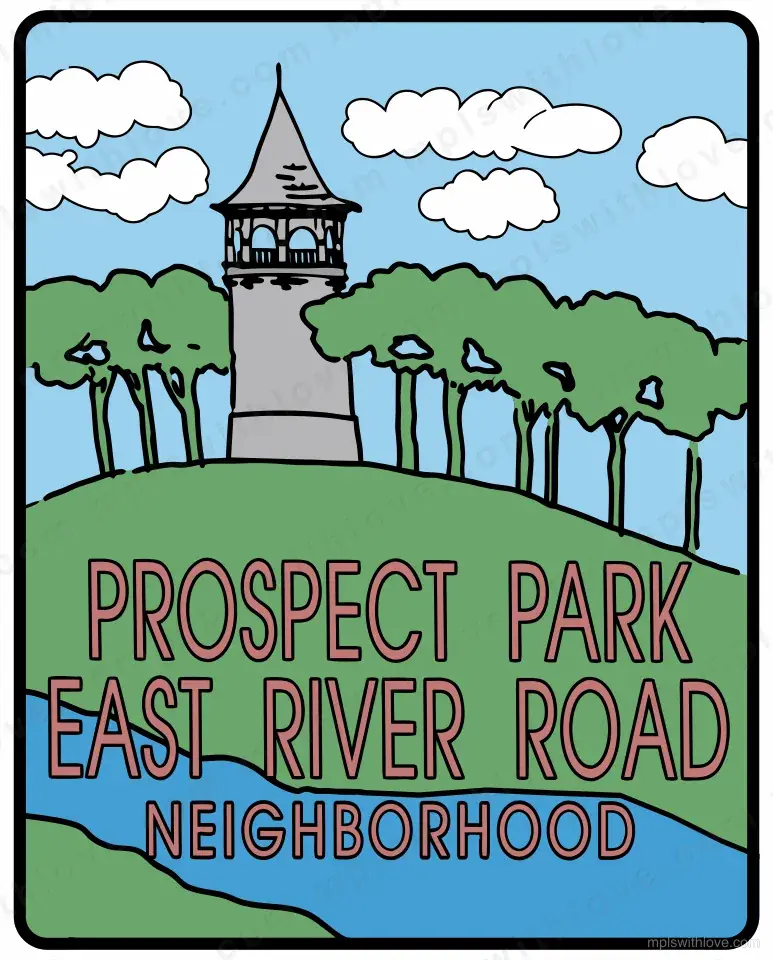
The second defining feature is the Witch's Hat water tower, built in 1913 and listed on the National Register of Historic Places. The tower's steep conical roof — visible from miles away — has become the symbol of the neighborhood, the logo of the neighborhood association, and the single most photographed non-lake landmark in Minneapolis. It sits atop Tower Hill Park and anchors the neighborhood's identity the way a church steeple anchors a European village — a fixed point around which everything else orients.
The third is the neighborhood's relationship to the University of Minnesota, whose East Bank campus borders Prospect Park to the west. The university has shaped Prospect Park for more than a century — professors and university staff have been drawn to the neighborhood since the early 1900s, and the academic culture permeates everything from the architecture (large, well-built homes designed for people who valued books over garages) to the civic culture (neighborhood meetings that sometimes read like faculty seminars). This university connection also brings the tensions that come with any town-gown border: student housing pressure, parking conflicts, and the slow expansion of institutional land use into what was once purely residential territory.
In the 2010s and 2020s, two forces reshaped Prospect Park dramatically: the Green Line light rail, which opened in 2014 with a station in the heart of the neighborhood, and the wave of transit-oriented development that followed. The Prospect North project and other apartment complexes along University Avenue added hundreds of units of new housing, bringing new residents, new commercial tenants, and a new scale of construction that the neighborhood's longtime residents are still processing. The result is a neighborhood in genuine transition — a place where 1920s professors' bungalows sit within sight of 2020s apartment towers, where the Witch's Hat still watches from the hilltop but now shares the skyline with structures that dwarf it.
Prospect Park Neighborhood Sign
Prospect Park, Minneapolis — Key Stats (2025–2026)
- Residents (2020 Census)
- ~11,400
- Median sale price, homes and condos (2025 data)
- $416K
- Year the Witch's Hat water tower was built
- 1913
- Era most original homes were built
- 1890s–1930s
- Elevation at Tower Hill Park — one of the highest points in Minneapolis
- ~940 ft
- Green Line ride to downtown Minneapolis
- 10 min
Prospect Park History & Origins
The land that is now Prospect Park is part of the ancestral homeland of the Dakota people, for whom the confluence of the Mississippi and Minnesota Rivers at Bdote, several miles to the southeast, is a site of profound spiritual and cultural significance. Any honest history of this place begins with that fact and the dispossession that followed: the treaties of 1837 and 1851, the US-Dakota War of 1862, and the forced exile of Dakota people from their homeland.
European-American settlement of the area began in the mid-19th century, and the neighborhood's unusual topography shaped its development from the start. While the rest of Minneapolis was being platted on the relentless grid that defines the city — straight streets, square blocks, flat lots — the hills of Prospect Park demanded something different. Streets curved to follow contour lines. Lots were irregularly shaped, sloping, and sometimes difficult to build on. The result was a neighborhood that felt, from its earliest days, like it belonged to a different city — one with terrain, one where the landscape had opinions about where buildings should go.
The name comes from the two plats that real estate developer Louis F. Menage put before the city council in 1883 and 1884, soon after Minneapolis annexed the area: Prospect Park, First and Second Divisions. Growth was slow until an interurban line opened in 1890 and streetcars began running on University Avenue in 1896. By then the area was attracting residents who appreciated both the views and the proximity to the growing University of Minnesota campus, which was established in 1851 and expanding steadily on the East Bank of the Mississippi. Residents — many of them academics drawn by the university — built substantial homes on the hilly streets: Queen Anne and Colonial Revival houses at first, then Craftsman bungalows, Prairie-style houses, and Tudor Revivals, all designed with the kind of architectural ambition that suggested their owners cared about ideas, including ideas about how a house should sit on a hillside.
The Witch's Hat water tower was built in 1913 and dedicated in 1914, designed by city engineer Frederick William Cappelen (who also designed the Franklin Avenue Bridge over the Mississippi). It was built to raise water pressure on the hill, but Cappelen gave it a whimsical, almost medieval look, topped by a steep conical roof of green tile, and the tower quickly became the neighborhood's defining landmark. It served the neighborhood's water supply until 1952, and the tower and Tower Hill Park were listed on the National Register of Historic Places in 1997. The city still owns the tower. For years its one open evening a year, during the Pratt Ice Cream Social, drew visitors from across the metro who climbed the interior stairs for the panoramic view from the top; it has not opened to the public since 2019 while the city prepares repairs.
Through the early and mid-20th century, Prospect Park settled into its identity as a quiet, intellectual, university-adjacent enclave. Many residents were academics — professors, researchers, graduate students who stayed after finishing their degrees, university librarians and administrators. The neighborhood association, formed in 1901 as the Prospect Park Improvement Association (the oldest organization of its kind in Minneapolis), reflected this character — civic meetings were well-attended, articulate, and occasionally contentious in the way that faculty meetings are contentious, with passionate disagreements conducted in complete sentences. The neighborhood developed a reputation as one of Minneapolis's most self-consciously intellectual communities — a reputation that was not entirely unearned and not entirely endearing to outsiders.
Interstate 94, built in the 1960s, cut through the southern part of the neighborhood and severed the blocks along East River Road from the rest of Prospect Park. The highway brought noise, pollution, and a wall of concrete that turned what had been a gentle slope from the hilltop down to the river into an abrupt boundary. Residents had fought the route since 1956. They lost the push to divert it to a railroad spur at 26th Street, but won a route along the Milwaukee Road tracks that saved many of the threatened houses, the Glendale Homes public housing project, and Luxton Park. The same freeway cost about 600 families in St. Paul's Rondo neighborhood, that city's largest African American community, their homes.
The neighborhood remained relatively unchanged for decades after the highway — a stable, small, university-adjacent residential community where houses changed hands slowly and the neighborhood association guarded its character with the kind of vigilance that only a community full of people who read zoning codes for intellectual stimulation could maintain. Then the Green Line came.
The METRO Green Line light rail, which opened in 2014 connecting downtown Minneapolis to downtown St. Paul along University Avenue, included a station in the heart of Prospect Park. The station transformed the neighborhood's accessibility — suddenly, a quiet residential enclave had direct rail connections to both downtowns, the university, the Capitol, and the broader transit network. It also transformed the neighborhood's development trajectory. The land along University Avenue near the station — previously occupied by light industrial uses, parking lots, and underutilized commercial properties — became some of the most valuable transit-oriented development sites in the Twin Cities. What followed was a building boom that is still reshaping Prospect Park today.
Living in Prospect Park
Living in Prospect Park means living in two neighborhoods at once. There is the historic Prospect Park — the hilly streets south of University Avenue where professors' houses from the 1910s and 1920s sit behind stone retaining walls and mature oaks, where the Witch's Hat tower is visible from your porch, where your neighbors include retired academics who have lived in the same house for forty years and know the Latin names of every tree on the block. And there is the new Prospect Park — the corridor along University Avenue where six-story apartment buildings have risen on former parking lots and industrial sites, where the residents are twenty-somethings and graduate students and young professionals, where the ground-floor retail spaces are still filling in and the landscaping is still immature and the whole thing has the slightly raw energy of a neighborhood that is being built in real time.
These two Prospect Parks coexist within a few blocks of each other, and the relationship between them is the central drama of the neighborhood in 2026. The longtime residents — many of whom moved here precisely because it was small, quiet, and insulated from the pressures that shaped denser neighborhoods — watch the new construction with a mixture of resignation and alarm. The new residents — many of whom chose Prospect Park because of the Green Line, the proximity to campus, and the new apartments — wonder why the old-timers are so resistant to the very density and connectivity that makes the neighborhood viable. Both groups have a point. Neither is entirely wrong.
The physical character of the historic core is genuinely remarkable for Minneapolis. The hills create sight lines and perspectives that simply don't exist elsewhere in the city. You walk up Arthur Avenue or Seymour Avenue and the street rises ahead of you, lined with mature trees and houses that step up the slope in a way that feels almost East Coast. Stone retaining walls, many of them original to the early 1900s construction, terrace the lots. Gardens cascade down hillsides. The houses themselves are a mix of Craftsman, Prairie, and Colonial Revival styles — built with the kind of solid construction and architectural detail that reflected their original owners' expectations of permanence. There are no McMansions. There are no teardowns-and-rebuilds. The neighborhood has been protected by a combination of historic preservation activism, the difficulty of building on hilly terrain, and the sheer stubbornness of residents who consider their neighborhood's character a public trust.
The University of Minnesota's presence is felt everywhere, even if the campus boundary is technically a few blocks away. A significant share of Prospect Park residents work at the U — faculty, staff, postdocs, researchers — and the academic calendar shapes the neighborhood's rhythms in subtle ways. September brings a surge of new faces. Summers are quieter. Conversations at Tower Hill Park tend toward the well-informed. The neighborhood has always attracted people who chose a neighborhood the way they chose a book — for substance rather than packaging — and that intellectual self-selection has given Prospect Park a character that is distinctive even within a city full of distinctive neighborhoods.
To the northwest, past the university's East Bank campus, Marcy-Holmes and the Dinkytown commercial district offer the student-facing energy that Prospect Park has historically kept at arm's length. To the south, across the river, Seward provides a different model of community engagement — co-op culture versus faculty culture, though the two overlap more than either side might admit. University Avenue, which runs right through the neighborhood, connects Prospect Park to the broader corridor of development and commerce running between the two downtowns. The neighborhood sits at a crossroads, literally and figuratively, and the question of what it becomes next is one of the more interesting urban conversations happening in Minneapolis right now.
Prospect Park Food, Drink & Local Spots
Prospect Park has never been a dining destination, and that has always been part of the deal. You moved here for the hills, the tower, the quiet, the proximity to campus — not for the restaurant scene. For decades, the neighborhood's food landscape consisted of whatever the university district offered next door and whatever you cooked in your own kitchen. That has begun to change as new development along University Avenue has brought ground-floor commercial space and a few new tenants, and as one very large brewery put Prospect Park on the culinary map in a way that no one anticipated. But the food scene here is still thin by Minneapolis standards — a handful of spots rather than a corridor, a neighborhood where Surly Brewing looms large and everything else is still finding its footing.
The Anchor
520 Malcolm Avenue SE. The elephant in the room — or rather, the 50,000-square-foot destination brewery in the neighborhood. Surly opened its taproom and beer hall in 2014, transforming a former industrial site into one of the most visited breweries in the Midwest. The beer hall is massive, loud, and designed for gathering. The beer garden is one of the best outdoor drinking spaces in the Twin Cities. The food — pizza, burgers, smoked meats — is better than brewery food needs to be. Surly's flagship Furious IPA and the annual Darkness imperial stout release have a cult following. For Prospect Park, Surly is both a point of pride and a source of friction — it brings thousands of visitors into a neighborhood that was designed for hundreds, and the traffic, parking, and noise impacts are real. But it also put the neighborhood on the map for people who had never heard of the Witch's Hat.
The Corridor
The new development along University Avenue has begun to fill in with ground-floor commercial tenants, though the process has been slower than developers projected. Coffee shops, a few quick-service restaurants, and service businesses have opened in the Prospect North complex and adjacent buildings, adding options that the neighborhood historically lacked. The corridor is still maturing — there are vacant storefronts and spaces that have yet to find tenants — but the trajectory is toward a walkable commercial strip that serves both the new apartment residents and the broader neighborhood.
501 30th Avenue SE. A multi-vendor food hall in a converted industrial building on the north side of the neighborhood, near Surly. Multiple vendors offering tacos, ramen, pizza, barbecue, and other options under one roof. The market has added genuine food diversity to a neighborhood that historically had very little, and the outdoor seating area is popular in warm months.
University District Access
Prospect Park residents have always supplemented their neighborhood's limited food options with the university district's offerings. Dinkytown — the commercial cluster across campus to the northwest — has cheap eats, coffee shops, and the kind of no-frills restaurants that serve a campus community. Stadium Village, at the neighborhood's western edge along the Green Line, offers additional options. And the Green Line itself opens up the entire University Avenue corridor between the two downtowns, including the Midway area of St. Paul with its growing food scene. For a neighborhood with a modest internal food landscape, the transit connections make the functional dining radius much larger than the neighborhood boundaries suggest.
Parks & Outdoors Near Prospect Park
Prospect Park's outdoor assets punch above the neighborhood's weight. The combination of Tower Hill Park's hilltop vantage point, the Mississippi River gorge along the neighborhood's southwestern edge, and the broader university-area trail network gives residents access to some of the most distinctive outdoor spaces in the city — not the lakes and manicured parkways of Southwest Minneapolis, but something wilder and more geologically interesting.
Tower Hill Park
Tower Hill Park is small — barely more than a hilltop clearing with the Witch's Hat water tower at its center — but it is one of the most distinctive public spaces in Minneapolis. At about 940 feet above sea level, it is one of the highest points in the city, and the views from the summit are genuinely panoramic: the downtown skyline to the west, the river gorge to the south, the university campus sprawling below, and on clear days, a horizon that extends well into the outer suburbs. The park is the neighborhood's gathering place — the spot where residents come for sunset, where kids play on the grass, where the Pratt School community holds events, and where new residents come to understand why the people who live here tolerate the hills and the limited parking and the six-month winters. Standing at the top of Tower Hill on an October evening, watching the sun drop behind the Minneapolis skyline while the river gorge fills with shadow, you understand the "prospect" in Prospect Park.
The Mississippi River Gorge
The Mississippi River forms Prospect Park's southwestern boundary, and this stretch of the river is one of the most spectacular in the metro. The river gorge — the only true gorge along the Mississippi's entire 2,340-mile length — runs between Prospect Park and Seward here, with limestone bluffs, overhanging tree canopy, and a wildness that feels improbable within city limits. East River Parkway runs along the bluff top, providing a paved trail for walking, running, and cycling that connects north to the university, the Stone Arch Bridge, and downtown, and south — as St. Paul's Mississippi River Boulevard — toward Minnehaha Falls and Fort Snelling. The river bluffs in fall — cottonwoods and maples turning gold and orange against the dark water — are among the most beautiful landscapes in Minneapolis. Bald eagles are regularly spotted along this stretch.
Access to the river itself is limited by the steep bluffs, but several trail connections and stairways provide routes down to the water's edge. For Prospect Park residents, the river gorge is the daily luxury — a ten- to fifteen-minute walk from most of the neighborhood to one of the finest stretches of urban riverfront in the Upper Midwest. The combination of the hilltop views from Tower Hill and the riverside trails below gives Prospect Park a vertical dimension to its outdoor life that flat neighborhoods cannot offer.
University Trails & East River Parkway
The University of Minnesota's campus trail network connects seamlessly to Prospect Park, providing cycling and walking routes to the Stone Arch Bridge, downtown, and the broader Grand Rounds system. East River Parkway — part of the Minneapolis Grand Rounds scenic byway — runs along the river bluff through the neighborhood, offering one of the most scenic cycling commutes in the city. Riders heading downtown can follow the parkway north, cross the river at the Washington Avenue Bridge or the Stone Arch Bridge, and reach the office in under twenty minutes by bike. The trail is maintained year-round, though winter ice on the hills can make the Prospect Park segments adventurous.
Prospect Park Schools
Schools in Prospect Park reflect the neighborhood's dual identity — a small residential community with a deeply rooted neighborhood school, surrounded by the educational resources of a major research university. The picture is one of genuine community investment in public education, supplemented by the unique advantages that come with living next to the University of Minnesota.
Pratt Community School (PreK–5) is the elementary school in the neighborhood and one of its most important institutions. Pratt serves a diverse student body that reflects Prospect Park's evolving demographics — longtime faculty families, new arrivals in the apartment developments, immigrant families, and students from the surrounding area. The school has a strong community connection, with active parent involvement and neighborhood partnerships that make it more than just a school — it is a gathering point for the community, the place where Prospect Park residents of all ages and backgrounds actually interact. The annual Pratt ice cream social, held at the school across the street from Tower Hill Park, is one of the neighborhood's signature events.
For middle and high school, nearby MPS options include Northeast Middle School and Edison High School; the district's school finder shows which schools serve a specific address. Many Prospect Park families also access the Minneapolis Public Schools open enrollment system, magnet programs, and charter schools across the district. The University of Minnesota's proximity provides unique enrichment opportunities — campus museums, libraries, lectures, and programs that are accessible to neighborhood families in ways that aren't available in most parts of the city. For families who value educational breadth over a single pipeline, Prospect Park's school landscape is richer than it first appears.
Prospect Park Real Estate & Housing
Prospect Park's real estate market is defined by scarcity. The neighborhood covers a lot of ground on paper, but the historic residential core — the hilly streets south of University Avenue — is small and has very limited inventory. When a house comes to market in the historic core, it attracts significant attention, particularly from university-affiliated buyers who value the walk-to-campus lifestyle. The median sale price for homes and condos was $415,500 in 2025, up from $361,000 a year earlier, according to Minneapolis Area REALTORS — well above the city's $350,000 and reflecting the neighborhood's unique combination of character, location, and scarcity.
Demand rests on the Green Line's connectivity, the university's continued growth, and the simple fact that there are very few neighborhoods in Minneapolis that offer this combination of topography, transit, and architectural character. Even so, prices were flat for several years — the median sat between $361,000 and $370,000 from 2021 through 2024 — before the 2025 jump. The 2020 disruptions had less impact on Prospect Park than on many Minneapolis neighborhoods — the area's relative insularity and university connection provided stability that more commercially dependent neighborhoods lacked. Sales were also slower than the city average in 2025 — an average of 71 days on the market, against 55 citywide — though that figure blends houses in the historic core with the neighborhood's condos.
What Your Money Buys
The historic housing stock in Prospect Park consists primarily of Craftsman bungalows, Prairie-style homes, and Colonial Revival houses from the 1890s through 1930s — built on irregularly shaped, often sloping lots that give each house a slightly different relationship to the street. At the lower end of the market, you're looking at smaller bungalows or homes that need updating — original kitchens, single bathrooms, the deferred maintenance that comes with houses that have been owned by people who spent their renovation budget on books. The middle of the market gets you a well-maintained three- or four-bedroom home with updated systems, a finished basement, and possibly a view of the river gorge or the downtown skyline. At the top, you're in renovated territory with premium lots — hilltop positions, river views, or the kind of architectural detail that reflects the original owners' ambitions.
The rental market has been transformed by new construction. The Prospect North development and other apartment projects along University Avenue have added hundreds of units, ranging from studios to three-bedrooms, at rents that reflect new construction and transit proximity. Census estimates put the neighborhood's median rent, across all units old and new, at about $1,430 a month, a little above the city's $1,371. The older rental stock in the neighborhood — converted houses, small apartment buildings — offers more affordable options, though the supply is limited. The net effect has been a significant expansion of Prospect Park's rental population, shifting the neighborhood's demographic balance toward younger, more transient residents.
Getting Around Prospect Park
Prospect Park's transportation story was rewritten in 2014 when the Green Line light rail opened, and the neighborhood is still adjusting to the implications. Before the Green Line, getting around from Prospect Park meant driving or biking — the neighborhood's relative isolation (bounded by the railroad tracks, the river, and the university) made transit connections limited. The Green Line changed that calculus fundamentally, and the Prospect Park station has become the neighborhood's most important piece of infrastructure — more important, arguably, than any road.
The Green Line runs along University Avenue between downtown Minneapolis and downtown St. Paul, with the Prospect Park station providing direct access to both downtowns, the University of Minnesota campus stations, the Midway area of St. Paul, and connections to the Blue Line (for the airport and Mall of America) at the downtown Minneapolis end. A ride to downtown Minneapolis takes approximately 10 minutes. A ride to downtown St. Paul takes approximately 25 minutes. For university employees — a significant share of the neighborhood — the light rail provides a seamless commute to campus without the parking hassle that has been a source of complaint at the U for decades.
The neighborhood's walkability is mixed. The residential core has limited commercial amenities — no neighborhood grocery store, no dense commercial corridor — but the Green Line station area is developing commercial options, and the university district is within walking distance for most residents. Prospect Park is an excellent cycling neighborhood, with direct trail connections along East River Parkway to the Stone Arch Bridge, downtown, and the broader Grand Rounds system. The university campus trail network adds further connectivity. For bike commuters heading to downtown or campus, Prospect Park is one of the best-positioned neighborhoods in the city.
By car, downtown Minneapolis is approximately 10 minutes. MSP International Airport is 15–20 minutes via Highway 55 or I-94. Parking in the historic core is generally available on residential streets, though university-related parking pressure is a perennial complaint — game days at Huntington Bank Stadium are particularly challenging, as visitors compete for street parking throughout the neighborhood. The new apartment developments along University Avenue have added structured parking, but the overall parking supply has not kept pace with the population growth, and car storage is an increasingly relevant consideration for residents.
What's Changing: The Honest Version
Prospect Park's tensions are not subtle. They are physically visible — you can see them in the contrast between a 1920s bungalow and the six-story apartment building that now rises behind it, in the construction cranes that have been a near- constant presence along University Avenue for the past decade, in the full parking lots at Surly on a Saturday night and the quiet, almost-empty streets of the residential core three blocks away. This is a neighborhood where the forces of change are not abstract — they are concrete, steel, and glass, and they have names and addresses.
The Development Question
The Prospect North development and the broader wave of transit- oriented construction along University Avenue represent the most significant physical transformation in Prospect Park's history. Multiple apartment buildings — some exceeding six stories — have been built on land that was previously industrial, commercial, or simply underutilized. The scale of this construction is unlike anything the neighborhood has experienced, and the debate it has generated is the defining civic conversation in Prospect Park.
Supporters of the new development argue — persuasively — that adding housing near transit is exactly what Minneapolis needs to do. The Green Line station exists. The land was available. Building dense housing near rail transit reduces car dependency, increases housing supply in a city that needs it, and creates the kind of walkable urban district that progressive planning advocates have been calling for. The new buildings bring new residents, new commercial tenants, and new energy to a neighborhood that was, by any measure, quiet to the point of sleepiness.
Critics — many of them longtime residents — counter that the scale and speed of development have overwhelmed a neighborhood that was not designed for it. The six-story apartment buildings dwarf the surrounding residential streets. Traffic has increased. Parking is more difficult. The neighborhood's character — its smallness, its quiet, its sense of being a place apart from the urban grid — is being eroded by the very density that the city is encouraging. The critics are not, for the most part, anti-development in principle. They are concerned about scale, about the relationship between new construction and existing neighborhood fabric, and about whether anyone in a position of authority is asking whether this much change, this fast, in a neighborhood this small, is good planning or just opportunism.
Student Housing and University Expansion
The University of Minnesota is both Prospect Park's greatest asset and its most complicated neighbor. The university's growth — in enrollment, in physical plant, in the demands it places on surrounding neighborhoods — has been a source of tension for decades. Student housing is the most visible flashpoint: as the university's enrollment has grown and its on-campus housing has not kept pace, students have spilled into surrounding neighborhoods, including Prospect Park. The new apartment developments have absorbed some of this demand, but they have also changed the neighborhood's demographic character — more transient, younger, and less invested in the kind of long-term neighborhood stewardship that Prospect Park's civic culture depends on.
The university's institutional land use has also expanded incrementally into what was once residential territory. Each individual change is small — a house converted to office space, a lot acquired for parking — but the cumulative effect is a slow erosion of the residential character that defines the neighborhood. The Prospect Park neighborhood association has been vigilant about monitoring and contesting these changes, but the power imbalance between a small neighborhood organization and a major research university is significant and not in the neighborhood's favor.
Preserving the Small-Neighborhood Feel
The deepest tension in Prospect Park is existential rather than architectural. The neighborhood's identity has always been built on being small — a compact, walkable, self-contained community where everyone knows the Witch's Hat, where the neighborhood association meetings are attended by people who actually know each other, where the community feels like a community rather than a collection of strangers who happen to share a zip code. The new development threatens that identity not because the new residents are unwelcome but because adding thousands of new residents in a decade changes a community's fundamental nature. The neighborhood meeting that once drew thirty people who all recognized each other now draws seventy people, half of whom are new. The block party that once included every household now includes a six-story apartment building whose residents may not even know the party is happening.
This is not a complaint unique to Prospect Park — it is the universal tension of urban growth, playing out in a neighborhood that is small enough and self-aware enough to articulate it clearly. The question is whether Prospect Park can find a way to integrate its new residents, its new buildings, and its new identity without losing the qualities that made it worth fighting for in the first place. The Witch's Hat will still be there regardless. But the neighborhood it watches over is changing, and not everyone agrees about what it's changing into.
Prospect Park FAQ
Is Prospect Park a good neighborhood in Minneapolis?
Yes — Prospect Park is one of Minneapolis's most distinctive and well-located neighborhoods. It offers direct Green Line light rail access to both downtown Minneapolis and downtown St. Paul, proximity to the University of Minnesota campus, one of the city's most iconic landmarks in the Witch's Hat water tower, rare hilly topography, mature tree canopy, and a historic residential character unlike anything else in the city. The neighborhood is in the midst of significant transformation as large-scale development reshapes its edges, but the core residential streets remain quiet, walkable, and deeply rooted. For people who value transit access, university adjacency, and a neighborhood with genuine architectural character, Prospect Park is an excellent choice.
Is Prospect Park, Minneapolis safe?
Prospect Park is generally one of the safer neighborhoods in Minneapolis. The residential core — the hilly streets between University Avenue and the river — is quiet and neighborly, with relatively low rates of violent crime. The University Avenue corridor and areas near campus see more property crime, including bike theft and car break-ins, which is typical of university-adjacent neighborhoods. The influx of new apartment development has brought more foot traffic and activity, which some residents perceive as both a safety improvement (more eyes on the street) and a concern (unfamiliar faces in a formerly insular neighborhood). Overall, Prospect Park's crime profile is below the Minneapolis citywide average.
What is the Witch's Hat water tower?
The Witch's Hat water tower is a historic water tower built in 1913 at the top of Tower Hill Park in Prospect Park. Designed by city engineer Frederick William Cappelen, the tower features a distinctive steep conical roof — the 'witch's hat' — that makes it one of the most recognizable structures in Minneapolis. The tower and Tower Hill Park were listed on the National Register of Historic Places in 1997. The tower was decommissioned in 1952 and is owned by the City of Minneapolis; the park around it is run by the Minneapolis Park and Recreation Board. For years its observation deck opened one evening a year, during the Pratt Ice Cream Social, offering panoramic views from one of the highest points in the city, but the tower has not opened to the public since 2019 while the city prepares repairs. The tower has become the defining symbol of the Prospect Park neighborhood and appears on neighborhood association materials, local business signage, and countless photographs.
How much do homes cost in Prospect Park, Minneapolis?
Prospect Park's median sale price was $415,500 in 2025, up from $361,000 a year earlier, according to Minneapolis Area REALTORS — well above the city's $350,000, reflecting the neighborhood's desirable combination of transit access, university adjacency, and historic character. That figure covers houses and condos together; nearly half of the neighborhood's 30 sales in 2025 were condos or townhomes. The historic core has significantly less inventory than larger residential neighborhoods, which creates competition when homes come to market. New apartment and condo construction along University Avenue has added rental and ownership options at higher price points.
What is the Prospect North development?
Prospect North is a large-scale mixed-use development on the northern edge of the Prospect Park neighborhood, near the Green Line light rail station. The project includes multiple phases of apartment buildings, ground-floor retail space, and public amenities built on formerly industrial and underutilized land along University Avenue. The development has been one of the largest new construction projects in the neighborhood's history and represents the most visible symbol of Prospect Park's transformation from a quiet, insular residential neighborhood into a transit-oriented urban district. The project has been both celebrated for bringing new housing, services, and density near transit and criticized for changing the neighborhood's character and scale.
Is Prospect Park walkable?
Prospect Park's walkability is a tale of two contexts: the residential core has limited commercial amenities within walking distance, but the University Avenue corridor — accessible via the Green Line station — provides grocery stores, restaurants, and services. The Green Line light rail makes car-free living genuinely viable, connecting residents to both downtowns in minutes. Biking is excellent, with connections to the University of Minnesota campus trail network and the Mississippi River trails. The neighborhood's hills — unusual for Minneapolis — add character to walks but can be challenging in winter ice.
What schools serve Prospect Park, Minneapolis?
Prospect Park is served by Minneapolis Public Schools. Pratt Community School (PreK–5) is the elementary school in the neighborhood and a valued community institution with a diverse student body reflecting the neighborhood's mix of longtime residents and university-affiliated families. Marcy Arts Elementary School in Marcy-Holmes is another option. Nearby MPS options for upper grades include Northeast Middle School and Edison High School; the district's school finder shows which schools serve a specific address. Many families in Prospect Park also use charter schools and the district's open enrollment and magnet options. The proximity to the university provides unique educational resources and enrichment opportunities not available in most neighborhoods.
What is Surly Brewing?
Surly Brewing Company is a major craft brewery and destination taproom located at 520 Malcolm Avenue SE, on the northeast side of the Prospect Park neighborhood near the St. Paul line. Opened in 2014, the brewery's 50,000-square-foot facility includes a large beer hall, restaurant, outdoor beer garden, and event spaces. Surly is one of Minnesota's most recognized craft breweries, known for beers like Furious (an American IPA) and Darkness (an imperial stout). The taproom draws visitors from across the metro and has become one of Prospect Park's most significant destinations, though its relationship with the surrounding residential neighborhood has not been without friction around traffic, noise, and parking.
Where exactly is Prospect Park in Minneapolis?
Prospect Park is in Southeast Minneapolis, roughly bounded by the BNSF railroad tracks to the north, the St. Paul city line to the east, the Mississippi River and East River Parkway to the southwest, and Oak Street and the University of Minnesota East Bank campus to the west. It is one of the largest official neighborhoods in Minneapolis by area. The neighborhood sits between the University of Minnesota campus to the west, the St. Anthony Park neighborhood of St. Paul to the east (across the border), Como to the north across the tracks, and Seward and Cooper across the river to the south. The full official name is Prospect Park - East River Road, though most residents simply say Prospect Park.
Is Prospect Park changing?
Prospect Park is experiencing some of the most dramatic physical transformation of any neighborhood in Minneapolis. The Prospect North development, new apartment construction along University Avenue, and the ongoing effects of Green Line light rail access have reshaped the neighborhood's edges and demographics significantly. The population has grown as new housing has been added, and the mix has shifted toward younger renters and students. The historic residential core — the hilly streets around Tower Hill Park — remains largely unchanged, but longtime residents are keenly aware that the neighborhood's small-town feel is being tested by the scale of new development. This tension between preservation and growth is the defining issue in Prospect Park today.
What is Tower Hill Park?
Tower Hill Park is a small hilltop park at the center of the Prospect Park neighborhood, notable for sitting on one of the highest points in Minneapolis, about 940 feet above sea level. The park is home to the iconic Witch's Hat water tower and offers panoramic views of the Minneapolis skyline, the Mississippi River valley, and on clear days, points well beyond the metro area. The park is a beloved gathering spot for neighborhood residents, a popular destination for sunset viewing, and a focal point for community events, including the annual Pratt School ice cream social held across the street. Despite its modest size, Tower Hill Park is one of the most distinctive public spaces in the city.
What Makes Prospect Park Irreplaceable
There are neighborhoods in Minneapolis with more restaurants, more nightlife, more commercial polish, and more predictable trajectories. Prospect Park has never competed on those terms. What it offers is something rarer — a place where the land itself rises above the flat prairie grid and demands a different kind of neighborhood, one built on winding streets and steep lots and a water tower that looks like it wandered out of a fairy tale. The topography shaped the character: a neighborhood of professors and eccentrics, of people who chose a place because it was interesting rather than convenient, and who built a community around that shared sensibility over the course of a century.
That community is now being tested by forces larger than any neighborhood meeting can fully control — the Green Line brought connectivity and the connectivity brought development and the development is rewriting the edges of a place that prided itself on being small, quirky, and self-contained. The Witch's Hat still watches from the top of Tower Hill, but it looks down on a neighborhood that includes things its builders never imagined: six-story apartment blocks, a destination brewery, a light rail station connecting two downtowns. Whether Prospect Park can absorb all of this and remain Prospect Park — whether the hilly streets and the professors' porches and the stubborn small-neighborhood identity can coexist with the transit-oriented future the city is building — is the question that will define this place for the next generation. The answer matters, because neighborhoods like this do not get built anymore. They can only be preserved or lost.

From the shop
Made for people who love it here.
From Minneapolis, With Love - Large Tote Bag
Keep exploring