Minneapolis Neighborhood
Webber - Camden
The heart of Camden, where Webber Park's natural swimming pool draws the whole North Side in summer, the Mississippi River runs just beyond the eastern edge, and a diverse community of families holds down one of the most underrated residential corners of Minneapolis.
№ 81 of 87 · Camden community · Last updated: October 2026 · A complete neighborhood guide
On a July afternoon, the Webber Park natural swimming pool is doing what no public pool in North America did before it opened in 2015 — filtering water through a wetland of aquatic plants instead of pumping it full of chlorine. Kids are cannonballing off the edge while their parents sit on the surrounding deck, some reading, some watching, some just letting the sun hit their faces. The water is clear and soft — no chemical sting in your eyes, no bleach smell on your skin. A group of Hmong teenagers is playing a complicated game involving a volleyball and rules that seem to shift with each point. Two Somali women in swimwear designed for modesty are wading in the shallow end with toddlers. A white-haired man in a lawn chair is reading a paperback with the patience of someone who has been coming to this park his entire life. This is Webber-Camden — a neighborhood where the most innovative public amenity in the city sits in the part of town that most of Minneapolis never visits.

What is Webber-Camden, Minneapolis?
Webber-Camden is a residential neighborhood in the Camden community of far north Minneapolis, roughly bounded by the rail line to the north, Washington Avenue North to the east, Dowling Avenue North to the south, and Newton and Penn Avenues North to the west. Home to about 5,700 residents, it occupies the geographic center of Camden and takes its identity from Webber Park — the community's central green space and home to the first public natural swimming pool in North America.
The neighborhood is diverse in the way that Camden broadly is diverse — a mix of Black, white, Hmong, East African, and Latino families who share blocks and schools and parks. The housing stock is modest — bungalows and small frame houses from the 1910s through 1950s — and prices are well below the citywide median, making Webber-Camden one of the more accessible entry points for homeownership in Minneapolis. The Mississippi River runs just past the eastern edge, providing access to North Mississippi Regional Park and the river trail system — an amenity that neighborhoods costing three times as much would envy.
Webber-Camden is not a flashy neighborhood. It does not have a commercial corridor full of restaurants or a nightlife scene or new construction rising on every corner. What it has is the quiet infrastructure of residential life — homes with yards, parks with programming, schools with dedicated teachers, and a community that shows up for itself even when the city doesn't always show up for it.
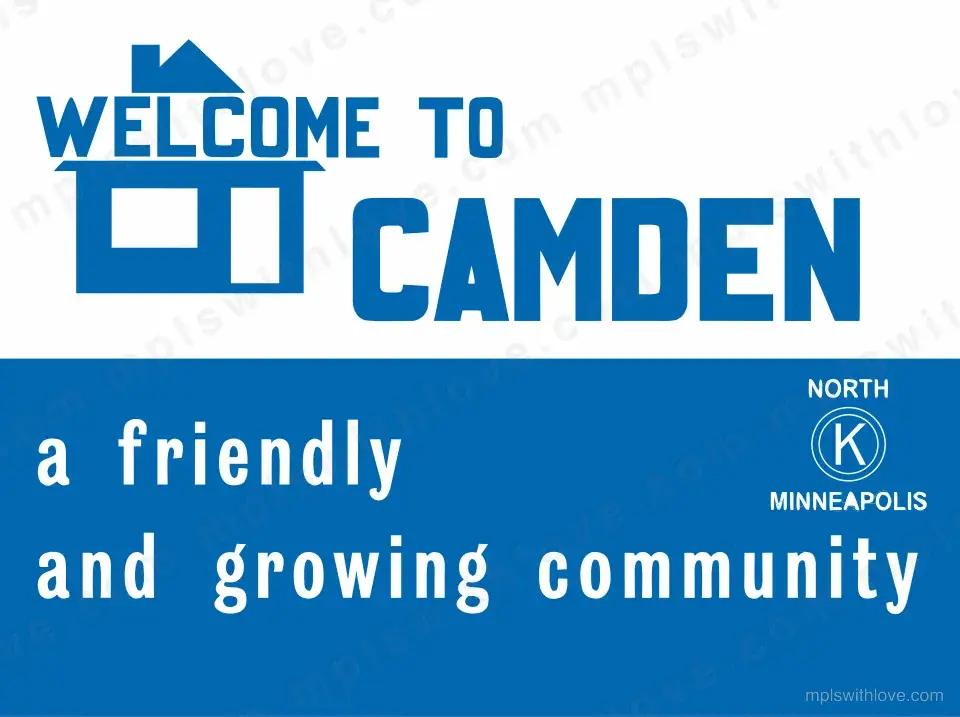
Webber-Camden Neighborhood Sign
Webber - Camden, Minneapolis — Key Stats (2025–2026)
- Residents (2020 Census)
- ~5,700
- Median home sale price (2025 data)
- $230K
- Webber Park natural swimming pool opened
- 2015
- Era most homes were built
- 1910s–1950s
- Webber Park, natural pool included
- 19.9 acres
- Drive to downtown Minneapolis
- 15–20 min
- Walk Score (Oct 2026)
- 64
- Bike Score (Oct 2026)
- 70
Webber-Camden History & Origins
The land that is now Webber-Camden is part of the ancestral homeland of the Dakota people — the Mdewakanton band in particular — for whom the Mississippi River and its surrounding landscapes held deep spiritual and practical significance. The dispossession of Dakota lands through treaties, war, and forced removal is the foundational history of this place, preceding and enabling everything that followed.
The area that would become Webber-Camden developed primarily in the 1910s and 1920s as the city expanded northward, filling in with small houses on standard lots. The name "Webber" comes from Webber Park, which the park board renamed in 1939 for Charles C. Webber, a grandson of John Deere who ran the company's Minneapolis branch, and his wife, Mary. The Webbers had paid for the park's first recreation building and pool, named for their son, John Deere Webber, who died at the age of nine.
Webber Park itself, first called Camden Park, was developed in the early 20th century as part of the Minneapolis park system's expansion into the north side. The park became the social center of the neighborhood — the place where kids swam in summer, played baseball in spring, and sledded in winter. The opening of the natural swimming pool in 2015, replacing the 1979 pool that had closed in 2010, was a watershed moment — proof that innovative public investment could happen on the North Side, not just in the wealthier parts of the city.
Through the mid-20th century, Webber-Camden was predominantly white. Racial covenants, redlining, and the broader patterns of racial segregation in Minneapolis restricted who could live where — Mapping Prejudice has found covenants in deeds here from the 1920s and 1930s — and the neighborhood changed after those legal barriers fell. Black families, Hmong families, and East African immigrants each added layers to the community's identity. The result is the diverse, multicultural neighborhood that exists today — built not by design but by the successive waves of people seeking affordable housing and a community that would accept them.
Living in Webber-Camden
Living in Webber-Camden means living in a neighborhood where the houses are small, the yards are big enough for a garden, and the neighbors know each other in the way that neighbors know each other when they've been sharing a block for years. The residential texture is unpretentious — bungalows with front porches, chain-link fences, detached garages, basketball hoops in driveways, and the occasional trampoline in a backyard. Some blocks are meticulously maintained; others show the wear of economic pressure and deferred upkeep. The mix is honest.
The diversity is everyday and unremarkable — which is the highest compliment a diverse neighborhood can receive. A Hmong family's garden overflows with herbs and vegetables you won't find at a suburban grocery store. A Black family is hosting a cookout in their backyard, smoke rising from a grill that has seen serious use. A Somali teenager is shooting hoops in a driveway. An older white couple is walking their dog past houses they've watched turn over two or three times. Nobody is performing diversity for an audience. It simply is what it is.
Webber Park is the neighborhood's center of gravity. The natural swimming pool draws families from across the North Side in summer, and the park's courts, playground, winter rink, and community programming provide year-round gathering points. The park is where the neighborhood comes together — for Fourth of July, for community events, for the simple daily act of being outside with your neighbors. The Mississippi River, a couple of blocks past the eastern edge, adds another dimension — wilder, quieter, and less manicured than the park but equally important as a place to walk, fish, and remind yourself that a city is built alongside something much older.
The commercial landscape is limited. There is no walkable main street, no collection of restaurants and shops within easy distance. Residents drive to Robbinsdale, to the commercial nodes on West Broadway, or to the suburban strip malls along Brookdale to do their shopping. This is the tradeoff of living in Webber-Camden: you gain affordability, space, parks, and river access, and you give up the walkable urban amenities that denser neighborhoods provide.
Webber-Camden Food, Drink & Local Spots
Webber-Camden's food options are limited and practical, reflecting a residential neighborhood where most meals happen at home. The commercial landscape is thin — there are no destination restaurants, no coffee shops with pour-over menus, no brunch spots with weekend lines. What exists serves the community's daily needs and reflects its diversity.
Local Options
The stretch of 44th Avenue North carries some of the neighborhood's commercial activity — small restaurants, convenience stores, and service businesses. Options rotate and are modest in scale, but they serve the immediate needs of the surrounding blocks.
Dowling Avenue, at the neighborhood's southern edge, has some additional commercial presence — takeout spots, small markets, and service businesses that cater to the neighborhood's diverse population.
Nearby Options
For more variety, Webber-Camden residents look outward. Robbinsdale's small downtown — a five-minute drive west — has restaurants, bars, and shops. West Broadway in Near North has been seeing new food businesses. Crystal and Brooklyn Center to the west and north offer suburban commercial options. The honest reality is that Webber-Camden is a neighborhood where you cook at home, order delivery, or drive to eat out — a pattern that is normal for residential neighborhoods at the city's edges but frustrating for residents who see the investment gap between their neighborhood and the rest of Minneapolis.
Parks & Outdoors Near Webber-Camden
Webber-Camden's outdoor amenities are genuinely excellent — arguably the strongest feature of the neighborhood and a set of assets that would command premium home prices if they were located anywhere in South or Southwest Minneapolis. The natural swimming pool, the riverfront, and the connected park system give residents access to outdoor experiences that most of the city envies.
Webber Park & Natural Swimming Pool
Webber Park is the neighborhood's centerpiece — a community park with a recreation center, a playground, basketball and tennis courts, a winter ice rink, and the crown jewel: the Webber Park Natural Swimming Pool, opened in 2015 as the first public natural swimming pool in North America. The pool uses a regeneration basin filled with aquatic plants to naturally filter and clean the water, eliminating the need for chlorine or other chemicals. The result is a swimming experience that feels different — softer water, no chemical smell, and the knowledge that the system cleaning your pool is a functioning wetland ecosystem. The pool is free, open to all, and operated by the Minneapolis Park and Recreation Board. On hot summer days, it draws families from across the North Side and beyond.
North Mississippi Regional Park
The Mississippi River runs just east of Webber-Camden's boundary, and North Mississippi Regional Park, across Lyndale Avenue and I-94 from Webber Park, provides structured access to the riverfront. The park includes trails for walking and biking, picnic areas, fishing spots, and views of the river that feel more like rural Minnesota than urban Minneapolis. The river trail connects north to the Coon Rapids Dam Regional Park — one of the best stretches of riverside trail in the metro — and south through the city toward downtown and the Mill District. The riverfront here is wilder and less developed than the manicured parkways of South Minneapolis, which is part of its appeal.
Connected Trail System
Victory Memorial Drive connects Webber Park to Theodore Wirth Park to the south and west, creating a continuous trail corridor that links Webber-Camden to the Grand Rounds scenic byway system. Combined with the river trail to the east, this gives the neighborhood connectivity to a regional trail network that is one of the best in any American city. A resident can walk or bike from Webber Park to the Chain of Lakes, to Minnehaha Falls, or to downtown without ever touching a road. The infrastructure is there — what's missing is the recognition.
Webber-Camden Schools
Webber-Camden is served by Minneapolis Public Schools, and the school landscape here carries the same challenges and commitments that characterize education across North Minneapolis. School quality is a primary concern for families, and many actively navigate the district's open enrollment system.
Nearby MPS schools include Jenny Lind Elementary in Lind-Bohanon and Loring Elementary in Victory, both pre-K–5; Olson Middle School, for grades 6–8; and Camden High School, the former Patrick Henry High, renamed in 2024, which sits inside the neighborhood at 4320 Newton Avenue North. In September 2026 the district proposed closing Loring in all three of its school-transformation options; the school board is expected to vote Nov. 10. MPS assigns schools by address, so check the district's school finder for a specific house. Charter schools provide additional options, and some families access magnet and specialty programs across the district through open enrollment.
The schools here need investment — in staffing, facilities, programming, and the wrap-around services that students in high-poverty communities require. Dedicated teachers and administrators are doing important work, but they are doing it with fewer resources than their counterparts in wealthier parts of the city. Families who move to Webber-Camden for the affordability should plan to be engaged, informed, and proactive about their children's education — the options are there, but they require research and advocacy to navigate.
Webber-Camden Real Estate & Housing
Webber-Camden is one of the most affordable neighborhoods in Minneapolis for single-family homeownership. The median sale price was $229,900 in 2025, up from $212,000 a year earlier, according to Minneapolis Area REALTORS — well below the citywide median of $350,000 and a fraction of what comparable homes cost in South or Southwest Minneapolis. For first-time buyers, families on working-class incomes, and anyone who has been priced out of the city's more expensive neighborhoods, Webber-Camden offers a genuine entry point.
The housing stock is primarily bungalows and small frame houses from the 1910s through 1950s — sturdy, simple homes on standard lots with detached garages and front porches. Below the median, you're looking at homes that need updating — original systems, dated finishes, deferred maintenance; above it, well-maintained three-bedroom homes with updates. Minneapolis Area REALTORS counted 53 sales in 2025, none of them condos, and homes took 58 days on market on average, close to the city's 55.
Investor activity has been present — affordable homes attract buyers looking for rental income, which can be a mixed blessing for the neighborhood. Owner-occupancy is high: roughly three in four households own their homes, according to Census estimates, against fewer than half citywide, and the homeownership culture in Camden is an important stabilizing force. Census estimates put the median rent at about $1,350, near the city's $1,371, though the margin of error for a neighborhood this size is wide.
Getting Around Webber-Camden
Webber-Camden is car-oriented by Minneapolis standards, with a Walk Score of 64 and a Bike Score of 70. The limited commercial options within the neighborhood mean that most errands require a car, and commuting to downtown or other employment centers is most practical by car or bus.
Metro Transit bus routes serve the area along main corridors, connecting to downtown Minneapolis with a ride time of approximately 30–40 minutes. Service frequency is typical of outer-ring neighborhoods — adequate for commuting but not convenient enough for car-free living.
The trail system provides good recreational cycling connectivity. Victory Memorial Drive connects to Theodore Wirth Parkway, which connects to the Cedar Lake Trail into downtown — a scenic bike commute of about 8 miles. The river trail provides an alternative route south into the city. Some residents do bike-commute, particularly in warmer months, but year-round car-free living would require more transit access than currently exists.
By car, downtown Minneapolis is 15–20 minutes. Robbinsdale is 5 minutes west. Brooklyn Center and Crystal are 10 minutes north and west. MSP Airport is approximately 25 minutes. Street parking is never an issue.
What's Changing: The Honest Version
Webber-Camden's tensions are fundamentally about equity — the gap between what this neighborhood has and what it deserves, and the question of whether closing that gap will benefit the people who are already here or the people who arrive after the improvements are made.
Investment Gap
The natural swimming pool was a landmark investment — proof that the city could direct innovative public resources to the North Side. But one pool does not fix decades of disinvestment in commercial corridors, infrastructure, and public spaces. Webber-Camden residents see the gap between their neighborhood and South Minneapolis every day — in the condition of the streets, the availability of grocery stores and restaurants, the quality of sidewalks and lighting. The pool was a start. The question is whether the investment continues.
Crime and Safety
Crime remains a concern, particularly property crime and the occasional violent incident that generates outsized attention and reinforces negative narratives about the North Side. The post-2020 period was difficult — crime rose, police response times increased, and community trust in public safety institutions eroded. By 2025–2026, the situation had stabilized but not fully recovered. Residents navigate this reality with a mix of vigilance, community organizing, and frustration at a city that seems to accept higher crime rates in North Minneapolis as normal.
Affordability and Change
Home prices here have barely moved — the median was $220,000 in 2021 and $229,900 in 2025, according to Minneapolis Area REALTORS — but the prospect of rising prices raises questions about who future investment will serve. If improvements to commercial corridors, schools, and public spaces drive prices up, will the families who stayed through the lean years be able to stay through the good ones? Or will the familiar pattern repeat — underinvestment followed by gentrification that displaces the community? Webber-Camden is early enough in this cycle that the outcome is not yet determined, and residents are working to ensure that investment benefits the existing community rather than replacing it.
Webber-Camden FAQ
Is Webber-Camden a good neighborhood in Minneapolis?
Webber-Camden is a solid residential neighborhood in Camden, the northernmost section of North Minneapolis. It offers affordable housing, Webber Park with its unique natural swimming pool, Mississippi River access, and a diverse, family-oriented community. The neighborhood faces challenges common to North Minneapolis — crime rates above the citywide average, limited commercial options, and legacies of disinvestment — but it also has strong community identity, engaged residents, and outdoor amenities that rival neighborhoods costing twice as much. For families seeking affordable homeownership with real neighborhood character, Webber-Camden deserves a serious look.
What is the Webber Park natural swimming pool?
The Webber Park natural swimming pool, opened in 2015, was the first public natural swimming pool in North America. Instead of chlorine, the pool uses a natural filtration system — water flows through a regeneration basin filled with aquatic plants that filter and clean the water biologically. The pool has upper and lower swimming areas — a shallow pool with zero-depth entry, an open swim area, lap lanes, and a jumping platform — beside the regeneration basin that doubles as a landscape feature. The pool is operated by the Minneapolis Park and Recreation Board and is free to use, making it one of the most significant public amenities on the North Side.
Is Webber-Camden, Minneapolis safe?
Webber-Camden's safety profile is mixed, consistent with broader North Minneapolis patterns. The residential blocks are generally quiet, and many residents feel safe on their streets during the day. Property crime — car break-ins, theft, catalytic converter theft — is the most common concern. Violent crime rates are higher than the citywide average but lower than in some North Side neighborhoods closer to downtown. Crime rose across the area during 2020–2022 and has since declined, though some categories remain elevated. Community policing efforts and neighborhood watch programs are active.
How much do homes cost in Webber-Camden, Minneapolis?
Webber-Camden's median sale price was $229,900 in 2025, up from $212,000 a year earlier, according to Minneapolis Area REALTORS — well below the citywide median of $350,000. The neighborhood remains one of the most affordable in Minneapolis for buyers seeking single-family homes. The gap between Webber-Camden prices and citywide medians reflects both the challenges of the North Side and the opportunity for buyers willing to invest in a community with real strengths.
Where exactly is Webber-Camden in Minneapolis?
Webber-Camden is in the Camden community in far north Minneapolis. It is roughly bounded by the rail line to the north, Washington Avenue North to the east, Dowling Avenue North to the south, and Newton and Penn Avenues North to the west. It sits east of the Victory neighborhood, north of the Folwell and McKinley neighborhoods, south of Lind-Bohanon across the tracks, and west of Camden Industrial, which runs between Washington Avenue and the Mississippi River.
What schools serve Webber-Camden?
Webber-Camden is served by Minneapolis Public Schools. Nearby MPS schools include Jenny Lind and Loring elementaries (both pre-K–5), Olson Middle School (grades 6–8), and Camden High School, the former Patrick Henry High, which sits inside the neighborhood on Newton Avenue North. In September 2026 the district proposed closing Loring; the school board is expected to vote Nov. 10. Assignments depend on address, so check the MPS school finder for a specific house. Charter school options and the district's open enrollment system provide additional choices. School outcomes vary, and many families actively research and navigate the enrollment system to find the best fit.
Is Webber-Camden on the Mississippi River?
Nearly — Webber-Camden's eastern boundary is Washington Avenue North, a couple of blocks short of the Mississippi River, and North Mississippi Regional Park and the river trail system sit just across Lyndale Avenue and I-94 from Webber Park. The riverfront here is less developed than in downtown or South Minneapolis — more natural, more wooded, and less crowded. The river trail connects north to the Coon Rapids Dam and south through the city toward downtown and beyond. For a neighborhood at this price point, the river access is a significant and underappreciated asset.
What is Camden in Minneapolis?
Camden is a community district in far north Minneapolis that includes nine neighborhoods: Webber-Camden, Victory, Cleveland, Folwell, McKinley, Lind-Bohanon, Shingle Creek, Humboldt Industrial Area, and Camden Industrial. Camden is generally considered the most residential and stable part of the North Side, with higher homeownership rates and lower crime rates than neighborhoods closer to downtown. The Camden community has its own identity — distinct from the Near North and Hawthorne neighborhoods that dominate media coverage of 'North Minneapolis' — and residents often identify as being from Camden rather than from the broader North Side.
What Makes Webber-Camden Worth Knowing
Webber-Camden is the kind of neighborhood that rarely makes anyone's must-visit list, and that is both its challenge and its charm. There are no trendy restaurants here, no craft cocktail bars, no new-construction condos with rooftop decks. What there is — and what matters more than any of those things — is a community of families who own homes they can afford, a park with the first public natural swimming pool in North America, a stretch of Mississippi River just past I-94 that most of the city has never seen, and the kind of neighbor-to-neighbor relationships that hold a place together when institutions fail.
The challenges are serious and persistent — crime, disinvestment, school quality, commercial vacancy, and the psychic weight of living in a part of the city that much of Minneapolis has decided to write off. But Webber-Camden has not written itself off. The residents who stay, who maintain their homes, who show up at park board meetings and school events, who swim in that improbable natural pool on summer afternoons — they are betting on a neighborhood that has more going for it than the headlines suggest. That bet deserves more takers.

Keep exploring