Minneapolis Neighborhood
Fulton
A quietly beloved corner of Southwest Minneapolis — where century-old bungalows meet Lake Harriet, summer concerts are still free, and the argument between old and new plays out one teardown at a time.
№ 28 of 87 · Southwest community · Last updated: October 2026 · A complete neighborhood guide
On a Tuesday evening in July, the path around Lake Harriet fills up the way only a Minneapolis summer path can — joggers weaving past dog walkers weaving past families with strollers weaving past couples on cruiser bikes going nowhere in particular. Someone has a Caribou Coffee. Someone else has a wine in a Yeti. The Bandshell, barely visible through the trees, is throwing out big band music that bounces off the water and drifts across the whole northeast corner of the neighborhood. A hundred yards away, a kid is chasing ducks. Nobody is on their phone. This is Fulton on a summer Tuesday. The rest of the year, it's quieter — but it's always like this, underneath.

What is Fulton, Minneapolis?
Fulton is a residential neighborhood in Southwest Minneapolis, bounded by West 47th Street to the north, Penn Avenue South to the east, West 54th Street to the south, and France Avenue South to the west. Lake Harriet anchors its northeastern corner and Minnehaha Creek runs through it, making Fulton one of the most naturally endowed neighborhoods in the Twin Cities — home to about 6,500 residents at the 2020 Census.
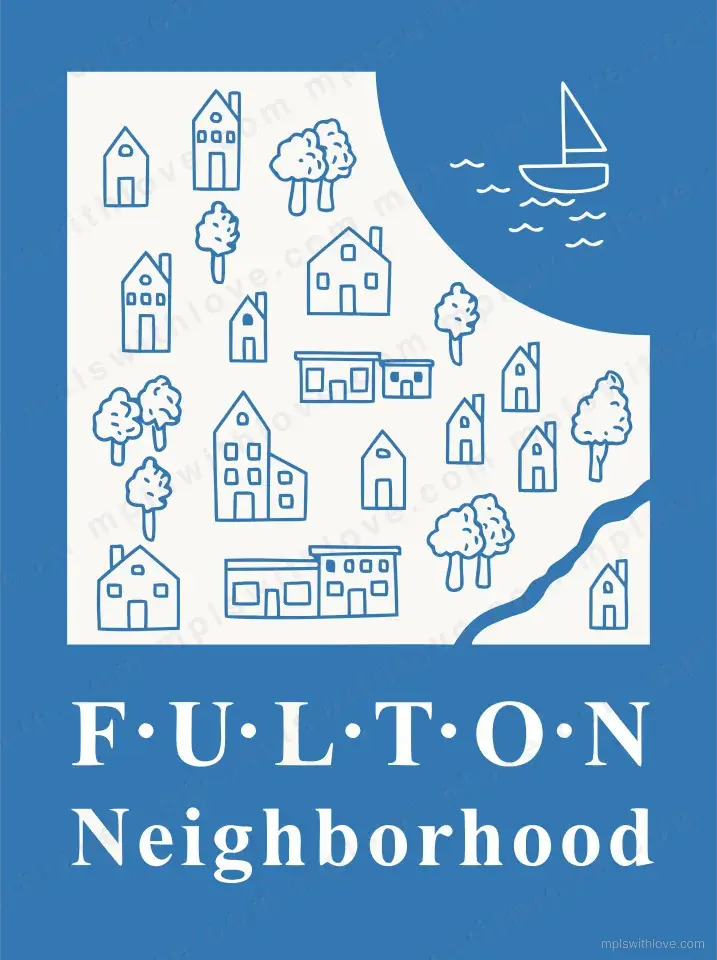
Fulton Neighborhood Sign
Fulton, Minneapolis — Key Stats (2025–2026)
- Residents (2020 Census)
- ~6,500
- Median home sale price (2025 data)
- $675K
- Days on market (2025 data)
- 41 days
- Loop trail around Lake Harriet
- 3 miles
- Era most homes were built
- 1920s–30s
- Drive to downtown or MSP airport
- 15–20 min
- Walk Score (Oct 2026)
- 72
- Bike Score (Oct 2026)
- 64
Fulton History & Origins
Named after Robert Fulton, the engineer credited with developing the steamboat in the early 1800s, the neighborhood took shape primarily in the 1920s and 1930s, leaving it with a stock of Craftsman bungalows, Tudor cottages, and American Foursquares that still define the streetscape. West 50th Street bisects the neighborhood east to west, connecting three small commercial nodes — at France, Xerxes, and Penn Avenues — that give Fulton its walkable, small-town-in-the-city personality.
Before Fulton was a Minneapolis neighborhood, it was something else entirely. The land sits within the homeland of the Dakota people, a short distance from Bdote — the confluence of the Mississippi and Minnesota Rivers, which many Dakota people consider a sacred place of creation. At Bde Maka Ska (long called Lake Calhoun), about a mile north of what is now Fulton, a Dakota farming village led by a chief named Cloud Man thrived from 1829 until 1839, when the band moved to the Minnesota River to avoid conflict with the Ojibwe. The ground underfoot here has a long memory.
European and American settlement arrived with the 1850s and accelerated after the Civil War, as Minneapolis grew rapidly outward from the Mississippi. In the 1880s, the Minneapolis Street Railway Company extended its tracks to Lake Harriet, and the lake itself became a major recreational destination — in 1888 the company built a pavilion and offered concerts to drive ridership, a tradition of music at the lake that persists to this day in the free Minneapolis Pops Orchestra concerts at the Bandshell.
The neighborhood as we know it was built out primarily in the interwar period, the 1920s and 1930s, when middle-class Minneapolis families favored the solid, modest architecture of the Craftsman bungalow, the Tudor cottage, and the American Foursquare. These weren't grand mansions — they were homes for working- and middle-class families. Their modest scale and excellent bones are a large part of what makes the neighborhood feel cohesive a century later. Pershing Field Park, the neighborhood's main park, was dedicated on Armistice Day in 1931, named for General John "Blackjack" Pershing, commander of American forces in World War I — a reminder of how much the wars shaped civic memory in these years.
For most of the 20th century, Fulton remained quietly prosperous and relatively stable — a steady, tree-shaded corner of Southwest Minneapolis that never went through the cycles of disinvestment and revival that marked neighborhoods closer to downtown. That stability is part of what makes Fulton so desirable today. It's also part of what now drives up its price.
Living in Fulton
Walk almost any residential block in Fulton in the spring and you'll see the same thing: deep front porches, mature elms and oaks overhanging the sidewalk, a kid's bike left out front. The sidewalks are wide. People say hello. Block clubs are not a formality here — they're how people actually know their neighbors. The Fulton Neighborhood Association has organized networking events, happy hours at the local pub, and a Saturday farmers market, May through October, that ran at Chowen Avenue until it moved east into Lynnhurst in 2025. It's the kind of neighborhood where someone will come over to welcome you on open house day, not to spy, but because that's just what people here do.
The commercial strips on 50th Street are deliberately modest in scale — neighborhood-sized, not destination-sized. At 50th and France you get slightly closer to destination territory, since that corner is shared with Edina and draws shoppers from across the metro. But at 50th and Xerxes, or 50th and Penn, the scale stays human: a coffee shop, a bakery, an antique store, a wine bar. Fulton doesn't try to be Uptown. It doesn't need to be.
The neighborhood skews toward families and long-term owners. Niche rates it as one of the best places to live in Minnesota, and residents describe block parties, Southwest High School choir concerts, and walking the lake as their defining neighborhood rituals. There's a particular kind of Minneapolis pride here — deeply civic, environmentally conscious, genuinely community-oriented — that feels less performed than in trendier parts of the city. Neighboring Linden Hills and Lynnhurst share much of this character, forming a cluster of Southwest neighborhoods with an unusually strong sense of place.
Fulton Food, Drink & Local Spots
Fulton's food scene is rooted and reliable rather than trendy and volatile. Most of the institutions here have been around long enough to be considered neighborhood fixtures — places that have earned loyalty over years, not just hype cycles.
The Institutions
2308 W. 50th Street. The Broders family has been making pasta in Fulton since 1982, after founders Molly and Tom traveled to Bologna to study Italian cooking seriously. The deli imports goods directly from Italy; the pasta bar cooks everything to order. One of the most beloved independent restaurants in the entire Twin Cities.
At the Lake Harriet Bandshell, on the lake's north shore in Linden Hills. A seasonal lakeside concession that elevates the genre — real food, local ingredients, and lake views. The wait can be long on summer weekends, but the setting is worth it. A Fulton warm-weather ritual.
3624 W. 50th Street. A neighborhood tavern elevated — gourmet burgers, a deep craft beer list, and fine wine. The corner spot at 50th and Drew has become a genuine anchor of the strip, lively at lunch and buzzing on weekend evenings.
4944 Xerxes Ave. S. Technically not food, but no local list is complete without it. A visually chaotic, deeply wonderful antique and vintage shop that looks like an explosion in the best possible way.
5025 Knox Ave. S., five blocks east of Penn in Lynnhurst. Every Saturday, May through October, 8:30 a.m. to 1:00 p.m. This is the old Fulton Farmers Market, renamed and moved off Chowen Avenue in 2025, and it's still as much a neighborhood gathering as it is a market. Local produce, baked goods, flowers, and conversation.
Also Worth Knowing
Lunds & Byerlys at 50th and France, just across France Avenue in Edina, is the neighborhood's primary grocery store — well-stocked, upscale, and convenient. Saturday Dumpling (just across 54th Street at Penn, in Armatage) and Mothership Pizza Paradise are among the newer additions drawing strong attention as of early 2026. Gallery 360 on W. 50th is a long-running community art gallery that supports local artists and sells handmade goods.
Parks & Lakes Near Fulton
This is, in many ways, the real reason people live in Fulton. The neighborhood's outdoor offerings are exceptional by any standard, and for a city neighborhood they're almost absurdly good.
Lake Harriet
Lake Harriet sits at Fulton's northeastern corner and is one of the jewels of the Minneapolis Chain of Lakes Regional Park — a string of interconnected lakes linked by parkways, trails, and greenways that give Minneapolis its reputation as one of America's most park-rich cities. The 3-mile paved loop around Lake Harriet accommodates walkers, runners, cyclists, and rollerbladers through all but the coldest months. In summer, kayak and canoe rentals launch from the north shore. There are two beaches for swimming, fishing piers, gardens, and tennis courts at Beard's Plaisance.
The Lake Harriet Bandshell
Since the 1880s — first at an entertainment pavilion built by the street railway company, now at a public venue — concerts have been performed at the lake. The current Bandshell hosts the Minneapolis Music and Movies in the Parks series, which is free and runs through the summer months. The Minneapolis Pops Orchestra, which has given free summer concerts since 1950, plays regularly. In 2014, President Barack Obama gave a public address here to a crowd of thousands. On any given August weekend, the lawn in front of the Bandshell will be covered in blankets and folding chairs. People bring wine.
Minnehaha Creek
The creek enters the neighborhood from Edina across 54th Street, runs east along its southern edge, and cuts diagonally across the southeast corner into Lynnhurst, continuing east toward Minnehaha Falls and the Mississippi River. Farther east, the paved trail alongside it connects to the Grand Rounds Scenic Byway, Minneapolis's 51-mile network of parkways and bike paths. In summer, kids float the shallower stretches on inner tubes.
Pershing Field Park
The neighborhood's dedicated park occupies 8.5 acres in Fulton's northwest corner, a block south of Southwest High School. It includes baseball and softball fields, a basketball court, a soccer field, tennis courts, a wading pool, walking paths, and the Pershing Recreation Center. It was dedicated on Armistice Day, November 11, 1931, and named for General Pershing.
Fulton Schools
Schools are a major draw for families considering Fulton, and the nearby public schools are genuinely strong by Minneapolis standards.
Lake Harriet Community School runs two elementary campuses: the Lower Campus, for kindergarten through second grade, on Chowen Avenue, and the Upper Campus, for grades three through five, on Vincent Avenue inside Fulton. Anthony Middle School is the nearby middle school. Southwest High School is a well-regarded International Baccalaureate World School that also offers career and technical education programs, and it is known particularly for its performing arts program. Assignments depend on the address, so check the Minneapolis Public Schools boundary map for a specific block.
Private and early childhood options in and around Fulton include Southwest Montessori School (4–6 year olds) and Casa de Corazon on France Avenue. Families also have access to Minneapolis's broader magnet school system for alternative pathways.
Fulton Real Estate & Housing
Fulton is not an affordable neighborhood by Minneapolis standards — and the gap between Fulton and city-wide medians is significant. Fulton's median sale price was $675,000 in 2025, up from $599,000 in 2024 and $561,000 in 2021, according to Minneapolis Area REALTORS. The citywide median, by contrast, was $350,000. Fulton trades at a steep premium, and that premium has been growing.
Homes here sell a little faster than in the city as a whole: 41 days on market on average in 2025, against 55 citywide. Sellers received, on average, about 99 percent of their original asking price.
What Your Money Buys
Below the median, you're looking at smaller Cape Cods or bungalows in need of updating. Around the median gets you a well-maintained three- or four-bedroom Craftsman or Tudor. Well above it are larger homes on bigger lots, renovated historic properties, or newer construction. Anything near the lake commands a significant additional premium.
The dominant home styles remain those built in the 1920s and 1930s: Craftsman bungalows, Tudor cottages, and American Foursquares. Most are owner-occupied.
Getting Around Fulton
Fulton is walkable within the neighborhood — the commercial nodes on 50th Street are reachable on foot from most addresses, and the lake and creek paths encourage human-powered movement. Fulton earns a Walk Score of 72 and a Bike Score of 64, reflecting decent infrastructure for cycling and everyday errands on foot.
For getting beyond Fulton, the car is still dominant. Downtown Minneapolis is 15–20 minutes by car; MSP International Airport is similarly 15–20 minutes via Highway 62. Bus routes along France Avenue and 50th Street connect to Uptown, downtown, and the Blue Line, though most residents drive for their commute. Parking is ample on residential streets and generally straightforward at the commercial nodes.
What's Changing: The Honest Version
Fulton is not a neighborhood in crisis, but it is a neighborhood in conversation with itself — and some of those conversations are uncomfortable.
The Teardown Problem
The same forces that drive prices up are eating the neighborhood's physical character. As land values rise, older bungalows and cottages on large lots become attractive targets for demolition and replacement with larger, more contemporary homes. Long-term residents have watched the Craftsman and Tudor streetscape they bought into slowly punctuated by large, boxy new construction — homes that maximize square footage at the expense of the scale and proportion that made the neighborhood appealing in the first place. This is a tension with no clean resolution — it's the market working exactly as intended, in a neighborhood where the market is working very well.
Affordability and Access
Fulton's desirability comes with a price that makes it inaccessible to a large portion of Minneapolis residents. The demographics of the neighborhood are not representative of Minneapolis as a whole — it is largely white, largely wealthy, and largely homeowning. This isn't a secret, and it raises real questions about who gets to live near the lake and benefit from the park system.
Property Crime
Fulton's reputation for safety is generally well-earned, but residents note a rise in property crime — particularly vehicle break-ins, window smashing, and package theft. These are patterns seen across many desirable Minneapolis neighborhoods, not unique to Fulton, but they're real. It's worth being clear-eyed about: Fulton is safe in the ways that matter most, but it's not insulated from the property crime that affects much of Minneapolis.
The Justine Damond Case
In 2017, Fulton was the site of a high-profile police shooting that drew international attention. Justine Damond, a 40-year-old Australian woman, was shot and killed by Minneapolis police officer Mohamed Noor after she called 911 to report a possible assault near her home. The case sparked broad debate about police accountability, use of force, and the way police respond differently in different communities. Noor was convicted of third-degree murder and second-degree manslaughter in 2019; the Minnesota Supreme Court overturned the murder conviction in 2021, and he was resentenced to nearly five years on the manslaughter count. The case is part of Fulton's recent history and part of a larger Minneapolis reckoning with policing that intensified after 2020.
Fulton FAQ
Is Fulton a good neighborhood in Minneapolis?
Yes — it consistently ranks as one of the most desirable neighborhoods in Minneapolis and in Minnesota overall. Its combination of walkable commercial strips, exceptional park access (Lake Harriet and Minnehaha Creek), strong public schools, and genuine community cohesion makes it appealing to families, professionals, and long-term residents alike.
Is Fulton, Minneapolis safe?
Fulton is considered one of the safer neighborhoods in Minneapolis. Violent crime is rare. Property crime — vehicle break-ins, package theft — has increased in recent years, as it has across much of the city. Overall, families with children are comfortable here and the neighborhood has a strong, watchful community culture.
What is Fulton, Minneapolis known for?
Fulton is best known for its proximity to Lake Harriet and the Lake Harriet Bandshell's free summer concerts, its well-preserved 1920s–30s architectural character, the 50th & France shopping and dining district it shares with Edina, and its strong school system.
How much do homes cost in Fulton, Minneapolis?
Fulton's median sale price was $675,000 in 2025, up from $599,000 in 2024, according to Minneapolis Area REALTORS — nearly twice the citywide median of $350,000. Smaller Cape Cods that need work sell below the median; larger renovated homes and anything near the lake sell well above it.
Is Fulton walkable?
Yes, within the neighborhood. The three commercial nodes on West 50th Street — at France, Xerxes, and Penn — are walkable from most Fulton addresses. Lake Harriet and Minnehaha Creek are accessible on foot or bike. For commuting beyond the neighborhood, most residents rely on cars. Fulton has a Walk Score of 72 and a Bike Score of 64.
What schools serve Fulton, Minneapolis?
Nearby Minneapolis Public Schools include Lake Harriet Community School, whose Upper Campus (grades 3–5) is inside Fulton on Vincent Avenue and whose Lower Campus (K–2) is on Chowen Avenue; Anthony Middle School; and Southwest High School — an International Baccalaureate World School with strong academic and arts programs. Assignments depend on the address, so check the MPS school boundary map for a specific block.
What are the best restaurants in Fulton, Minneapolis?
The most beloved local institutions include Broders' Pasta Bar and Cucina Italiana (fresh pasta since 1982), Red Cow (gourmet burgers and craft beer), and Bread & Pickle at the Lake Harriet Bandshell, on the north shore in Linden Hills.
Where exactly is Fulton in Minneapolis?
Fulton is in Southwest Minneapolis, bounded by West 47th Street (north), Penn Avenue South (east), West 54th Street (south), and France Avenue South (west). It borders Linden Hills to the north, Lynnhurst to the east, Armatage to the south, and the suburb of Edina to the west.
Is Fulton a good place to raise a family?
Fulton is widely considered one of the best family neighborhoods in Minneapolis. The nearby public schools, from Lake Harriet Elementary to Southwest High School, are well regarded. The neighborhood is safe, walkable, and rich with parks, trails, and outdoor activities. Block parties and the weekly farmers market foster a genuine sense of community.
Where is 50th and France?
50th and France is a popular shopping and dining district at the intersection of West 50th Street and France Avenue South, straddling the border of Fulton (Minneapolis) and Edina. It features boutiques, restaurants, Lunds & Byerlys grocery, and a mix of local and regional shops.
How far is Fulton from downtown Minneapolis?
Fulton is approximately 15–20 minutes from downtown Minneapolis by car, depending on traffic. Bus routes along France Avenue and 50th Street connect to Uptown, downtown, and the Blue Line. MSP International Airport is also roughly 15–20 minutes away via Highway 62.
What Makes Fulton Irreplaceable
There are neighborhoods in Minneapolis with more energy, more edge, more diversity, more nightlife, more novelty. Fulton isn't competing with those places. What it offers is something harder to manufacture: the feeling that a neighborhood has been loved consistently, by many people, over a long time, and that the love has accumulated into something physical — in the quality of the trees, the care of the houses, the persistence of the farmers market, the fact that people still pack the Bandshell lawn on a Tuesday night for a free concert, more than a century after the street railway company began offering concerts at the lake.
Fulton isn't perfect, and it's honest enough not to pretend it is. But for the people who live here — the ones who shovel their neighbor's walk without being asked, who know the barista at the coffee shop, who can hear the Pops Orchestra from their backyard — it's close enough to perfect that the distinction doesn't often come up.

Keep exploring