Nokomis
Signature Park
Lake Nokomis & Nokomis Beach
Park Acres
80+
Lake Access
Yes — swimming beach
Playgrounds
3
Highlights: Lake Nokomis swimming beach, Nokomis Parkway trails, volleyball courts, fishing pier, picnic pavilion, winter ice skating
Lake Nokomis is the most swimmable lake in the Minneapolis park system — the beach is sandy, well-maintained, and genuinely pleasant, not just a patch of grass near water. The 2.7-mile loop around the lake is flat and paved, perfect for jogging, biking, or pushing a stroller. In winter, the city maintains an ice skating rink on the lake. Volleyball courts near the beach fill up on summer weekends. The surrounding parkland connects north to Minnehaha Creek and Lake Hiawatha, creating a continuous green corridor. What keeps Nokomis at the top: the lake is big enough to feel like an escape but small enough that you recognize the other regulars. It functions as a genuine community gathering place, not just a recreational amenity.
Read the full Nokomis guide →Hiawatha
Signature Park
Minnehaha Falls & Regional Park
Park Acres
193
Lake Access
No — river access
Playgrounds
4
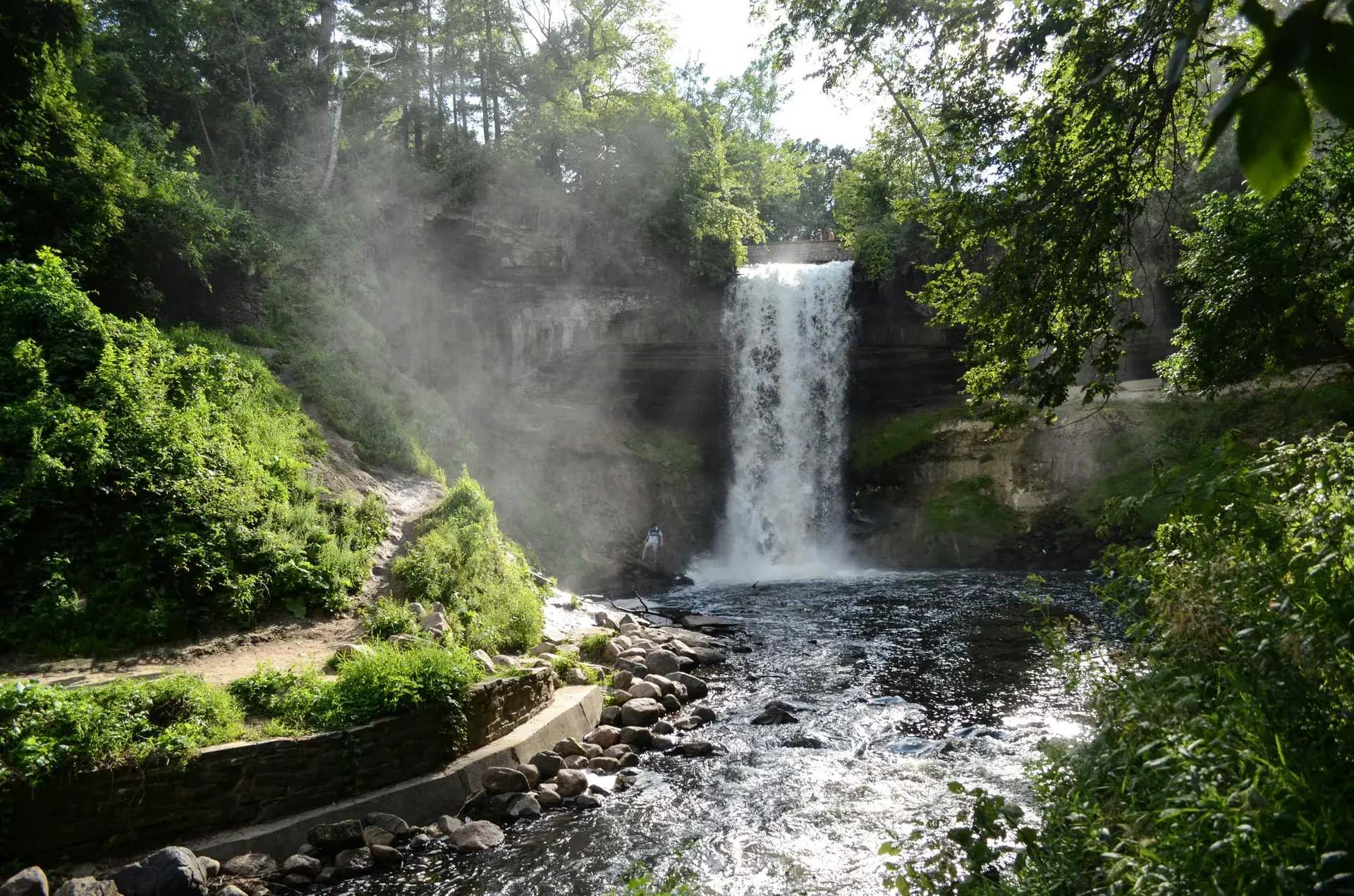
Highlights: Minnehaha Falls (53-ft waterfall), limestone bluffs, wading pool, Sea Salt Eatery, off-leash dog park, bike trails to Fort Snelling
Minnehaha Falls is the single most spectacular natural feature in the Minneapolis park system — a 53-foot waterfall inside city limits that draws 850,000 visitors annually. But the park is far more than the falls. The 193-acre regional park extends south along the Mississippi River gorge with limestone bluffs, wooded trails, and a bike path that connects to Fort Snelling State Park. Sea Salt Eatery, the seasonal fish restaurant in the park, has some of the best outdoor dining in the city. The off-leash dog park near the river is spacious and well-used. The wading pool near the main pavilion is a summer staple for families. The honest note: on peak summer weekends, the falls area is genuinely crowded — parking fills early, and the viewing platforms can feel packed. Visit on a Tuesday evening and it is a completely different experience.
Read the full Hiawatha guide →Linden Hills
Signature Park
Lake Harriet & Bandshell
Park Acres
100+
Lake Access
Yes — beach and boat launch
Playgrounds
3
Highlights: Lake Harriet Bandshell (free summer concerts), rose garden, bird sanctuary, sailing, canoe/kayak rental, North Beach, Como-Harriet Streetcar Line
Lake Harriet is arguably the most beautiful lake in the Minneapolis chain. The bandshell hosts free concerts nearly every summer evening — bring a blanket, grab food from Bread & Pickle, and sit on the hillside while the sun sets over the water. It is one of the best free experiences in the city. The rose garden near the north end of the lake, across the line in East Harriet, is small but meticulously maintained. The bird sanctuary on the north side, also in East Harriet, provides surprisingly wild-feeling trails just blocks from million-dollar homes. You can rent canoes, kayaks, and paddleboards at the refectory. The historic Como-Harriet Streetcar Line runs a vintage trolley on summer weekends. What makes Lake Harriet special is the combination of beauty and programming — it feels cared-for in a way that goes beyond mowing the grass.
Read the full Linden Hills guide →Lynnhurst
Signature Park
Lynnhurst Park & Lake Harriet access
Park Acres
60+
Lake Access
Yes — via Lake Harriet
Playgrounds
2
Highlights: Lynnhurst Park (baseball fields, tennis courts, wading pool, rec center), Lake Harriet southern shore access, neighborhood ball fields
Lynnhurst's park story is two-part: Lynnhurst Park as the neighborhood anchor and Lake Harriet as the headliner a few blocks northwest. Lynnhurst Park is the kind of neighborhood park that actually works — the rec center runs youth programs year-round, the baseball fields are busy every summer evening, the wading pool fills with families on hot afternoons, and the tennis courts are well-maintained. It is a social hub, not just green space. Lake Harriet's southern shoreline, at Lynnhurst's northwest corner, adds lake access that most neighborhoods would kill for. The honest assessment: Lynnhurst does not have the dramatic scenery of Minnehaha or the lake-wrapping parkland of Nokomis. What it has is consistent, well-maintained, family-oriented park space that functions as an extension of your backyard.
Read the full Lynnhurst guide →Bryn Mawr
Signature Park
Theodore Wirth Regional Park
Park Acres
759
Lake Access
Yes — Wirth Lake beach
Playgrounds
2
Highlights: Theodore Wirth Park (largest park in the Minneapolis system), Wirth Lake beach, mountain bike trails, cross-country skiing, disc golf, wildflower garden, Eloise Butler Wildflower Garden
Theodore Wirth Park is 759 acres — the largest park in the Minneapolis system and one of the largest urban parks in the country. Bryn Mawr sits at its southeastern edge, which means residents have what amounts to a national park-scale green space as their backyard. The Eloise Butler Wildflower Garden, tucked inside Wirth, is a 15-acre native plant sanctuary that has operated continuously since 1907. The mountain bike trails are legitimate single-track, not paved paths pretending to be trails. In winter, the cross-country ski trails are some of the best in the metro. Wirth Lake has a small but genuine swimming beach. The Trailhead building, completed in 2018, added a modern adventure center with equipment rental and a cafe. The scale is the point: this is not a neighborhood park, it is a regional wilderness on the city's edge. The tradeoff is that the park's size means parts of it feel isolated, which is either an advantage or a concern depending on your perspective.
Read the full Bryn Mawr guide →Powderhorn Park
Signature Park
Powderhorn Park
Park Acres
66
Lake Access
Yes — Powderhorn Lake
Playgrounds
2
Highlights: Powderhorn Lake, ice skating, MayDay Parade staging area, rec center, baseball fields, community gathering space
Powderhorn Park is the civic heart of its neighborhood in a way that few Minneapolis parks achieve. The MayDay Parade — founded by In the Heart of the Beast Puppet and Mask Theatre and community-run since 2023 — stages its finale on the lake shore. Summer evenings bring out a cross-section of the neighborhood that is genuinely diverse in age, race, and income. The lake itself is small and not swimmable, but the walking loop, the mature trees, and the open sight lines make it a beautiful urban green space. The rec center runs affordable programming year-round. In winter, the city maintains an ice skating rink. The honest note: Powderhorn Park has been a contested space — the 2020 encampment was traumatic for the neighborhood, and the park's identity as a commons that belongs to everyone was tested. It has rebounded, but the experience left marks on how residents relate to the space.
Read the full Powderhorn Park guide →St. Anthony West / Northeast
Signature Park
Boom Island Park
Park Acres
28
Lake Access
No — river access
Playgrounds
2
Highlights: Boom Island Park (Mississippi riverfront, boat launch, picnic areas), B.F. Nelson Park, views of the downtown skyline, riverfront trail system
Boom Island Park gives Northeast Minneapolis something rare: direct Mississippi River access with a boat launch, picnic grounds, and unobstructed views of the downtown skyline. The park sits on a former industrial site at the river's edge, and the reclamation is well-done — the grounds feel open and connected to the water without the over-engineered quality of some riverfront redevelopments. The connected trail system runs south along the river to the Stone Arch Bridge and north toward the 18th Avenue bridge. B.F. Nelson Park, just to the east, adds a smaller green space with a playground and more skyline views. Northeast's park story is really about the river — the neighborhood's western edge has continuous riverfront access that most Minneapolis residents do not realize exists. The tradeoff: the parks are concentrated on the river side, and the interior of Northeast is denser and more industrial with less green space per block.
Read the full St. Anthony West / Northeast guide →East Bde Maka Ska
Signature Park
Bde Maka Ska (Lake Calhoun)
Park Acres
90+
Lake Access
Yes — beach and boat rental
Playgrounds
2
Highlights: Bde Maka Ska beach, paddleboard and kayak rentals, 3.1-mile lakeside loop, Pimento on the Lake at the rebuilt pavilion, Midtown Greenway access, winter kite skiing
Bde Maka Ska is the most popular lake in the chain of lakes — the most swimming, the most paddleboarding, the most people on the running loop, the most energy. The lake is large enough (401 acres of water surface) to support sailing, and the shoreline is lined with mature trees and well-maintained paths. The 3.1-mile paved loop connects to Lake Harriet to the south and Lake of the Isles to the north, creating a continuous 13+ mile chain of lakes trail system. Paddleboard, kayak, and canoe rentals operate from the northeast shore by the pavilion. The pavilion itself is worth knowing: the 1930 original burned down in 2019, and its 2023 replacement now houses Pimento on the Lake, a seasonal Jamaican restaurant and market that has made the east shore a destination again. The honest take: Bde Maka Ska is crowded in summer. Peak weekend afternoons feel more like a festival than a park. The beach is packed, the loop is congested with a mix of runners, cyclists, rollerbladers, and families, and finding parking requires patience. This is the lake for people who want energy and social activity, not solitude.
Read the full East Bde Maka Ska guide →Downtown East
Signature Park
The Commons & Gold Medal Park
Park Acres
10
Lake Access
No
Playgrounds
1
Highlights: The Commons (4.2 acres, event programming), Gold Medal Park (7.5 acres, spiral mound), Stone Arch Bridge access, Mill Ruins Park, riverfront trail
Downtown East's parks are small but architecturally intentional in a way that separates them from the rest of the Minneapolis system. The Commons, a 4.2-acre park built as part of the US Bank Stadium development, functions as a designed urban room — flat, open, programmed with events, and surrounded by new construction. Gold Medal Park, across Washington Avenue, offers a different experience: the 7.5-acre park features a 32-foot spiral earthwork mound with views of the Stone Arch Bridge and the river. Mill Ruins Park preserves the stone foundations of the flour mills that built Minneapolis, creating a park that is equal parts green space and industrial archaeology. These parks will never compete with Lake Harriet or Theodore Wirth on acreage or natural beauty, but they offer something different — urban parks that function as public living rooms, designed for density rather than escape.
Read the full Downtown East guide →Cedar-Isles-Dean
Signature Park
Cedar Lake & Lake of the Isles
Park Acres
100+
Lake Access
Yes — Cedar Lake hidden beach
Playgrounds
1
Highlights: Cedar Lake (hidden beach, mountain biking, wild shoreline), Lake of the Isles (canoeing, running loop, winter skating), Kenilworth Trail, Chain of Lakes connection
Cedar-Isles-Dean has access to two lakes with completely different personalities. Lake of the Isles is manicured and formal — the 2.8-mile loop passes some of the most expensive homes in Minneapolis, and the lake itself, too shallow for swimming, functions as a scenic centerpiece for walking, running, and winter ice skating. Cedar Lake is the opposite: the hidden beach on its east shore is the closest thing to a secret that Minneapolis parks have, the shoreline is wilder and less maintained than the other chain lakes, and the surrounding trails attract mountain bikers and trail runners. The Kenilworth Trail, a former rail corridor, cuts through the neighborhood and connects to the Midtown Greenway. Living here means two-lake access with minimal crowds compared to Bde Maka Ska. The tradeoff: the neighborhood is expensive and the parks, while beautiful, do not have the programming or facilities (rec centers, organized sports) of the neighborhood parks in Lynnhurst or Powderhorn.
Read the full Cedar-Isles-Dean guide →Ericsson
Signature Park
Minnehaha Creek Corridor & Lake Hiawatha
Park Acres
55+
Lake Access
Yes — Lake Hiawatha
Playgrounds
3
Highlights: Minnehaha Creek trail, Lake Hiawatha, Hiawatha Golf Course, creek wading, Minnehaha Parkway, connection to Minnehaha Falls
The Ericsson neighborhood wraps around the Minnehaha Creek corridor and Lake Hiawatha, providing a green belt that connects the chain of lakes system to Minnehaha Falls. Minnehaha Parkway follows the creek for miles through mature tree canopy — the fall colors along this stretch are some of the best in the city. Lake Hiawatha is smaller and quieter than its more famous neighbors, with fishing and a public golf course on its west shore. The creek itself is wadeable in summer at several access points, making it a favorite for families with young kids. The parkway trail is excellent for biking, running, and walking, and it connects to the broader trail system in both directions. The honest note: Lake Hiawatha has dealt with water quality issues and sediment buildup for years. It is getting attention and investment, but it is not the pristine lake experience of Harriet or Nokomis.
Read the full Ericsson guide →About the Minneapolis Park System
The Minneapolis Park and Recreation Board has been independently governing the city's parks since 1883. The system consistently ranks in the top 3 nationally by the Trust for Public Land's ParkScore index. Every Minneapolis resident lives within a 10-minute walk of a park — a claim very few American cities can make. The park system is funded by its own dedicated property tax levy, which is why even neighborhoods with modest home values have well-maintained parks.
Frequently Asked Questions
Which Minneapolis neighborhood has the best parks?+
Nokomis — Lake Nokomis and the Minnehaha Parkway put daily lake-and-trail life within a walk of most front doors — with Hiawatha (Minnehaha Falls) and the Lake Harriet neighborhoods of Linden Hills and Lynnhurst close behind.
How many parks does Minneapolis have?+
180 parks, 49 recreation centers, and 22 lakes, managed by the Minneapolis Park and Recreation Board — an independent, elected body separate from city government. Minneapolis has more parkland per capita than almost any major U.S. city.
Where is Minnehaha Falls?+
In Minnehaha Regional Park on the city's southeast side, where the creek drops toward the Mississippi — Hiawatha's signature park and one of the reasons that neighborhood ranks near the top of this list.
Why is the Minneapolis park system so good?+
Structure and history: an independent elected Park Board with its own mandate has protected and funded green space for over a century. The result is a system where park access is a neighborhood-by-neighborhood amenity you can actually rank — which is what this guide does.