Minneapolis Neighborhood
Longfellow
A South Minneapolis neighborhood shaped by fire and stubborn community pride — where the Greenway carries you across the city on two wheels and the rebuilding of Lake Street tells you everything about what this place is made of.
№ 44 of 87 · Longfellow community · Last updated: October 2026 · A complete neighborhood guide
Most of what you need to know about Longfellow sits within a few blocks of Lake Street and Minnehaha Avenue. The old Third Precinct police station is on the corner — burned in May 2020 and now headed for a second life as the city's elections center. Moon Palace Books is just down the block on Minnehaha. The Blue Line runs down Hiawatha a few blocks west, and the Greenway follows the rail line along the neighborhood's northern edge. Off Lake Street, the side streets are bungalows and duplexes, most of them built before 1940. And even after everything this neighborhood has been through, the good days still outnumber the bad ones by a wide margin.
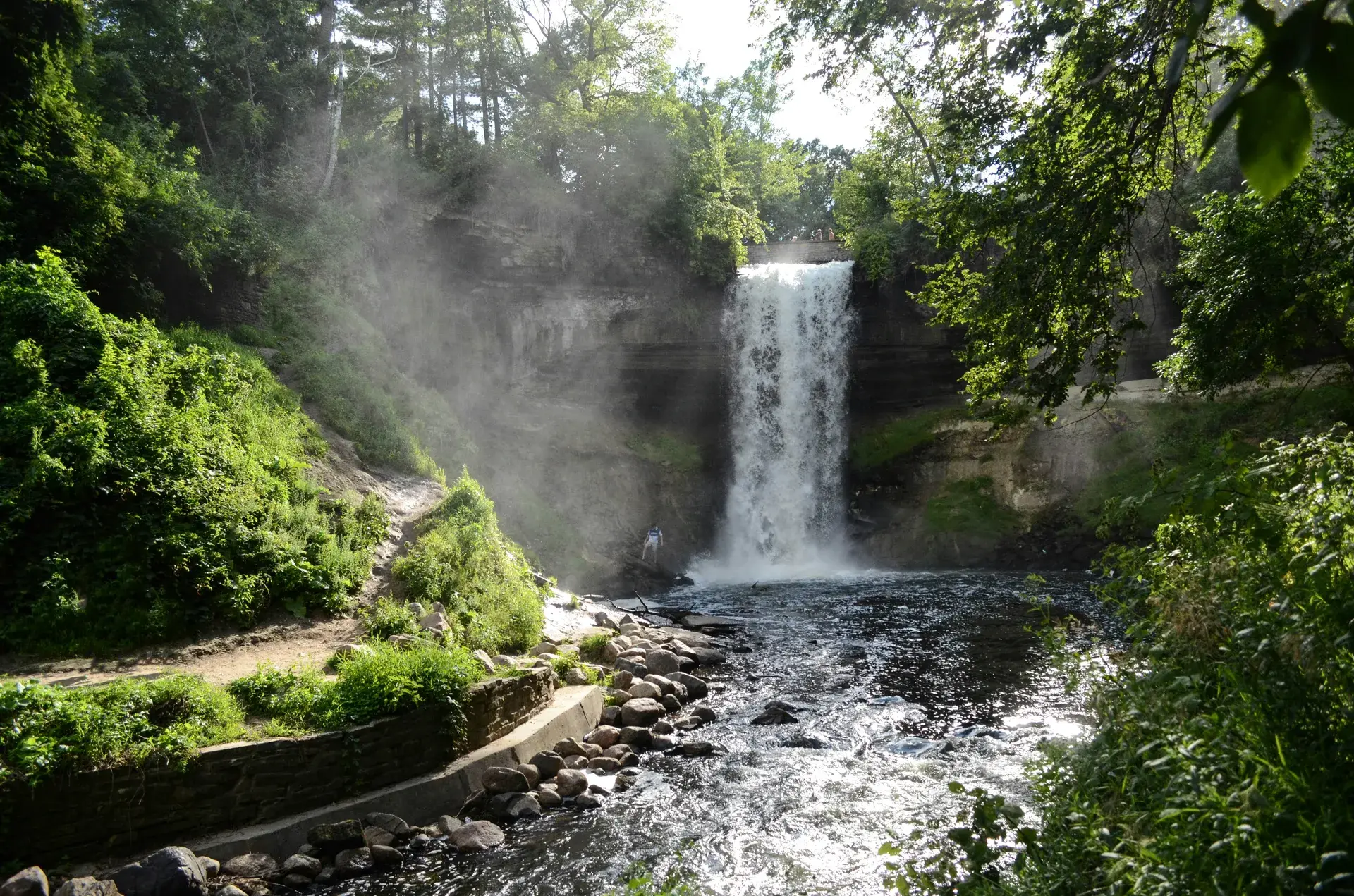
What is Longfellow, Minneapolis?
Longfellow is a residential neighborhood in South Minneapolis, roughly bounded by the rail line and Midtown Greenway to the north, Hiawatha Avenue (Highway 55) to the west, East 34th Street to the south, and 38th Avenue South to the east. It counted about 5,100 residents at the 2020 Census. The Midtown Greenway runs along its northern edge, and Lake Street — the commercial corridor that has become one of the most watched stories in urban recovery in the country — runs straight through the middle.
Longfellow is one of five neighborhoods in the city's Longfellow community, along with Seward, Cooper, Howe, and Hiawatha. Locally, "Greater Longfellow" usually means the four the Longfellow Community Council serves: Longfellow, Cooper, Howe, and Hiawatha. When people in Minneapolis say "Longfellow," they sometimes mean the specific neighborhood and sometimes mean the whole cluster, which runs south along the river all the way to Minnehaha Falls. This guide is about the neighborhood itself.
Longfellow Neighborhood Sign
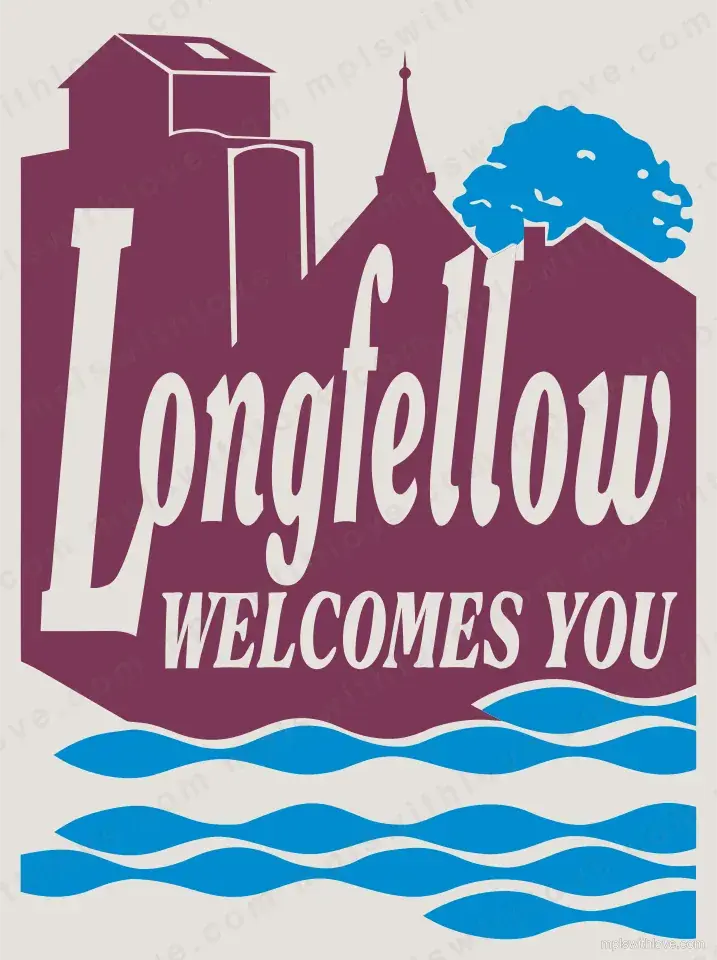
The sign, printed
Longfellow, Minneapolis — Key Stats (2025–2026)
- Residents (2020 Census)
- ~5,100
- Median home sale price (2025 data)
- $330K
- Area, from Hiawatha Avenue east to 38th Avenue South
- 0.85 sq mi
- Era most homes were built
- 1900s–1940s
- Length of the Midtown Greenway, which runs along the north edge
- 5.5 miles
- Drive to downtown Minneapolis
- 10–15 min
Longfellow History & Origins
The land that is now Longfellow is part of the Dakota homeland, and it mattered to human communities for far longer than Minneapolis has existed. The neighborhood's name came much later, from the poet Henry Wadsworth Longfellow, whose 1855 epic The Song of Hiawatha made Minnehaha Falls — about two and a half miles south-southeast, at the far end of the Longfellow community — famous around the world. Longfellow never visited the falls. He worked from other writers' accounts, romanticizing and misrepresenting Native culture in ways that are now widely recognized as harmful. That's an uncomfortable origin story for a neighborhood name, but it's an honest one.
The residential neighborhood filled in primarily between 1900 and 1940; about two-thirds of the homes standing today were built before 1940. The housing stock reflected its working-class and middle-class residents — sturdy Craftsman bungalows, modest Foursquares, and simple frame houses built for the families of railroad employees, tradespeople, and workers in the industrial corridor along the tracks and Hiawatha Avenue. Unlike the grand homes of Kenwood or the carefully planned blocks of Southwest Minneapolis, Longfellow's housing was practical and unpretentious. Many of those original houses — with their deep front porches and narrow lots — still stand.
Hiawatha Avenue (Highway 55) runs down the neighborhood's western edge, and with the rail line beside it, it separates Longfellow from the neighborhoods to its west — a barrier that still defines the area's geography. The neighborhood aged through the mid-twentieth century. But it never hollowed out the way some urban neighborhoods did — the housing stock, while modest, was solid enough to reward those who stayed.
The opening of the Hiawatha Light Rail Line (now the Blue Line) in 2004, with a station at Lake Street just across Hiawatha, brought new transit access and new development pressure. The Midtown Greenway — a bike and pedestrian trail built in a former railroad corridor running east-west across South Minneapolis — reached the Mississippi in 2006, its final stretch running along Longfellow's northern edge, making Longfellow one of the best-connected neighborhoods in the city for human-powered transportation. These two infrastructure investments, more than anything else, set the stage for the neighborhood's twenty-first century transformation.
Living in Longfellow
Longfellow is not one thing. That's the first thing to understand about living here, and the thing that makes it different from many of the more uniform neighborhoods in Southwest Minneapolis or the suburbs. Walk a few blocks in any direction and the texture changes — the bungalow block gives way to a stretch of duplexes, which gives way to a newer apartment building, which gives way to a community garden, which gives way to a taco truck. The residential streets are quiet — almost surprisingly so, given how much has happened here — with mature trees, modest houses, and the kind of porches that people actually sit on.
The demographic mix is genuinely diverse by Minneapolis standards. The neighborhood has long been home to working-class white families, and since 2000 it has grown more diverse: Latino residents have gone from under 10 percent of the population to about 15 percent, the Black share has grown as well, and about one in seven residents was born outside the United States. Lake Street, the major commercial corridor that runs through the middle of the neighborhood, is one of the most ethnically diverse commercial strips in the state — a place where you can get Vietnamese pho, Somali sambusa, Mexican barbacoa, and Ethiopian injera within a few blocks of each other. This diversity isn't performative or curated — it's the result of decades of immigration, affordability, and the way transit corridors shape settlement patterns.
Community organizing runs deep here. The Longfellow Community Council has been active for decades, and the neighborhood has a strong tradition of block clubs, mutual aid networks, and civic engagement that predates 2020 but intensified dramatically after it. When Lake Street burned, it was neighborhood residents — not outside organizations — who showed up first to clean debris, board up buildings, and set up food distribution. That organizing energy hasn't dissipated. If anything, it's become part of the neighborhood's identity in a way that attracts a certain kind of person — the kind who wants to live somewhere where showing up for your community isn't optional.
The vibe, to use a word that Longfellow residents would probably resist, is DIY and unpretentious. Artists live here — not because it's been branded an "arts district," but because the rent has historically been manageable and the community tolerates weirdness. Young families live here because they can afford a house with a yard and still bike to work. Retirees who've been in their bungalow since the 1970s live next door to grad students renting a duplex. The neighborhood doesn't have a single dominant personality. It has several, and they coexist with surprising grace.
Longfellow Food, Drink & Local Spots
Longfellow's food scene is eclectic, immigrant-driven, and fiercely independent. This is not a neighborhood of polished restaurant concepts with PR teams — it's a neighborhood of family-run spots, converted gas stations, and places where the owner is also the cook. Some of the best restaurants here survived the 2020 unrest; some were destroyed and rebuilt; some are new arrivals filling the gaps. The turnover has been real, and the losses were painful. But what remains — and what has emerged — is a food scene with more character per square foot than almost anywhere in the metro.
The Anchors
3032 Minnehaha Avenue, just south of Lake Street. Part independent bookstore, part community living room, part venue. Moon Palace has become one of the most important cultural institutions in South Minneapolis — a place where you can buy a novel, attend a reading, and overhear three conversations about local politics simultaneously. The bookstore is deeply embedded in the neighborhood's identity and its organizing culture. If Longfellow has a town square, this is it.
3300 East Lake Street. A Longfellow institution serving generous plates of Mexican food — enchiladas, burritos, carne asada, and some of the best salsa in the neighborhood. The kind of place where families come for Sunday dinner and regulars know the staff by name.
In Howe, about half a mile southeast of the neighborhood, at 3753 42nd Avenue South. Opened in 2024 in the former Riverview Cafe space, Lynette brings a fresh take to Longfellow-area dining — a thoughtfully designed room with a menu that draws from global influences while staying neighborhood-accessible.
Also Worth Knowing
The Lake Street corridor is home to a rotating cast of food trucks and pop-ups, particularly in the warmer months. Midtown Global Market — about a mile west of Hiawatha on Lake Street, in the old Sears building in Midtown Phillips — is a multi-vendor food hall featuring cuisines from around the world and is an essential stop for anyone exploring the area. Numerous small Latino and East African grocery stores and restaurants along Lake Street and Minnehaha Avenue round out a food landscape that is genuinely global in scope, if modest in presentation. Du Nord Social Spirits, the Black-owned distillery on East 32nd Street, has drawn national attention for its community reinvestment work; its original cocktail room was damaged in 2020, and the one that replaced it in the Coliseum building on Lake Street closed in 2025, so look for its bottles at local bars and stores instead.
Parks & Outdoors Near Longfellow
Longfellow has no lake, no creek, and no river frontage of its own. What it has is one park inside its borders, its namesake park just across 34th Street, the Greenway along its northern edge, and the Mississippi less than a mile east, on the far side of Cooper. For a neighborhood of less than a square mile, that's plenty.
Brackett Field Park
Brackett Field Park, at 2728 39th Avenue South, straddles the neighborhood's eastern edge where 38th Avenue South runs into it, which is why the Park Board lists it under both Longfellow and Cooper; the recreation center itself sits on the Cooper side. Its 10 acres hold baseball, softball, and soccer fields, a tennis court, a skate park, a wading pool, a playground, and a picnic area.
The Mississippi River
Longfellow sits less than a mile from one of the most dramatic stretches of the Mississippi River in the Upper Midwest — the river gorge, where the Mississippi cuts through limestone bluffs between Minneapolis and St. Paul. Head east on Lake Street through Cooper and you reach it at the Lake Street–Marshall Avenue bridge into St. Paul; the Greenway's eastern end connects to the paths along West River Parkway. The trails along the rim offer views that feel more like a national park than an urban neighborhood.
The Midtown Greenway
The Midtown Greenway is a 5.5-mile dedicated bike and pedestrian trail running east-west across South Minneapolis in a former railroad corridor; along Longfellow's northern edge it runs beside the rail line that still uses the corridor here. It is, by any measure, one of the best pieces of urban cycling infrastructure in the United States — plowed in winter, lit at night, open around the clock, and connected to the broader trail network at both ends. For Longfellow residents, the Greenway is both a commuting route and a recreational trail — a way to get to Uptown, the Chain of Lakes, or toward downtown with little time on busy streets. The eastern end connects to the paths along the Mississippi.
Longfellow Park
The neighborhood's namesake park sits just across East 34th Street in Howe — the Park Board says it's unofficially named for the poet — and includes a recreation center, playing fields, tennis courts, a wading pool, and a playground. It's the kind of neighborhood park that doesn't make the tourism brochures but anchors the daily life of the blocks around it — ball games in summer, a skating rink in winter, and programming at the rec center year-round.
Longfellow Schools
Schools in Longfellow reflect the neighborhood's diversity and its position within the broader Minneapolis Public Schools system. The picture here is more complex than in wealthier Southwest Minneapolis neighborhoods — test scores are generally lower, resources are more stretched, and families often navigate the district's open enrollment system to find the right fit. But the schools that serve this area are deeply community-connected, and for families who value diversity and neighborhood embeddedness, they offer something that higher-scoring schools in more homogeneous neighborhoods cannot.
Two district schools sit inside the neighborhood: Anishinabe Academy, a pre-K–5 citywide school at 3100 East 28th Street that teaches through an American Indian lens, with Ojibwe and Dakota language built into the school day, and Longfellow Alternative High School on East 31st Street. The nearest other district schools are just outside the lines. Sanford Middle School and Howe Elementary are to the southeast in Howe. South High School — across Hiawatha in Corcoran — is known for its diversity, its strong music program, and its engaged student body. South earns mixed ratings from standardized metrics, but its community culture and breadth of programming make it a genuine point of pride for many neighborhood families. Which school a given address is assigned to depends on MPS attendance areas, so check with the district.
Minneapolis Public Schools' open enrollment system means that Longfellow families are not limited to neighborhood schools. Many families access magnet programs and specialty schools across the district. Charter schools in the area provide additional options. The school landscape here rewards engaged parents who are willing to research and navigate options — it is less automatic than the pipeline in, say, Fulton, but it is far from devoid of good choices.
Longfellow Real Estate & Housing
Longfellow is one of the more affordable neighborhoods in Minneapolis that still offers genuine walkability, park access, and neighborhood character — and that combination has not gone unnoticed. The median home sale price was $330,000 in 2025, according to Minneapolis Area REALTORS — a little below the citywide median of $350,000 and roughly half the medians of Southwest Minneapolis neighborhoods like Fulton, Linden Hills, or Lynnhurst, all of which topped $650,000. For buyers priced out of those areas, Longfellow has become an increasingly attractive option.
Prices have moved modestly. The neighborhood median was $307,500 in 2021, $330,000 in 2022, about $315,000 in 2023 and 2024, and back to $330,000 in 2025. The market is small — 43 sales in 2025 — and homes went quickly, at 27 cumulative days on market against 55 citywide, and at about their original asking price.
What Your Money Buys
The dominant housing types in Longfellow are Craftsman bungalows and simple frame houses from the 1900s through 1940s, sitting on narrow lots with deep front porches and detached garages. Below the median, you're looking at smaller bungalows or duplexes that need updating. Around it, you get a well-maintained three-bedroom bungalow or a larger updated home. Well above it, you're in renovated territory.
Duplexes and triplexes are more common here than in Southwest neighborhoods, reflecting Longfellow's historically mixed-income character. Some newer buildings have added density — roughly one in ten housing units here dates from 2010 or later. Owner-occupancy rates are lower than in Fulton or Linden Hills but higher than in denser neighborhoods closer to downtown.
Getting Around Longfellow
Longfellow is one of the better-connected neighborhoods in Minneapolis for people who don't want to rely entirely on a car — and the infrastructure keeps getting better. The neighborhood is walkable and exceptionally bikeable, thanks to a combination of dedicated cycling infrastructure, proximity to commercial corridors, and a trail network that rivals any in the country.
The Midtown Greenway is the headline act — a bike trail that runs the width of South Minneapolis along Longfellow's northern edge, connecting the neighborhood to Uptown, the Chain of Lakes, and points west. For bike commuters, it's transformative. The trail is plowed in winter (a rarity), lit at night, and connects to the paths along the Mississippi at its eastern end.
The Blue Line light rail runs along Hiawatha Avenue on the neighborhood's western edge. The Lake Street/Midtown station sits just across Hiawatha at Lake Street, and the 38th Street station is a little farther south; trains run directly to downtown Minneapolis, the airport, and the Mall of America. The METRO B Line runs the length of Lake Street through the neighborhood, from the Lake Street/Midtown station east into St. Paul. Route 7 runs on Minnehaha Avenue, Route 9 stops at 36th Avenue and Lake Street, and Route 27 ends at 27th Avenue and Lake.
By car, downtown is 10–15 minutes depending on traffic. MSP International Airport is approximately 10–15 minutes via Highway 55. Street parking is generally available on residential blocks, though Lake Street parking can be competitive during business hours.
What's Changing: The Honest Version
Any honest guide to Longfellow has to address 2020. Not as a footnote, not as a disclaimer, but as the defining event of the neighborhood's recent history — a rupture that changed the physical landscape, the community's identity, and the way residents relate to their city. What happened here was not an aberration. It was the result of forces that had been building for decades. And the way the neighborhood has responded tells you more about its character than any description of the housing stock or the Walk Score ever could.
May 2020 and the Third Precinct
On May 25, 2020, George Floyd was murdered by Minneapolis police officer Derek Chauvin at the intersection of 38th Street and Chicago Avenue — about a mile and a half west of Longfellow, in the Powderhorn community. In the days that followed, protests erupted across the city and the nation, and Longfellow became the physical epicenter of the unrest in Minneapolis. The Minneapolis Police Department's Third Precinct station, located at 3000 Minnehaha Avenue, was overrun and set on fire on May 28, 2020, after officers abandoned the building. The precinct had long been a source of tension in the community.
In the days that followed, significant portions of the Lake Street commercial corridor were damaged or destroyed by fire and looting. Neighborhood fixtures — including Gandhi Mahal, the post office, and numerous small shops — were burned. Target, Cub Foods, and other retailers were looted and shuttered. For several days, the neighborhood was without basic services — no grocery stores, no pharmacy, limited emergency response. Residents organized their own patrols, food distribution, and debris cleanup. Mutual aid networks that formed during those days continue to operate.
It is important to be clear about what happened: the destruction was real, the fear was real, and the losses — particularly for small business owners, many of whom were immigrants and people of color — were devastating. It is equally important to be clear about why it happened: the uprising was a response to decades of police violence against Black communities in Minneapolis, not a random act of destruction. Both of these things are true at the same time, and Longfellow residents generally hold both truths without flinching.
The Rebuilding
Six years later, in 2026, the rebuilding of Lake Street is substantially advanced but not complete. Some businesses have returned. New ones have opened. Several major redevelopment projects — including mixed-use buildings with affordable housing and ground-floor retail — have broken ground or been completed. The former Third Precinct building remains a charged piece of land. After years of debate, the city settled on turning it into the Minneapolis Democracy Center — home to its Elections and Voter Services office, with community space on the ground floor — and its timeline has construction starting in fall 2026.
The recovery has been uneven. Some blocks of Lake Street look almost normal. Others still show gaps where buildings stood. Insurance disputes, supply chain delays, and the sheer complexity of rebuilding in a neighborhood that is simultaneously processing collective trauma have slowed the timeline. But the trajectory is forward, and the businesses that have opened or returned are, in many cases, stronger and more community-connected than before. The We Love Lake Street campaign and other community-led efforts have raised millions for reconstruction and small business support.
Crime and Safety
Crime — particularly carjackings, property crime, and gun violence — rose sharply in Longfellow and across Minneapolis in 2020–2022, driven by the pandemic, reduced police staffing, and the community disruption that followed the unrest. By 2024–2025, most crime categories had declined significantly from their peaks, though they remained elevated compared to pre-2020 levels. Residents report that the feeling of safety has improved meaningfully, but acknowledge that the neighborhood has not fully returned to its pre-2020 baseline — and may never, in exactly the same way.
The relationship between the neighborhood and the police remains complicated. The Third Precinct was not rebuilt on its old site; police service is now provided from other facilities, and the city is building a new station and community safety center less than half a mile north at 2633 Minnehaha Avenue, near the Seward line. Trust in MPD is low among many residents, particularly in communities of color, and the November 2021 ballot question on replacing the police department with a Department of Public Safety revealed deep divisions within the neighborhood and the city. What is clear is that Longfellow residents — regardless of where they fell on that question — care intensely about safety and are actively engaged in figuring out what it looks like going forward.
Gentrification and Displacement
Even as Longfellow recovers from crisis, it faces a more familiar urban tension: the pressure of rising desirability in a neighborhood where affordability has been a defining feature. The same qualities that make Longfellow attractive to young professionals and homebuyers — the Greenway, Lake Street, the diversity, the community culture — can, paradoxically, erode those qualities by driving up prices and displacing the people who created them. New construction has added housing supply, but not all of it is affordable. Long-term renters, particularly in communities of color, have expressed concern about being priced out of a neighborhood they helped build.
This is not a crisis unique to Longfellow — it's the central tension of desirable urban neighborhoods across America. But it carries particular weight here, where the community has explicitly organized around values of inclusion and equity. The question of whether Longfellow can remain the diverse, mixed-income neighborhood it has been is not hypothetical — it is being answered, block by block, every time a house sells or a lease is renewed.
Longfellow FAQ
Is Longfellow a good neighborhood in Minneapolis?
Yes — Longfellow is one of South Minneapolis's most appealing neighborhoods, combining the Midtown Greenway and the Lake Street corridor with a strong sense of community identity. It's more affordable than Southwest Minneapolis neighborhoods while offering neighborhood parks, a growing food scene, and genuine neighborhood character. The area has faced real challenges since 2020 but has demonstrated remarkable community resilience.
Is Longfellow, Minneapolis safe?
Longfellow's safety picture is nuanced. The neighborhood experienced significant upheaval in 2020 following the murder of George Floyd and the burning of the Third Precinct. Crime — particularly property crime and carjackings — rose sharply in 2020–2022. By 2025–2026, the situation has improved meaningfully, though some areas along Lake Street still feel the effects. Most residential blocks are quiet and neighborly. Like much of Minneapolis, Longfellow is a neighborhood where safety varies by block and context.
What is Longfellow, Minneapolis known for?
Longfellow is best known for Lake Street's corridor of restaurants and small businesses, Moon Palace Books, and the Midtown Greenway bike trail along its northern edge. Since 2020, it has also become known for the Third Precinct protests and the community-led rebuilding effort that followed.
How much do homes cost in Longfellow, Minneapolis?
The median sale price in Longfellow was $330,000 in 2025, according to Minneapolis Area REALTORS — a little below the citywide median of $350,000. Compared to Southwest Minneapolis, where neighborhoods like Fulton and Linden Hills had medians around $670,000, Longfellow remains significantly more affordable.
Is Longfellow walkable?
Yes, and it's exceptionally bikeable. Lake Street and Minnehaha Avenue provide commercial corridors within walking distance for many residents. The Midtown Greenway — a dedicated bike and pedestrian trail running east-west along the neighborhood's northern edge — is one of the best pieces of cycling infrastructure in the country. For car-free living, Longfellow is one of the stronger options in South Minneapolis.
What schools serve Longfellow, Minneapolis?
Two Minneapolis Public Schools buildings are inside the neighborhood: Anishinabe Academy, a pre-K–5 citywide school at 3100 East 28th Street, and Longfellow Alternative High School on East 31st Street. The nearest other district schools are just outside it — Sanford Middle School and Howe Elementary to the southeast in Howe, and South High School across Hiawatha in Corcoran. Which school an address is assigned to depends on MPS attendance areas, so check with the district; families also use its magnet and citywide options.
What are the best restaurants in Longfellow, Minneapolis?
Longfellow's food scene is diverse and independent. Standouts include Sonora Grill (Mexican) on East Lake Street and, about half a mile southeast in Howe, Lynette (the stylish newcomer in the former Riverview Cafe space). Moon Palace Books, an independent bookstore on Minnehaha Avenue, doubles as a neighborhood gathering place.
Where exactly is Longfellow in Minneapolis?
Longfellow is in South Minneapolis, roughly bounded by the rail line and Midtown Greenway to the north, Hiawatha Avenue (Highway 55) to the west, East 34th Street to the south, and 38th Avenue South to the east. It sits south of Seward, west of Cooper, north of Howe, and east of the East Phillips and Corcoran neighborhoods across Hiawatha.
What happened in Longfellow in 2020?
Following the murder of George Floyd by Minneapolis police on May 25, 2020, Longfellow became the epicenter of the subsequent protests and unrest. The Minneapolis Police Department's Third Precinct station, located on Minnehaha Avenue at Lake Street in the neighborhood, was abandoned by police and set on fire on May 28, 2020. Significant portions of Lake Street's commercial corridor were damaged or destroyed. The neighborhood has since been engaged in a long, ongoing process of rebuilding — both physical structures and community trust.
Is Longfellow a good place to raise a family?
Longfellow has a strong family presence, with affordable housing, neighborhood parks (Brackett Field Park on the eastern edge and Longfellow Park just across 34th Street), and a community that actively organizes around family-friendly events. The neighborhood's diversity — racial, economic, generational — is something many families value. Schools are adequate, and families with specific school priorities often use the district's open enrollment to access magnet programs.
How far is Longfellow from Minnehaha Falls?
Minnehaha Falls is in Minnehaha Regional Park, in the Hiawatha neighborhood — about two and a half miles south-southeast of the center of Longfellow, and a little under two miles from its southeast corner. It isn't in the neighborhood, but most Longfellow residents can bike there in 10–15 minutes.
What Makes Longfellow Irreplaceable
There are neighborhoods in Minneapolis that are prettier, quieter, wealthier, and easier to explain. Longfellow is not competing on those terms. What it offers is something rarer and harder to manufacture — a place where the community has been tested by real crisis and responded not by retreating but by showing up, where the guy at the taco truck knows your order and the woman at the bookstore will argue politics with you for an hour if you let her, where you can bike the Greenway to work and ride down to the river after dinner and feel, despite everything, like you are exactly where you want to be.
Longfellow has scars. It would be dishonest to pretend otherwise. But scars are evidence of healing, not just injury — and the rebuilding that has happened here since 2020, block by block and business by business, is one of the more genuinely hopeful stories in American urban life. This is a neighborhood that knows what it lost. It also knows what it has. And if you spend any time here at all, you will too.

From the shop
Take the Longfellow sign home.
Longfellow — Minneapolis Neighborhood Sign Print
Keep exploring
Also in Longfellow
Longfellow appears in
- Best Bakeries
- Best Breweries by Neighborhood
- Best Burgers and Juicy Lucys
- Best Coffee Shops by Neighborhood
- Best Ethiopian and East African Food
- Best Food Trucks
All 25 guides ↓Show fewer ↑
- Best Happy Hours
- Best Indian Food
- Best Mexican Food
- 10 Best Neighborhoods
- Best Neighborhoods for Dog Owners
- Best Neighborhoods for First-Time Homebuyers
- Best Neighborhoods for Public Transit
- Best Neighborhoods for Remote Workers
- Best Neighborhoods for Renters
- Best Parks by Neighborhood
- Best Patios and Outdoor Dining by Neighborhood
- Best Restaurants on Lake Street
- Best Sushi
- Best Tacos
- Best Neighborhoods for Surviving (and Enjoying) Winter
- The History of Minneapolis Neighborhood Signs
- Most Bikeable Neighborhoods
- Most Walkable Neighborhoods
- Moving to Minneapolis