Minneapolis Neighborhood
Audubon Park
The quiet residential counterpoint to Northeast's brewery and arts district buzz — where bungalows with vegetable gardens line streets named after presidents, the neighborhood park is genuinely the center of community life, and the best thing about living here is that nobody is trying to sell you on living here.
№ 2 of 87 · Northeast community · Last updated: October 2026 · A complete neighborhood guide
There is a version of Northeast Minneapolis that gets written about — the breweries, the arts district, Art-A-Whirl, the gentrification debates, the Central Avenue food crawl. And then there is the Northeast Minneapolis that people actually live in on a Tuesday evening in February: a bungalow on a quiet street, a garage that needs painting, a neighbor shoveling the sidewalk before you get to it, and the particular silence of a residential block where the loudest sound is someone's dog barking at a squirrel. That is Audubon Park. Named for the park at its center — which is itself named for the naturalist John James Audubon — this is one of the least talked-about and most livable neighborhoods in Nordeast. It has no brewery. It has no gallery. It has no commercial corridor to speak of beyond the stretch of Central Avenue on its western edge. What it has is a grid of well-maintained homes, a genuinely pleasant park, and the kind of residential stability that looks boring from the outside and feels like luxury from the inside.
What is Audubon Park, Minneapolis?
Audubon Park is a residential neighborhood in Northeast Minneapolis, roughly bounded by Stinson Parkway to the east, Central Avenue NE to the west, Lowry Avenue NE to the south, and St. Anthony Parkway to the north. At about two-thirds of a square mile, it is a mid-sized neighborhood by city standards, and its profile is almost entirely residential — single-family homes on a regular grid, with commercial activity largely confined to Central Avenue on its western edge.
The neighborhood is named for Audubon Park, a 5.7-acre city park near the center of the area that serves as the community's de facto town square. The park — with its playground, athletic fields, wading pool, and recreation center — is the single most important community institution in a neighborhood that has very few institutions of any kind. In most Minneapolis neighborhoods, the park is one of several gathering places competing with coffee shops, taprooms, and commercial corridors for community attention. In Audubon Park, the park is it.
The neighborhood sits on the residential east side of Northeast Minneapolis, running from the Central Avenue commercial corridor on its western edge to the St. Anthony city line, northeast of the arts district that defines Logan Park and south of the quieter reaches of Waite Park. Its position — close enough to the action to benefit from it, far enough to avoid the noise — is the fundamental proposition of living in Audubon Park. You can bike to a taproom in ten minutes, eat on Central Avenue in less, and be home on your quiet block in time to hear the ice cream truck make its summer rounds.
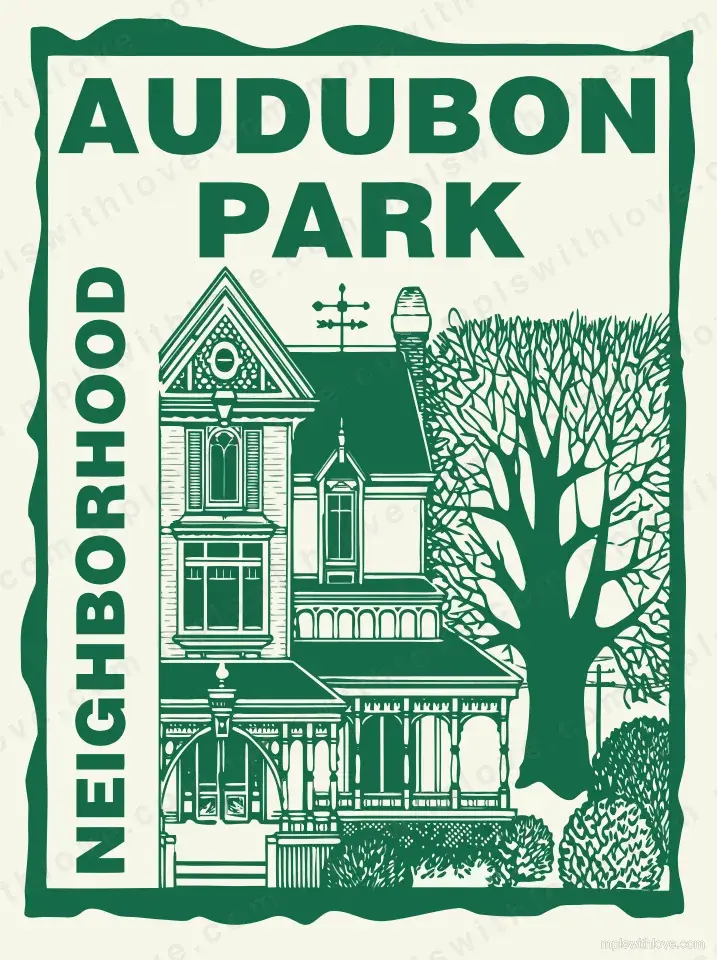
Audubon Park Neighborhood Sign
Audubon Park, Minneapolis — Key Stats (2025–2026)
- Residents (2020 Census)
- ~5,400
- Median home sale price (2025 data)
- $364K
- Median rent, all units (2020–24 ACS)
- $1,514
- Walk Score (Oct 2026)
- 73
- Bike Score (Oct 2026)
- 83
- Transit Score (Oct 2026)
- 44
- Primary era of residential development
- 1900–1950
- Audubon Park green space
- 5.7 acres
Audubon Park History & Origins
The land that is now Audubon Park is part of the traditional homeland of the Dakota people, for whom the Mississippi River corridor was essential to spiritual and material life. In an 1837 treaty signed in Washington, Mdewakanton Dakota leaders were pressured into ceding all their land east of the Mississippi, and that dispossession preceded the European-American settlement that would transform the land into the residential grid that exists today.
Audubon Park became part of Minneapolis in the late 1800s, but it grew mostly in the first half of the 20th century, part of the broader buildout of Northeast Minneapolis that accompanied the industrial growth of the city, helped along by the streetcar line up Central Avenue. Most of the houses standing today were built before 1950. The street names — many of which honor U.S. presidents (Johnson, Polk, Tyler, Fillmore, Pierce, Buchanan) — come from the street-naming plan drawn up when Minneapolis and St. Anthony merged in 1872.
The early residents were largely working families, drawn in part by jobs in the mills, factories, and trades that powered Northeast Minneapolis's economy. The houses they built reflected their means: small bungalows and one-and-a-half-story cottages, typically 900 to 1,400 square feet, on narrow lots with detached garages. These were not grand houses. They were houses built to be functional, to be paid off within a working lifetime, and to shelter families who measured success in stability rather than display.
Audubon Park — the park itself — was bought by the park board in 1910 and named for John James Audubon. It took decades to fill out. A skating rink came in 1918 and playground equipment in 1921, but as late as 1935 park superintendent Theodore Wirth listed it among the city's well-used but poorly equipped playgrounds. Low areas were filled and the steep grades eased in the late 1950s; a wading pool and ball fields followed in 1959, a shelter building in 1960, and the current recreation center in 1979.
Audubon Park's population peaked in the 1950s and declined through the rest of the 20th century. But being primarily residential rather than industrial, the neighborhood kept its housing stock largely intact. The same houses, maintained by successive generations of owners, continued to serve the same function: providing affordable, decent housing for working and middle-class families.
Living in Audubon Park
Living in Audubon Park is living in a neighborhood that doesn't perform. There is no curated identity, no marketing hook, no Instagram-ready aesthetic. The streets look like streets. The houses look like houses. The park looks like a park. If you're used to neighborhoods that announce themselves — with murals, with signage, with a particular commercial vocabulary — Audubon Park might initially feel like nothing at all. Give it time. The nothing is the point.
The residential fabric is remarkably consistent. Block after block of bungalows and small two-story houses, many with original front porches, detached garages (sometimes in better shape than the house, sometimes not), and yards that range from meticulously gardened to charmingly neglected. The lots are modest — 40 feet wide is typical — which means the houses sit close together, creating a pedestrian-scale density that fosters neighborliness without crowding. You know your neighbors in Audubon Park because you can't avoid knowing them — the houses are close enough that a conversation on the porch carries to the next yard.
The community is a mix of long-time Northeast families and newer arrivals. The old-timers — some of them second and third generation in the same house — carry the Nordeast identity with quiet pride: the accent, the work ethic, the loyalty to the neighborhood. The newer residents tend to be young families and couples priced out of St. Anthony West and St. Anthony East (or the Southwest lakes neighborhoods) who discover that Audubon Park offers more house, more yard, and more quiet for less money. The two groups coexist without much friction, united by the basic social contract of residential life: maintain your property, shovel your walk, keep an eye on each other's houses, and don't let your parties run past midnight.
The park is the social center. On summer evenings, Audubon Park fills with the soundtrack of residential community life: kids on the playground, teens on the basketball court, adults walking dogs on the paths, the wading pool generating the particular frequency of shrieking that means children are having a good time. The recreation center hosts programs and serves as a community meeting space. On the Fourth of July, the park hosts a neighborhood celebration that is earnest and unpretentious and exactly what you would expect from a neighborhood that values function over fashion.
Audubon Park Food, Drink & Local Spots
Away from Central Avenue, Audubon Park's dining scene is, frankly, minimal. The neighborhood is almost entirely residential, and the few commercial establishments in its interior are modest. This is not a criticism — it's a description of a neighborhood that was designed for living, not eating out. For restaurants and bars, Audubon Park residents rely on Central Avenue along the western edge, on Johnson Street NE, and on the commercial corridors in adjacent neighborhoods.
Within Reach
Central Avenue's food corridor runs right along Audubon Park's western edge — Holy Land bakery and deli and Chimborazo's Ecuadorian cooking both sit on the neighborhood's side of the street, and the full range of old-school and new-school Northeast Minneapolis dining runs up and down the avenue. Central Avenue is Audubon Park's restaurant row, shared with Holland across the street.
The brewery ecosystem of Logan Park and surrounding neighborhoods, Indeed among them, is accessible from Audubon Park in ten to fifteen minutes by bike. The ride home on quiet residential streets, after a couple of beers on a summer evening, is one of the genuine pleasures of living in this neighborhood.
Johnson Street NE, running north–south through the middle of Audubon Park, carries some commercial activity — a convenience store, a restaurant or two — that provides closer options for residents who don't want to bike to Central Avenue. The offerings are modest but functional.
The Home Cooking Culture
It's worth noting that Audubon Park has a strong home cooking culture — the vegetable gardens visible in yards throughout the neighborhood are not just decorative. The combination of houses with actual yards, a population that includes both old-school Nordeast families (who cook from tradition) and newer residents (who cook from farmers' market hauls), and the lack of convenient restaurants creates a neighborhood where people cook at home more than in most urban areas. The Northeast Minneapolis Farmers Market on summer Saturdays draws Audubon Park residents in numbers disproportionate to the neighborhood's size.
Parks & Outdoors in Audubon Park
Audubon Park's outdoor life revolves around the neighborhood's namesake park, supplemented by biking connections to the broader trail system and green spaces of Northeast Minneapolis.
Audubon Park (the Park)
Audubon Park, the city park at the neighborhood's center, is a 5.7-acre green space that includes a playground, softball and soccer fields, sport courts for basketball, futsal, and pickleball, a wading pool, and the Audubon Recreation Center. The park is well-maintained by Minneapolis Park and Recreation Board standards and serves as the primary outdoor gathering space for the neighborhood. The wading pool is the summer center of gravity for families with young children. The athletic fields host community leagues and pickup games. The recreation center offers youth and adult programming year-round.
The park is not dramatic — it lacks the river views of Boom Island, the lakefront setting of Lake Harriet, or the cultural overlay of the Northeast Arts District. But it is a genuinely good neighborhood park: well-sized, well-equipped, well-used, and well-loved. The community's relationship to the park is the heart of what makes Audubon Park function as a neighborhood rather than just a collection of houses.
Biking & Trail Access
The Bike Score of 83 reflects Audubon Park's strong cycling connectivity. The neighborhood's quiet residential streets make for pleasant riding, and connections to the broader Northeast Minneapolis bike network provide access to the riverfront trails (west along the St. Anthony Parkway, or via a ride through Logan Park) and the university campus. The ride to the Mississippi River trails takes roughly 15 minutes. The St. Anthony Parkway, which forms the neighborhood's northern edge, provides a scenic route for recreational riding.
Audubon Park Schools
Schools in Audubon Park are served by Minneapolis Public Schools. The neighborhood's school-age population is moderate — enough to support local schools but not enough to dominate the neighborhood's character.
Audubon Park is served by elementary schools within the Minneapolis Public Schools system, with the specific attendance zone determined by the district's boundary process. The neighborhood's families also access the broader magnet and choice system, which allows enrollment in schools across the city. Several charter schools in Northeast Minneapolis provide additional options.
Northeast Middle School (grades 6–8) and Edison High School (9–12) are the district's middle and high schools in Northeast Minneapolis; which schools serve a given address depends on the district's attendance boundaries, and the MPS school boundary map has the details. Edison has a diverse student body and career and technical education programs that connect to the neighborhood's working-class heritage.
Audubon Park is a reasonable neighborhood for families who value residential quality and are willing to navigate the Minneapolis Public Schools system to find the right school fit. The schools in the area are not the neighborhood's primary draw, but they are functional, and the community's family-friendly character provides a supportive environment for children outside of school hours.
Audubon Park Real Estate & Housing
Audubon Park's housing market is still within reach for many middle-income buyers — a neighborhood where the bungalow-on-a-quiet-street dream remains realistic, though no longer cheap. The market has appreciated along with the rest of Northeast, and in 2025 Audubon Park sat near the top of Northeast prices: above Logan Park and Holland, below St. Anthony West and St. Anthony East.
Buying in Audubon Park
The dominant housing type is the single-family bungalow or one-and-a-half-story house built in the first half of the 20th century. These homes are typically 900 to 1,400 square feet on lots of 4,000 to 6,000 square feet, with detached garages. Interior features often include original hardwood floors, built-in bookcases, and the particular charm of Craftsman-era construction — tapered columns, wide window trim, a sense of proportion that modern builders rarely match.
The median sale price was about $364,000 in 2025, up from $311,000 in 2021, according to Minneapolis Area REALTORS — a little above the citywide median of $350,000. Homes that need updating sell below it and fully renovated properties above, and houses spent an average of 25 days on the market in 2025, against 55 citywide.
Duplexes exist in moderate numbers. New construction is minimal — the neighborhood's lots are built out, and the economics of tearing down a livable bungalow to build new have not generally penciled out at Audubon Park price points.
Rental Market
Audubon Park is mostly owner-occupied — about two-thirds of households own, by Census estimates — and rental options are correspondingly limited. The median rent across all units is about $1,500, above the citywide median of $1,371, with the rental stock consisting mainly of units in older duplexes and small apartment buildings. The limited rental supply means that units in Audubon Park can be hard to find; prospective renters often need to watch listings closely or rely on word-of-mouth.
Getting Around Audubon Park
Audubon Park's transportation profile is straightforward: biking is great, driving is easy, walking is limited by the lack of nearby commercial destinations, and transit is functional but infrequent. The Walk Score of 73 reflects the neighborhood's residential character — you can walk to the park, to a neighbor's house, and to a handful of scattered businesses, but reaching a restaurant or grocery store on foot requires a longer trek to Central Avenue or Johnson Street.
The Bike Score of 83 is the number that matters. Audubon Park's quiet streets and connections to the Northeast Minneapolis bike network make cycling the most practical mode for reaching the commercial and recreational amenities that the neighborhood itself lacks. A ten-minute bike ride puts you on Central Avenue, at a taproom, or on the riverfront trails. Most Audubon Park households that don't have a car get by comfortably on bikes.
Transit service reaches the neighborhood through bus routes on nearby arterial streets, but frequency is lower than in more centrally located neighborhoods. The Transit Score of 44 is honest — you can get downtown by bus, but the headways may require planning around the schedule rather than showing up and waiting. Most Audubon Park residents who commute downtown drive (10–15 minutes) or bike (20–25 minutes on the riverfront trails).
For drivers, access is uncomplicated. Central Avenue provides a direct route to downtown and to the northern suburbs. Interstate 35W is accessible via Stinson Boulevard or Johnson Street. MSP Airport is 20 minutes via I-35W. Parking is never an issue — most homes have garages and off-street parking, and the residential streets have ample room.
What's Changing: The Honest Version
Audubon Park is not a neighborhood under dramatic pressure. Its changes are slow, incremental, and mostly welcome — the kind of gradual evolution that characterizes stable residential neighborhoods rather than the rapid transformation that generates headlines and community meetings.
Northeast Gentrification Spillover
As Logan Park and the Central Avenue corridor have become more expensive and more trendy, some of the demand has spilled eastward into neighborhoods like Audubon Park. This is visible in rising home prices — the median went from $311,000 in 2021 to about $364,000 in 2025 — and in the arrival of younger buyers who are drawn to the Northeast Minneapolis brand. So far, this spillover has been moderate in Audubon Park: prices have risen but remain accessible, new construction has been minimal, and the character of the neighborhood has not shifted dramatically. The question is whether that moderation continues as Northeast Minneapolis as a whole becomes more desirable and more expensive.
Housing Stock Aging
The bungalows and small houses that define Audubon Park are now 100 years old or approaching it. At that age, the maintenance demands increase: foundations need repair, wiring needs updating, windows need replacing, roofs need attention. For long-time homeowners on fixed incomes, these costs can be burdensome. For new buyers, the charm of an original Craftsman bungalow comes with the reality of century-old plumbing. The neighborhood's housing stock is generally in good condition — a testament to decades of careful ownership — but the next generation of maintenance is arriving, and the costs are not trivial.
The Density Question
The Minneapolis 2040 Plan allows increased density on lots that were previously single-family-only, and Audubon Park — with its modest lot sizes and aging housing stock — could theoretically see some conversions to duplexes or triplexes. In practice, the economics have not driven significant change yet: the cost of acquiring a bungalow, demolishing it, and building a multi-unit structure exceeds the revenue that the resulting units would generate at Audubon Park rents. But as prices continue to rise, that math could change, and the community is watching.
Audubon Park FAQ
Is Audubon Park a good neighborhood in Minneapolis?
Audubon Park is an excellent neighborhood for people who prioritize residential quality over commercial amenities and nightlife. It's one of the quietest neighborhoods in Northeast Minneapolis, with well-maintained homes, a strong sense of community, and a genuinely nice park at its center. The trade-off is limited walkability to restaurants, bars, and shops — you'll need a bike or car for most commercial needs. If you want the Northeast Minneapolis address without the Northeast Minneapolis noise, Audubon Park is a strong option.
Is Audubon Park, Minneapolis safe?
Audubon Park is one of the safer neighborhoods in Minneapolis. Both violent and property crime rates are below the city average. The neighborhood's residential density and stable homeownership rates contribute to a quiet, low-crime environment. Residents generally feel safe walking the neighborhood at all hours. The most common issues are the same minor property crimes — bike theft, occasional car break-ins — that affect all Minneapolis neighborhoods.
How much does it cost to live in Audubon Park?
Audubon Park's median sale price was about $364,000 in 2025, up from about $350,000 in 2024, according to Minneapolis Area REALTORS — a little above the citywide median of $350,000. Most of what sells is bungalows and modest two-story houses from the early 20th century. Rentals are more limited, since about two-thirds of households own their homes; the median rent across all units is about $1,500, by Census estimates, above the city's $1,371. Compared to St. Anthony West, where the 2025 median was $400,000, Audubon Park offers more house for less money, though it is no longer among the cheapest corners of Northeast.
Where is Audubon Park in Minneapolis?
Audubon Park is in Northeast Minneapolis, roughly bounded by Stinson Parkway and the St. Anthony city line to the east, Central Avenue NE to the west, Lowry Avenue NE to the south, and St. Anthony Parkway to the north. It sits across Central Avenue from Columbia Park and Holland, north of Windom Park, and south of Waite Park. The neighborhood is named for Audubon Park, a city park near its center.
Is Audubon Park walkable?
Reasonably. Audubon Park's Walk Score of 73 reflects a neighborhood where you can walk to the park, to a nearby convenience store, and to a few scattered businesses, but where most commercial needs require a bike ride to Central Avenue or the commercial corridors in adjacent neighborhoods. The Bike Score of 83 is more relevant — biking is the practical mode for reaching restaurants, breweries, groceries, and other amenities in Northeast Minneapolis. The neighborhood's quiet, residential streets are pleasant for walking even if the destinations are limited.
What is there to do in Audubon Park?
Audubon Park is primarily a residential neighborhood, and 'things to do' center on the park itself — playground, sports fields, wading pool, community events — and on the broader Northeast Minneapolis ecosystem that's accessible by bike. The neighborhood's appeal is not about attractions; it's about quality of daily life. Residents bike to Logan Park's breweries, to Central Avenue's restaurants, to the riverfront trails, and to the arts district, then come home to a quiet block. Audubon Park is a base of operations, not a destination.
Is Audubon Park good for families?
Very much so. Audubon Park is one of the better family neighborhoods in Northeast Minneapolis: safe, quiet, with a community-centered park that includes a playground and wading pool. The housing stock — single-family homes with yards — is well-suited to families with children. Schools serve the area through Minneapolis Public Schools, with Audubon Park itself hosting community programs and events. The neighborhood's distance from bars and nightlife is a feature, not a bug, for families with young children.
How does Audubon Park compare to other Northeast Minneapolis neighborhoods?
Audubon Park is the quiet residential east side of Northeast Minneapolis. Compared to Logan Park (arts district, breweries, gentrification drama), Holland (diverse, commercial corridors, more urban), or St. Anthony West (historic, riverfront, foodie scene), Audubon Park offers less excitement and more stability. It's less expensive than St. Anthony West and St. Anthony East, safer and quieter than most, and more family-oriented. Think of it as the neighborhood where Northeast Minneapolis's brewery workers and artists actually live — the functional residential fabric that the flashier neighborhoods depend on but don't talk about.
What Makes Audubon Park Worth Knowing
Audubon Park will never be the subject of a magazine feature or a real estate thinkpiece. No one will write a trend story about it, because it is not a trend — it is a neighborhood, in the most fundamental and least glamorous sense of the word. It is a collection of houses on a grid of streets organized around a park, populated by people who mow their lawns and shovel their sidewalks and show up at community meetings when something matters. That description could apply to a thousand neighborhoods in a thousand American cities, and that's exactly the point. The things that make a neighborhood good are not unique — they're universal, just unevenly distributed.
What Audubon Park offers is the Northeast Minneapolis identity — the creative proximity, the working-class heritage, the Central Avenue food corridor, the brewery culture — without the noise that comes with being at the center of that identity. It's the residential fabric that makes the flashier neighborhoods possible: a place where people can afford to live, raise kids, maintain a house, and bike to the taproom on Friday evening without worrying that the taproom's success will double their rent. That quiet functionality is Audubon Park's contribution to the ecosystem of Northeast Minneapolis, and it is not a small one.

From the shop
Made for people who love it here.
From Minneapolis, With Love - Large Tote Bag
Keep exploring