Minneapolis Neighborhood
Logan Park
The creative engine of Nordeast — where the largest open studio tour in the country fills converted factories and warehouse lofts, breweries outnumber banks, Central Avenue still smells like kielbasa and cardamom, and the artists who made this neighborhood famous are wondering how much longer they can afford to stay.
№ 43 of 87 · Northeast community · Last updated: October 2026 · A complete neighborhood guide
On the third weekend of May, something happens in Logan Park that doesn't happen anywhere else in the country. More than forty thousand people pour into a grid of converted warehouses and old industrial buildings to look at art — not in a museum, not in a gallery with white walls and price lists, but in the studios where it was actually made. They climb freight elevators in the Northrup King Building, wander through four floors of open doors — a painter here, a printmaker there, a ceramicist pulling pieces from a kiln in the hallway — and spill out onto loading docks where someone has set up a bar and a band is playing in a parking lot. This is Art-A-Whirl, the largest open studio tour in the United States, and it has been happening here for decades. The rest of the year, Logan Park is quieter but no less itself — a neighborhood of working artists and old-school Nordeast families, of taprooms in former machine shops and pierogies alongside pho. It is the creative heart of Northeast Minneapolis, and it is fighting to stay that way.
What is Logan Park, Minneapolis?
Logan Park is a compact neighborhood in Northeast Minneapolis — “Nordeast” to anyone who grew up here — roughly bounded by Broadway Street NE to the south, 19th Avenue NE to the north, Central Avenue NE to the east, and Washington Street NE to the west. With about 2,200 residents at the 2020 Census, it is one of the smaller neighborhoods in the city by population, but its cultural footprint is wildly disproportionate to its size. Logan Park is the nucleus of the Northeast Minneapolis Arts District, the largest concentration of working artists in the Upper Midwest, and the home base of Art-A-Whirl, a three-day open studio event that has become one of the most important visual arts events in the region.
The neighborhood is named for Logan Park itself, a city park at 690 13th Avenue NE that serves as a modest green anchor in a landscape dominated by converted industrial buildings, workers' cottages, and the kind of light-industrial architecture that urban neighborhoods either demolish or reinvent. Logan Park chose reinvention. Beginning in the 1990s, artists began colonizing the neighborhood's abandoned and underused warehouses and factory buildings — drawn by cheap rents, high ceilings, freight elevators that could move sculpture, and the particular quality of north light that pours through industrial windows. They were followed, eventually, by breweries, restaurants, and developers. That sequence — artists first, capital second — is the defining story of Logan Park, and the source of its deepest tension.
If you want to understand what Northeast Minneapolis actually is — not the brunch-and-brewery version marketed to suburbanites, but the layered, complicated, genuinely creative place underneath — Logan Park is where you start.
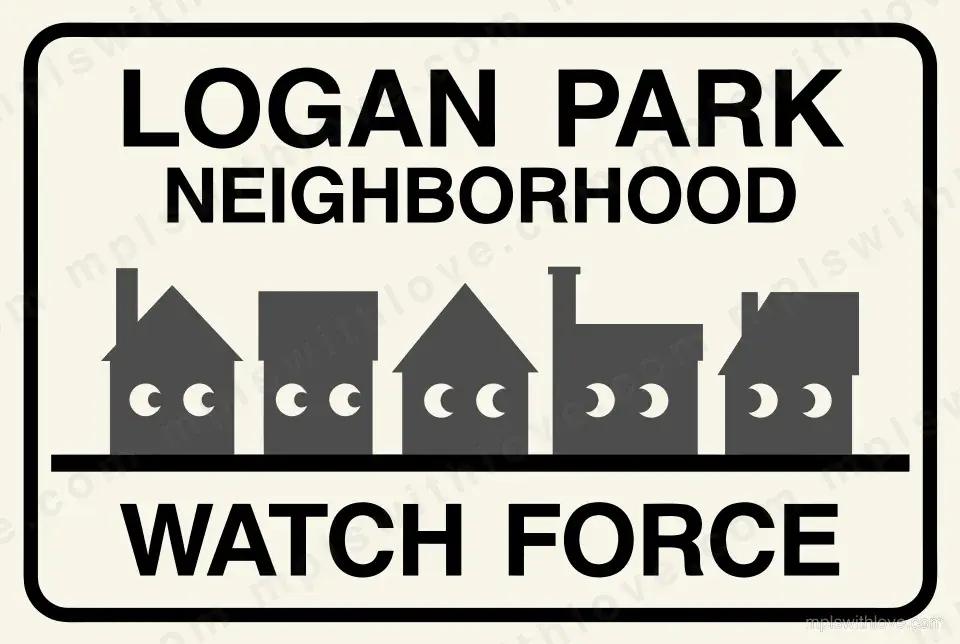
Logan Park Neighborhood Sign
Logan Park, Minneapolis — Key Stats (2025–2026)
- Residents (2020 Census)
- ~2,200
- Median home sale price (2025 data)
- $338K
- Median rent, all units (2020–24 ACS)
- $1,116
- Walk Score (Oct 2026)
- 84
- Bike Score (Oct 2026)
- 93
- Transit Score (Oct 2026)
- 49
- Artist studios in the Northeast Arts District
- 800+
- Visitors during Art-A-Whirl weekend
- 40,000+
Logan Park History & Origins
The land that is now Logan Park sits within the traditional homeland of the Dakota people, for whom the Mississippi River corridor and the falls at St. Anthony were sites of deep spiritual and practical significance. The falls were a place of gathering, trade, and ceremony long before European arrival. The Dakota name for the falls, Owámniyomni, means “turbulent waters” — water that would later be harnessed to power the flour mills that built Minneapolis.
European-American settlement of the east bank of the Mississippi began in the 1840s and 1850s, centered on the village of St. Anthony, which would later merge with Minneapolis. The area that became Northeast Minneapolis — and Logan Park within it — was settled largely by waves of immigrants drawn by industrial jobs: Poles, Ukrainians, and Lebanese among them. This wasn't the Minneapolis of Lake of the Isles mansions and Episcopalian church suppers. This was the working side of the river — the side where people ran lathes and poured iron and packed meat and came home smelling like the job.
The Polish and Ukrainian communities left the deepest imprint. By the early 1900s, Northeast Minneapolis had a large and growing Polish community. Holy Cross Church on University Avenue NE, founded in 1886, served as its spiritual anchor, with masses in Polish that continue today. The Ukrainian community built its own churches — St. Constantine's Ukrainian Catholic Church among them — and established cultural organizations that preserved language, music, and traditions across generations. The Lebanese community opened businesses of its own, and some still operate today. These weren't communities that assimilated quickly or quietly. They held onto their languages, their food, their faith, their accents. The “Nordeast” identity — the distinctive vowels, the stubborn loyalty, the unapologetic working-class pride — grew directly out of this immigrant bedrock.
The neighborhood's built environment reflected its industrial economy. Small workers' cottages and duplexes filled the residential blocks — modest frame houses with narrow lots, built for families who walked to work at the nearby factories, foundries, and machine shops. The commercial and industrial buildings were more substantial: brick warehouses, manufacturing plants, and rail-served facilities that processed and distributed goods across the Upper Midwest. These buildings were built for function, not beauty — but they were built with materials and construction methods that would prove remarkably durable, which is why so many of them are still standing today, reborn as artist studios and brewery taprooms.
The mid-20th century brought the same forces that reshaped urban neighborhoods across America: suburban flight, deindustrialization, disinvestment. Factories closed. Younger generations moved to the suburbs. The population aged. By the 1970s and 1980s, Logan Park and the surrounding Nordeast neighborhoods were characterized by empty industrial buildings, aging infrastructure, and a population that was older, smaller, and poorer than it had been a generation earlier. Property values were low. Vacancy was high. The neighborhood had the look and feel of a place that the broader city had stopped thinking about.
And that, paradoxically, is what saved it. Empty industrial buildings with cheap rents and good bones are exactly what artists need — space, affordability, and the freedom that comes from nobody paying attention. Beginning in the early 1990s, artists began moving into Northeast's vacant warehouses and industrial spaces. The Northrup King Building, a massive industrial complex at 1500 Jackson Street NE originally built for the Northrup King seed company, became the anchor — its sprawling floors subdivided into studios that eventually housed over 300 artists. The Casket Arts Building (a former casket factory, because Nordeast), the California Building and the Grain Belt Bottling House to the west in Bottineau and Sheridan, and a constellation of smaller spaces filled out the district. Over the years that followed, Logan Park developed the critical mass of working artists that has defined its identity ever since.
Art-A-Whirl, organized by the Northeast Minneapolis Arts Association (NEMAA), grew out of that community. The concept was irresistible: instead of asking people to come to a gallery, bring them to the place where the art is actually made. Let them see the mess, the process, the half-finished canvases and the kilns still warm. The event grew, eventually drawing tens of thousands of visitors and establishing Northeast Minneapolis — and Logan Park in particular — as one of the most significant arts districts in the country. It was, and remains, the single most important thing that ever happened to the neighborhood's identity.
Living in Logan Park
Living in Logan Park means living in a neighborhood that is simultaneously two things: the Nordeast of memory — working-class, immigrant, unpretentious, a little rough around the edges — and the Nordeast of the present, where a craft cocktail costs $14 and the new apartment building has a rooftop dog park. The tension between these two versions is not subtle. You can see it on a single block: a 1920s workers' cottage with a chain-link fence next to a newly renovated duplex with a Tesla in the driveway, across from a building where a sculptor has been renting a studio for fifteen years and is wondering about next year's lease.
The residential fabric is a mix of those early 20th century workers' cottages — small, sturdy, typically one or one-and-a-half stories with modest yards — alongside duplexes, small apartment buildings, and increasingly, new construction townhomes and mid-rise apartments. The houses are not architecturally distinguished in the way that, say, the Victorians in Lowry Hill or the Craftsman bungalows in Longfellow are. They are plain, practical buildings that were designed to house families who worked with their hands, and they have a particular dignity that comes from that honesty. Many have been well-maintained by multi-generational families; others have been updated by new owners with more capital than the original occupants ever dreamed of. The neighborhood's streets are quieter than you might expect, given its cultural reputation — most of the energy is concentrated along Central Avenue and in the industrial-to-creative buildings scattered through the neighborhood.
The arts community is the neighborhood's most visible identity, but it is not the only one. Long-time Nordeast families — many of them Polish, Ukrainian, or Lebanese in origin — still live here, still attend the same churches, still shop at the same meat markets and bakeries their parents used. These communities are smaller than they were, and older, but they haven't vanished. On a Sunday morning, you can still hear church bells from multiple directions, still find fresh kielbasa at Kramarczuk's (technically in Nicollet Island - East Bank, but spiritually Nordeast to the bone), still encounter the “Nordeast” accent that flattens vowels in ways that make linguists smile and locals proud. This is a neighborhood that has layers, and the most interesting thing about it is how those layers coexist — sometimes harmoniously, sometimes not.
The brewery culture deserves its own mention, because in Logan Park, taprooms function as something between a bar and a community center. Indeed Brewing's patio on a summer Thursday is one of the great casual social spaces in Minneapolis — dogs, kids, food trucks, and a crowd that mixes artists and accountants and construction workers with an ease that few institutions manage. Bauhaus Brew Labs, just across Central Avenue, with its mid-century aesthetic and dance floor (yes, a dance floor in a brewery), is a different animal entirely — louder, more designed, unapologetically fun. These aren't just places to drink beer. They're the closest thing Logan Park has to a town square.
Logan Park Food, Drink & Local Spots
Logan Park's food and drink scene reflects its identity: layered, unpretentious, anchored by immigrant tradition and energized by the creative community that arrived later. Central Avenue is the spine — a commercial corridor that runs the full length of Northeast Minneapolis, carrying a mix of old-school ethnic restaurants, newer gastropubs, bakeries, and shops that together tell the story of every wave of people who have called this place home. Thirteenth Avenue NE, a few blocks west in Sheridan, serves as a secondary corridor. This is not a neighborhood where you need a reservation. It's a neighborhood where you need a sense of adventure and a willingness to eat at a place with a hand-lettered sign.
Nordeast Institutions
215 E. Hennepin Ave. (in Nicollet Island - East Bank, but the spiritual center of Nordeast food culture). Kramarczuk's has been making kielbasa, bratwurst, pierogi, and Eastern European deli meats since 1954, when Wasyl and Anna Kramarczuk — Ukrainian immigrants — bought the meat market that became their sausage shop. The bakery counter sells poppy seed rolls and kolachi that taste like someone's grandmother made them, because the recipes are someone's grandmother's. The deli case is a cathedral of cured meat. This is Nordeast in edible form.
303 E. Hennepin Ave. (also technically Nicollet Island - East Bank, but inextricable from the Nordeast identity). Surdyk's is a legendary liquor store and cheese shop that has been operating since 1934. The wine and spirits selection is one of the best in the Twin Cities. The cheese counter and deli are worth the visit on their own. Surdyk's is the kind of place where the staff actually knows what they're talking about, which is rarer than it should be.
2513 Central Ave. NE, six blocks north of Logan Park in Audubon Park. A sprawling Middle Eastern bakery, deli, and grocery that has been a Central Avenue anchor for decades. The hummus is made fresh daily and is better than anything you'll find in a plastic container. The bakery turns out flatbreads, baklava, and spinach pies. The grocery section stocks ingredients for home cooking from across the Middle East and North Africa. Holy Land is one of those places that proves the best food often comes from the simplest operations.
Central Avenue Eats
2851 Central Ave. NE, about ten blocks north of Logan Park in Audubon Park. One of the few Ecuadorian restaurants in the Twin Cities, Chimborazo serves llapingachos (potato patties), encebollado (fish stew), and other dishes that are rare finds in the Midwest. The portions are generous and the prices are fair. The restaurant's presence reflects the growing Latin American community in Northeast Minneapolis.
641 University Ave. NE, southwest of Logan Park in St. Anthony West. A tiny, no-frills deli serving some of the best Lebanese food in Minneapolis — falafel, shawarma, tabbouleh, and fattoush made with care and priced for the working people who built this neighborhood. Emily's is a reminder of the Lebanese community's deep roots in Northeast Minneapolis.
Breweries & Taprooms
The brewery scene in Logan Park and surrounding Northeast Minneapolis is not a trend — it's infrastructure. These taprooms are where the neighborhood socializes, where artists meet after studio hours, where families bring kids on Sunday afternoons, where the line between nightlife and community life dissolves entirely. The concentration is remarkable: within a mile or two of Logan Park, you can visit half a dozen independent craft breweries, each with its own personality and loyal following.
711 15th Ave. NE. Indeed's taproom and patio are one of the great gathering spaces in Northeast Minneapolis. The beer is excellent — the Day Tripper Pale Ale and the Mexican Honey Imperial Lager are flagships — but the real draw is the atmosphere: picnic tables, food trucks, dogs, and a crowd that embodies the Logan Park mix of creative and blue-collar. The patio on a warm evening is as close to a town square as this neighborhood gets.
1315 Tyler St. NE, just across Central Avenue in Northeast Park. Bauhaus occupies a converted industrial space with a mid-century modern aesthetic, a sound system that gets used, and a dance floor that is not ironic. The beer (Wonderstuff, Sky-Five IPA) is solid, but Bauhaus is really a social venue that happens to brew beer. Events, themed nights, and a general commitment to fun make it the most energetic taproom in the area.
Coffee & Drink Beyond Beer
Coffee culture in Logan Park leans toward the independent and unfussy. Spyhouse Coffee has a location on Broadway, just across Central Avenue, that draws the laptop crowd and serves excellent single-origin pour-overs. For cocktails, the options have expanded significantly in recent years — several bars along Central Avenue and 13th Avenue NE offer craft cocktail programs that would have been unthinkable in a neighborhood that was, until recently, a beer-and-a-shot kind of place. The 331 Club, a dive bar a few blocks west on 13th Avenue NE in Sheridan, represents the older tradition — cheap drinks, live music, and a crowd that doesn't care what you're wearing. It's one of the last places in Nordeast where a PBR tallboy is still the default order, and it is beloved for exactly that reason.
Parks, Arts & Outdoors in Logan Park
Logan Park is not a parks-and-lakes neighborhood. You will not step out your front door onto a trail circling a pristine urban lake. What you will find is something different and, for the right person, more interesting: one of the most significant working arts districts in the United States, a well-used neighborhood park, and access to the Mississippi River corridor that is better than most Northeast Minneapolis residents realize.
The Northeast Minneapolis Arts District
This is the heart of it. The Northeast Minneapolis Arts District — centered in Logan Park and extending into neighboring Sheridan and St. Anthony West — is the largest concentration of working artists in the Upper Midwest. Over 800 studios are spread across converted warehouses, industrial buildings, and some purpose-built spaces. The district is organized and advocated for by NEMAA (the Northeast Minneapolis Arts Association), which runs Art-A-Whirl and has long been the institutional backbone of the arts community.
The key buildings — the anchors of the district — are worth knowing individually, because each has its own character and community:
1500 Jackson St. NE. The flagship. A massive former seed company complex that now houses over 300 artist studios across multiple floors. The NKB is the single most important building in the Northeast Arts District — the place where Art-A-Whirl reaches its highest density and where the creative ecosystem of the neighborhood is most visible. Studios range from tiny workspaces to sprawling production facilities. The building hosts First Thursdays (monthly open studio nights) year-round, not just during Art-A-Whirl. Walking the hallways is an education in the range of what 'art' means — painting, sculpture, jewelry, ceramics, printmaking, photography, mixed media, and things that defy category.
681 17th Ave. NE. A former casket factory — the name is not a metaphor — converted into artist studios, creative offices, and event spaces. The building's industrial bones are intact: heavy timber columns, freight elevators, and the particular aesthetic of a space that was designed to build things, repurposed for people who still build things, just different ones. Casket Arts hosts studios, a gallery, and community events.
2205 California St. NE, west of Logan Park in Bottineau. A converted industrial building housing studios, galleries, and creative businesses. The California Building is slightly quieter than the NKB — fewer tourists, more working space — and tends to attract artists who are more focused on production than presentation. During Art-A-Whirl, it's one of the essential stops.
711 15th Ave. NE. Located adjacent to Indeed Brewing, the Solar Arts Building combines artist studios with event space and a taproom. It's the building where the art district and the brewery culture literally share a wall, which is as Logan Park as it gets.
Art-A-Whirl: The Main Event
Art-A-Whirl deserves its own subsection because it is, for many people, the only time they encounter Logan Park — and because what happens during that one weekend in May shapes the neighborhood's identity for the rest of the year. The event runs from Friday evening through Sunday afternoon on the third weekend of May (typically), and involves hundreds of artists opening their studios to the public across the entire Northeast Arts District. The scale is staggering: the Northrup King Building alone could consume an entire day. Add the Casket Arts Building, the California Building, the Solar Arts Building, and dozens of smaller venues, galleries, pop-up shows, and parking lot installations, and you have an event that is genuinely impossible to see completely in a single weekend.
What makes Art-A-Whirl different from a standard gallery crawl or art fair is the access. You are not looking at finished work hung on a white wall. You are standing in the room where it was made, talking to the person who made it, seeing the tools and the failed attempts and the works-in-progress. That intimacy — the collapse of distance between viewer and maker — is the event's genius and its emotional core. It also generates the bulk of many participating artists' annual income, which makes the event's health existentially important to the creative community.
The event has grown significantly over the decades, and that growth brings its own complications. Crowds are dense. Parking is impossible (bike or take the bus). Some artists complain that the festival atmosphere — the food trucks, the brewery parties, the bands — overshadows the art. Others argue that the spectacle is what brings more than 40,000 people to a neighborhood they would otherwise never visit, and that the economic impact justifies the chaos. Both sides have a point. But whatever your feelings about the event's evolution, walking through the Northrup King Building on a Saturday afternoon during Art-A-Whirl — the hallways packed, the studio doors open, the conversation flowing — remains one of the best cultural experiences Minneapolis has to offer.
Logan Park (the Actual Park)
The neighborhood's namesake park, at 690 13th Avenue NE, is a modest but well-used community green space with a playground, a half basketball court, a wading pool, and a recreation center that hosts youth programs, fitness classes, and community events. It's not a destination park — nobody drives across the city to visit Logan Park — but it serves its neighborhood well, providing outdoor space in an area that is otherwise dominated by pavement, industrial buildings, and residential lots too small for much of a yard. On summer evenings, the park fills with kids, dogs, and families — the same cross-section of old Nordeast and new Nordeast that defines the neighborhood as a whole.
Mississippi River Access
The Mississippi River runs roughly three-quarters of a mile west of Logan Park, and the riverfront trail system — part of the Grand Rounds National Scenic Byway — provides paved paths for walking, running, and biking along the east bank. The trails connect south to the Stone Arch Bridge and the Mill City area. Most Logan Park residents access the river via bike — it's a quick ride down to the St. Anthony Main area, where the river, the falls, and the downtown skyline form one of the more dramatic urban landscapes in the Midwest. The river is Logan Park's backyard in the same way the Chain of Lakes is south Minneapolis's — close enough to use regularly, far enough to feel like an escape.
Grain Belt Brewery Campus
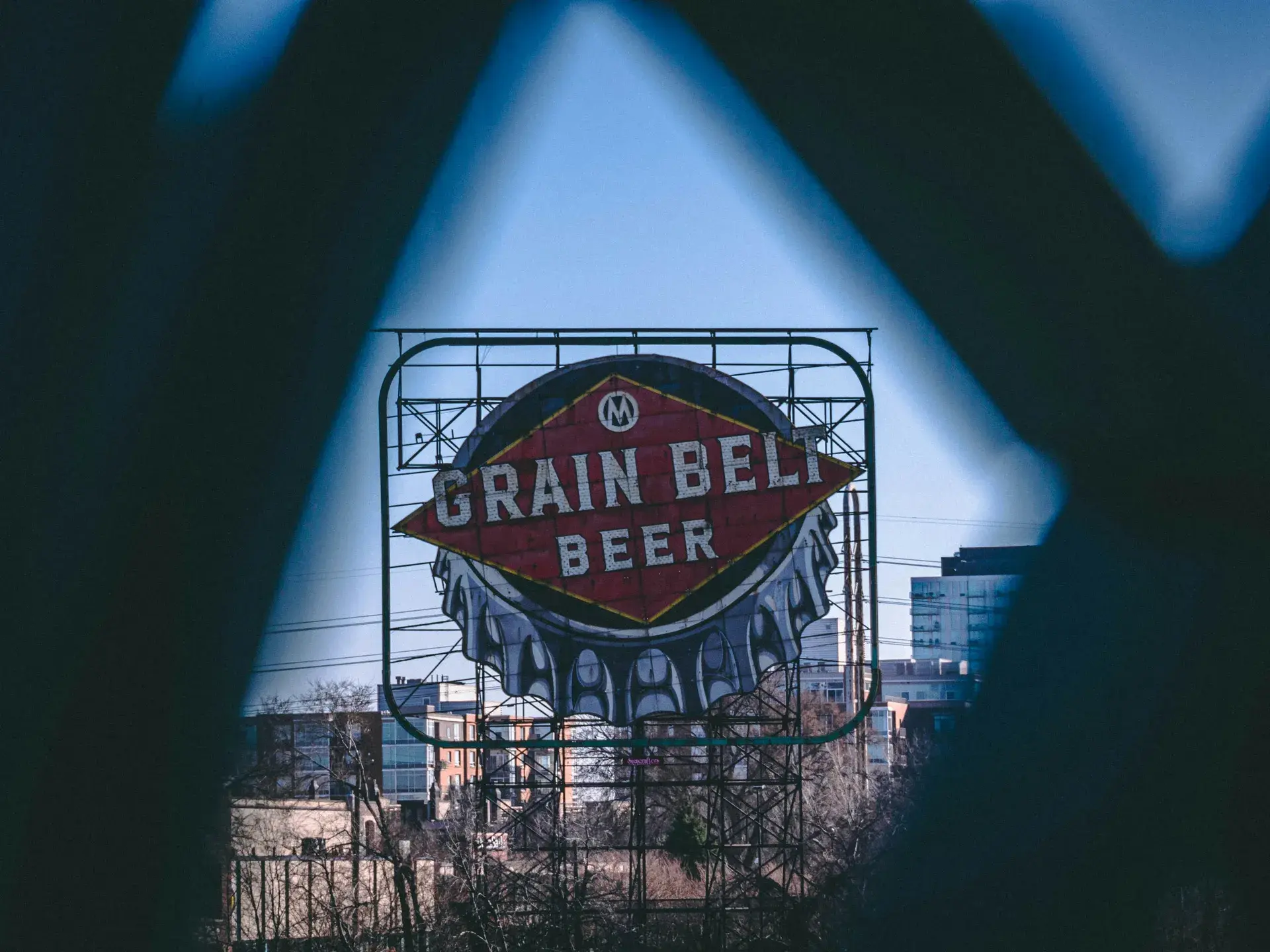
The Grain Belt Brewery complex, located along the river in adjacent Sheridan, is worth mentioning because it is part of Logan Park's extended cultural geography. The historic brewery — whose iconic “Grain Belt Beer” sign is one of the most recognizable landmarks in Minneapolis — has been partially redeveloped into offices, event spaces, and residential units. The sign, which stands on Nicollet Island by the Hennepin Avenue bridge, is a beacon of Nordeast identity that carries more emotional weight per square foot than almost any object in the city.
Logan Park Schools
Schools in Logan Park reflect the realities of a small, changing neighborhood in a large urban district. Minneapolis Public Schools serves the area, and families here navigate the same system of neighborhood schools, magnets, and open enrollment that operates citywide.
Nearby district schools include Pillsbury Elementary School (pre-K–5), about a mile northeast in Windom Park. Like many Minneapolis public elementary schools, it serves a diverse student body and offers programming tailored to the community's needs. Test scores, as in much of the district, reflect socioeconomic factors as much as instructional quality — a pattern that is consistent across Minneapolis Public Schools and that resists simple interpretation.
For middle school, Northeast Middle School (6–8) draws from several Northeast Minneapolis neighborhoods, and Edison High School, on 22nd Avenue NE, is the nearest of the district's high schools. Assignments depend on the address, so check the district's school finder for a specific house. Edison has a diverse student body and offers programs including career and technical education, arts, and college preparatory tracks. The school's location in Northeast Minneapolis gives it a connection to the neighborhood's identity, though like all large urban high schools, it faces the challenges of serving students with widely varying needs and backgrounds.
Families with school-age children in Logan Park often explore the broader Minneapolis magnet and choice system, which allows enrollment in schools across the city based on program interest and availability. Charter school options in Northeast Minneapolis include several with arts-focused programming — a natural fit for a neighborhood built around creative practice. Private and parochial schools, drawing on the neighborhood's Catholic heritage, provide additional options.
It's worth noting honestly: Logan Park is not a neighborhood that most families choose primarily for its schools. People move here for the arts community, the breweries, the cultural energy, and the relative affordability. Families who prioritize school rankings tend to look elsewhere — to the southwestern neighborhoods or the suburbs — though plenty of families raise kids here happily and value the diversity and community that Logan Park's schools provide.
Logan Park Real Estate & Housing
Logan Park's housing market tells the story of the neighborhood's transformation. A decade ago, this was one of the more affordable neighborhoods in Minneapolis — cheap workers' cottages, studio rents that artists could cover with part-time work, the kind of pricing that made creative risk-taking economically viable. Today, the neighborhood is still more affordable than the southwest Minneapolis lakeside neighborhoods or the North Loop, but the gap is closing. The arts district and brewery culture that made Logan Park interesting also made it desirable, and desirability is the enemy of affordability.
Buying in Logan Park
The owner-occupied market is dominated by single-family homes — primarily the early 20th century workers' cottages and bungalows that define the residential streets. These are not large homes: typical footprints are 900 to 1,400 square feet, on lots of 3,000 to 5,000 square feet. The neighborhood's median sale price was $338,250 in 2025, up from $299,000 in 2024, according to Minneapolis Area REALTORS — just under the citywide median of $350,000. With only a dozen sales in 2025, though, Logan Park's median swings from year to year, so treat any single year's figure as a rough guide.
Duplexes and small multi-family properties — a common housing type in Northeast Minneapolis — attract both owner-occupants (who live in one unit and rent the other) and investors. Condos offer an alternative for buyers who want the Logan Park aesthetic without the maintenance of a house, though only two sold in 2025.
New construction has entered the market in the form of townhomes and small multi-family developments. These developments are often controversial — they replace older structures (sometimes industrial buildings, sometimes houses) with contemporary designs that some residents view as incompatible with the neighborhood's character. The debate mirrors the broader tension in Logan Park between preservation and development.
Rental Market
Census estimates put the median rent across all of Logan Park's rental units at about $1,100 a month, against $1,371 citywide, though for a neighborhood this small the margin of error is wide. Older walk-ups sit at the lower end and newer construction at the higher end. Rents here are still lower than in the North Loop, and increasingly out of reach for the artists and service workers who gave the neighborhood its character.
Artist studio space — the critical infrastructure of the neighborhood's creative economy — is a separate market with its own pressures. Studio rents in the Northrup King Building, the Casket Arts Building, and similar spaces have risen substantially over the past decade, driven by demand from non-artist tenants (tech companies, design firms, creative agencies) who can pay more and by property owners who have recognized the value of the “arts district” brand. NEMAA and other organizations have advocated for policies to preserve affordable studio space, but the market incentives run in the opposite direction.
The Developer Question
New development in Logan Park is a loaded subject. Several significant projects — apartment buildings, townhome developments, mixed-use buildings — have been built or proposed in recent years, some on sites that previously held industrial buildings or artist studios. The argument for development is straightforward: the neighborhood needs more housing, density supports commercial corridors, and the tax base benefits from investment. The argument against is equally clear: every industrial building that becomes luxury apartments is studio space that's gone forever, and the new residents who move into market-rate units are typically not artists — they're professionals drawn by the arts district's aesthetic, who consume the neighborhood's creative culture without contributing to it.
The Logan Park Neighborhood Association has been active in negotiating with developers, pushing for affordable units, design standards, and community benefits. But the leverage of a neighborhood association in a hot real estate market is limited, and the fundamental dynamic — that Logan Park's cultural capital is being converted into financial capital at a rate that threatens the source — hasn't changed.
Getting Around Logan Park
Logan Park sits in the upper tier of Minneapolis walkability — not as pedestrian-friendly as downtown itself, but significantly more navigable than the suburban-style neighborhoods in the city's outer ring. The Walk Score of 84 reflects a neighborhood where daily errands are possible on foot if you live near Central Avenue, but where the industrial pockets and lower-density residential streets can feel spread out. The real story here is biking: Logan Park's Bike Score of 93 is among the best in the city, and cycling is the default mode of transportation for a significant portion of the neighborhood's population.
Central Avenue is served by Metro Transit Route 10, one of the busier bus routes in the system, providing frequent service between downtown Minneapolis and the northern suburbs. Additional bus routes serve Broadway and University Avenue. The Transit Score of 49 is honest — transit here is functional but not exceptional, and most Logan Park residents who commute downtown either bike (a 15–20 minute ride) or drive (10 minutes without traffic, which in Minneapolis means most of the time).
Biking infrastructure in Northeast Minneapolis is generally good, with bike lanes on several key corridors and connections to the riverfront trail system. The ride from Logan Park to downtown via the river trails is one of the best urban bike commutes in the city — flat, scenic, and largely separated from car traffic. Many Logan Park residents — particularly those in the arts community — don't own cars at all, relying on a combination of biking, transit, and occasional ridesharing.
For drivers, access is straightforward. Interstate 35W passes less than half a mile southeast of the neighborhood, connecting to downtown (5 minutes), the northern suburbs, and MSP Airport (20 minutes). Central Avenue itself provides a direct surface route to downtown via the Hennepin Avenue or Third Avenue bridges. Parking, unlike in denser neighborhoods like the North Loop or Uptown, is generally not a problem — most residential streets have free on-street parking, and the commercial corridors have adequate surface parking. During Art-A-Whirl weekend, parking becomes genuinely impossible in a radius of several blocks around the major studio buildings — plan to bike.
What's Changing: The Honest Version
Logan Park's changes are not theoretical or gradual — they are visible, ongoing, and the source of genuine anguish among the people who built the neighborhood's reputation. This section is the one that matters most for understanding where Logan Park is right now, and where it's heading.
The Artist Displacement Problem
Here is the central irony of Logan Park, stated plainly: artists moved into cheap industrial spaces, built a nationally recognized arts district, attracted breweries and restaurants, made the neighborhood desirable, drove up property values and rents, and are now being priced out of the spaces they transformed. This is not an exaggeration or a narrative convenience. It is happening in real time, building by building, lease by lease.
The mechanism is straightforward. A building owner who rented studio space to artists cheaply discovers that a tech company or design firm will pay far more. A developer buys an industrial building, evicts the studios, and builds luxury apartments. An artist whose lease comes up for renewal faces a steep increase and can't make the numbers work on a painter's income. The Northrup King Building — the district's anchor — has so far maintained its commitment to artist tenancy, but the economic pressures on its ownership are significant, and the building's long-term future as affordable artist space is not guaranteed.
NEMAA has advocated for policy interventions: zoning protections for artist workspace, tax incentives for building owners who maintain below-market studio rents, publicly funded studio spaces. Some progress has been made — the city has acknowledged the arts district as a cultural asset worth preserving — but the pace of policy change is slower than the pace of the real estate market. Every year, the district loses studios. Every year, the thing that makes Logan Park Logan Park gets a little smaller.
Old Nordeast vs. New Nordeast
The gentrification of Logan Park isn't just about artists. The long-time working-class communities — the Polish and Ukrainian families who have been here for generations, the Lebanese business owners on Central Avenue, the older residents on fixed incomes who bought their houses decades ago — are also navigating a neighborhood that is becoming more expensive, more transient, and culturally different from the place they know. Property taxes rise as values increase. The corner bar becomes a craft cocktail lounge. The meat market becomes a coffee shop. The VFW loses members.
This is not a simple narrative of villains and victims. Many long-time homeowners have seen their property values double or triple, which is financial security they couldn't have imagined. The new businesses bring amenities and foot traffic. The neighborhood is objectively safer and better-maintained than it was twenty years ago. But the texture of daily life has changed — the accents are different, the prices are different, the assumptions about what this place is and who it's for are different — and that matters to people who remember when it was otherwise.
Development Pressure
New construction continues across Logan Park and Northeast Minneapolis more broadly. The Minneapolis 2040 Plan, which eliminated single-family-only zoning and encourages density along transit corridors, has created new development possibilities in a neighborhood that was historically zoned for lower-density residential and industrial use. Apartment buildings and townhome developments are appearing on lots that previously held smaller structures or light industrial operations. The physical transformation is accelerating.
The debate is familiar but no less urgent for that. Proponents of development argue that more housing supply moderates prices (eventually), that density supports transit and commercial vitality, and that the neighborhood's industrial character was never static to begin with — the warehouses and factories were built for one purpose and repurposed for another; this is just the next cycle. Critics argue that the new construction is overwhelmingly market-rate, that it doesn't serve the artists or working-class families who need affordable housing, that it replaces irreplaceable industrial buildings with generic apartment blocks, and that the “arts district” label is being used to market units in buildings that are displacing the actual arts district. Both sides are substantially correct, which is what makes the conversation so difficult.
The Authenticity Paradox
Logan Park faces a version of the problem that every interesting urban neighborhood eventually encounters: authenticity is a finite resource that is consumed by the very people attracted to it. The neighborhood's appeal is rooted in its grit, its creative energy, its working-class honesty, its rough edges. But every new luxury development, every curated retail concept, every $16 cocktail sands down one of those edges. The question is whether Logan Park can remain genuinely creative and working-class as the economics push it toward something more polished and more expensive, or whether it will follow the trajectory of a hundred other arts districts across the country — beloved in memory, bland in reality.
The answer isn't determined yet. The Northrup King Building is still full of working artists. Art-A-Whirl still draws tens of thousands. The breweries still function as genuine community spaces rather than tourist traps. Nordeast still has Holy Land and Emily's Lebanese alongside the newer spots. The bones of the real neighborhood are intact. But the pressure is real, the direction of change is clear, and the people who care most about Logan Park's identity know that the window for preserving it is not unlimited.
Logan Park FAQ
Is Logan Park a good neighborhood in Minneapolis?
Logan Park is one of the most interesting neighborhoods in Minneapolis — creative, walkable along its commercial corridors, loaded with breweries and galleries, and more affordable than comparable neighborhoods south of the river. It's particularly appealing to artists, young professionals, and anyone who values cultural energy over manicured lawns. That said, it's changing fast: rents are rising, new luxury construction is replacing industrial buildings, and the gritty creative character that made Logan Park famous is under real pressure. If you want a neighborhood with personality and don't need everything polished, Logan Park is outstanding.
Is Logan Park, Minneapolis safe?
Logan Park is generally considered safe by Minneapolis standards. Violent crime rates are below the city average, and most residents feel comfortable walking the neighborhood day and night. Property crime — bike theft, car break-ins, occasional catalytic converter theft — is a reality, as it is across Northeast Minneapolis. The neighborhood's mix of residential streets, active commercial corridors, and foot traffic from the arts district creates a level of natural surveillance that contributes to safety. Exercise normal urban awareness, lock your bike with a U-lock, and you'll be fine.
What is Art-A-Whirl?
Art-A-Whirl is the largest open studio tour in the United States, held annually over a weekend in mid-May. It's organized by the Northeast Minneapolis Arts Association (NEMAA) and involves hundreds of artists opening their studios to the public across the Northeast Arts District, with Logan Park at its epicenter. The event draws more than 40,000 visitors and transforms the neighborhood into a massive, walkable gallery — studios in converted warehouses, pop-up shows in parking lots, live music, food trucks, and brewery events. Over the past few decades it has grown into one of the defining cultural events in the Twin Cities.
What breweries are in or near Logan Park?
Logan Park and the surrounding Northeast Minneapolis neighborhoods have one of the highest concentrations of craft breweries in the Midwest. Within or immediately adjacent to Logan Park: Indeed Brewing Company (711 15th Ave. NE) and Bauhaus Brew Labs (1315 Tyler St. NE, just across Central Avenue). Slightly farther out but very much part of the ecosystem: Dangerous Man Brewing (reopened at 861 E Hennepin Ave under new ownership), Sociable Cider Werks, Padraigs Brewing (945 Broadway NE), and Surly Brewing (in Prospect Park). The brewery scene here is social infrastructure as much as nightlife — taprooms function as neighborhood living rooms.
How much does it cost to live in Logan Park?
Logan Park straddles affordable and gentrifying. Census estimates put the median rent across all units at about $1,100 a month, against $1,371 citywide, though the margin of error for a neighborhood this small is wide. For buyers, the median sale price was $338,250 in 2025, according to Minneapolis Area REALTORS, just under the city's $350,000 — but that figure rests on only 12 sales. Most of what sells is early 20th century workers' cottages and bungalows, along with duplexes and the occasional condo. Prices have risen as the arts district reputation and brewery culture have drawn demand.
What is Central Avenue in Northeast Minneapolis?
Central Avenue is the main commercial corridor running through Northeast Minneapolis, along Logan Park's eastern edge. It's one of the most culturally diverse commercial streets in the Twin Cities, with a mix of Polish delis, Middle Eastern bakeries, Mexican taquerias, Vietnamese restaurants, East African shops, and increasingly, craft cocktail bars and brunch spots. The avenue reflects the neighborhood's layered immigrant history — each wave of newcomers added to the commercial ecosystem rather than replacing what came before, though gentrification is beginning to change that dynamic.
Where exactly is Logan Park in Minneapolis?
Logan Park is in Northeast Minneapolis, roughly bounded by Broadway Street NE to the south, 19th Avenue NE to the north, Central Avenue NE to the east, and Washington Street NE to the west. It sits at the heart of the Northeast Minneapolis Arts District and is surrounded by the neighborhoods of Holland, Sheridan, St. Anthony East, Northeast Park, and Windom Park. The neighborhood is named for Logan Park, a city park at 690 13th Avenue NE.
What is the Northeast Minneapolis Arts District?
The Northeast Minneapolis Arts District is the largest concentration of working artists in the Upper Midwest, with over 800 studios spread across converted warehouses, industrial buildings, and purpose-built studio spaces. The district spans several Northeast neighborhoods but is centered in Logan Park, where buildings like the Northrup King Building, the Casket Arts Building, and the Solar Arts Building house hundreds of painters, sculptors, printmakers, photographers, ceramicists, and mixed-media artists. The district is anchored by NEMAA (Northeast Minneapolis Arts Association), which organizes Art-A-Whirl and advocates for artist workspace preservation.
Is Logan Park walkable?
Mostly. Logan Park earns a Walk Score of 84 — you can walk to restaurants, bars, and shops along Central Avenue and 13th Avenue NE, but the neighborhood's industrial pockets and spread-out layout mean some errands require a bike or car. The Bike Score of 93 is more telling: Northeast Minneapolis is exceptionally bikeable, with good trail connections and relatively flat terrain. Most Logan Park residents use a combination of biking and driving, with transit as a supplement rather than a primary mode.
Is Logan Park gentrifying?
Yes, and the irony is acute. Artists moved into Logan Park's cheap industrial spaces in the 1990s and 2000s, built a nationally recognized arts district, attracted breweries and restaurants, and made the neighborhood desirable — which raised property values and rents to the point where many artists can no longer afford the studios that created the district's reputation. New luxury apartments and condos are replacing some of the older industrial buildings. Long-time working-class residents, many from the neighborhood's Polish, Ukrainian, and Lebanese communities, are also feeling the pressure. The gentrification here isn't theoretical — it's the central tension of the neighborhood's present and future.
What is the Nordeast accent?
The 'Nordeast' accent is a distinctive regional dialect associated with Northeast Minneapolis's Eastern European immigrant communities — particularly Polish and Ukrainian families who settled here in the late 19th and early 20th centuries. It's characterized by particular pronunciations (think 'Nordeast' instead of 'Northeast') and cadences that reflect the neighborhood's working-class, immigrant roots. The accent is fading as the original communities age and the neighborhood's demographics shift, but it remains a point of cultural identity and affectionate local humor. You'll still hear it at Surdyk's, at the VFW, and from longtime residents who grew up when the neighborhood was more kielbasa than IPA.
What Makes Logan Park Irreplaceable
There are neighborhoods in Minneapolis with better restaurants, better schools, better park access, more polish. Logan Park has never competed on those terms. What it offers is rarer and harder to engineer than any of that — a place where people actually make things. Not as a lifestyle brand or an Instagram aesthetic, but as a daily practice carried out in drafty studios with north-facing windows and paint on the floor. The painters and printmakers and ceramicists and metalworkers who filled these old industrial buildings didn't move here because it was trendy. They moved here because it was cheap and the light was good and nobody bothered them. They built something remarkable almost by accident — a creative district with national recognition, anchored by Art-A-Whirl, sustained by community, and threatened now by the very success it generated.
The question Logan Park faces is whether a neighborhood can survive its own story. The artists made it interesting; the breweries made it fun; the developers noticed; and now the economics are squeezing out the people who created the thing everyone wants to be near. That's not unique to Logan Park — it's the oldest story in American urbanism. But it stings more here because the neighborhood never pretended to be anything it wasn't. It was working-class and immigrant and creative, and it wore all of that openly, without apology. Whether it can hold onto that honesty as the money arrives is the only question that matters. Walk through the Northrup King Building on an Art-A-Whirl Saturday — past the open studios and the spilled wine and the conversations between strangers about a piece of art that someone made in this room, in this light — and you'll understand what's at stake.

Keep exploring
Logan Park appears in
- Best Bakeries
- Best Breweries by Neighborhood
- Best Burgers and Juicy Lucys
- Best Cheap Eats in Minneapolis — Under $15
- Best Coffee Shops by Neighborhood
- Best Food Neighborhoods
All 27 guides ↓Show fewer ↑
- Best Food Trucks
- Best Happy Hours
- Best Hmong Food
- Best Ice Cream
- Best Late Night Food
- Best Mexican Food
- 10 Best Neighborhoods
- Best Neighborhoods for Artists and Creatives
- Best Neighborhoods for Dog Owners
- Best Neighborhoods for Nightlife
- Best Neighborhoods for Remote Workers
- Best Neighborhoods for Young Professionals
- Best Parks by Neighborhood
- Best Patios and Outdoor Dining by Neighborhood
- Best Pizza
- Best Restaurants in Northeast Minneapolis
- Best Tacos
- The History of Minneapolis Neighborhood Signs
- Most Bikeable Neighborhoods
- Most Walkable Neighborhoods
- Moving to Minneapolis