Minneapolis Neighborhood
Kenny
One of the smallest neighborhoods in Southwest Minneapolis — where the yards are deep, the streets are quiet, and the biggest decision most evenings is whether to walk to Kenny Park or bike up to Lake Harriet.
№ 38 of 87 · Southwest community · Last updated: October 2026 · A complete neighborhood guide
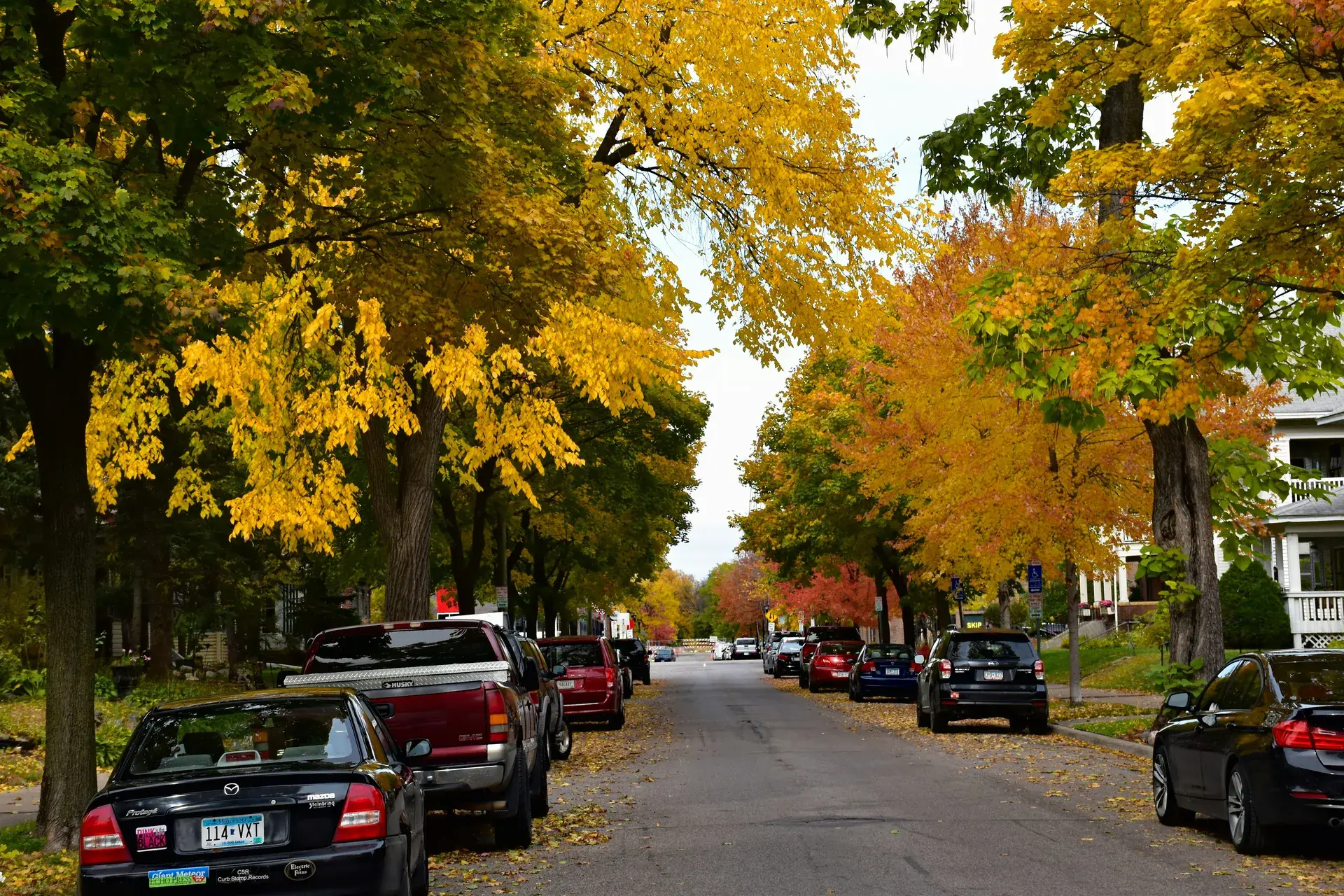
There's a particular kind of quiet that settles over Kenny on a weekday afternoon in October. Not silence — you can hear a leaf blower somewhere, and a dog barking two blocks over, and the faint hum of traffic on the Crosstown — but the specific quiet of a neighborhood where most people are at work or at school and the houses are just sitting there, solid and patient, doing what houses in Southwest Minneapolis have done for generations: holding their ground. A kid on a bike rides past without looking up. Someone is raking. The light through the elms is gold and serious. Two blocks over, the rec center at Kenny Park is probably hosting something — a youth basketball clinic, a neighborhood association meeting, a birthday party in the shelter. This is Kenny at its most essential — not performing anything, not selling anything, just being a neighborhood in the plainest, best sense of the word.
What is Kenny, Minneapolis?
Kenny is a small residential neighborhood in Southwest Minneapolis, bounded by West 54th Street to the north, Lyndale Avenue South and Highway 121 to the east, the Crosstown (Highway 62) to the south, and Logan Avenue South to the west. It covers a little under two-thirds of a square mile and had about 3,900 residents in the 2020 Census — by area, the smallest of the neighborhoods in Southwest Minneapolis. It shares its northern border with Lynnhurst, its eastern edge with Windom, and its western boundary with Armatage. To the south, across the Crosstown, lies Richfield.
If you've heard of Kenny at all, it's probably because someone who lives here mentioned it quietly — Kenny doesn't advertise. It appears on few "best of" lists and shows up in no tourism guides. It is, in the most literal sense, a neighborhood for the people who live in it.
Kenny doesn't have a big lake — just Grass Lake, a wetland tucked against the Crosstown. It doesn't have a creek running through it; Minnehaha Creek passes a couple of blocks north, in Lynnhurst. It doesn't have a bandshell or a farmers market or a commercial district that draws visitors from across the metro. What it has is a park, a school, good bones, and the kind of residential character that makes people stay for decades. In a city full of neighborhoods competing for attention, Kenny is content to be the one that doesn't compete at all.
The neighborhood shares its name with Kenny Park, which the Park Board named for Sister Elizabeth Kenny, the polio fighter who founded the Sister Kenny Institute in Minneapolis. There's nothing showy here. The houses are solid. The trees are mature. The lots are generous. The neighbors wave. It's a neighborhood that earns its reputation through consistency rather than spectacle, and for the families who choose it, that's precisely the point.
Kenny Neighborhood Sign
Kenny, Minneapolis — Key Stats (2025–2026)
- Residents (2020 Census)
- ~3,900
- Median home sale price (2025 data)
- $436K
- Days on market (2025 data)
- 32 days
- Neighborhood area
- 0.6 sq mi
- Era most homes were built
- 1940s–60s
- Drive to downtown or MSP airport
- 15–20 min
- Walk Score (Oct 2026)
- 46
- Bike Score (Oct 2026)
- 60
Kenny History & Origins
Kenny shares its name with Kenny Park, named for Sister Elizabeth Kenny after polio scares in 1946 and 1949 had all but emptied Minneapolis playgrounds. Before any European settler arrived, this ground was Dakota homeland — part of the vast territory stretching across what is now southern Minnesota and including Bdote, where the Mississippi and Minnesota Rivers meet, which many Dakota people consider a sacred place of creation. The Dakota people lived, hunted, and gathered across these prairies and woodlands for centuries before treaties and forced removal reshaped the landscape irrevocably in the 1850s and 1860s. The ground underfoot has a longer memory than any of the houses sitting on it.
Until 1927, this wasn't Minneapolis at all. It was the northern edge of Richfield; that year Minneapolis annexed about a mile of northern Richfield, from Fort Snelling to Edina. A rail line had reached Lake Harriet in 1880, and the neighborhoods closest to the water — Linden Hills, East Harriet, the northern part of what is now Fulton — filled in long before the blocks this far south.
Kenny's development as a residential neighborhood came later than that of its neighbors to the north, and it came in two stages. The northern blocks filled in first; today about three in ten Kenny homes date from before 1940. Much of the land south of 58th Street was the Bachman family farm, and according to the Kenny Neighborhood Association it stayed open field until the early 1950s, when the family moved its nursery out of the city. Most of Kenny's houses — about 60 percent — were built between 1940 and 1969, which gives the neighborhood a housing stock that's mostly mid-century, with older houses toward 54th Street. The ambition wasn't grandeur. It was solidity. And decades later, that solidity is exactly what makes the neighborhood hold together.
The neighborhood's anchor institution — Kenny Park — was a long time coming. The Park Board first looked for a park site here in 1928, marked the block between Emerson and Dupont and 57th and 58th for acquisition in 1931, and dropped the plan in 1932, when property owners objected to being assessed for it in the early years of the Depression. The board finally acquired the land in 1948, half of it tax-forfeited property it got from the state for free. Kenny School was built around the same time, the park was dedicated in October 1955, and Susan B. Anthony Junior High went up on the west side of the park a few years later. Together, the park and the schools gave the neighborhood a center of gravity that it still orbits today. Unlike Fulton, which orients itself around the lake and the commercial energy of 50th Street, Kenny's identity has always been more inward-facing — organized around the park, the school, and the blocks themselves.
Kenny is more affordable than the lake-adjacent neighborhoods to the north, and perhaps a touch less self-conscious about it. That relative affordability, combined with the same excellent park infrastructure and school access, makes Kenny a quiet draw for young families who can't quite afford Fulton or Linden Hills but want the same Southwest Minneapolis package.
Living in Kenny
If you drew a Venn diagram of Kenny and Armatage, its neighbor across Logan Avenue, the overlap would be enormous. Same mid-century housing stock. Same lawn-care habits and block-party culture. Same general orientation toward family, stability, and quiet civic participation. The differences are ones of degree, not kind: Kenny is smaller, it has Grass Lake instead of a big park, and its few businesses sit along Lyndale instead of Penn. Even that is only the edge of one node — 54th & Lyndale, at Kenny's northeast corner, where the grocery store and the restaurants are across the street in Tangletown.
The result is a neighborhood that feels even more purely residential than its already-residential neighbors. You can walk four or five blocks in any direction through Kenny and see nothing but houses, trees, sidewalks, and the occasional garage. This is the appeal. People who live in Kenny aren't here for the nightlife or the restaurant scene or the cultural calendar — they're here because they want a deep yard, a good school within walking distance, neighbors who look out for each other, and a level of quiet that's genuinely hard to find inside city limits.
The neighborhood skews heavily toward families and long-term homeowners. Block clubs are active. The Kenny Neighborhood Association organizes events, coordinates with the city on planning issues, and maintains the kind of civic infrastructure that keeps a small neighborhood from feeling anonymous. There's a particular pride in Kenny's smallness — residents know they're not the headline neighborhood of Southwest Minneapolis, and they like it that way. The lack of a marquee attraction means the people who find Kenny tend to be the people who are specifically looking for what Kenny offers: peace, stability, and the feeling of being slightly off the beaten path while still being ten minutes from everything.
There's a suburban quality to daily life in Kenny that some people love and others find suffocating — though the people who find it suffocating tend not to live here. The streets are wide and quiet. The yards are deep. Kids play outside unsupervised in a way that feels almost anachronistic. In the summer, someone is always grilling. In the winter, the ice rink at Kenny Park fills with kids in hockey skates after school. The rhythms are seasonal, predictable, and comforting in their repetition. If you want surprise and novelty, you live in Uptown. If you want to know exactly what your Tuesday evening looks like, you live in Kenny.
The neighborhood's relationship with its borders is worth understanding. 54th Street to the north is the dividing line between Kenny and Lynnhurst. Crossing 54th northbound puts you in Lynnhurst's territory — Minnehaha Creek and its parkway a couple of blocks up, Lake Harriet beyond. Crossing Lyndale eastbound puts you in Windom; crossing Logan westbound puts you in Armatage. The Crosstown runs along the south edge, with Richfield on the other side. Kenny sits in the quiet quadrant behind these more visible edges, and its character is defined as much by what it borders as by what it contains.
Kenny Food, Drink & Local Spots
Let's be honest: Kenny is not a food destination. The neighborhood is almost entirely residential, and what commerce it has lines Lyndale Avenue along its east edge — the neighborhood association counts two churches and "a number of businesses along Lyndale Avenue." The corner of 54th & Lyndale, at Kenny's northeast corner, is the closest thing to a commercial node, and most of it sits just across the street in Tangletown and Windom. This isn't a complaint — it's a description. Kenny residents have made peace with borrowing their dining scene from the neighbors.
Along Lyndale
5516 Lyndale Ave. S., on the Kenny side of Lyndale. A big liquor store with a market, deli, and wine bar attached; the wine bar runs a Sunday brunch from 10 to 2.
5327 Lyndale Ave. S., kitty-corner across 54th & Lyndale in Tangletown. A full grocery store a short walk from Kenny's northeast blocks, open 6 a.m. to 10 p.m., with a café, a soup bar, and a salad bar.
5244 Lyndale Ave. S., a block north of 54th Street in Lynnhurst. Hennepin County Library's Washburn branch, in its current building since 1970, with computers, a meeting room, and free events.
Parks & Outdoors in Kenny
Kenny doesn't have a big lake — Grass Lake, at its southern edge, is a wetland — and if you're coming from Linden Hills or East Harriet, that feels like a notable absence. But what Kenny does have is a genuinely excellent neighborhood park and easy access to the broader Minneapolis park system, which remains one of the best urban park systems in the country.
Kenny Park
Kenny Park is the neighborhood's anchor — a well-maintained nine-acre park at the center of the neighborhood that functions as the community's living room. The park includes a recreation center, a playground, a wading pool, baseball and softball fields, a soccer field, tennis and pickleball courts, a half-court basketball court, and a winter ice rink with a pond hockey rink that draws kids from across the surrounding blocks. The rec center hosts youth programming, community meetings, and neighborhood events. In the warmer months, the park fills with families after dinner; in the colder months, the ice rink becomes the social center. If Kenny has a town square, this is it. The park is the reason the neighborhood feels like a community rather than just a collection of houses.
Grass Lake
A couple of blocks south of Kenny Park, Grass Lake sits at the south end of the neighborhood: a 27-acre wetland that runs down to the Crosstown. It's home to a wide variety of birds and waterfowl, and the Kenny Neighborhood Association calls it a favorite walking destination. The association's Grass Lake Restoration Team works on it through the season, with buckthorn busts in the fall and a BioBlitz in August 2026.
Lake Harriet & the Chain of Lakes
Lake Harriet is about three-quarters of a mile north of Kenny's border — a reasonable bike ride, a longer walk. The 3-mile loop around the lake, the Bandshell concerts, the beaches, the kayak rentals — all of it is accessible from Kenny without too much effort. Kenny residents don't have the walk-out-the-door lake access that Linden Hills and East Harriet enjoy, but they're close enough to use the lake regularly. The broader Chain of Lakes trail system connects Lake Harriet to Bde Maka Ska and Lake of the Isles, forming an interconnected loop that's one of Minneapolis's greatest public assets.
Armatage Park
A few blocks west of Kenny's border, Armatage Park offers another set of athletic fields, a wading pool, a skate park, and a full-size basketball court. Between Kenny Park and Armatage Park, families in this part of Southwest Minneapolis have strong options without needing to drive anywhere.
Grand Rounds & Biking
Kenny connects to the Grand Rounds Scenic Byway — Minneapolis's 51-mile network of parkways and bike paths — via Minnehaha Parkway, a couple of blocks north of 54th Street. The Bike Score of 60 reflects decent cycling infrastructure: well-maintained paths and connections to the lake trails and the Minnehaha Creek corridor. For a neighborhood without its own marquee natural feature, Kenny punches above its weight in outdoor access simply by being well-connected to the network around it.
Kenny Schools
Schools are a major draw for families in Kenny — and right now, they're also the biggest open question.
Kenny Elementary School serves kindergarten through fifth grade and functions as a genuine community institution. It's walkable from nearly every address in the neighborhood, and the school community overlaps heavily with the park and the neighborhood association.
Middle school is Anthony Middle School, on the west side of Kenny Park, which serves several Southwest Minneapolis neighborhoods. Anthony feeds Southwest High School — an International Baccalaureate school in Linden Hills. The elementary-through-high-school pipeline is one of the things that keeps families rooted in Kenny for the long haul.
That pipeline may change. In September 2026, Minneapolis Public Schools proposed closing Kenny Elementary in all three of its school-transformation options; Kenny students would join Armatage or Windom by home address, and Anthony would continue to feed Southwest. The district is taking feedback through mid-October, with a board vote expected in November and changes as early as the 2027–28 school year.
The school question matters more in Kenny than in most Minneapolis neighborhoods because the school is so physically central to the community. Kenny Elementary isn't tucked away on the edge of the neighborhood — it's right there, visible from the park, walkable from everywhere. The morning drop-off and afternoon pickup are neighborhood rituals. Parents know each other from the playground and the PTA and the ice rink. The school and the park and the neighborhood association form a kind of triple helix of community life that makes Kenny feel unusually cohesive for its size.
Families also have access to Minneapolis's broader magnet school system for alternative pathways, and to private and faith-based schools in the surrounding area.
Kenny Real Estate & Housing
Kenny is more affordable than Fulton and Linden Hills — but "more affordable" in Southwest Minneapolis still means above the citywide median. The median sale price in Kenny was $436,238 in 2025, according to Minneapolis Area REALTORS, and it has stayed between about $410,000 and $450,000 since 2021. The citywide Minneapolis median was $350,000, so Kenny trades at a modest premium — significant, but far less steep than the lake-adjacent neighborhoods to the north. Lynnhurst, across 54th Street, had a median of $773,000.
Homes sell reasonably quickly here. The average time on market in 2025 was 32 days, against 55 for Minneapolis as a whole, and sellers received just over their original list price on average. Only 48 homes changed hands all year — this is a small neighborhood, and the supply is thin.
What Your Money Buys
At the lower end of the market, you're looking at smaller houses that need updating — original kitchens, unfinished basements, single-car garages. Around the median, you get a well-maintained three-bedroom house with updates. Well above it, you're into larger renovated homes, four-bedroom properties, or the newer construction that's starting to appear as teardowns replace the original housing stock.
The housing is mostly mid-century: about 60 percent of Kenny's homes were built between 1940 and 1969, and most of the rest before 1940. Lots tend to be generous by city standards — deep backyards are common. Most homes are owner-occupied — about 85 percent of households own — and the rental stock is minimal, giving the neighborhood a settled, invested feel.
One thing worth noting for buyers: Kenny's lots tend to be slightly larger than those in the denser neighborhoods closer to the lakes, which means the teardown-and-rebuild calculus is particularly attractive to developers. A 7,000-square-foot lot with a 1,200-square-foot house on it is, to a builder, an invitation. This is reshaping the market in ways that benefit sellers and complicate the experience for everyone else. If you're shopping in Kenny, be prepared for the possibility that the modest house next door might not be there in three years.
Getting Around Kenny
Kenny earns a Walk Score of 46 — walkable for a few neighborhood errands but not a place where you can go car-free. The commercial corner at 54th & Lyndale is walkable from the northern and eastern blocks of the neighborhood; from the southwest blocks, you're more likely to bike or drive. The interior of Kenny is almost entirely residential, so there's not much to walk to within the neighborhood itself besides the park, the schools, and Grass Lake.
Biking is the better bet. The Bike Score of 60 reflects workable infrastructure — connections to the Grand Rounds trail system and the general culture of cycling that defines Southwest Minneapolis. A bike opens up the lake trails, the Minnehaha Creek corridor, and the commercial nodes in a way that walking alone doesn't quite manage.
For getting beyond the neighborhood, the car remains dominant. Downtown Minneapolis is 15–20 minutes by car; MSP International Airport is similarly accessible via the Crosstown. Metro Transit's Route 4 runs up Lyndale Avenue along Kenny's east edge, and its Penn Avenue branch runs a few blocks west through Armatage; both continue through Lyn-Lake to downtown, but frequency and coverage are limited enough that most residents drive for their commute. Parking is easy — residential streets are uncrowded.
One practical note: Kenny's position on the southern edge of Minneapolis means that access to Highway 62 (the Crosstown), which forms its south edge, and to I-35W, under a mile east, is straightforward, making commutes to the southern suburbs, Bloomington, and the airport relatively painless. For anyone working in Richfield or Edina, the commute from Kenny is even shorter. The neighborhood's geography is quietly convenient — not transit-rich in the way that Uptown or Northeast can claim, but well-positioned for the car-based commuting that most Southwest Minneapolis residents actually do.
What's Changing: The Honest Version
Kenny is not a neighborhood in crisis. It's not even a neighborhood in transition, exactly. But it has the same set of low-grade tensions that run through all of Southwest Minneapolis — tensions that are worth naming honestly.
The Teardown Question
As land values rise across Southwest Minneapolis, the same dynamic playing out in Fulton and Linden Hills is arriving in Kenny: older houses on generous lots are being purchased, demolished, and replaced with larger, more expensive homes. The new construction tends to maximize square footage — two stories where there was one, a roofline that towers over the neighbors, a price point that pushes the block's comps upward. Long-term residents watch the streetscape they bought into change house by house, and the feelings about it range from resigned to angry. The market is doing what markets do. Whether the neighborhood is better for it is a different question.
Affordability Is Relative
Kenny has traditionally been the "affordable" option in Southwest Minneapolis — the entry-level neighborhood for families who wanted the schools and the parks without the lake premium. By the numbers, that still holds: Kenny's median sale price rose 6.4 percent from 2021 to 2025, while Fulton's rose 20 percent. But as teardowns replace older houses and renovation costs climb, the top of the market keeps moving up, and the neighborhood that was once accessible to teachers and city workers is becoming less so. The demographic implications of that shift are real. Kenny, like most of Southwest Minneapolis, is largely white, largely homeowning, and largely upper-middle-class. That homogeneity isn't an accident — it's a product of housing costs, historical patterns, and the self-reinforcing dynamics of desirable school districts.
Property Taxes
Rising home values mean rising property tax assessments, and long-term Kenny homeowners — particularly retirees and those on fixed incomes — feel the squeeze. This is a tension shared across Southwest Minneapolis: the very desirability that makes the neighborhood pleasant to live in also makes it increasingly expensive to stay. Some long-term residents are being priced out not by the housing market but by the tax bill. When a teardown next door sells for $700,000, the assessor takes note — and your taxes go up whether you asked for it or not.
Property Crime
Like most of Southwest Minneapolis, Kenny has seen a modest uptick in property crime in recent years — vehicle break-ins, catalytic converter thefts, the occasional package taken from a porch. Violent crime remains rare. Kenny is a safe neighborhood by any reasonable standard, but it's not insulated from the property-crime patterns that affect much of Minneapolis. Long-term residents note that things have changed since 2020, and while the shift is more about perception than statistics in most cases, the perception matters. People lock their cars now. They didn't always.
Kenny FAQ
Is Kenny a good neighborhood in Minneapolis?
Yes. Kenny is a small, quiet, family-oriented neighborhood in Southwest Minneapolis with good park access and solid housing stock. It lacks the commercial buzz of Linden Hills or 50th & France, but for residents who want stability and calm above all else, that's the point.
Is Kenny, Minneapolis safe?
Kenny is one of the safer neighborhoods in Minneapolis. Violent crime is rare. As with most Southwest neighborhoods, property crime — vehicle break-ins and package theft — has ticked up in recent years, but the overall safety profile remains strong. Families with children are comfortable here.
What is Kenny, Minneapolis known for?
Kenny is known for being small, quiet, and deeply residential. Kenny Park is the neighborhood anchor — a well-maintained park with a rec center, playground, ball fields, a wading pool, and a winter ice rink. Grass Lake, a 27-acre wetland at the south end of the neighborhood, is a favorite place to walk.
How much do homes cost in Kenny, Minneapolis?
The median sale price in Kenny was $436,238 in 2025, across 48 closed sales, according to Minneapolis Area REALTORS. It has stayed between about $410,000 and $450,000 every year since 2021. That puts Kenny a little below Armatage ($460,000) and far below Lynnhurst ($773,000), but above the citywide median of $350,000.
Is Kenny walkable?
Not especially. Kenny earns a Walk Score of 46 and a Bike Score of 60. The commercial corner at 54th & Lyndale, on the neighborhood's northeast corner, is walkable from the northern and eastern blocks, but Kenny is primarily residential and car-dependent for most errands beyond the immediate area. Biking is decent, with the Minnehaha Parkway trail and the Grand Rounds a couple of blocks north of 54th Street.
What schools serve Kenny, Minneapolis?
The standard public school pipeline runs through Kenny Elementary (K–5), Anthony Middle School, and Southwest High School, an International Baccalaureate school in Linden Hills. Kenny Elementary and Anthony both sit beside Kenny Park. In September 2026, Minneapolis Public Schools proposed closing Kenny Elementary in all three of its school-transformation options, with a board vote expected in November.
What are the best restaurants near Kenny, Minneapolis?
Kenny itself has very few commercial establishments, and they sit along Lyndale Avenue on its east edge. South Lyndale Liquors & Market, on the Kenny side of Lyndale, has a deli and a wine bar, and Kowalski's Lyndale Market is just across 54th & Lyndale in Tangletown. For a wider choice of restaurants, residents head northwest to Linden Hills or 50th & France.
Where exactly is Kenny in Minneapolis?
Kenny is in Southwest Minneapolis, bounded by West 54th Street (north), Lyndale Avenue South and Highway 121 (east), the Crosstown Highway (south), and Logan Avenue South (west). It borders Lynnhurst to the north, Windom to the east, Armatage to the west, and the suburb of Richfield to the south.
Is Kenny a good place to raise a family?
Kenny is widely considered one of the best family neighborhoods in Minneapolis. Kenny Park provides a central gathering place with a playground, ball fields, a wading pool, and a rec center, with the elementary and middle schools on either side of it. The streets are quiet, the lots are generous, and the community is tight-knit.
How is Kenny different from Armatage?
Kenny and Armatage share a border along Logan Avenue and have very similar housing — in both, most homes were built between 1940 and 1969. The main differences: Kenny is smaller (about 3,900 residents in the 2020 Census vs. Armatage's 5,400), has Grass Lake at its south end, and keeps its few businesses on Lyndale, while Penn Avenue runs through Armatage. Armatage has the bigger park, with a skate park and a full-size basketball court.
How far is Kenny from downtown Minneapolis?
Kenny is approximately 15–20 minutes from downtown Minneapolis by car, depending on traffic. Metro Transit's Route 4 runs up Lyndale Avenue along Kenny's east edge, and its Penn Avenue branch a few blocks west; both continue through Lyn-Lake to downtown, though most residents drive for their commute. MSP International Airport is also roughly 15–20 minutes away via the Crosstown, which runs along Kenny's south edge.
What Makes Kenny Worth Knowing
Kenny doesn’t announce itself. There’s no marquee attraction, no destination restaurant, no lake with a bandshell. What there is, instead, is a neighborhood that has figured out how to be genuinely good at the ordinary things — good schools, good park, good neighbors, good trees, houses that were built to last and mostly have. The scale is small enough that you actually know the people on your block, and stable enough that they’re still there five years later.
It’s the kind of place where the biggest controversy is what’s happening to the lot on the corner, and the biggest joy is watching your kid walk to the same elementary school you can see from your front porch. Where the ice rink freezes over every winter and the same families show up every year, a little taller, a little older, but still here. That’s not glamorous. But for the people who live here, it’s enough — and then some.

From the shop
Made for people who love it here.
From Minneapolis, With Love - Large Tote Bag
Keep exploring