Minneapolis Neighborhood
King Field
A South Minneapolis neighborhood between Lyndale and I-35W, from 36th Street south to 46th, where Martin Luther King Park anchors a community that is affordable by Minneapolis lake-adjacent standards, walkable enough to matter, and close-knit without making a bumper sticker out of it.
№ 40 of 87 · Southwest community · Last updated: October 2026 · A complete neighborhood guide
On a Saturday morning in September, Martin Luther King Park is doing what it does best — holding the whole neighborhood at once without making it look crowded. A Somali family is picnicking near the wading pool while two kids chase each other through the spray. A white couple in their seventies walks the perimeter path with matching Nordic poles. A group of Latino dads is running a pickup soccer game on the east field, and the shouts carry across the rec center parking lot where a woman is unloading folding chairs for what appears to be a birthday party. This is just what the park looks like on a regular weekend.
What is King Field, Minneapolis?
King Field is a residential neighborhood in South Minneapolis, roughly bounded by 36th Street to the north, I-35W to the east, 46th Street to the south, and Lyndale Avenue to the west. It takes in two of South Minneapolis's most significant commercial corridors — Nicollet through its eastern half, Lyndale along its western edge — without being dominated by either. The neighborhood is home to about 7,600 residents and is anchored by Martin Luther King Park, a green space with a recreation center, playground, wading pool, and athletic fields that functions as the neighborhood's living room.
King Field does not have the name recognition of Minneapolis's lake neighborhoods or the cultural cachet of Uptown or Northeast. What it has, instead, is a residential quality that people who live here describe in practical terms — houses on quiet blocks, walkable access to groceries and restaurants on Nicollet, a park that the kids actually use, and neighbors who look out for each other without expecting a parade for it. It is one of those neighborhoods that shows up on nobody's "top ten" lists and consistently holds onto the people who find it.
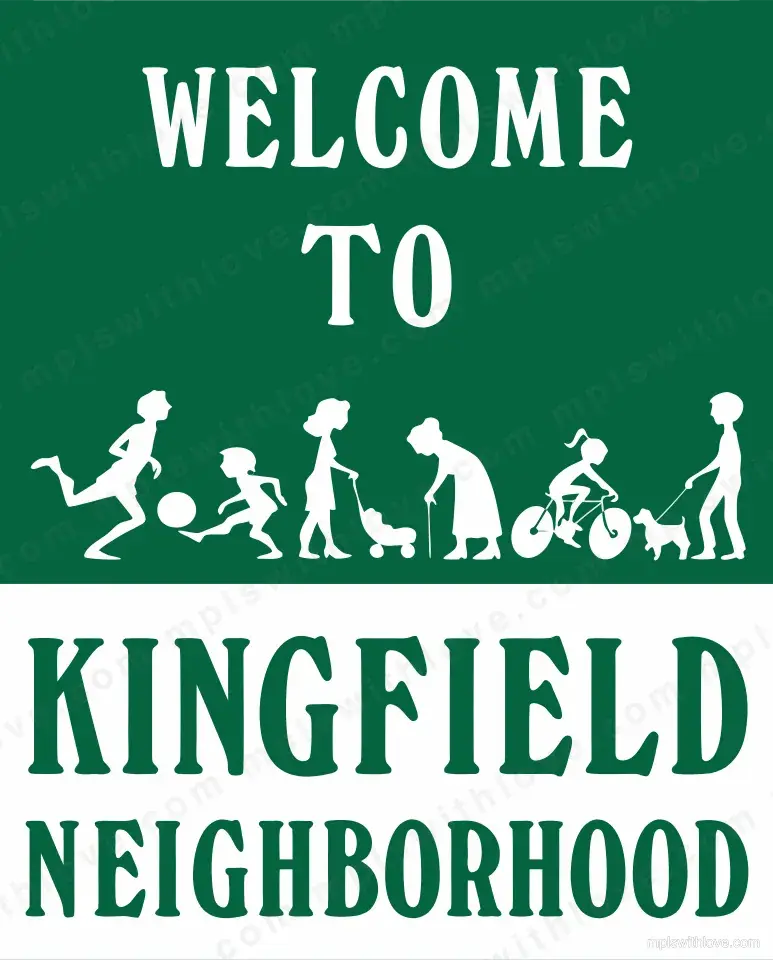
King Field Neighborhood Sign
King Field, Minneapolis — Key Stats (2025–2026)
- Residents (2020 Census)
- ~7,600
- Median home sale price (2025 data)
- $471K
- Era most homes were built
- 1900s–1930s
- Primary commercial corridor
- Nicollet Ave
- Signature green space
- Martin Luther King Park
- Drive to downtown Minneapolis
- 15–20 min
King Field History & Origins
The land that is now King Field is Dakota homeland, part of the territory that the Dakota people inhabited for centuries before European colonization displaced them. The area was developed for residential use in the early twentieth century as Minneapolis followed its streetcar lines south from the downtown core, filling in block by block. North of 40th Street, much of it was built up between 1903 and 1914 with Colonial Revival houses, duplexes, and Craftsman bungalows; the blocks south of 40th followed from the late 1910s through the 1930s. Middle-class families made up the bulk of the newcomers.
Where the name King Field comes from is an open question. The park that anchors it was Nicollet Field, named for the avenue on its western edge, until October 9, 1968, when the Park Board renamed it for Martin Luther King Jr., who had been assassinated earlier that year. Some trace the neighborhood's name to the park; others to the fields of Colonel William S. King, the nineteenth-century congressman whose Lyndale Farm gave Lyndale Avenue its name. The Kingfield Neighborhood Association's director has called the name an ongoing debate, spelling included: the city uses both King Field and Kingfield.
Through the postwar decades, King Field followed the trajectory common to many South Minneapolis neighborhoods — stable, middle-class, predominantly white, and quietly suburban in feel despite being within city limits. It is still predominantly white: in Minnesota Compass's 2020–2024 estimates, about four in five residents are white, and about one in twenty was born outside the United States.
Living in King Field
King Field is a neighborhood that you understand by walking it. The blocks between Lyndale and Nicollet are lined with mature elms and maples, and the houses beneath them — one- and two-story bungalows with front porches and detached garages — create a scale that is human and unpretentious. You can tell which houses have been in the same family for decades (the immaculate lawn, the aluminum awnings, the small statue of the Virgin Mary near the front steps) and which were bought recently by young families (the new roof, the updated windows, the toddler's bicycle on the porch). The mix is one of King Field's defining features — this is not a neighborhood that has been gentrified into uniformity or neglected into decline. It is in the middle, which is where most actual neighborhoods are.
King Field is mostly white: about four in five residents, by Census estimates, a higher share than in Minneapolis as a whole.
Martin Luther King Park is the social center. The rec center hosts youth programming, community meetings, and pickup basketball. The playground draws families from the surrounding blocks. The wading pool is the summer babysitter for kids too young for the public pools. And the open fields — large enough for soccer, frisbee, or just lying in the grass — give the neighborhood a sense of breathing room that the modest lot sizes of the housing stock do not provide on their own. The park is not just a green space. It is the place where the neighborhood's different communities overlap.
King Field Food, Drink & Local Spots
King Field's food scene is neighborhood-scale — a handful of places that serve the community well without attracting destination diners from across the city. The Nicollet Avenue corridor through the neighborhood's east side provides the most options, while Lyndale Avenue to the west adds a few more. This is not a neighborhood you come to for a culinary experience. It is a neighborhood where you can get a solid meal, a decent cup of coffee, and the groceries you need without driving to a different part of town. For a residential neighborhood, that is exactly the right calibration.
The Anchors
4552 Grand Avenue South, at 46th Street. John Kraus's celebrated bakery — serious French pastry technique applied with Midwestern restraint. The croissants are exceptional. The cakes are precise. The space is small and the line can be long on weekend mornings, but the quality justifies the wait.
Also Worth Knowing
Nicollet Avenue through this stretch of South Minneapolis is a working commercial corridor — not a destination strip, but a functional one. Laundromats, auto shops, small groceries, and restaurants serving the neighborhood's various communities line the avenue. The food reflects the demographics: you can find Somali tea shops, Mexican bakeries, and American diners within a few blocks of each other. Lyndale Avenue to the west has its own commercial nodes, though the stretch near King Field is quieter than the Lyndale corridor further north. For more ambitious dining, residents head to Tangletown or the 48th and Chicago area.
Parks & Outdoors Near King Field
King Field does not have a lake. This is the first thing that separates it from the neighborhoods next door to the west or a mile northeast that can claim water access. What it has instead is Martin Luther King Park — about 18 acres of green space that functions as the neighborhood's backyard, playground, sports complex, and community gathering place all at once. For a neighborhood of modest homes on modest lots, the park provides the outdoor scale that the private parcels cannot.
Martin Luther King Park
MLK Park is the neighborhood's anchor. The park includes a recreation center with gym space, meeting rooms, and youth programming; a playground that was updated in recent years; a wading pool that is packed on summer afternoons; baseball, softball, and football fields; tennis courts; and open green space for the kind of unstructured outdoor time that kids and adults both need. The rec center is a genuine community institution — not just a building with programs, but a place where King Field's different communities intersect.
Connections to Broader Green Space
King Field is within biking distance of several significant green spaces. Diamond Lake and its park are roughly two miles to the south. The Minnehaha Creek corridor and the Grand Rounds trail system are accessible via connecting bike routes. Lake Harriet is less than a mile to the west and Lake Nokomis roughly two miles southeast — close enough for a bike ride, far enough that you would not call King Field a "lake neighborhood." The neighborhood's flat terrain and good bike infrastructure make these connections practical for residents who are comfortable on two wheels.
King Field Schools
King Field is served by Minneapolis Public Schools, and the school landscape here reflects the district's characteristic blend of dedicated educators, diverse student bodies, and uneven outcomes. The district's boundary maps put King Field in the attendance area for Barton Community School (K–5), on Colfax Avenue a few blocks west of Lyndale in East Harriet.
The same maps put King Field in the attendance areas for Justice Page Middle School and Washburn High School, both on 49th Street in Tangletown, a few blocks south of the neighborhood. Boundaries change, so check the district's school finder for a specific house. Families' experiences vary, and some opt for magnet programs or open enrollment to other district schools.
Minneapolis Public Schools' open enrollment system means families in King Field are not limited to assigned schools. Language immersion programs, magnet schools, and other options are available across the district. For families who value diversity in the student body — and who are willing to engage with the enrollment process — King Field's schools offer something real, even if the test scores alone don't tell the full story.
King Field Real Estate & Housing
King Field's median home sale price was $471,000 in 2025, according to Minneapolis Area REALTORS — well above the citywide median of about $350,000, but below East Harriet, Linden Hills and Lynnhurst to the west. The housing stock is modest but solid, and the location between two commercial corridors gives residents options that more isolated neighborhoods cannot match.
The housing stock is mostly single-family — Craftsman bungalows and Colonial Revival houses, with duplexes and some small apartment buildings mixed in — on narrow lots with detached garages and alleys. The houses are modest by suburban standards but well-built and, in many cases, carefully maintained. Finished basements add living space that the floor plans above don't always suggest. The neighborhood is essentially built out — there is almost no vacant land, and new construction is limited to the occasional teardown-rebuild or small multifamily project.
What Your Money Buys
Below the median, you're looking at smaller two-bedroom bungalows that need cosmetic work — dated kitchens, original windows, the kind of deferred maintenance that brings a price down. Around the median gets you a well-maintained three-bedroom home with a finished basement, updated mechanicals, and a yard that works for kids and a garden. Well above it, you're in renovated territory — updated kitchens and baths, expanded footprints, or corner lots with more space and light.
Getting Around King Field
King Field is well-served by the bus network and the bike infrastructure, and it's a neighborhood where most errands can be handled on foot if you live near Nicollet Avenue, though the interior blocks are more car-dependent for anything beyond the immediate neighborhood. Biking is the bigger draw — King Field is flat, connected to the broader Minneapolis bike network, and positioned so that cycling to downtown, the lakes, or adjacent neighborhoods is practical and pleasant for much of the year.
Metro Transit Route 18 runs along Nicollet Avenue — one of the more frequent and reliable bus lines in the system, connecting King Field to downtown Minneapolis in roughly 25–30 minutes. Route 4 on Lyndale Avenue provides a parallel north-south option. East-west bus service is less frequent, and reaching the Blue Line light rail on Hiawatha Avenue requires a transfer or a bike ride.
By car, downtown is 15–20 minutes depending on traffic. MSP International Airport is roughly 15 minutes via Crosstown Highway 62. The Crosstown provides east-west freeway access, and I-35W runs along the neighborhood's eastern edge. Parking is abundant on residential blocks and generally available on the commercial corridors.
What's Changing: The Honest Version
King Field is not a neighborhood in crisis, and it is not a neighborhood defined by its tensions. But it is a neighborhood where several forces are at work, and naming them honestly is part of understanding what it means to live here in 2026.
Affordability Under Pressure
King Field has long cost less than the lake neighborhoods to the west, but that is not guaranteed to last. Home prices have risen steadily over the past decade, and the same forces that priced young families out of Linden Hills and Fulton a generation ago are beginning to push into neighborhoods like King Field. King Field's median sale price was $471,000 in 2025, up from $385,000 a year earlier, according to Minneapolis Area REALTORS. For lower-income renters and buyers, the trajectory is concerning. Rental prices have also risen, putting pressure on the neighborhood's economic mix.
Nicollet Avenue's Commercial Future
Nicollet Avenue through King Field is a functional commercial corridor, but it is not thriving in the way that Nicollet in Tangletown or further north once did. Storefronts turn over. Some sit vacant. The corridor's future depends on investment, zoning decisions, and whether the city can support small-business development in neighborhoods that are not already destinations. King Field residents watch these dynamics with a mixture of hope and wariness.
The Density Conversation
Minneapolis 2040's elimination of single-family-only zoning has opened King Field — like every neighborhood in the city — to increased density. Duplexes and triplexes are now permitted on historically single-family blocks, and Nicollet Avenue is zoned for taller multifamily buildings. Some residents welcome the potential for more housing, more neighbors, and more commercial activity. Others worry about parking, traffic, and changes to the neighborhood's residential scale. The tension is not unique to King Field, but it is felt here because the neighborhood's character is closely tied to its single-family housing fabric — and any significant change to that fabric will change what King Field feels like.
King Field FAQ
Is King Field a good neighborhood in Minneapolis?
Yes — King Field is one of South Minneapolis's more livable neighborhoods. It offers houses that cost less than the lake neighborhoods to the west, walkable access to Nicollet Avenue's restaurants and shops, Martin Luther King Park as a community anchor, and a residential character that manages to be both quiet and connected. It's a strong choice for families and young professionals.
Is King Field, Minneapolis safe?
King Field is generally safe by Minneapolis standards. The residential blocks are quiet and neighborly, and violent crime rates are below city averages. Property crime — car break-ins, catalytic converter thefts, package theft — is the most common concern, consistent with broader South Minneapolis trends. Nicollet Avenue and Lyndale Avenue see more activity and occasional incidents. As with all Minneapolis neighborhoods, safety varies by block and time of day, but most residents describe King Field as a comfortable place to live.
What is King Field, Minneapolis known for?
King Field is known for Martin Luther King Park — a community hub with a recreation center, playground, and wading pool — and for its position on Nicollet and Lyndale Avenues, two of South Minneapolis's most important commercial corridors. The neighborhood is also known for its housing that costs less than the lake neighborhoods to its west, and its role as a residential anchor for families who want urban living.
How much do homes cost in King Field, Minneapolis?
The median home sale price in King Field was $471,000 in 2025, up from $385,000 in 2024, according to Minneapolis Area REALTORS. That is well above the citywide median of about $350,000, but below East Harriet, Linden Hills and Lynnhurst to the west.
What's the difference between King Field and Lyndale?
King Field and Lyndale are adjacent South Minneapolis neighborhoods with similar housing stock and residential character. King Field runs from 36th Street south to 46th Street between Lyndale Avenue and I-35W, while the Lyndale neighborhood sits directly to its north, between the same two edges, from 36th Street up to Lake Street. Both draw on the same Nicollet and Lyndale corridors. The two neighborhoods share middle and high schools, parks, and a generally similar feel — the boundary between them is more administrative than experiential.
Is King Field walkable?
Residents near Nicollet Avenue can walk to groceries, restaurants, and shops. The neighborhood is well-connected to the Minneapolis bike network, and the relatively flat terrain makes cycling practical year-round for committed riders. Bus service on Nicollet Avenue (Route 18) and Lyndale Avenue provides transit connections to downtown and the broader system.
What schools serve King Field, Minneapolis?
King Field is served by Minneapolis Public Schools. The district's boundary maps put it in the attendance areas for Barton Community School (K–5), Justice Page Middle School, and Washburn High School; check the district's school finder for a specific house. Families also access the district's magnet and open enrollment options, and several families opt for language immersion or other specialized programs. School quality is a common topic of conversation, and parents who engage with the system tend to find options that work for their families.
How does King Field compare to Powderhorn Park?
King Field is quieter and more uniformly residential than Powderhorn Park, which has a stronger activist identity, more commercial and institutional density, and a more visible social service landscape. King Field's housing prices are considerably higher — a $471,000 median sale price in 2025, against $318,000 in Powderhorn Park, by Minneapolis Area REALTORS figures. King Field appeals more to families seeking residential calm; Powderhorn appeals to those who want to be closer to the energy — and the friction — of a more urban, more politically engaged community.
What are the best restaurants near King Field?
King Field benefits from proximity to Nicollet Avenue, from Patisserie 46 at 46th and Grand, and from the 48th and Nicollet commercial node just south in Tangletown. Lyndale Avenue to the west offers additional options. The neighborhood is positioned to access dining in multiple directions without having a dense restaurant scene of its own — which is, for a residential neighborhood, arguably the right arrangement.
Is King Field good for families?
Yes. King Field is one of the better family neighborhoods in South Minneapolis, offering Martin Luther King Park with its playground and rec center, houses with yards and porches, and walkable streets. The neighborhood's mix of families with kids, older long-term residents, and younger homeowners creates a stable, multi-generational community. It's not glamorous — there's no lake, no trendy commercial strip — but the fundamentals of family life are solid here.
What Makes King Field Worth Knowing
King Field is not a neighborhood that announces itself. There is no lake to put on a postcard, no commercial district with a brand identity, no single feature that makes it the obvious choice for anything. What there is, instead, is a residential fabric that works — blocks where the houses are modest and the trees are mature, a park that functions as a real community gathering place, and a location between two commercial corridors that gives residents options without overwhelming the neighborhood with traffic and noise.
The people who live in King Field tend to know exactly why they chose it and tend to stay. It's a neighborhood that rewards commitment — not because it demands sacrifice, but because the things that make it good are the things that take time to notice. The prices sit below the lake neighborhoods but above the city median. The community is strong but not performative. If you want a neighborhood that is trying to impress you, look elsewhere. If you want one that is trying to be a good place to live, King Field does that as well as anywhere in Minneapolis.

Keep exploring