83 Neighborhoods. Why 83?
Most American cities do not have an official number of neighborhoods. Ask someone in Chicago how many neighborhoods the city has and you will get answers ranging from 77 (the community areas) to 200+ (the neighborhoods as locals define them). New York has boroughs, community districts, and neighborhoods that overlap and contradict each other. Even St. Paul, sitting right across the river, uses 17 “planning districts” rather than granular neighborhood designations.
Minneapolis chose a different path. The city recognizes 83 residential neighborhoods, each with official boundaries and an official name, and every resident is represented by a neighborhood organization funded in part by the city. The Neighborhood Revitalization Program, launched in 1990, put money behind that map. The number itself has shifted over the years — coverage of the program's launch spoke of the city's 81 neighborhoods.
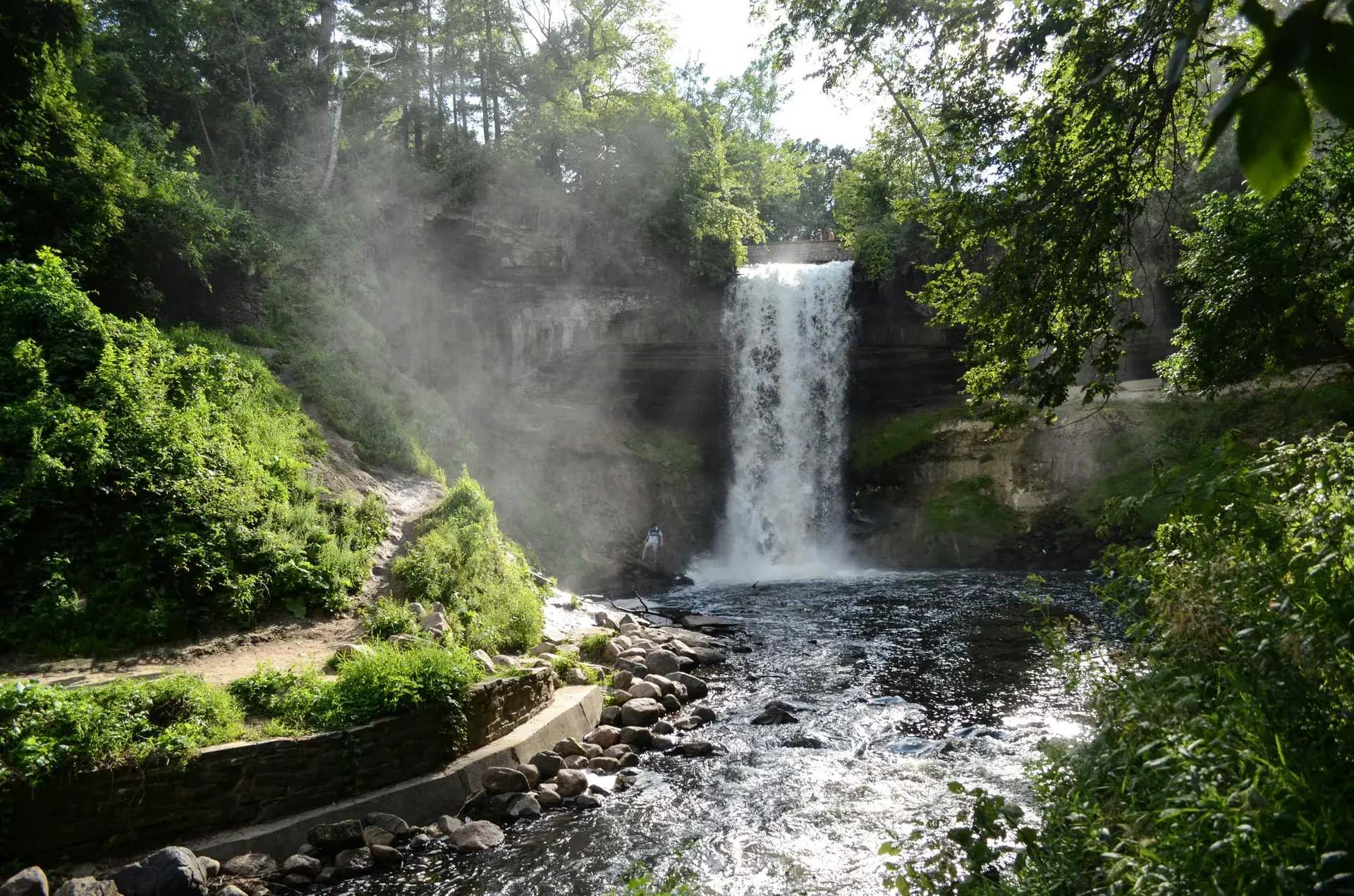
Some of the 83 names have deep roots. Powderhorn Park takes its name from the park's lake, which was named for its shape (resembling a powder horn, a cow horn used to carry gunpowder). Seward is named for William Seward, Lincoln's Secretary of State who brokered the purchase of Alaska. Longfellow honors Henry Wadsworth Longfellow, whose poem “The Song of Hiawatha” (romanticized and problematic as it is) put Minnehaha Falls on the national map. Other names are more prosaic: Downtown East and Downtown West are exactly what they sound like.
The Sign Program
The physical signs that mark Minneapolis neighborhoods today are not a single matched set — they are an accumulation. Community organizations have put up their own markers over the years, a grassroots act of territorial identity, and the results are inconsistent in design, materials, and placement. Some neighborhoods have nothing.
The Neighborhood Revitalization Program (NRP), created in 1990, was a groundbreaking initiative: it was projected to channel as much as $400 million over 20 years into neighborhood-level planning and improvements, and residents of each neighborhood wrote the plan for how its share was spent. Neighborhood identity — including how, and whether, to mark it — was decided neighborhood by neighborhood, and the signs vary from one border to the next.
The result is that there is no single standard design. Some neighborhoods have polished, professionally designed markers; others have a weathered sign bolted to a light pole; some have nothing at all. North Loop and Logan Park in Northeast have particularly distinctive markers that reflect their neighborhoods' creative identities.
The Neighborhood Revitalization Program
The signs are visible, but the system behind them is more important. When Minneapolis created the Neighborhood Revitalization Program in 1990, it did something unusual for an American city: it devolved real power and real money to neighborhood-level organizations. Each neighborhood's share was set by a formula that measured population and economic distress. Residents, working through their neighborhood organizations, wrote the plans for how to spend it.
Some neighborhoods used NRP funds to build parks, improve streetscaping, or fund housing rehabilitation. Others invested in commercial corridor improvements, public art, or community gardens. The program was not without criticism — critics said neighborhood planning committees were often controlled by insiders who did not represent renters and people of color, raising equity concerns that persist today. But the NRP established a principle that remains central to Minneapolis governance: the neighborhood is the fundamental unit of civic life.
The NRP's direct funding ended, but the neighborhood organization system it helped build persists. Today, roughly 70 neighborhood organizations operate across the city, funded through a combination of city grants (now through the Neighborhoods 2020 program), private fundraising, and volunteer labor. These organizations run community events, review development proposals, advocate for infrastructure improvements, and serve as the first point of contact between residents and city government. The signs are the visible markers of this invisible infrastructure.
Design and Evolution
The signs have never been fully standardized, and that is part of their charm. Many neighborhoods have added their own markers over the years. Some examples:
Lowry Hill East, commonly called the Wedge, has a welcome sign that uses the official name. The signs in Fulton and Linden Hills are well-maintained and prominently placed, reflecting neighborhoods with strong organizational capacity and civic pride.
Some neighborhoods have gone beyond signs to create entire visual identity systems. North Loop has branded banners on light poles. Northeast Minneapolis neighborhoods have embraced arts-district branding. The Powderhorn and South Uptown areas have seen grassroots mural projects that function as unofficial neighborhood markers. The signs are the official system; the murals, banners, and custom markers are the folk system that exists alongside it.
What the Signs Mean
The neighborhood signs are more than wayfinding. They represent a civic philosophy: that a city of 430,000 people works best when it is organized as a federation of 83 smaller communities, each with its own identity, its own organizations, and its own voice in how the city is governed. This is not how most American cities operate. Most cities use larger planning districts or wards as their primary sub-city units. Minneapolis uses neighborhoods.
This has practical consequences. When a developer proposes a new building in Whittier, the Whittier Alliance reviews and comments on the proposal. When a park in Kingfield needs renovation, the Kingfield Neighborhood Association advocates for it. When the 3rd Precinct police station and dozens of businesses in Longfellow burned in the unrest that followed the police killing of George Floyd in 2020, the Longfellow Community Council pressed City Hall on the neighborhood's recovery.
The system is imperfect. Neighborhood organization boards can be dominated by a small number of vocal residents who do not represent the broader community. Renters, immigrants, and younger residents are chronically underrepresented. The organizations in wealthier neighborhoods have more resources and more influence. But the principle — that neighborhood identity matters, that it deserves a sign and a seat at the table — is deeply embedded in how Minneapolis works.
How Minneapolis Compares
Most American cities have neighborhood signs of some kind. What makes Minneapolis distinctive is not the signs themselves but the system behind them: 83 officially recognized neighborhoods, each represented by a funded organization, each with a defined role in city governance.
Chicago has 77 community areas but 200+ self-identified neighborhoods. Portland has 95 neighborhoods organized into seven district coalitions. Boston has 23 neighborhoods. Minneapolis's 83 is high for a city of its size, resulting in neighborhoods that are small enough to feel like genuine communities. The average Minneapolis neighborhood has about 5,000 residents — small enough that a dedicated resident can walk the entire neighborhood in 30 minutes and recognize faces at the coffee shop.
This granularity is what makes the signs meaningful. A sign that says Kenny is not marking a large, anonymous district. It is marking a community small enough for its residents to know their neighbors, attend a meeting at the community center, and feel genuine ownership over a few square blocks of the city. That is the promise of the Minneapolis neighborhood system, and the signs are the physical reminder of that promise.
The Signs Today
In 2026, the neighborhood sign system is both enduring and evolving. Some neighborhoods have invested in updated signs and branding. Others have signs that are faded, bent, or missing.
There is an ongoing conversation about whether 83 is the right number. Some neighborhoods are so small that their organizations struggle to find board members or maintain programming. Others have boundaries that no longer reflect how residents actually identify. But identity, once established and marked with a sign, is hard to take away.
What is not in question is the significance of the system. When a Minneapolis resident tells you they live in Seward or Logan Park or Tangletown, they are not just giving you a geographic reference. They are telling you something about who they are, what they value, and how they relate to the city. The signs are how Minneapolis says: this place is specific, this community is real, and the people who live here have a name for where they belong.
That is worth a sign on every corner.