Minneapolis Neighborhood
Powderhorn Park
The most unapologetically itself neighborhood in Minneapolis — where the May Day Parade still marches down Bloomington Avenue every spring, a dozen cultures share a single lake, activists and artists built something real and complicated, and the tensions of American urban life are not politely ignored but argued about on front porches and at park picnics.
№ 64 of 87 · Powderhorn community · Last updated: October 2026 · A complete neighborhood guide
On the first Sunday of May, Bloomington Avenue shuts down. The giant puppets come first — towering cloth-and-papier-mache figures on poles, swaying above the crowd like benevolent spirits, built over weeks in community workshops where nobody checks your resume. Then the drummers, the stilt-walkers, the kids in homemade costumes, the lowriders, the dance troupes from six different traditions moving to six different rhythms on the same street. Crowds line the avenue — Somali families in bright hijabs, Latino kids on their fathers' shoulders, white punks with face paint, elders in lawn chairs who have been watching this parade for thirty years. The procession winds south to Powderhorn Lake, where a ceremony at the water's edge closes the day with something that feels less like a performance and more like a prayer. This is the MayDay Parade — Powderhorn's annual declaration that a neighborhood can be chaotic and beautiful and broke and magnificent all at once. The rest of the year, the neighborhood tries to live up to it. Sometimes it succeeds. Sometimes it doesn't. But it never stops trying.
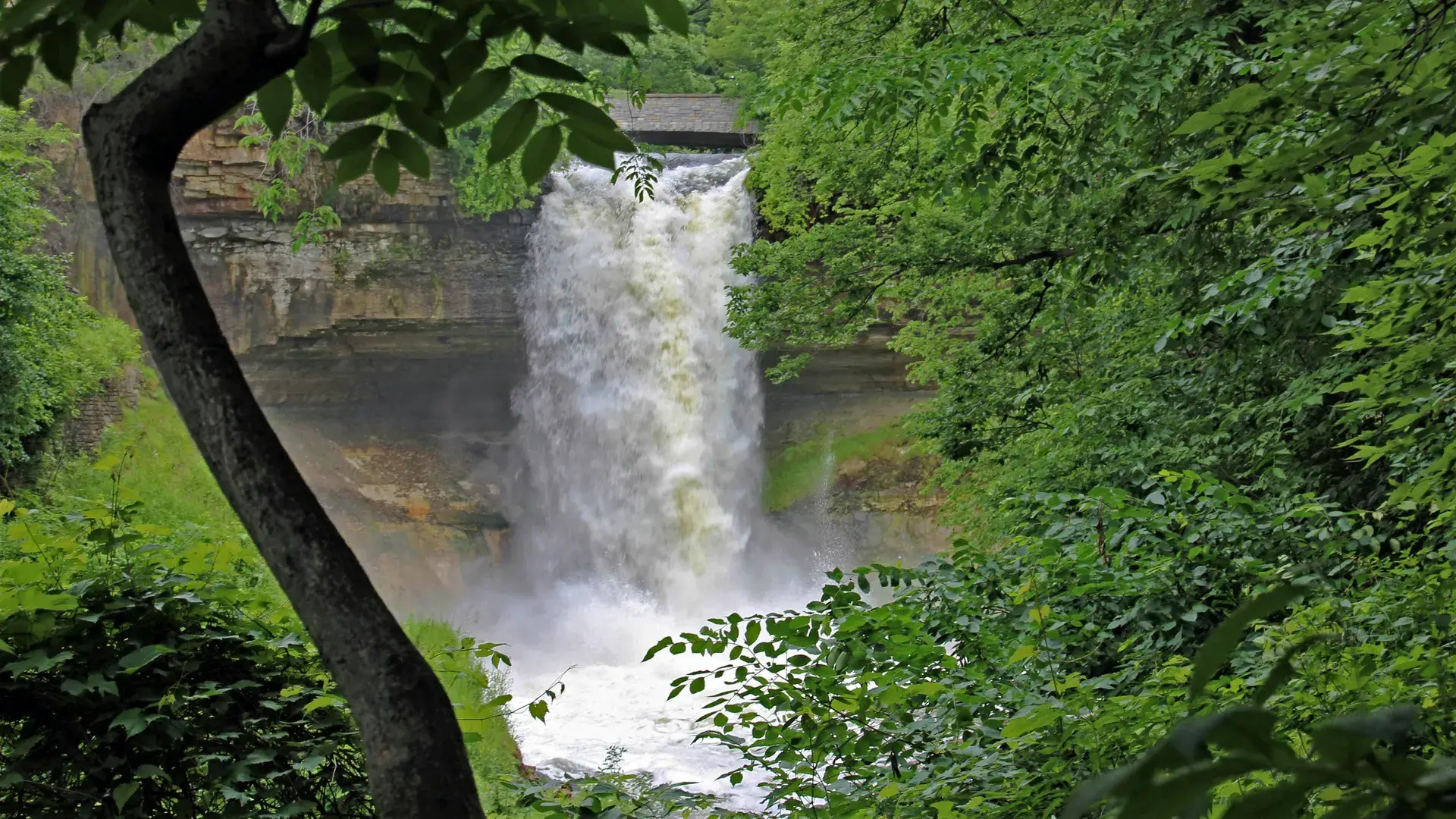
What is Powderhorn Park, Minneapolis?
Powderhorn Park is a neighborhood in South Minneapolis, roughly bounded by East Lake Street to the north, Cedar Avenue to the east, East 38th Street to the south, and Chicago Avenue to the west. It takes its name from Powderhorn Lake, a small natural lake near the center of the neighborhood whose original shape — roughly that of an old powder horn — gave the park and eventually the community its name. Approximately 8,400 people live here, making it one of the larger Minneapolis neighborhoods by population, and its cultural footprint is wildly disproportionate to its acreage.
What defines Powderhorn is not one thing but several, layered on top of each other in ways that don't always fit neatly together. It is more racially and ethnically diverse than Minneapolis as a whole — by Census estimates, nearly half its residents are people of color, and about a quarter are Latino, one of the highest shares in the city — with Latino, Somali, Native American, and white families sharing blocks and schools and park space. It is an arts neighborhood — In the Heart of the Beast Puppet and Mask Theatre (now relocated to Lowry Hill East) began in 1973 as the Powderhorn Puppet Theatre, named for it — with a dense network of working artists, musicians, and writers who came for the cheap rent and stayed for the community. It is an activist neighborhood, with a tradition of organizing — around housing, policing, immigration, queer rights, environmental justice — that is older and deeper than any single issue. And since 2020, it is a neighborhood that has been tested in ways that few American neighborhoods have, and that is still figuring out what it looks like on the other side.
Powderhorn sits within the broader "Powderhorn" community cluster, which includes the adjacent Central, Corcoran, and Bancroft neighborhoods. When people in Minneapolis say "Powderhorn," they almost always mean the specific neighborhood around the lake — the one with the parade and the politics and the complicated recent history.
Powderhorn Park Neighborhood Sign
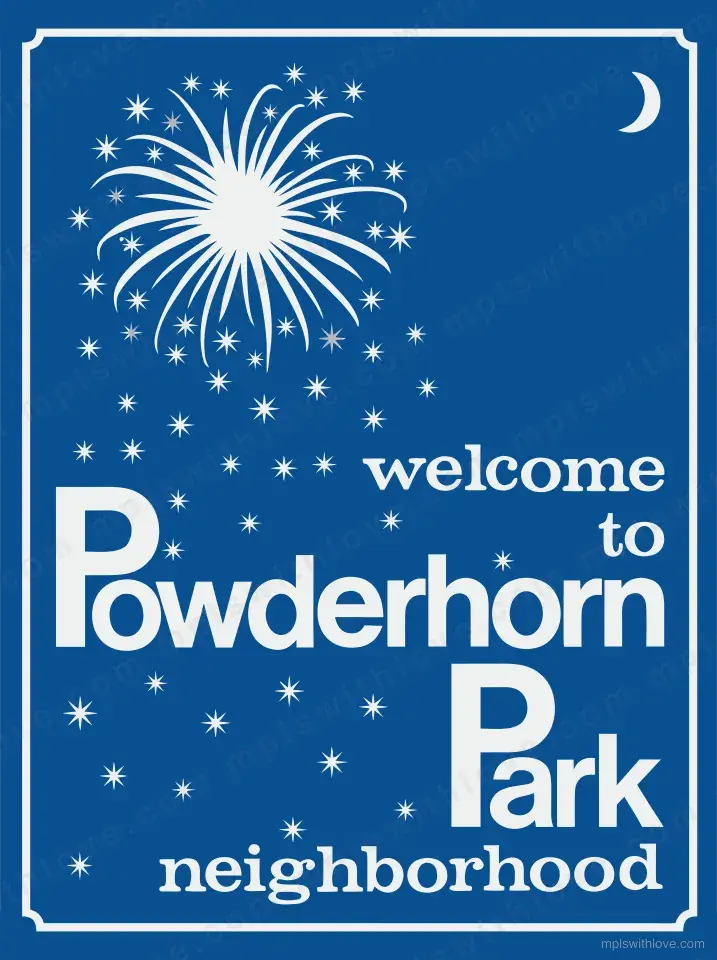
The sign, printed
Powderhorn Park, Minneapolis — Key Stats (2025–2026)
- Residents (2020 Census)
- ~8,400
- Median home sale price (2025 data)
- $318K
- Median rent, all units (2020–24 ACS)
- $1,472
- Walk Score (Oct 2026)
- 82
- Bike Score (Oct 2026)
- 92
- Transit Score (Oct 2026)
- 54
- Renter-occupied homes (2020–24 ACS)
- 39%
- Residents of color (2020–24 ACS)
- 47%
- Year the Park Board first bought land for Powderhorn Park
- 1890
Powderhorn Park History & Origins
The land that is now Powderhorn Park is Dakota homeland — part of the territory of the Mdewakanton band of the Dakota people, who lived, hunted, and gathered throughout what would become Minneapolis for centuries before European contact. The Dakota knew this landscape intimately. The lakes, the creeks, the prairies — all of it was homeland, not wilderness. The distinction matters.
European-American settlement came in the 1850s and 1860s, following the treaties — signed under heavy pressure — that dispossessed the Dakota of their lands. The area around Powderhorn Lake lay on the southern edge of a rapidly growing Minneapolis, which was booming on flour milling and lumber. The lake was among the first places considered for a park in the city's ambitious park system: neighbors petitioned the new Park Board in 1883, and after two failed attempts the board completed its purchase of the land around the lake in 1890. The name came from the lake's shape, which resembled a powder horn — a cow horn used to carry gunpowder — and first appeared on an 1839 survey of the Fort Snelling Military Reservation, when the lake was larger than it is today.
The residential neighborhood filled in between the 1880s and the 1920s, following the pattern common to much of South Minneapolis: streetcar lines extended outward from downtown, and developers platted blocks of modest homes for the working and middle classes. The housing stock from this era — Craftsman bungalows, Foursquares, small Victorians, and the occasional Arts and Crafts gem — still dominates the neighborhood's residential streets. The homes were practical, affordable, and solidly constructed — not grand, but meant to last. Many of them have.
The neighborhood's first major demographic shift came in the mid-twentieth century, following the familiar American pattern of white flight to the suburbs. As families who could afford it moved out, Powderhorn's housing stock aged, rents dropped, and the neighborhood attracted new residents who were priced out of other areas or excluded from them entirely. By the 1970s, Powderhorn was becoming home to artists, hippies, and political organizers. The low rents that suburbanites considered evidence of decline were, for these new arrivals, an opening.
In the Heart of the Beast Puppet and Mask Theatre was founded in 1973 and staged the first MayDay Parade in 1975 — a community celebration that would become the neighborhood's signature event and one of the most distinctive traditions in the Upper Midwest. The parade was political from the start — the first one, a procession of 50 or 60 people, came two weeks after the end of the Vietnam War — and open to anyone who wanted to participate. It drew a coalition that would define Powderhorn for decades: artists, activists, immigrants, queer people, families, oddballs, and anyone else who wanted to belong to something that wasn't corporate or curated.
The 1990s and 2000s brought new waves of immigration, including Somali families fleeing civil war and other East African communities seeking affordable housing near Lake Street's commercial corridor. The Latino community deepened its roots, with businesses, churches, and social networks that transformed stretches of Lake Street and Bloomington Avenue. Native American families have also been part of Powderhorn's fabric for decades. By the 2010s, Powderhorn was one of the most diverse neighborhoods in a state that is, on the whole, very white — a place where diversity was not aspirational but simply the reality of who lived there.
Living in Powderhorn Park
Powderhorn's identity is built on a paradox: it is a neighborhood that values community above almost everything else, and it is a neighborhood where deep disagreements about what community means are a permanent feature of daily life. The yard signs tell you something — they are everywhere, in multiple languages, advocating for immigrants' rights, racial justice, queer liberation, climate action, housing for all. But the yard signs don't tell you everything. They don't tell you about the block club meetings where longtime homeowners and new renters argue about noise. They don't tell you about the tension between the neighbor who calls the police and the neighbor who doesn't believe in calling the police. They don't tell you that diversity, when it's real and not just a poster, is work.
The physical landscape of the neighborhood is structured around the lake. Powderhorn Lake is small — just 11 acres — but it functions as the neighborhood's commons, the place where all the different communities overlap. On a summer evening, you will see Somali families barbecuing on the south shore, Latino teenagers playing soccer on the open field, white dog-walkers circling the path, a drum circle assembling near the rec center, and someone fishing from the dock who might be any of the above. The lake doesn't ask for credentials. It is, in the most literal sense, common ground.
The residential streets radiate outward from the park in a grid of tree-lined blocks — some immaculate, some rough around the edges, most somewhere in between. The housing stock is a mix of original Craftsman bungalows and Foursquares, duplexes and triplexes (many converted from single-family homes), some newer infill, and the occasional Victorian that someone has lovingly or haphazardly maintained. There are blocks that feel like the Minneapolis version of a Norman Rockwell painting and blocks that feel like they could use a coat of paint and a functioning streetlight. This variety is part of Powderhorn's charm, and also part of its challenge — the neighborhood's unevenness is honest, but it's not always comfortable.
The arts community runs deep. Powderhorn has historically been one of the most affordable neighborhoods in the core city, and that affordability drew painters, puppeteers, musicians, poets, and theater-makers who couldn't afford Uptown or Northeast. Many of them didn't just live here — they organized, built institutions, created public art, and wove themselves into the civic fabric in ways that went far beyond making objects. In the Heart of the Beast is the most visible example, but the network extends to house shows, backyard studios, cooperative galleries, and the kind of informal creative economy that doesn't show up in arts funding reports. Some of this community has been priced out in recent years. Some of it remains. The tension between the two is one of Powderhorn's defining stories.
The queer community has long found a home in Powderhorn — not because the neighborhood marketed itself that way, but because affordability, tolerance, and proximity to other queer-friendly spaces (the Whittier and Phillips corridors) made it a natural landing place. There are rainbow flags on porches, queer-owned businesses along Lake Street, and a social infrastructure that is woven into the neighborhood rather than confined to a single strip or district.
Politically, Powderhorn leans far left by Minneapolis standards, which is to say far left by almost any American standard. This is a neighborhood where abolitionist politics and mutual aid are not abstract concepts but organizing frameworks that shape how people respond to everything from crime to homelessness to snow removal. This political identity is genuine and deeply held — and it has also created real divisions, particularly since 2020, between residents who want systemic transformation and residents who just want their car to stop getting broken into.
Powderhorn Food, Drink & Local Spots
Powderhorn's food scene is not polished. It does not have a Michelin-adjacent restaurant or a cocktail bar with a velvet rope. What it has is something harder to manufacture and more worth celebrating: a constellation of immigrant-owned restaurants, family taquerias, East African cafes, corner bakeries, and neighborhood spots that serve genuinely excellent food at prices that don't require a second income. The food here is a direct expression of who lives here — diverse, affordable, unpretentious, and occasionally transcendent. You will eat better for less money in Powderhorn than in almost any other neighborhood in Minneapolis. The trade-off is that you'll have to find these places yourself, because most of them don't have Instagram accounts.
Lake Street Corridor
Lake Street — the commercial corridor that forms Powderhorn's northern boundary — is one of the most culturally diverse commercial streets in the Midwest. Through the Powderhorn stretch, the dominant flavors are Mexican and Central American, with taquerias, panaderias, and carnecerias that serve the neighborhood's large Latino community. This is not gentrified "authentic Mexican" — it's the real thing, priced for the people who depend on it.
Lake Street. A no-frills taqueria doing exactly what a taqueria should do — excellent tacos al pastor, carnitas, and barbacoa at prices that make you wonder how they stay in business. The kind of place where the tortillas are made fresh and the salsa verde could strip paint. Cash preferred. Lines on weekends are a quality indicator.
920 East Lake Street, just across Lake in Midtown Phillips. Located in the old Sears building at the intersection of Lake and Chicago, this multi-vendor food hall is one of the best things in Minneapolis. Over 40 vendors represent cuisines from around the world — Somali, Mexican, Vietnamese, Hmong, Peruvian, Scandinavian, and more. It's a community institution as much as a market, hosting events, providing affordable retail space for immigrant entrepreneurs, and serving as an informal neighborhood gathering place. If you eat at one place near Powderhorn, eat here.
Bloomington Avenue
3440 Bloomington Avenue South. Sharing its name with the parade that defines the neighborhood, May Day Cafe serves breakfast and lunch with an emphasis on local ingredients and community vibes. The huevos rancheros are excellent. The coffee is strong. The bulletin board by the door is an education in Powderhorn's political ecosystem.
East African & Somali Spots
Somali and East African restaurants, tea shops, and grocery stores are part of the Lake Street mix, too. These places are community hubs as much as businesses — the Somali tea shops, in particular, function as informal gathering places where news is shared, deals are made, and the social fabric of the diaspora community is maintained. Many of these spots are modest in presentation and enormous in flavor — goat suqaar, sambusa, canjeero (Somali crepes), and sweet spiced tea that will recalibrate your morning. Explore with curiosity and respect. You will be rewarded.
Coffee, Drink & Night
Powderhorn is not a nightlife destination — the bar scene is modest compared to Uptown or Northeast — but it has its anchors. The neighborhood's coffee culture leans independent and community-oriented: May Day Cafe is the standout, and several smaller shops and bakeries serve the caffeine needs of a neighborhood that runs on organizing energy and late nights. For bars, the options skew dive-ish and unpretentious — the kind of places where the bartender knows your name and the jukebox hasn't been updated since the Obama administration.
Parks & Outdoors Near Powderhorn Park
Powderhorn's relationship with its park is more complicated than most neighborhoods' relationship with their green space. The park is the neighborhood's soul — the commons, the parade ground, the gathering place, the site of joy and crisis and everything in between. It is also, since 2020, a place that carries a different kind of memory. Both things are true. The lake doesn't care about your politics. It freezes in winter and thaws in spring and reflects the sky regardless.
Powderhorn Lake & Park
Powderhorn Lake is an 11-acre lake at the center of a 66-acre park that has been public land since 1890. The park includes a paved, lighted path around the lake (roughly three-quarters of a mile), playgrounds, a recreation center, a wading pool, basketball and tennis courts, open fields, a winter skating rink, and a fishing pier behind the recreation center. The lake itself supports fishing — the Park Board stocks it every year with crappies, sunfish and catfish — but there is no swimming beach.
On a summer weekend, Powderhorn Park is one of the most alive public spaces in Minneapolis. The diversity of the neighborhood shows up in concentrated form — families grilling, kids playing soccer, drummers drumming, people practicing tai chi, someone doing yoga, someone else reading a novel, all of it happening simultaneously without anyone needing to coordinate. The park hosts community events throughout the year — the MayDay Festival, National Night Out, neighborhood picnics, and informal gatherings that nobody organized but everyone attends.
It would be dishonest to talk about Powderhorn Park without acknowledging the summer of 2020. Following the murder of George Floyd and the unrest that followed, a large homeless encampment formed in the park in June 2020. It grew to several hundred tents. Conditions were difficult. Sexual assaults and other violent incidents were reported within the encampment. Neighbors were deeply divided — some brought supplies and volunteered; others felt their park and their safety had been taken from them. The encampment was eventually cleared, but the experience reshaped how many residents relate to the park. By 2025–2026, usage has largely returned to normal, but the memory persists — particularly for families with young children who stopped using the park during that period. The park is beautiful and complicated. That is, in a sense, the most Powderhorn thing about it.
The Midtown Greenway
The Midtown Greenway — the 5.5-mile grade-separated bike and pedestrian trail that runs east-west through South Minneapolis in a former railroad trench — passes just north of Powderhorn, a block above Lake Street. For Powderhorn residents, the Greenway is a commuting artery, a recreational trail, and a connection to the Chain of Lakes to the west and the Mississippi River to the east. It is plowed in winter, lit at night, and one of the most heavily used pieces of cycling infrastructure in the Upper Midwest. Access points near Lake Street and the Midtown Global Market make it easy to hop on from the neighborhood.
Nearby Parks & Green Space
Beyond the namesake park, Powderhorn residents have access to several smaller parks and green spaces. The neighborhood is within easy biking distance of Minnehaha Regional Park to the southeast, the Mississippi River gorge to the east, the Chain of Lakes to the west, and the many smaller Minneapolis parks that make the city's park system one of the best in the country. The Minneapolis Park Board's network of parkways — tree-lined boulevards designed for walking, biking, and driving at residential speed — connects many of these spaces, and Powderhorn is well-positioned within the system.
Powderhorn Park Schools
Schools in Powderhorn Park reflect the neighborhood's diversity — and the systemic challenges that come with serving a student body that includes recent immigrants, English language learners, and families navigating poverty. Test scores are generally below city averages, which reflects socioeconomic context more than teaching quality. For families who value diversity, multilingual environments, and community connection, the schools here offer something that higher-scoring schools in more homogeneous neighborhoods cannot replicate.
Andersen United Middle School (grades 6–8), at 1098 Andersen Lane, a few blocks north of Lake Street in Midtown Phillips, is the closest district middle school and one of the most diverse schools in the Minneapolis Public Schools system. Students come from dozens of countries and speak numerous home languages. It is an International Baccalaureate school with two programs — a community program for neighborhood students and the district's dual-language middle school pathway. Andersen's test scores are below the city average, which is common for schools serving high-poverty, high-mobility populations. Families who prioritize diversity and community embeddedness tend to value what Andersen offers; families who prioritize test metrics may look elsewhere through the district's open enrollment system. For the elementary grades, Bancroft Elementary (PreK–5) sits just across 38th Street in Bancroft. Assignments depend on the address, so check the district's school finder for a specific house.
South High School, located at 3131 19th Avenue South, just east of Cedar in Corcoran, is the closest district high school (grades 9–12) and one of the most diverse high schools in Minnesota. South offers college-credit courses, the All Nations program, arts, theater and music, and college and career pathways. The school has an engaged student body known for its activism — South students have been at the forefront of walkouts and advocacy campaigns on climate, gun violence, and racial justice. Test scores are mixed, but the school's breadth of programming and community culture make it a point of pride for many neighborhood families.
Minneapolis Public Schools' open enrollment system means Powderhorn families are not limited to neighborhood schools. Many families access magnet programs, language immersion schools, and specialty options across the district. Charter schools in the area provide additional choices. As in much of Minneapolis, the school landscape rewards families willing to research and navigate options — it is less automatic than the pipeline in Southwest neighborhoods like Fulton or Linden Hills, but it is far from devoid of good choices.
Powderhorn Park Real Estate & Housing
Powderhorn's housing market is one of the most interesting — and most contested — in Minneapolis. This is a neighborhood where you can still buy a house for under $300,000 within the city limits, a fact that draws first-time buyers, artists, young families, and investors. The affordability that has defined Powderhorn for decades is real but shrinking, and the question of who gets to live here as prices rise is one of the neighborhood's most active conversations.
What Your Money Buys
The dominant housing types are Craftsman bungalows and Foursquares from the 1900s–1920s, sitting on narrow lots with front porches, detached garages, and mature trees. Powderhorn's median sale price was $318,000 in 2025, up from $295,000 a year earlier, according to Minneapolis Area REALTORS — still below the citywide median of $350,000. At the lower end of the market, you're looking at smaller bungalows or duplexes that need work — deferred maintenance, older systems, cosmetic updates. Around the median, you'll find well-maintained three-bedroom bungalows and larger updated homes with original character. Well above it, you're in renovated territory or looking at larger properties near the park.
Duplexes and triplexes are more common here than in Southwest Minneapolis, reflecting Powderhorn's historically mixed-income character and its role as a rental neighborhood. Multi-family properties — particularly duplexes with an owner-occupied unit and a rental unit — are a popular strategy for buyers who want to offset their mortgage. The investor market is active, which creates tension: investor purchases can drive up prices while deferring maintenance in favor of cash flow.
Victorian-era homes — some with beautiful original woodwork, stained glass, and wraparound porches — are scattered throughout the neighborhood, particularly on blocks closer to the park. These are the houses that make real estate photographers earn their money, and when they come on the market in good condition, they sell quickly.
Rental Market
About four in ten of Powderhorn's homes are renter-occupied, by Census estimates, making it more balanced between owners and renters than heavily renter-dominated neighborhoods like Whittier but less owner-heavy than Southwest Minneapolis. The estimated median rent is about $1,470 a month — a little above the citywide $1,371, though well below North Loop's roughly $2,100. The rental stock is mostly in smaller buildings — duplexes, triplexes, converted houses — rather than large apartment complexes, which gives the neighborhood a different feel than the high-density corridors along Nicollet or Lyndale.
The 2020 Effect
The events of 2020 — the Floyd protests, the park encampment, the crime spike — tested Powderhorn's real estate market. Some homeowners left. Some prospective buyers looked elsewhere. But prices kept climbing: Minneapolis Area REALTORS figures show the median sale price rising every year since 2021, from $272,000 to $318,000 in 2025. The underlying demand drivers — affordability relative to the rest of the city, proximity to the Greenway and transit, the park, the community culture — have proven resilient.
Getting Around Powderhorn Park
Powderhorn is a solid transportation neighborhood — not quite at the walk-everywhere level of Whittier or downtown, but well above the car-dependent suburbs and better than most of Minneapolis for human-powered and public transit. The Bike Score of 92 is the headline number: this is an outstanding biking neighborhood, with access to the Midtown Greenway and a network of bike lanes and low-traffic streets that make cycling the most practical mode for many errands and commutes.
The Walk Score of 82 reflects a neighborhood that has good commercial access — Lake Street to the north, scattered businesses along Bloomington and Chicago Avenues — without the wall-to-wall retail density of Eat Street or downtown. You can walk to groceries, restaurants, and the park from most addresses, but some errands will take you outside the neighborhood. The Transit Score of 54 reflects decent but not exceptional bus service — Metro Transit routes run along Lake Street (the METRO B Line), Chicago Avenue, and Bloomington Avenue; the Chicago and Bloomington routes reach downtown in 15–20 minutes. The Blue Line light rail runs along Hiawatha Avenue, roughly a mile east, with stations accessible by bike or bus transfer.
By car, downtown Minneapolis is 10–15 minutes. MSP International Airport is 15–20 minutes via Highway 55 or I-35W. Street parking is generally available on residential blocks — this is not a neighborhood where you circle for a spot, unlike denser areas closer to downtown. The Midtown Greenway deserves emphasis: for residents who bike, it is a genuine piece of infrastructure that connects Powderhorn to the Chain of Lakes (west), the Mississippi River (east), Uptown, and downtown via connecting trails. Year-round commuters use it daily; it is plowed in winter and lit at night.
What's Changing: The Honest Version
No neighborhood in Minneapolis has been through more in the past six years than Powderhorn Park. That is not hyperbole. The murder of George Floyd happened at the neighborhood's border. The largest homeless encampment in the metro area's history formed in its park. The crime spike hit its streets. The debates about policing, abolition, and public safety split its community down lines that haven't fully healed. And underneath all of it — quieter but no less consequential — the gentrification that was already underway before 2020 has continued, raising the question of whether the people who made Powderhorn what it is can afford to stay.
The 2020 Reckoning
On May 25, 2020, George Floyd was murdered by Minneapolis police officer Derek Chauvin at the intersection of 38th Street and Chicago Avenue — at the boundary of Powderhorn Park and the adjacent Central neighborhood. The intersection became George Floyd Square, a community memorial and autonomous space that remained barricaded for over a year. Powderhorn residents gathered there to mourn, to protest, and to organize. The relationship between the neighborhood and the site has been intimate and complicated — it is close enough to walk to, close enough that the grief and the anger were not abstract but immediate.
In the days that followed Floyd's murder, Minneapolis erupted. Lake Street — Powderhorn's commercial corridor — was damaged during the unrest. Businesses were burned or looted. The Midtown Global Market survived but many surrounding businesses did not. Powderhorn residents organized supply distribution, community patrols, and mutual aid. The community infrastructure that had been built over decades — the block clubs, the activist networks, the relationships across racial and cultural lines — proved its value in crisis.
The Encampment
In June 2020, a homeless encampment began forming in Powderhorn Park. The Minneapolis Park Board first ordered the campers out, then backed off after pushback from volunteers, and on June 17 voted to let people take refuge in the city's parks. The encampment grew rapidly — at its peak, several hundred tents occupied the park's east and west sides. Conditions deteriorated. Reports of sexual assaults, drug use, fires, and other safety incidents emerged. National media descended.
The encampment split Powderhorn in ways that have not fully mended. Some residents — often the most politically progressive — supported the encampment as a necessary response to a housing crisis, bringing supplies, volunteering, and advocating for services rather than removal. Others — including some long-term residents of color who had been advocating for safe parks for years — felt that their neighborhood had been sacrificed to a cause that prioritized ideology over the safety of the people who actually lived there. The divide did not fall neatly along racial or political lines, which made it even harder to resolve.
The last of the encampment was cleared in August 2020, and residents were connected to varying degrees of shelter and housing. By 2025–2026, the park has substantially returned to its pre-2020 function — families use it, events happen, the lake freezes into a skating rink each winter. But the experience left scars on community trust that are still visible in the way neighbors talk about the park, about the Park Board, and about each other. The phrase "the encampment" carries a weight in Powderhorn that outsiders may not fully appreciate.
Crime and Safety
Crime rose sharply in Powderhorn — and across Minneapolis — in 2020–2022. Carjackings, which had been relatively uncommon, spiked dramatically. Property crime — car break-ins, catalytic converter theft, package theft — became a near-constant irritant. Gun violence increased. The Minneapolis Police Department, already distrusted by many Powderhorn residents, lost hundreds of officers to attrition and retirements, reducing response times and visibility. The result was a period in which many residents felt genuinely unsafe — a feeling that was compounded by the political complexity of calling for more policing in a neighborhood where many had just called for reimagining policing entirely.
By 2024–2025, most crime categories had declined from their peaks, though they remained elevated compared to pre-2020 levels. The feeling of safety has improved meaningfully on most residential blocks. But Powderhorn's crime rates remain above the citywide average, and the neighborhood's relationship with law enforcement remains strained. Many residents have found a pragmatic middle ground — supporting systemic reform while also locking their doors and watching their bikes. This is not hypocrisy. It is what living in a complicated place actually looks like.
Gentrification and Displacement
The gentrification dynamic in Powderhorn is particularly bitter because it is self-inflicted — not by individuals, but by the same forces that make the neighborhood attractive in the first place. Artists moved here because it was cheap. They made art, built institutions, created community. Activists moved here because it was diverse and tolerant. They organized, built networks, made the neighborhood politically engaged. Together, these communities made Powderhorn culturally desirable — which attracted people with more money, which raised prices, which began to push out the artists and activists who created the desirability. This is not a Powderhorn-specific story — it is the story of Williamsburg, of the Mission, of East Austin, of every urban neighborhood that has been through this cycle. But it carries particular pain here because the community is so self-aware about it. People are watching themselves get priced out of the neighborhood they built, in real time, and the awareness doesn't change the economics.
The impact falls unevenly. Latino families who have been on Lake Street for decades face rising rents. East African immigrants who settled here for the affordability find that affordability eroding. Artists who made Powderhorn culturally rich can no longer afford studios. Meanwhile, young professionals and homebuyers — often white, often with higher incomes than the neighbors they're joining — are drawn by the same diversity and community energy that they are, by their presence, potentially undermining. Nobody is the villain in this story. That's what makes it hard.
Homelessness and Visible Poverty
Powderhorn's proximity to social services, its relatively affordable commercial rents, and its political culture of tolerance have made visible homelessness a more persistent reality here than in most Minneapolis neighborhoods. The 2020 encampment was the most extreme manifestation, but smaller encampments and individuals experiencing homelessness are a regular presence in and around the park and along Lake Street. Residents hold a range of views — from radical hospitality to deep frustration — and the conversation is ongoing and unresolved. What most agree on is that the current system is failing both housed and unhoused residents.
Powderhorn Park FAQ
Is Powderhorn Park a good neighborhood in Minneapolis?
It depends entirely on what you're looking for. Powderhorn is one of the more diverse and culturally rich neighborhoods in Minneapolis, with home prices still below the city median. It has a beautiful lake and park, a strong arts and activist community, excellent biking infrastructure, and a genuine neighborhood identity that most places can only aspire to. It also has higher crime rates than Southwest Minneapolis, visible poverty, and the kinds of tensions that come with rapid demographic change and a still-unfinished post-2020 recovery. If you want a neighborhood with character, diversity, and affordability — and you're comfortable with complexity — Powderhorn is outstanding. If you want predictability and polish, look elsewhere.
Is Powderhorn Park, Minneapolis safe?
Powderhorn's safety picture is honest-to-God complicated. Property crime — car break-ins, catalytic converter theft, bike theft, package theft — is a regular reality. Violent crime is higher than the city average and has been for years, though it declined from 2020–2021 peaks by 2024–2025. The 2020 events brought an acute spike in crime that the neighborhood is still processing. Most residential blocks are quiet on most nights, and many long-term residents feel safe walking the neighborhood and the lake path. But situational awareness matters here more than in quieter neighborhoods, and the gap between Powderhorn's reality and the reality in, say, Fulton or Linden Hills is real.
What is the May Day Parade in Minneapolis?
The MayDay Parade and Festival is an annual community celebration, started by In the Heart of the Beast Puppet and Mask Theatre (HOBT) and run by community groups since HOBT stepped back in 2023, held on the first Sunday of May. The parade travels down Bloomington Avenue to Powderhorn Park, featuring giant puppets, stilt-walkers, drummers, dancers, and community-built floats — all created through free public workshops in the weeks beforehand. It culminates with a ceremony at the lake. The event began in 1975 and at its height drew tens of thousands of people. It is Powderhorn's defining cultural event and one of the most distinctive community traditions in the American Midwest.
What happened in Powderhorn Park in 2020?
Following the murder of George Floyd on May 25, 2020, at 38th and Chicago Avenue — at the border of Powderhorn and neighboring Central — the neighborhood was directly affected by the protests and unrest that followed. In June 2020, a large homeless encampment formed in Powderhorn Park; the Minneapolis Park Board first ordered the campers out, then backed off and voted to let people take refuge in the parks, and the neighborhood became a flashpoint in citywide debates about homelessness, policing, and public safety. The encampment grew to hundreds of tents, drew national media attention, and deeply divided the neighborhood. The last campers were cleared in August 2020, but the experience left lasting marks on community trust, park usage, and neighborhood identity.
How much does it cost to live in Powderhorn Park?
Powderhorn remains one of the more affordable neighborhoods in Minneapolis with genuine urban amenities. The median sale price was $318,000 in 2025, up from $295,000 a year earlier, according to Minneapolis Area REALTORS — still below the citywide median of $350,000. Renting is a different story: Census estimates put the median rent at about $1,470 a month, a little above the city's $1,371. Compared to Southwest Minneapolis, where median prices often exceed $500,000, Powderhorn offers significantly more house for the money.
Is Powderhorn Park walkable?
Mostly. Powderhorn earns a Walk Score of 82, which is respectable but not exceptional — you can walk to the park, several restaurants, corner stores, and Lake Street's commercial corridor, but it's not the wall-to-wall commercial density of Whittier or Uptown. The Bike Score of 92 is the real standout — excellent cycling infrastructure, including connections to the Midtown Greenway, makes this one of the best biking neighborhoods in the city. Many residents bike more than they walk for errands.
What is Powderhorn Park, Minneapolis known for?
Powderhorn is best known for Powderhorn Lake and its surrounding park, the MayDay Parade and Festival (started by In the Heart of the Beast Puppet and Mask Theatre), its racial and cultural diversity, a strong arts and activist community, and — since 2020 — its role as a flashpoint in Minneapolis's reckoning with policing, homelessness, and racial justice. It's also known for home prices that have stayed below the city median.
Where exactly is Powderhorn Park in Minneapolis?
Powderhorn Park is in South Minneapolis, roughly bounded by East Lake Street to the north, Cedar Avenue to the east, East 38th Street to the south, and Chicago Avenue to the west. The neighborhood takes its name from Powderhorn Lake, a small natural lake near the center of the community at 3400 15th Avenue South.
Is Powderhorn Park gentrifying?
Yes, though the process is complicated and contested. Artists and activists who settled in Powderhorn because of its affordability and diversity helped make the neighborhood culturally desirable — which attracted new residents, which raised prices, which has begun to push out some of the people who created that desirability in the first place. Home prices keep rising: the median sale price went from $272,000 in 2021 to $318,000 in 2025, according to Minneapolis Area REALTORS. The neighborhood is acutely aware of this dynamic and actively debates it, but awareness hasn't stopped the economic forces at work.
What schools serve Powderhorn Park?
Nearby Minneapolis Public Schools include Bancroft Elementary (PreK–5), just across 38th Street in Bancroft; Andersen United Middle School (6–8), a few blocks north of Lake Street in Midtown Phillips; and South High School (9–12), just east of Cedar Avenue in Corcoran. Assignments depend on the address, so check the district's school finder. Families also use the district's open enrollment and magnet programs to access options citywide. The neighborhood has several charter school options as well.
What is the Heart of the Beast Theatre?
In the Heart of the Beast Puppet and Mask Theatre (HOBT) is a community-based theater company founded in 1973 as the Powderhorn Puppet Theatre, named for the neighborhood. It is best known for the MayDay Parade and Festival, which it started in 1975 and released to the community in 2023, and it also produces original puppet theater and hosts community workshops. HOBT left its longtime home at 1500 East Lake Street, just across Lake in Midtown Phillips, in fall 2025 and relocated to Lowry Hill East (2411 Hennepin Ave), but the MayDay Parade remains a Powderhorn tradition, and the theater's identity is inseparable from Powderhorn.
What Makes Powderhorn Irreplaceable
There are neighborhoods in Minneapolis that are safer, cleaner, quieter, easier to explain to your parents when they ask where you moved. There are neighborhoods where the park doesn't carry the memory of an encampment, where the community meetings don't turn into two-hour arguments about policing and displacement, where you don't have to hold so many contradictions in your head at once. Powderhorn is not those places. What it is — what it has been for decades and what it stubbornly continues to be — is a neighborhood where people who are genuinely different from each other share a lake and a parade and a set of problems and, somehow, a sense of belonging. The Somali family at the picnic table, the queer punk house on the corner, the Mexican grocery on Lake Street, the retired teacher who has been on the block since 1987 — they are not performing diversity for a brochure. They are living next to each other, which is harder and more valuable than any brochure could convey.
Powderhorn has been through more than most Minneapolis neighborhoods in the past six years. The murder of George Floyd happened at its border. The encampment happened in its park. The crime spike happened on its streets. The gentrification is happening to its people. None of this has been easy, and pretending otherwise would be a lie. But Powderhorn has never been a neighborhood that lies to itself — that radical honesty, that willingness to look at hard things and keep going, is the quality that defines the place more than the lake or the parade or the Victorians on the side streets. If you can hold the beauty and the difficulty at the same time, Powderhorn will feel like home. If you need to choose one or the other, you will probably be happier somewhere else. And that is completely fine.

From the shop
Take the Powderhorn Park sign home.
Powderhorn Park — Minneapolis Neighborhood Sign Print
Keep exploring
Also in Powderhorn
Powderhorn Park appears in
- Best Burgers and Juicy Lucys
- Best Cheap Eats in Minneapolis — Under $15
- Best Coffee Shops by Neighborhood
- Best Food Neighborhoods
- Best Hmong Food
- Best Korean Food
All 23 guides ↓Show fewer ↑
- Best Late Night Food
- Best Mexican Food
- 10 Best Neighborhoods
- Best Neighborhoods for Artists and Creatives
- Best Neighborhoods for Dog Owners
- Best Neighborhoods for First-Time Homebuyers
- Best Neighborhoods for Renters
- Best Neighborhoods for Young Professionals
- Best Parks by Neighborhood
- Best Restaurants on Lake Street
- Best Somali Food
- Best Tacos
- Best Vietnamese Food
- The History of Minneapolis Neighborhood Signs
- Most Bikeable Neighborhoods
- Most Walkable Neighborhoods
- Moving to Minneapolis