Minneapolis Neighborhood
Downtown East
A neighborhood built on flour dust and river power — where 19th-century mill ruins share the skyline with a billion-dollar stadium, the Guthrie Theater cantilevers toward the Mississippi, and the question of who downtown belongs to plays out every single day on the sidewalks between The Commons and the train tracks.
№ 18 of 87 · Central community · Last updated: October 2026 · A complete neighborhood guide
On a Sunday in October, the contradictions of Downtown East are on full display within a quarter-mile radius. At US Bank Stadium, 66,000 people in purple jerseys are roaring at a third-down conversion, the noise leaking through the glass panels and rolling across the plaza. At Gold Medal Park, a woman is reading on a bench beneath the spiral earthwork mound, unbothered. On the Stone Arch Bridge, a photographer is shooting the St. Anthony Falls with the mill ruins in the background — the same composition that has been photographed roughly ten million times, and yet it still works. Along the riverfront trail, runners pass a man sleeping under a blanket near the Water Works building. In the lobby of the Guthrie, someone is buying tickets to a matinee of an August Wilson play. A light rail train pulls into the US Bank Stadium station, disgorging another wave of fans. And through all of it, the Mississippi keeps moving — the same river that powered the flour mills, that made this city possible, that doesn't care about any of this.
What is Downtown East, Minneapolis?
Downtown East is the southeastern quadrant of downtown Minneapolis, occupying the stretch of riverfront where the city was born. It is roughly bounded by Portland Avenue to the west, the light rail tracks and South 6th Street to the south, I-35W to the east, and the Mississippi River to the north. The neighborhood encompasses what locals call the Mill District — the historic flour milling quarter along the river — as well as the East Town area around US Bank Stadium and The Commons park. It is home to about 3,200 residents, most of them living in the condominiums and apartment towers that have risen over the past two decades on land that was, not long ago, rail yards and industrial ruins.
This is not a traditional Minneapolis neighborhood in any meaningful sense. There are no bungalows, no front porches, no block clubs grilling in the alley on the Fourth of July. Downtown East is vertical, dense, and still new enough that it smells faintly of construction adhesive in places. What it offers instead is something most of Minneapolis cannot — genuine urban living at a walkable, transit-connected, culturally saturated scale, set against a riverfront that happens to be one of the most historically significant sites in the American Midwest. The North Loop gets more food press. Loring Park has been urban longer. But Downtown East has the river, the ruins, and the ambition — and in Minneapolis, that combination is hard to beat.
Downtown East Neighborhood Sign
As far as we can tell, Downtown East doesn’t have a neighborhood welcome sign — at least, nobody has documented one that we can find. If you’ve seen one, tell us where it is — we’d love to be wrong about this.
Downtown East, Minneapolis — Key Stats (2025–2026)
- Residents (2020 Census)
- ~3,200
- Median condo sale price (2025 data)
- $728K
- Year the Washburn A Mill was built
- 1880
- US Bank Stadium capacity
- 66,655
- The Commons park
- 4.2 acres
- Light rail lines serving the neighborhood (Blue & Green)
- 2 lines
- Walk Score (Oct 2026)
- 91
- Transit Score (Oct 2026)
- 86
Downtown East History & Origins
To understand Downtown East, you have to understand flour — and the waterfall that made it possible. St. Anthony Falls is the only major waterfall on the entire Mississippi River. The Dakota people knew it as Owámniyomni — a sacred site long before European arrival. When Euro-American settlers reached the falls in the mid-19th century, they saw something else: power. Raw, mechanical, inexhaustible power.
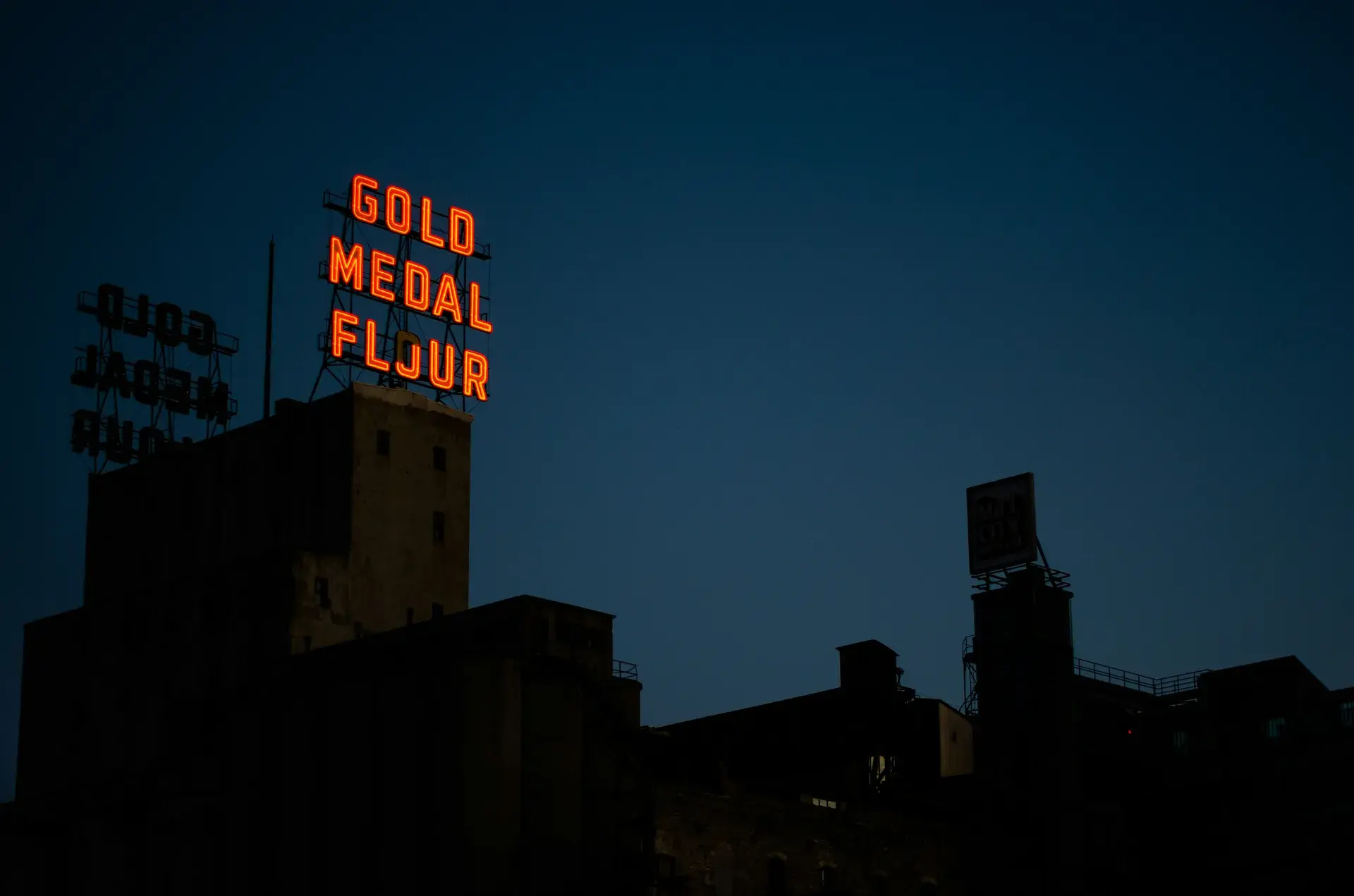
By 1880, Minneapolis had harnessed the falls to drive flour mills on an industrial scale that the world had never seen. Cadwallader Washburn built his massive Washburn A Mill on the riverbank in 1874 — it exploded in 1878, killing eighteen workers, and was rebuilt bigger in 1880. The Pillsbury A Mill rose across the river. The Washburn-Crosby Company (later General Mills) made Gold Medal Flour a household name. For fifty years after 1880, Minneapolis was known as the flour milling capital of the world, and the district that is now Downtown East was the engine room of that empire. The air smelled like wheat dust. Rail cars lined up for blocks to carry flour to the eastern seaboard and beyond.
The milling era ended slowly. Competition from Buffalo, closer to eastern markets and favored by rail rates, eroded Minneapolis's dominance, and in 1930 Buffalo overtook it. The Washburn A Mill closed in 1965; across the river, the Pillsbury A Mill, the last of the riverfront mills, held on until 2003. On this bank, what remained was a landscape of abandoned industrial buildings, rail yards, and crumbling infrastructure along the riverfront — a district that most Minneapolis residents simply drove past on their way somewhere else. For decades, this stretch of the Mississippi was essentially a dead zone within the city.
The revival gathered speed in the 1990s with historic preservation efforts and a citywide recognition that the riverfront — Minneapolis's reason for existing — should not be a wasteland. The Stone Arch Bridge, a former railroad bridge built by James J. Hill in 1883, was converted to pedestrian and bicycle use in 1994. Mill Ruins Park opened in 2001, incorporating the archaeological remains of the mills into a public park. The Guthrie Theater moved from its original Vineland Place location to a striking new Jean Nouvel–designed building on the riverfront in 2006. Mill City Museum — built into the ruins of the Washburn A Mill — opened in 2003. And the condos started going up.
The second wave of transformation came with US Bank Stadium, which opened in 2016 on the site of the former Metrodome. The $1.1 billion stadium brought with it The Commons — a 4.2-acre park that serves as the stadium's front lawn and the neighborhood's primary green space — and an explosion of hotel, residential, and commercial development in the surrounding blocks. The East Town area, which had been largely parking lots and low-rise commercial buildings, became a construction zone that has only recently begun to feel like a finished neighborhood.
Living in Downtown East
Living in Downtown East is not like living in the rest of Minneapolis. It is not even like living in the rest of downtown. The neighborhood has a particular rhythm — quiet on weekday mornings, buzzing on weekend evenings, and absolutely unhinged on game days — that takes some adjustment if you're coming from a residential neighborhood where the biggest disruption is a neighbor's lawnmower. The trade-off is that you get to live in the most culturally dense square mile in the state, with a world-class theater, a major museum, a professional sports stadium, and the Mississippi River all within a ten-minute walk of your front door. For the right person, that trade-off isn't even close.
The resident profile skews younger professionals, empty nesters who've sold the suburban house, and a scattering of committed urbanists who genuinely prefer concrete to grass. Families with children exist but are relatively rare — the neighborhood is not set up for that life in the way that, say, Fulton or Longfellow are. Dog ownership is high. Balcony gardening is an art form. People know their barista and their doorman but may not know the name of the person in the unit next door. This is not a criticism — it is the nature of vertical urban living, and most people who choose Downtown East have chosen it deliberately.
The Mill District end of the neighborhood — the stretch along the river from the Guthrie to the Stone Arch Bridge — has the most character. The buildings here are a mix of converted industrial lofts (the Washburn Lofts, with the Whitney just across Portland) and newer construction that at least tries to honor the industrial scale and materiality of the old mills. Exposed brick, timber beams, oversized windows — the aesthetic is genuine in the older buildings and aspirational in the new ones. The East Town end, closer to the stadium, is shinier and more generic — the architecture of a city trying very hard to look like every other city that has built a stadium district in the last twenty years. It is functional, clean, and almost entirely without soul. Give it time.
What holds the neighborhood together — what gives it an identity beyond "downtown condos near a stadium" — is the riverfront. The Mississippi is right there. You can see it from the Guthrie's Endless Bridge. You can walk along it on the trails that run from Boom Island down through Mill Ruins Park to the Stone Arch Bridge and beyond. You can hear the falls from certain balconies on quiet nights. The river is the thing that made this place matter 150 years ago, and it is the thing that makes it matter now. Everything else — the stadium, the condos, the restaurants — is built on top of that foundation.
Downtown East Food, Drink & Local Spots
Downtown East's food scene is smaller and more curated than the North Loop's, but it has its own identity — one shaped by proximity to the theater, the stadium, and the riverfront. The restaurants here tend toward polished rather than scrappy, destination rather than neighborhood. That's both a strength and a limitation. You can eat very well in Downtown East. You may struggle to find the kind of unpretentious, everyday spot where you'd grab a Tuesday night dinner without thinking about it. The gap between "special occasion" and "nothing" is wider here than in more established residential neighborhoods.
The Anchors
211 North 1st Street. Across downtown in the North Loop, but close enough to Downtown East that residents claim it. Chef Gavin Kaysen's flagship has been one of the best restaurants in Minneapolis since it opened in 2014 — refined French technique applied to Midwestern ingredients in a beautifully restored stable building. The bar menu is more accessible; the dining room is a splurge worth making.
806 South 2nd Street, inside the Guthrie. Chef Sean Sherman's groundbreaking Indigenous restaurant opened as Owamni in the Water Works pavilion in 2021, won a James Beard Award for Best New Restaurant in 2022, and moved into the Guthrie under its new name in June 2026. Owamni decolonized the American menu — no wheat, no dairy, no cane sugar — and the new room, twice the size of the old one, cooks from Indigenous traditions across the Americas.
750 South 2nd Street. Every Saturday from May through October, the plaza outside Mill City Museum hosts one of the best farmers markets in the Twin Cities — local produce, artisan bread, cheese, prepared foods, and the kind of crowd that makes you feel like this city has its priorities right. Not a restaurant, but a food institution.
305 S. Washington Avenue, a couple of blocks west of Portland in Downtown West. An Italian restaurant and market occupying the former Eastside space. Pizzas, fried meats, sandwiches, housemade sausages, and gelato — plus a cocktail bar with espresso drinks and aperitifs. More personality than its predecessor, and a welcome addition to a part of downtown that needed one.
Also Worth Knowing
The stadium district has attracted the kind of restaurants that stadium districts always attract — sports bars, fast-casual chains, and places optimized for volume over quality. These serve a purpose on game day. They are not reasons to live here. The more interesting eating happens in the Mill District, along Washington Avenue, and increasingly in the blocks south of the stadium, across 6th Street in Elliot Park, where new development is bringing ground-floor retail. For serious grocery shopping, residents rely on the Target downtown or make the short trip across the river to the Lunds & Byerlys on University Avenue in Nicollet Island - East Bank. A full-service grocery within the neighborhood remains one of Downtown East's most persistent gaps.
Parks, Culture & Outdoors in Downtown East
Downtown East has an unusual relationship with outdoor space — it has more of it than most people expect, and almost all of it is historically or culturally significant. This is not a neighborhood of neighborhood parks with swing sets and baseball diamonds. It is a neighborhood where the parks are built on top of mill ruins, where the walking trails follow the course of a river that once powered an industry, and where the cultural institutions are embedded in the landscape rather than set apart from it.
Stone Arch Bridge & St. Anthony Falls
The Stone Arch Bridge is a 2,100-foot granite and limestone railroad bridge built by James J. Hill in 1883 to carry his railroad across the Mississippi. It is the only bridge of its kind on the entire Mississippi, and its gentle curve across the river — just below St. Anthony Falls — provides what may be the single best vantage point in Minneapolis. Converted to pedestrian and bicycle use in 1994, it now carries roughly 4,000 crossings per day in summer and connects Downtown East to the Marcy-Holmes neighborhood on the east bank. At sunset, with the falls thundering below and the skyline glowing behind you, it is genuinely difficult to believe you are standing in the middle of a Midwestern city.
Mill Ruins Park & Water Power Park
Mill Ruins Park, opened in 2001, is built on and around the archaeological remains of the flour mills that once lined the riverbank. The ruins — stone foundations, millrace channels, turbine pits — are incorporated into the park design, visible through grates and along walking paths. Interpretive signage explains what you're looking at, but the ruins themselves are eloquent enough. This is where Minneapolis happened. Across the river in Marcy-Holmes sits Water Power Park, a smaller green space near the falls that offers views of the dam and the river's turbulent descent.
Gold Medal Park
Gold Medal Park is a 7.5-acre green space in the Mill District, named for the Gold Medal Flour brand that was milled here. Its centerpiece is a 32-foot spiral earthwork mound — a land art piece designed by landscape architects Oslund and Associates — that provides elevated views of the river, the Guthrie, and the surrounding historic buildings. The park is popular with dog walkers, runners, and residents of the surrounding condos. It has the slightly manicured quality of a privately funded park, which is exactly what it is. But the views are real, and the proximity to the river is earned.
The Commons
The Commons is a 4.2-acre park between US Bank Stadium and the Downtown East residential development. Opened in 2016 alongside the stadium, it was designed to serve as both a public park and an event gathering space — a dual purpose that works better on some days than others. On a quiet Wednesday, it's a pleasant urban green space with water features, seating, and open lawn. On a Vikings game day, it's a sea of purple tailgaters. The park has struggled with some of the same challenges facing downtown public spaces across the country — visible homelessness, occasional safety concerns, and the tension between being a park for everyone and a park that serves a specific development agenda.
The Guthrie Theater & Mill City Museum
The Guthrie Theater, designed by French architect Jean Nouvel and opened in 2006, is one of the most important regional theaters in the United States — a Tony Award–winning institution that produces everything from Shakespeare to world premieres. The building itself is a landmark: a dark blue industrial-scaled structure with a cantilevered "Endless Bridge" that extends 178 feet over the riverfront, offering panoramic views of the falls and the Mill District. You do not have to buy a ticket to walk the bridge or visit the lobby. Many Downtown East residents treat the Guthrie as an extension of their living room.
Mill City Museum, operated by the Minnesota Historical Society, is built into the ruins of the Washburn A Mill. The museum tells the story of Minneapolis's flour milling industry through exhibits, a ride-through "Flour Tower" experience, and the sheer physical presence of the ruined mill walls that form the building's exterior. The rooftop observation deck offers one of the best views in the city. On Saturdays in season, the Mill City Farmers Market fills the adjacent plaza.
Downtown East Schools
Let's be direct: Downtown East is not where most families with school-age children choose to live, and the school infrastructure reflects that reality. There are no elementary, middle, or high schools located within the neighborhood's boundaries. Families with children in Downtown East typically access Minneapolis Public Schools through the district's enrollment system and school finder — Marcy Arts Elementary (PK–5), across the river in Marcy-Holmes, is one nearby option for elementary-age children. Downtown-adjacent charter schools and private options serve some families.
For high school, families look to the broader Minneapolis system — the assigned high school depends on address, and the district's magnet programs are another route. The University of Minnesota campus, a short trip across the river, provides cultural and educational programming that some families take advantage of, though it is obviously not a K-12 option. The bottom line: if schools are a primary factor in your housing decision, Downtown East is probably not your first choice. If you're a young professional, an empty nester, or someone without school-age children, this consideration is irrelevant.
Downtown East Real Estate & Housing
Downtown East's housing market is almost entirely condominiums and rental apartments — a reflection of its relatively recent development and its urban density. There are no single-family homes. There are no duplexes. Most of the housing stock was built within the last twenty-five years, which means modern amenities but also the occasionally soulless finishes of speculative development. The best units are in the Mill District lofts and the river-facing towers; the most generic are in the newer East Town buildings that prioritize unit count over character.
Prices vary dramatically by building, floor, and view, and they run high. The median condo sale price was $728,200 in 2025, up from $625,000 a year earlier and $589,000 in 2021, according to Minneapolis Area REALTORS — more than double the $350,000 citywide median. Units took 99 days on average to sell, against 55 citywide. HOA fees are a significant factor in Downtown East, varying with the building and its amenities. Factor these in before falling in love with a listing price.
The Rental Market
Most Downtown East residents rent rather than own — about two-thirds of homes are renter-occupied, by Census estimates. New apartment buildings have been going up steadily since 2016, and more than half the neighborhood's homes were built in 2010 or later. The median rent across all units is about $1,960 a month, well above the city's $1,371. The rental market softened somewhat during the pandemic-era flight from downtown but has stabilized by 2025–2026. Concessions (free month, waived fees) are less common than they were in 2021 but still appear in buildings trying to fill new inventory.
The buildings themselves range from the genuinely interesting (converted mill lofts with timber beams and industrial character) to the relentlessly mediocre (new construction with gray-toned finishes, quartz counters, and amenity decks that look identical from Portland to Portland). If character matters to you, look at the Mill District buildings first. If amenities matter more, the newer East Town towers have the rooftop pools and fitness centers.
Getting Around Downtown East
Downtown East is, by the numbers, one of the most walkable and transit-accessible neighborhoods in Minnesota — and for once, the numbers aren't lying. With a Walk Score of 91 and a Transit Score of 86, this is a place where a car is not just unnecessary but often a liability. Parking is expensive, traffic on game days is a nightmare, and everything you need on a daily basis is within walking distance. Even so, most households here keep a car: about one in seven has none, close to the citywide share, by Census estimates.
The Blue Line and Green Line light rail both serve the neighborhood, with stops at US Bank Stadium and Government Plaza within easy walking distance. The Blue Line connects to the airport (25 minutes) and the Mall of America (35 minutes). The Green Line connects to St. Paul's Union Depot, the Capitol area, and destinations along University Avenue. Multiple Metro Transit bus routes crisscross downtown. The Target Field transit hub — a twenty-five-minute walk or short train ride — connects to additional bus routes.
Cycling infrastructure is excellent. The Stone Arch Bridge connects to the east bank trail system. The riverfront trails run north toward Boom Island and south toward Minnehaha. Bike lanes on Washington Avenue and Portland Avenue provide street-level connections. Bike-share stations are common. For the roughly seven months of the year when cycling is viable, Downtown East is one of the most bike-friendly neighborhoods in the city.
By car, I-35W is immediately accessible along the east edge. Highway 55 connects to the airport. Street parking on non-event days is metered and limited; on event days, it essentially doesn't exist. If you own a car and live here, you will develop strong opinions about surface lot pricing and the Vikings schedule.
What's Changing: The Honest Version
Downtown East is a neighborhood defined by its contradictions, and any honest account of the place has to sit with all of them at once. This is simultaneously one of the most desirable and one of the most challenged neighborhoods in Minneapolis — a place where million-dollar condos overlook encampments, where world-class cultural institutions share the sidewalk with visibly struggling people, where the promise of urban renewal collides daily with the reality of urban inequality. None of these tensions are unique to Downtown East. But they are more visible here than almost anywhere else in the city, because the density and the public spaces make them impossible to ignore.
Game Days vs. Every Other Day
US Bank Stadium hosts approximately 40–50 major events per year — Vikings games, concerts, conventions, and marquee sporting events. On those days, Downtown East becomes a different place. Sixty-six thousand people descend on a neighborhood of about 3,200. Traffic gridlocks. Light rail trains run at crush capacity. Restaurants overflow. The noise — from the stadium itself, from the bars, from the tailgating lots — is substantial. For residents who embrace it, game days are a feature, not a bug. For residents who don't, they are forty to fifty days a year of planning your schedule around someone else's entertainment.
The stadium was designed with the neighborhood's interests in mind — or at least, that was the pitch. The Commons was supposed to be the buffer, the shared space that would make the stadium feel integrated rather than imposed. In practice, The Commons works well enough as a park on non-event days but becomes essentially unusable as a neighborhood amenity during events. The broader question — whether a billion-dollar stadium can coexist with a residential neighborhood — is still being answered, and the answer depends heavily on which resident you ask.
Homelessness and Public Space
Homelessness is visible in Downtown East — more visible than in most Minneapolis neighborhoods, because the combination of public spaces, transit infrastructure, skyway access, and shelter proximity creates a concentration that is difficult to miss. Encampments have appeared periodically in and near The Commons, along the riverfront, and in the underpasses near the freeway. The city has conducted clearings; the encampments have returned. This is not a problem that Downtown East created or can solve on its own — it is a regional and national crisis playing out on local sidewalks.
For residents, the experience of walking past people in crisis on the way to the Guthrie or the farmers market is disorienting and, for many, deeply uncomfortable — not because of physical danger (the risk is generally low) but because of the moral dissonance of extraordinary privilege and extraordinary suffering occupying the same block. Some residents respond with compassion and engagement. Others respond with frustration and withdrawal. Most feel both things simultaneously. It would be dishonest to write a neighborhood guide that pretends this is not part of the daily experience of living here.
Historic Preservation vs. New Development
Downtown East's riverfront sits in a National Register historic district, and the tension between preservation and development is a recurring theme. The Mill District's industrial ruins have been thoughtfully preserved — Mill Ruins Park, Mill City Museum, and the adaptive reuse of warehouse buildings are genuine successes. But development pressure is constant. Every surface parking lot is a potential tower site. Every historic building is a potential conversion project. The neighborhood's character — insofar as a twenty-year-old neighborhood can be said to have character — is still being formed, and the decisions being made now about what gets built and what gets preserved will determine what Downtown East looks like for the next fifty years.
The risk is the one that every American stadium district faces: that the neighborhood becomes a monoculture of luxury apartments, sports bars, and event infrastructure, with no room for the independent businesses, affordable housing, and community institutions that make a place worth living in between games. Downtown East is not there yet. The Mill District end of the neighborhood has genuine texture and cultural weight. But the East Town end is trending in a more generic direction, and the forces pushing it there — developer economics, stadium proximity, the sheer cost of downtown construction — are powerful.
The Return-to-Downtown Question
Like downtowns across the country, Downtown East was hit hard by the pandemic-era shift to remote work. Office buildings emptied. Foot traffic cratered. Restaurants that depended on the lunch crowd struggled or closed. By 2025–2026, the recovery is real but incomplete — office occupancy remains below pre-pandemic levels, and the daytime population has not fully returned. The neighborhood has adapted, partly by leaning into its residential identity and partly by embracing the event economy that the stadium provides. But the long-term viability of Downtown East as a neighborhood — not just a destination — depends on whether the daytime ecosystem of workers, shoppers, and casual visitors can be rebuilt. The signs are cautiously encouraging. The certainty is not there yet.
Downtown East FAQ
Is Downtown East a good neighborhood in Minneapolis?
Downtown East is one of the most walkable and culturally rich neighborhoods in Minneapolis, offering immediate access to the Guthrie Theater, Mill City Museum, Stone Arch Bridge, and the Mississippi riverfront. It suits people who want an urban, car-optional lifestyle with world-class amenities at their doorstep. It is not for everyone — the neighborhood is loud on game days, expensive by Minneapolis standards, and still working through the growing pains of a district that has transformed almost entirely in the last two decades.
Is Downtown East, Minneapolis safe?
Safety in Downtown East is a complicated picture. The neighborhood benefits from heavy foot traffic, good lighting, and a dense built environment. However, like all of downtown Minneapolis, it experienced elevated crime between 2020 and 2023 — particularly property crime, car break-ins, and occasional violent incidents. By 2025–2026, the situation has improved, but homelessness and encampments remain visible, and some residents feel less safe after dark than they did pre-pandemic. The area around US Bank Stadium and The Commons is well-monitored; blocks closer to the freeway and rail corridors require more awareness.
What is Downtown East, Minneapolis known for?
Downtown East is known for US Bank Stadium (home of the Minnesota Vikings), the Guthrie Theater, Mill City Museum, the Stone Arch Bridge, Gold Medal Park, and the Mill District's historic flour milling heritage. It is also known as the epicenter of Minneapolis's luxury condo boom and as one of the city's best neighborhoods for car-free living.
How much do condos cost in Downtown East?
Condo prices in Downtown East vary widely depending on the building and the view. The median condo sale price was $728,200 in 2025, up from $625,000 a year earlier, according to Minneapolis Area REALTORS — more than double the $350,000 citywide median. About two-thirds of homes here are rented, and the median rent across all units is about $1,960 a month by Census estimates, well above the city's $1,371.
What is the Mill District in Minneapolis?
The Mill District is the historic heart of Downtown East — the area along the Mississippi River where Minneapolis's flour milling industry was concentrated in the late 19th and early 20th centuries. Minneapolis was known as the flour milling capital of the world from 1880 to 1930, and the ruins of those mills — including the Washburn A Mill (now Mill City Museum) and the adjacent Gold Medal Flour complex — are preserved as part of the Mill Ruins Park and the St. Anthony Falls Historic District. The area has been redeveloped into condos, lofts, restaurants, and cultural institutions while retaining its industrial character.
Is Downtown East walkable?
Extremely. Downtown East earns a Walk Score of 91 and a Transit Score of 86, making it one of the most walkable neighborhoods in the entire state of Minnesota. Groceries, restaurants, cultural venues, parks, and transit are all accessible on foot. The Blue and Green light rail lines stop within the neighborhood, providing direct service to the airport, Mall of America, St. Paul, and destinations across the metro.
What is it like living downtown on game days?
Game days at US Bank Stadium transform Downtown East. Tens of thousands of fans flood the neighborhood hours before kickoff, filling restaurants and bars, tailgating in parking lots, and creating a festival atmosphere that can be thrilling or exhausting depending on your perspective. Traffic, noise, and crowds peak on Vikings Sundays, major concerts, and events like the Final Four. Residents who embrace it love the energy. Residents who don't learn to plan around it — leaving early, staying in, or heading to a quieter part of the city. The stadium hosts roughly 40–50 major events per year.
What schools serve Downtown East?
Downtown East has limited dedicated school options within walking distance. Nearby Minneapolis Public Schools include Marcy Arts Elementary (PK–5), across the river in the Marcy-Holmes neighborhood; assignment depends on address, so check the district's school finder. Families in Downtown East also use the district's magnet programs, or choose from charter and private schools in the broader downtown area. Only about one in twenty households here includes children, by Census estimates, so the school question affects fewer residents than in traditional family neighborhoods.
Where exactly is Downtown East in Minneapolis?
Downtown East occupies the southeastern portion of downtown Minneapolis, roughly bounded by Portland Avenue to the west, the light rail tracks and South 6th Street to the south, I-35W to the east, and the Mississippi River to the north. It encompasses the Mill District, the US Bank Stadium area, East Town, and The Commons park. It sits across the river from the Marcy-Holmes neighborhood.
Can you live in Downtown East without a car?
Yes — Downtown East is one of the best neighborhoods in the Twin Cities for car-free living. The Blue and Green light rail lines provide frequent service to downtown, the airport, St. Paul, and suburban destinations. Multiple bus routes serve the area. The neighborhood's Walk Score of 91 means daily errands are easily accomplished on foot. Bike infrastructure connects to the Stone Arch Bridge, the riverfront trails, and the broader city trail network. Many buildings offer bike storage, and Bike-share stations are common. The main limitation is access to suburban destinations and big-box retail, which may require occasional rideshare or car rental.
What happened to Owamni restaurant?
Owamni by the Sioux Chef, the groundbreaking Indigenous restaurant that opened in the Water Works pavilion along the riverfront in 2021 and won a James Beard Award for Best New Restaurant in 2022, didn't close — it moved. Chef Sean Sherman said it had outgrown its original space almost from the moment it opened, and in June 2026 it reopened inside the Guthrie Theater as Indígena by Owamni, in a bigger room with a menu that reaches across Indigenous foodways of the Americas. The move put it in Downtown East proper; the Water Works pavilion sits just upriver in Downtown West.
What Makes Downtown East Irreplaceable
There are easier places to live in Minneapolis. Quieter places, cheaper places, places where you don't have to navigate 66,000 football fans to get to your front door on a Sunday afternoon. Downtown East does not compete on comfort or convenience in the traditional suburban sense. What it offers is something else entirely — a place where you can walk from the ruins of a 19th-century flour mill to a cantilevered theater to a glass-walled stadium to a riverside park in twenty minutes, where the entire arc of Minneapolis's history is visible in the built environment, where the river that made this city possible is right there, flowing past your window.
The neighborhood is still becoming itself. The Mill District was rubble and rail yards twenty-five years ago. The Commons and the stadium are barely ten years old. The tensions — between event-day spectacle and everyday livability, between luxury development and public access, between the people who sleep in the skyways and the people who live in the penthouses — are real and unresolved. But that is what makes this place alive. Downtown East is not a finished product. It is a city in the act of deciding what it wants to be. And if you live here, you are part of that decision every single day.

Keep exploring
Downtown East appears in
- Best Coffee Shops by Neighborhood
- Best Food Neighborhoods
- Best Food Trucks
- Best Indian Food
- 10 Best Neighborhoods
- Best Neighborhoods for Nightlife
All 16 guides ↓Show fewer ↑
- Best Neighborhoods for Public Transit
- Best Neighborhoods for Remote Workers
- Best Neighborhoods for Young Professionals
- Best Neighborhoods Near Downtown Minneapolis
- Best Parks by Neighborhood
- Best Thai Food
- Best Neighborhoods for Surviving (and Enjoying) Winter
- Most Bikeable Neighborhoods
- Most Walkable Neighborhoods
- Moving to Minneapolis