Minneapolis Neighborhood
Elliot Park
A neighborhood caught between its past and its future — where one of the city's oldest parks sits in the shadow of hospital towers, affordable housing stands next to luxury apartments, and the slow machinery of gentrification grinds forward block by block through a community that has always been defined by who gets overlooked.
№ 24 of 87 · Central community · Last updated: October 2026 · A complete neighborhood guide
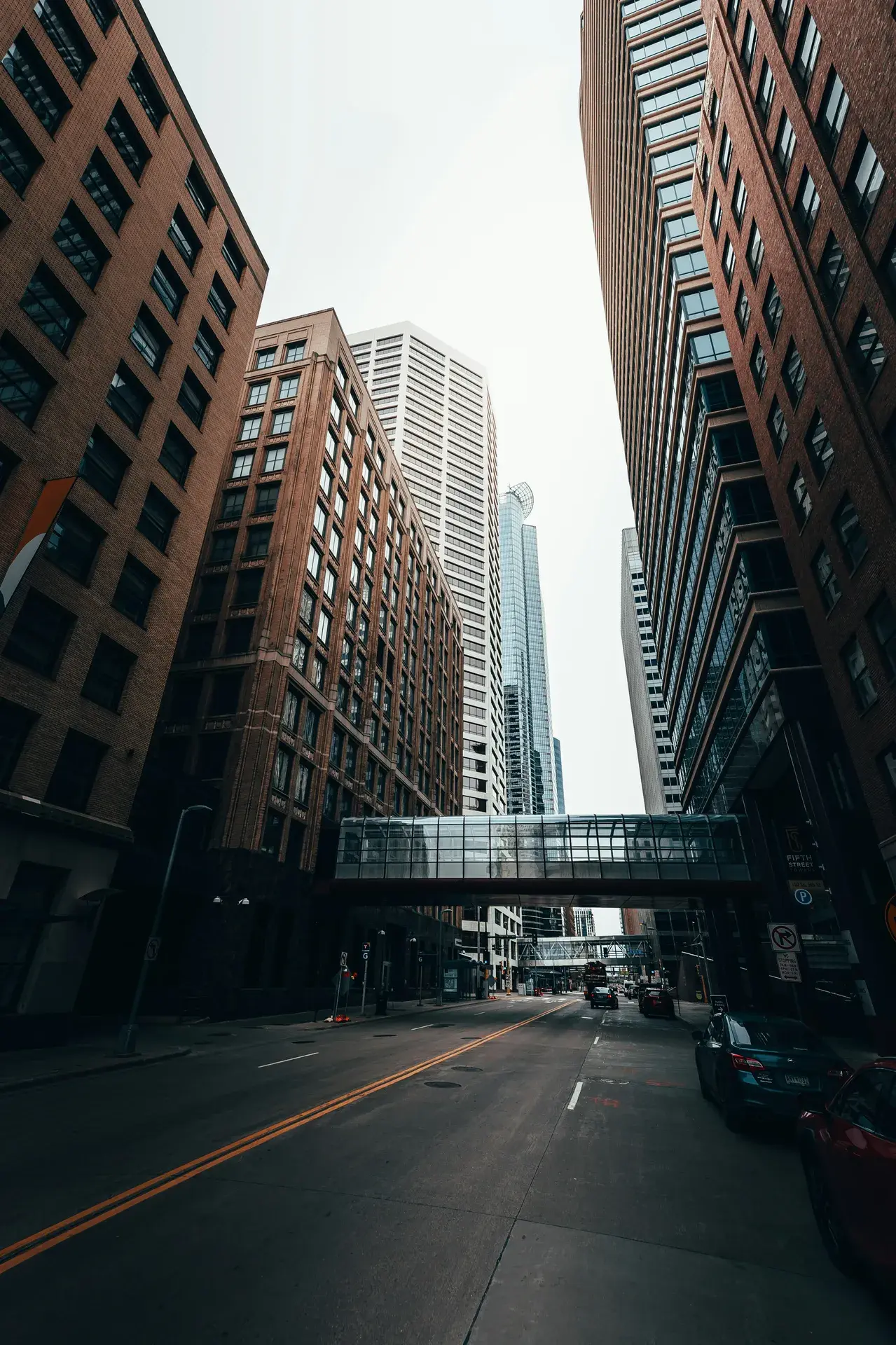
At 6:45 on a Wednesday morning, the shift change at Hennepin Healthcare is rippling outward through Elliot Park. Nurses in scrubs are walking south on Park Avenue toward their cars. Doctors are walking north from the parking ramp toward the hospital entrance. A construction crew is setting up on a half-block that was a surface parking lot six months ago and will be a seven-story apartment building in two years. Across the street, a man is sitting on a bench outside the Elliot Park Recreation Center, drinking coffee from a paper cup, watching all of this with the practiced patience of someone who has watched this neighborhood change before and knows it will change again. Off to the north, the morning light catches the Wells Fargo towers — glass and steel, impossibly clean, the kind of buildings that announce the future whether the neighborhood asked for it or not. And at the center of everything, the park itself sits quiet, its old trees unbothered by any of it.
What is Elliot Park, Minneapolis?
Elliot Park is the neighborhood between downtown Minneapolis and the Phillips community — a transitional zone that has spent most of its history being defined by what it sits next to rather than what it is. To the north, the towers and skyways of the downtown core. To the south, the residential density and diversity of Phillips. Elliot Park absorbs the overflow of both without fully belonging to either. It is roughly bounded by South 5th and 6th Streets to the north, I-35W to the east, I-94 and I-35W to the south, and 5th Avenue South and Highway 65 to the west. Chicago Avenue and Park Avenue run through it like arteries, carrying traffic between downtown and the south side.
The neighborhood's identity is shaped by institutions. Hennepin Healthcare — the county's public hospital, Level 1 trauma center, and one of the largest employers in the area — dominates the northern portion. The Wells Fargo office campus just north of the neighborhood, completed in 2016, brought corporate presence and thousands of workers to blocks that had been parking lots. New apartment towers have followed, filling in gaps and raising the skyline. But between and around these large-scale developments, the older Elliot Park persists — affordable housing complexes, small apartment buildings, social service organizations, and a population that is poorer, more diverse, and more transient than in the downtown neighborhoods next door. Downtown West has the office towers. Downtown East has the river and the culture. Elliot Park has the hospital, the affordable housing, and the ongoing experiment of whether a neighborhood can absorb massive development without losing the people who lived there first.
Elliot Park Neighborhood Sign
Elliot Park, Minneapolis — Key Stats (2025–2026)
- Residents (2020 Census)
- ~7,500
- Median condo sale price (2025 data)
- $320K
- Year Elliot Park was established
- 1883
- Major hospital campus (Hennepin Healthcare)
- 1
- Median rent, all units (2020–24 ACS)
- $1,032
- Walk Score (Oct 2026)
- 83
- Transit Score (Oct 2026)
- 83
- Distance to nearest light rail station
- 0.5 mi
Elliot Park History & Origins
Elliot Park was established as a public park in 1883, named after Dr. Jacob S. Elliot, a Minneapolis physician who, with his wife, donated the original land. The surrounding neighborhood developed as a middle- and working-class residential area in the late 19th century — Victorian-era houses, brownstone row houses, modest apartment buildings, and the kind of walkable urban fabric that was standard for American cities before the automobile. It was a respectable, unremarkable place to live, close enough to downtown to be convenient and far enough to feel residential.
The 20th century was not kind to Elliot Park. The construction of Interstate 35W and Interstate 94 in the 1960s — part of the federal highway program that devastated urban neighborhoods across the country — carved through the area's edges, severing connections to adjacent neighborhoods and creating the freeway-bordered island that Elliot Park remains today. The neighborhood lost half its population to the freeway construction, and by the 1970s and 1980s, it had deteriorated significantly. Streets reengineered to move traffic, surface parking lots, and the loss of neighborhood services wore away at what remained. Social service organizations — shelters, treatment centers, halfway houses — concentrated in the area. Elliot Park became one of the neighborhoods that cities use to warehouse their most vulnerable populations.
Hennepin County Medical Center (now Hennepin Healthcare) expanded through the decades, growing from the city hospital that opened in 1887 into a major medical campus. The hospital provided employment and institutional stability but also shaped the neighborhood around its needs — its buildings and parking ramps took up whole blocks, and the streets became conduits for emergency vehicles rather than pedestrians. The neighborhood survived, but it survived as a place defined by its institutions and its struggles rather than by the aspirations of its residents.
The current wave of transformation began around 2015 with the Wells Fargo campus just to the north and has accelerated since. New apartment buildings, a hotel, and mixed-use developments have risen on sites that were parking lots or vacant land for decades. The physical change is dramatic — entire blocks have been transformed in less than ten years. Whether the social fabric can survive the physical transformation is the question that defines Elliot Park in 2026.
Living in Elliot Park
Living in Elliot Park means living with contrast — not the curated contrast of a neighborhood that puts its contradictions on display for visitors, but the raw, unmediated contrast of a place where different economic realities occupy the same block. A new market-rate apartment tower stands across the street from a subsidized housing complex. The Wells Fargo campus, all glass and corporate polish, is a three-minute walk from a shelter serving people experiencing homelessness. A new coffee shop opens next to a liquor store that has been there for thirty years. None of this is unusual for an American city, but it is more compressed here than in most Minneapolis neighborhoods, and the compression makes it harder to ignore.
The residents who choose Elliot Park — particularly the newer arrivals — tend to be people who want to be close to downtown without paying downtown prices, healthcare workers who want to walk to their shifts, and young professionals who are comfortable with urban grit. The neighborhood is genuinely diverse — racially, economically, and in terms of household composition. East African, Native American, Southeast Asian, and Latino residents share the neighborhood with white-collar workers and university students. The diversity is organic rather than aspirational, a product of affordable housing and institutional proximity rather than marketing.
The park itself — the actual Elliot Park — is the neighborhood's emotional center, even if it is modest by Minneapolis standards. A few acres of grass, a recreation center, a basketball court, a playground. On summer evenings, the park fills with families, kids playing pickup basketball, and people simply sitting and watching the neighborhood go by. It is not Gold Medal Park or Loring Park. It does not have a spiral mound or a lake. But it is the one place in the neighborhood that belongs to everyone, and it has been there since 1883, which is more than the Wells Fargo towers can say.
Elliot Park Food, Drink & Local Spots
Elliot Park's food scene is functional rather than destination-worthy — a reflection of a neighborhood that has historically served its residents' daily needs rather than attracting diners from across the city. That is slowly changing as new development brings ground-floor retail and the population grows, but Elliot Park is not yet a food neighborhood in the way that the North Loop or Whittier are. What it offers is proximity to everything — downtown dining is a short walk north, and the ethnic restaurants of Cedar-Riverside and the Phillips neighborhoods are just east and south.
The Anchors
1333 Nicollet Mall, in Loring Park. A classic diner serving breakfast, lunch, and dinner around the clock — eggs, pancakes, burgers, and the kind of bottomless coffee that fuels early-morning hospital shifts. Not in Elliot Park proper but close enough that residents treat it as theirs. No-frills, reliable, and always open.
607 Washington Avenue South, a few blocks north in Downtown East. One of the original Thai restaurants in Minneapolis, Sawatdee has been serving pad thai, curries, and noodle dishes since the 1980s. The food is approachable rather than adventurous, but the consistency and the portion sizes have kept it alive for decades. A downtown institution in the literal sense.
Several new apartment buildings in Elliot Park have incorporated ground-floor restaurant and retail space. The tenants rotate as the buildings lease up, but the trend is toward coffee shops, fast-casual restaurants, and convenience-oriented businesses that serve the growing residential population. Check what's open — the landscape is changing fast.
Not glamorous, but honest: the Hennepin Healthcare cafeteria is open to the public, serves decent food at low prices, and is where a significant portion of the neighborhood's workforce eats lunch. It is a hospital cafeteria — adjust expectations accordingly — but it is also a genuinely democratic public space.
Also Worth Knowing
Elliot Park's grocery situation is thin. There is no full-service supermarket within the neighborhood boundaries. Residents rely on the downtown Target for basics, the Aldi on Franklin Avenue for affordable groceries, or the ethnic grocery stores along Nicollet Avenue in Whittier (known locally as Eat Street). Delivery services fill some of the gap. A proper grocery store remains one of the neighborhood's most significant unmet needs.
Parks, Culture & Outdoors in Elliot Park
Elliot Park is not a parks neighborhood. The namesake park is the primary green space — a modest but functional urban park with a recreation center, basketball courts, a playground, and enough open grass for informal sports and picnics. The Elliot Park Recreation Center offers programming for children and adults, including gym access, classes, and community events. It is well used by the neighborhood and serves as a de facto community center.
Elliot Park
The park that gives the neighborhood its name is not large — roughly two city blocks — but it punches above its weight as a community gathering space. In summer, the basketball courts are busy from early morning until dark. The playground draws families from the surrounding apartment buildings. The open lawn hosts informal soccer games and community events. The recreation center, built in 1980, provides indoor programming year-round. This is not a destination park. It is a neighborhood park in the best sense — a place that belongs to the people who live around it.
Nearby Cultural Resources
Elliot Park's cultural resources are mostly borrowed from neighboring areas. The Minneapolis Institute of Art (Mia) is a short walk southwest in Whittier. The Guthrie Theater and Mill City Museum are walkable to the northeast in Downtown East. The Walker Art Center and Minneapolis Sculpture Garden are accessible via the Loring Park neighborhood to the west. Elliot Park's central location means these world-class institutions are all within about a half-hour walk — a significant quality-of-life advantage that the neighborhood's modest appearance might not suggest.
The Midtown Greenway (A Mile South)
The Midtown Greenway — the 5.5-mile bike and pedestrian trail built in a former railroad trench — runs through the southern part of the broader Phillips area, about a mile south of Elliot Park and a short ride away. The Greenway connects to the Chain of Lakes, the Mississippi River trails, and the broader regional trail system. For cycling commuters and recreational riders, it is one of the best pieces of urban infrastructure in the Twin Cities.
Elliot Park Schools
Elliot Park has limited school options within its boundaries, but several Minneapolis Public Schools are accessible nearby. Whittier Elementary (PK–5) and Andersen United Middle School (6–8) are within reasonable distance. For high school, students access the broader MPS system; assignment depends on address, so check the district's school finder.
The neighborhood's school-age population is smaller than in surrounding areas but more significant than in downtown proper. Families with children do live in Elliot Park — particularly in the affordable housing complexes — and they navigate the same citywide enrollment system that all MPS families use. The quality and stability of school options is a concern: some nearby schools have experienced enrollment declines and programmatic changes. Families who prioritize schools may find stronger options in neighborhoods with established elementary schools and active parent communities.
Elliot Park Real Estate & Housing
Elliot Park's housing stock is an unusually diverse mix for a neighborhood this close to downtown. Affordable and subsidized housing — public housing, Section 8, nonprofit-owned buildings — makes up a substantial portion of the total, a legacy of the neighborhood's history as a low-income area. Older apartment buildings, some well-maintained and some not, provide relatively affordable market-rate rentals. And new construction — market-rate and luxury apartment buildings built in the last decade — has added a tier of housing that would have been unimaginable here twenty years ago.
Rental prices reflect this range, but the middle sits low: the median rent across all units is about $1,030 a month, by Census estimates, against $1,371 citywide. Condos are less common than in downtown proper — fewer than one in five homes is owner-occupied — and the median condo sale price was $320,000 in 2025, according to Minneapolis Area REALTORS, with units taking 170 days on average to sell. There are very few single-family homes.
The Development Pipeline
Elliot Park has one of the most active development pipelines in Minneapolis. Several new apartment buildings are in various stages of planning, approval, and construction. Most are market-rate or mixed-income, with affordability requirements negotiated through the city's inclusionary zoning policies and developer agreements. The sheer volume of new construction has raised concerns among existing residents about displacement — as the neighborhood becomes more desirable, rents in older buildings rise, and landlords have more incentive to sell to developers. The Elliot Park Neighborhood Inc. (EPNI) has advocated for affordability protections, with mixed results.
Getting Around Elliot Park
Elliot Park benefits from its proximity to downtown's transit infrastructure without having light rail stations directly within its boundaries. The nearest Blue and Green Line stations — Government Plaza and US Bank Stadium — are within a half-mile walk from most of the neighborhood. Bus service is strong: multiple routes run along Chicago Avenue, Park Avenue, and the cross-streets connecting to downtown, the University of Minnesota, and South Minneapolis. The METRO D Line rapid bus on Chicago Avenue stops at 14th Street, in the middle of the neighborhood.
Walking is the primary mode for many residents. The Walk Score of 83 reflects the reality — downtown is right there, and most daily needs are accessible on foot. The neighborhood's grid layout makes navigation simple, and the relatively flat terrain makes walking and biking easy. Bike infrastructure is adequate but not exceptional — bike lanes exist on some streets, and the Midtown Greenway is about a mile south.
By car, the neighborhood's freeway-adjacent location provides quick access to I-35W and I-94, making it easy to reach the suburbs and the airport. Street parking is generally available and often free, which is a significant advantage over downtown proper. Residents with cars appreciate the combination of walkability to downtown and easy car access to everywhere else.
What's Changing: The Honest Version
Elliot Park is changing faster than almost any neighborhood in Minneapolis, and the changes are generating tensions that are real, consequential, and not easily resolved. Here is what is actually happening.
Gentrification and Displacement
The word gentrification is overused, but in Elliot Park it fits. The neighborhood is experiencing a classic gentrification pattern: new, higher-end development attracts higher-income residents, which raises property values and rents, which pressures lower-income residents who were there first. The development is not inherently bad — Elliot Park genuinely needed investment, and some of the new buildings are filling spaces that were empty or blighted. But the benefits of development are not equally distributed. New residents get rooftop pools and fitness centers. Existing residents get higher rents and fewer affordable units. Community organizations have fought for affordability requirements in new projects, and some developers have included income-restricted units. Whether these measures are sufficient to prevent wholesale displacement remains to be seen.
The Healthcare Corridor's Expansion
Hennepin Healthcare and the broader healthcare industry continue to shape Elliot Park in ways that benefit and burden the neighborhood simultaneously. The hospital is the largest employer in the area and provides essential services — including as the county's safety-net hospital, treating patients regardless of ability to pay. But institutional expansion consumes land, generates traffic, and creates a neighborhood that revolves around an institution's needs rather than residents' needs. The tension between being a neighborhood where people live and a campus where people work is ongoing.
Safety and Social Services
Elliot Park hosts a concentration of social service organizations — shelters, treatment centers, food banks, outreach programs — that serve vulnerable populations from across the metro. These services are essential, and the need for them is not going away. But the concentration of services in a single neighborhood creates challenges: visible homelessness, substance use, and associated behavioral issues are part of daily life in parts of Elliot Park. Newer residents sometimes clash with service providers and their clients, creating friction that maps roughly onto class and racial lines. The honest reality is that Elliot Park absorbs more of the city's social service burden than most neighborhoods, and the people who live here — both longtime residents and newcomers — experience the consequences of that concentration every day.
Elliot Park FAQ
Is Elliot Park a good neighborhood in Minneapolis?
Elliot Park is a neighborhood in transition that offers genuine advantages — strong walkability, proximity to downtown, affordable housing options, and improving amenities — alongside real challenges, including visible poverty, safety concerns on certain blocks, and the disruptions of rapid development. It is a good neighborhood for people who value diversity, affordability, and urban convenience over polish. It is not the right fit for people who prioritize quiet residential streets or a curated neighborhood feel.
Is Elliot Park, Minneapolis safe?
Safety in Elliot Park varies significantly by block and time of day. The neighborhood has historically had higher crime rates than the city average, driven by a combination of poverty, substance abuse, and the concentration of social services. Property crime — car break-ins, package theft, bike theft — is a persistent issue. Violent crime occurs but is not evenly distributed; certain blocks, particularly near shelters and along the southern edge, see more incidents. The influx of new development and residents has improved conditions in some areas but has not eliminated the underlying challenges. Residents generally advise basic urban awareness — lock everything, be alert after dark, know your immediate surroundings.
Why is Elliot Park changing so fast?
Elliot Park is changing because of its proximity to downtown, the expansion of healthcare institutions, the availability of developable land (surface parking lots, underutilized parcels), and the citywide housing shortage. The Wells Fargo campus just to the north, new apartment buildings, and mixed-use developments have transformed the area's physical landscape in a short period. The change is driven by the same economic forces — land values, developer economics, institutional expansion — that are reshaping neighborhoods adjacent to every American downtown. Whether the change benefits existing residents or primarily serves newcomers is the central question.
What hospitals are in Elliot Park?
Elliot Park is home to Hennepin Healthcare (formerly Hennepin County Medical Center / HCMC), a Level 1 trauma center and safety-net hospital that serves as the primary public hospital for Hennepin County. Children's Minnesota has a significant campus nearby. Abbott Northwestern Hospital, part of Allina Health, is about a mile south of the neighborhood in the Phillips area. The concentration of healthcare institutions makes Elliot Park a major employment center and shapes the neighborhood's character — the streets are full of people in scrubs, the apartment market serves healthcare workers, and the needs of hospitals influence development patterns.
How much does it cost to live in Elliot Park?
Elliot Park is one of the more affordable neighborhoods within walking distance of downtown Minneapolis. The median rent across all units is about $1,030 a month, by Census estimates — well below the city's $1,371 — with significant variation between older affordable buildings and newer market-rate construction. The median condo sale price was $320,000 in 2025, a little below 2024's $332,375, according to Minneapolis Area REALTORS. The neighborhood has a large stock of income-restricted and subsidized housing, making it accessible to lower-income residents in a way that most downtown-adjacent neighborhoods are not.
What is the Wells Fargo campus near Elliot Park?
The Wells Fargo campus consists of two office towers on South 4th Street between 5th and Park Avenues, a block north of Elliot Park. The development, completed in 2016, brought thousands of office workers to the area and catalyzed surrounding development including new apartment buildings, a hotel, and ground-floor retail. The campus significantly altered the area's character — adding density, foot traffic, and a corporate presence to what had been blocks of surface parking. Post-pandemic office attendance patterns have moderated the impact, but the physical infrastructure remains one of the most visible modern landmarks just north of the neighborhood.
Can you walk to downtown from Elliot Park?
Yes. Elliot Park is immediately south of the downtown core, and the walk to Nicollet Mall or the Government Plaza light rail station takes approximately 10–15 minutes depending on your starting point. The neighborhood effectively functions as downtown's southern extension, with no meaningful physical barrier between them. Many Elliot Park residents commute to downtown jobs on foot.
Where exactly is Elliot Park in Minneapolis?
Elliot Park occupies the area immediately south of the downtown core, roughly bounded by South 5th and 6th Streets to the north, I-35W to the east, I-94 and I-35W to the south, and 5th Avenue South and Highway 65 to the west. It sits between Downtown West and Downtown East to the north and the Phillips neighborhoods to the south. Chicago Avenue and Park Avenue are the primary north-south corridors.
Is Elliot Park gentrifying?
Yes, by most measures. The neighborhood has seen significant new construction — luxury and market-rate apartments, the Wells Fargo campus just to the north, hotels — that has increased property values and changed the area's demographics. The share of higher-income, white residents has grown, while some lower-income residents and communities of color have been displaced or squeezed. The neighborhood retains substantial affordable housing stock, and community organizations have advocated for affordability requirements in new development. But the direction of change is unmistakable. Whether you call it gentrification, revitalization, or displacement depends on where you stand — and whether you were here before the cranes arrived.
What is the history of Elliot Park?
Elliot Park takes its name from the small public park at the neighborhood's center, established in 1883 and named after Dr. Jacob Elliot, an early Minneapolis physician. The neighborhood was originally a middle- and working-class residential area of Victorian homes and brownstone row houses, but suburbanization, highway construction (I-35W and I-94 cut through the neighborhood's edges), and urban decline transformed it into one of the city's poorest areas by the late 20th century. The presence of Hennepin Healthcare and other institutions provided stability but also shaped the neighborhood around institutional needs rather than residential ones. The current wave of development is the most significant change the neighborhood has experienced since the freeways were built.
What Makes Elliot Park Worth Understanding
Elliot Park is not the kind of neighborhood that ends up on lists of Minneapolis's best places to live. It does not have the charm of the North Loop, the cultural cachet of Downtown East, or the tree-lined streets of Southwest Minneapolis. What it has is something less photogenic and more important — a place where the actual city, with all of its contradictions, is visible and unavoidable. The hospital worker walking to her shift at Hennepin Healthcare and the software engineer walking to his desk at the Wells Fargo tower are using the same sidewalk, passing the same park, navigating the same neighborhood. The affordable housing and the luxury apartments share the same blocks. The questions that every American city is trying to answer — about who gets to live where, about what development serves, about the boundary between renewal and displacement — are being worked out here in real time.
The neighborhood will look different in five years. More towers will go up. More surface lots will become buildings. The old Elliot Park — the one that longtime residents remember, the one that was overlooked and under-invested and genuinely affordable — will continue to recede. What replaces it will be more prosperous and more polished. Whether it will also be more equitable, more inclusive, and more genuinely livable depends on decisions being made right now by developers, policymakers, and the people who choose to call this complicated, unfinished neighborhood home.

Keep exploring