Minneapolis Neighborhood
North Loop
Minneapolis's warehouse district reinvented — where century-old brick buildings now hold James Beard kitchens and million-dollar lofts, the Twins play ball a block away, and the tension between what's authentic and what's curated plays out on every corner.
№ 59 of 87 · Central community · Last updated: October 2026 · A complete neighborhood guide
On a Friday evening in June, Washington Avenue North fills the way only a Minneapolis summer street can — restaurant patios spilling onto the sidewalk, someone in a Twins jersey cutting through toward Target Field, a couple debating reservations they should have made yesterday, the smell of wood-fired something drifting from an open kitchen door. A cyclist in a blazer threads past. A dog sits patiently outside a coffee shop while its owner comes out with two oat-milk lattes. Three blocks east, the Mississippi is doing what it always does — flowing south, indifferent to the fact that the warehouses lining its bank now sell cocktails that cost fourteen dollars. This is North Loop on any given summer Friday. The rest of the year, it's a little quieter. But the ambition never quite turns off.

What is North Loop, Minneapolis?
North Loop is a compact urban neighborhood occupying the northwestern corner of downtown Minneapolis, roughly bounded by Plymouth Avenue to the north, the Mississippi River to the east, Hennepin and Washington avenues and I-394 to the south, and Interstate 94 to the west. It is home to approximately 7,500 residents — a number that has grown dramatically since the early 2000s, when the neighborhood was still largely commercial and industrial.
The neighborhood sits on land that was, for most of Minneapolis's history, a working warehouse and rail district — the place where goods arrived by train and were stored, processed, and distributed throughout the Upper Midwest. That industrial past is written into the architecture: heavy timber frames, load-bearing brick walls, freight elevators converted into design features. Today those same buildings house some of the best restaurants in the Twin Cities, boutique retailers, creative agencies, and residential lofts that sell for six and seven figures. Target Field, home of the Minnesota Twins, sits at the neighborhood's southern edge. The light rail ends here. The river is a short walk east.
The name itself tells a story. The city's own neighborhood history links "North Loop" to the "north loop" of rail lines — the railroad and city streetcars that ran through the area. For decades, the area was known simply as the Warehouse District, and many longtime Minneapolis residents still use that name. When residents formed a neighborhood group in 2001, they called it the Warehouse District – North Loop Association; as the neighborhood shifted from commercial to residential, "North Loop" won out. It's a small thing, but telling: the name that stuck leaves the old one's connotations — grit, vacancy, industrial utility — behind.
If you're looking for the neighborhood in Minneapolis that most resembles a coastal city's "it" district — dense, walkable, restaurant-saturated, visually curated — North Loop is it. Whether that's a compliment or a criticism depends on who you ask.
North Loop is small — you can walk the entire neighborhood in under 30 minutes — but it punches so far above its weight in dining, nightlife, and urban livability that it functions as the de facto center of gravity for young professional Minneapolis. On any given Saturday, half the brunch tables are filled by people who drove in from Uptown, Northeast, or the suburbs. The other half walked downstairs.
North Loop Neighborhood Sign
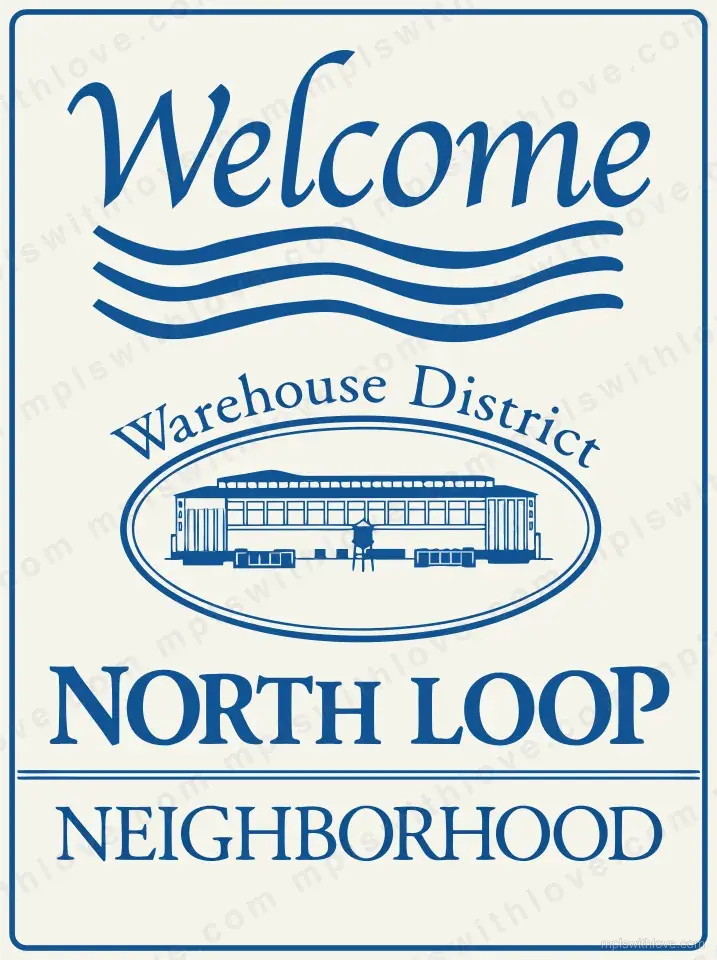
The sign, printed
North Loop, Minneapolis — Key Stats (2025–2026)
- Residents (2020 Census)
- ~7,500
- Median condo sale price (2025 data)
- $383K
- Walk Score (Oct 2026)
- 84
- Bike Score (Oct 2026)
- 92
- Transit Score (Oct 2026)
- 81
- Era most warehouse buildings were built
- 1880s–1920s
- Walk to Target Field
- 5 min
- Walk to downtown Minneapolis core
- 10 min
North Loop History & Origins
To understand North Loop, you have to understand what was here before — and what was here before was flour, grain, lumber, and rail. The land that is now North Loop sits within the traditional homeland of the Dakota people, at the edge of the Mississippi River corridor that was central to Dakota life and commerce for thousands of years before European arrival. The river here — powerful, wide, falling through a series of rapids and the falls that would later be named Saint Anthony — was a gathering place, a travel route, and a spiritual anchor.
European-American settlement transformed the falls and the river into industrial infrastructure. Fort Snelling, established at Bdote in 1819, served as the military anchor of American expansion into the Upper Midwest. By the 1850s and 1860s, sawmills and flour mills had begun clustering around Saint Anthony Falls — the only major waterfall on the entire Mississippi — and the city that grew up around them became, by the 1880s, the flour milling capital of the world. Pillsbury, Washburn-Crosby (later General Mills), and a dozen smaller operations ground wheat into flour at an industrial scale that made Minneapolis one of the most productive cities in America.
The area that is now North Loop served as the city's warehousing and wholesale district. Wholesalers built their warehouses here, just north of the central business district and close to the rail lines, and shipped dry goods, groceries, and later farm implements across the Upper Midwest. The Great Northern Railway depot, designed by architect Charles S. Frost and completed in 1914, stood as the monumental gateway to the district until it was torn down in 1978. Goods arrived by rail, were stored in massive brick and timber warehouses, and shipped out again. The buildings that survive from this era — and many do — were built to hold weight: thick masonry walls, heavy timber columns, cast-iron storefronts, wide freight doors. They were functional, not decorative, but they were built with the kind of material seriousness that accidentally produces beautiful buildings.
The district's commercial importance peaked in the early 20th century and declined steadily from the 1920s on, as manufacturers began shipping directly to buyers, trucking replaced rail, and Minneapolis's economic center of gravity shifted toward the office towers of downtown proper. The construction of Interstate 94 in the 1970s severed the warehouse district from the residential neighborhoods to the north and west, creating a physical and psychological barrier that would define the area for decades. By the 1970s and 1980s, the warehouse district was largely vacant — a grid of handsome, empty buildings surrounded by surface parking lots. Rents were low. And in the way that happens in cities everywhere, the very qualities that made the area undesirable to commercial tenants made it magnetic to artists, musicians, and people who needed cheap space and didn't mind a little grit.
First Avenue, the legendary music club just over the line in Downtown West, anchored the area's nightlife identity from its opening in 1970. Prince filmed the concert scenes of Purple Rain there in 1983. Galleries and studios occupied upper floors of warehouses. The Theatre de la Jeune Lune, an acclaimed experimental theater company, set up shop in a building it bought on North First Street. The neighborhood had grit, emptiness, and the particular energy of a place that hasn't yet decided what it wants to be next. It was, for a moment, the most creatively interesting part of Minneapolis — precisely because nobody important was paying attention.
The transformation gathered speed in the 1990s, when developers started seeing what the artists had already found: that these old warehouses, with their soaring ceilings and massive windows and heavy bones, could be extraordinary places to live. The first wave of loft conversions turned upper floors of commercial buildings into residential units. The Heritage Landing apartments, built around 2000, were part of an early wave of new residential construction that bet on the area's future.
The opening of Target Field in 2010 was the catalytic moment. The new outdoor ballpark — replacing the Metrodome and bringing the Twins back outdoors for the first time since 1981 — was deliberately sited at the southern edge of the warehouse district. It generated foot traffic, restaurant demand, and substantial public infrastructure investment, including the Target Field Station transit hub. The extension of the Blue Line and Green Line light rail into the neighborhood added transit connectivity that made car-optional living genuinely viable. New apartment and condo buildings began filling the surface parking lots that had defined the district for decades. Within ten years, North Loop went from one of the emptiest neighborhoods in downtown Minneapolis to one of the most desirable — and one of the most expensive.
The Warehouse District earned a place on the National Register of Historic Places in 1989, recognizing the architectural significance of the surviving late-19th- and early-20th-century warehouses. That designation has helped preserve the brick-and-timber character even as the neighborhood has transformed around it — developers who convert listed buildings can access federal historic rehabilitation tax credits, which provide a financial incentive to preserve rather than demolish. But preservation has its limits. New construction has filled many of the surface lots, and the resulting mix of old brick and new glass gives the neighborhood its current visual identity — a conversation between eras that is sometimes harmonious and sometimes jarring.
The speed of the transformation has been remarkable by Minneapolis standards. In 2000, North Loop still had only a small residential base — for most people, a place to drink or see a show, then leave. By 2010, it was a neighborhood in progress. By 2020, it was the most desirable zip code in downtown Minneapolis. That kind of compressed timeline creates its own dynamics — a neighborhood that skipped the slow accretion of identity that most places develop over generations, arriving at its current form through market forces and deliberate curation rather than organic evolution.
Living in North Loop
North Loop is, by Minneapolis standards, a genuinely urban neighborhood — which is to say it functions more like a neighborhood in Chicago or Portland than like most of Minneapolis. You can walk to dinner, walk to the grocery store (Whole Foods opened on Hennepin between Washington and North Second Street), walk to the gym, walk to the light rail, and walk home without ever needing your car. People here describe their daily life in terms of blocks, not miles. That density of convenience is rare in Minneapolis, and it's the core of North Loop's appeal.
The demographic profile skews young, professional, and relatively affluent. There are a lot of people in their late 20s and 30s working in tech, design, finance, or the creative industries — many of them choosing North Loop specifically because it offers urban amenities without requiring them to leave Minneapolis for a bigger city. Empty-nesters who've sold a suburban house and moved into a downtown loft make up another significant cohort. Families with young children are present but not dominant — the neighborhood is more likely to have a dog park than a playground, and the social scene revolves more around restaurants and fitness studios than school fundraisers.
The aesthetic is curated in a way that other Minneapolis neighborhoods aren't. Storefronts tend toward the well-designed: exposed brick, Edison bulbs, custom signage. Martin Patrick 3 is a menswear and lifestyle store that functions as much as a gallery as a shop. The coffee is invariably good (Spyhouse, for one). The fitness studios are abundant. There is a particular look to North Loop that you recognize immediately — clean, warm, industrial-modern — and you either find it inviting or you find it exhausting.
Community life here is real, if different in texture from a place like Loring Park or a Southwest Minneapolis neighborhood. The North Loop Neighborhood Association is active and well-organized. The neighborhood hosts a popular farmers market in summer. Block parties happen on the smaller residential streets. But the social fabric is knit more through shared commercial spaces — restaurants, coffee shops, the taproom at Fulton Brewing — than through the kind of front-porch, block-club intimacy you'd find across I-94 in Harrison. It's community, but it's city community.
What North Loop doesn't have — and this is worth saying plainly — is the kind of deep-rooted, generational community identity you find in neighborhoods like Longfellow or Powderhorn or even Fulton. Nobody's grandmother grew up here. Few residents, in terms of tenure, go back further than the 1990s. The community is being built in real time, which gives it an energy that established neighborhoods sometimes lack — but also a thinness. When you ask a North Loop resident what they love about the neighborhood, they talk about convenience, restaurants, walkability, the energy. When you ask a Fulton resident the same question, they talk about their neighbors by name. Both answers are real. They're just describing different kinds of belonging.
North Loop Food, Drink & Local Spots
Here is the honest truth about North Loop: the food scene is the neighborhood's single strongest asset, and it isn't particularly close. The concentration of acclaimed, ambitious, genuinely excellent restaurants in this small area rivals anything in the Twin Cities — and it's not just volume, it's quality. Multiple James Beard nominations and wins have come out of North Loop kitchens. The neighborhood has attracted chefs who could cook anywhere and chose to cook here.
The restaurant density is remarkable even by urban standards. Within a roughly six-block stretch of Washington Avenue and First Avenue North, you can eat New Nordic, handmade ramen, wood-fired pizza, James Beard-level tasting menus, and some of the best pasta in the Upper Midwest. Happy hours here are competitive — restaurants know they're fighting for the same pool of neighborhood diners — and the quality floor is high. There are very few genuinely bad meals to be had in North Loop, which is not something you can say about most neighborhoods anywhere.
The flip side: the restaurant scene here can feel narrow in its range. The price point skews upward. The aesthetic skews trendy. If you're looking for a $7 plate of genuinely great ethnic food — the kind of thing you'd find on Eat Street in Whittier or along Central Avenue in Northeast — North Loop is not the place. What it does, it does at an extremely high level. But what it does is a specific thing.
The Headliners
211 N. First Street. Chef Gavin Kaysen's flagship, opened in 2014 in a converted horse stable. Kaysen, a James Beard Award winner, brought his fine-dining pedigree back from New York to his home state — and the restaurant became an instant anchor of the North Loop dining scene. The pretzels with beer cheese fondue are iconic. The pasta is consistently among the best in the city. Reservations are essential.
33 N. First Avenue. An intimate omakase counter from chef Shigeyuki Furukawa — Minnesota's only 2026 James Beard Best Chef: Midwest finalist, his second consecutive nomination. The multi-course Japanese tasting menu is among the most precise and ambitious dining experiences in Minneapolis, with fish flown in from Japan and kaiseki service rooted in tea-ceremony tradition. Reservations are essential and seats are limited — this is a destination, not a drop-in.
212 N. Second Street. Gavin Kaysen's intimate tasting-menu restaurant — a 20-seat counter-service experience that earned a James Beard nomination for Best New Restaurant. It's the most ambitious dining experience in Minneapolis, full stop. Expect to spend $200+ per person. Expect it to be worth it.
Everyday Excellence
701 N. Washington Avenue. A three-story brewpub in a restored warehouse, The Freehouse brews its own beer on-site and serves an elevated pub menu. Weekend brunch is popular. The patio is one of the best in the neighborhood for warm-weather people-watching.
603 N. Washington Avenue. Started as a food truck and became a brick-and-mortar institution. The lobster roll is the signature — buttery, generous, and probably the best you'll find between the coasts. The lobster mac and cheese is unapologetic.
800 N. Washington Avenue. Chef Isaac Becker's Italian restaurant that opened in 2009 and has been a North Loop pillar ever since. The soft egg bruschetta is a Twin Cities legend. The pasta is made in-house. The wine list is deep.
Coffee & Drinks
Washington Avenue North. A Minneapolis-born chain that set the standard for third-wave coffee in the Twin Cities. The North Loop location has floor-to-ceiling windows and the particular minimalist aesthetic that Spyhouse has made its brand.
414 N. Sixth Avenue. Fulton Brewing started in a garage in the Fulton neighborhood, sold its first beer in 2009, and opened its North Loop taproom in 2012. The Sweet Child of Vine IPA is a local staple. The taproom has a large patio and a loyal game-day crowd.
Shopping & Retail
212 N. Third Avenue. Part menswear store, part home goods showroom, part barbershop — Martin Patrick 3 is the most North Loop store in North Loop. Beautifully curated, impeccably designed, and priced accordingly. It's become a destination in its own right.
Parks & Outdoors Near North Loop
North Loop is not a parks neighborhood the way Southwest Minneapolis is a parks neighborhood. You don't move here for lakefront access or vast green expanses. But the outdoor amenities are better than the neighborhood's downtown-core location might suggest — and the proximity to the Mississippi River gives North Loop something that most urban neighborhoods can't offer.
The Commons
The Commons is a 4.2-acre public green space in Downtown East, about half a mile southeast of North Loop across downtown — not in the neighborhood, but an easy walk. Opened in 2016, The Commons replaced what had been surface parking lots with a genuinely well-designed urban park: open lawns and room for concerts, food trucks, and festivals. It was built as part of the broader development around US Bank Stadium and has become one of the most successful new public spaces in downtown Minneapolis.
Mississippi Riverfront
The Mississippi River runs along North Loop's eastern boundary, and the riverfront trail system — part of the Minneapolis Grand Rounds — connects the neighborhood to the Stone Arch Bridge, St. Anthony Falls, Boom Island Park, and the broader network of riverfront parks that extend north toward Northeast Minneapolis. This is North Loop's greatest outdoor asset, and it's genuinely world-class. The Minneapolis riverfront parks system, concentrated in this stretch between Plymouth Avenue and the falls, represents decades of civic investment in reclaiming industrial riverfront for public use.
Boom Island Park, just across the Plymouth Avenue Bridge in St. Anthony West, sits on a peninsula that was once a lumber sorting yard — the "boom" in the name refers to the log booms that corralled floating timber before it was pulled from the river and processed. Today the 22.5-acre park has a boat dock, picnic areas, a lighthouse (decorative, not functional), and some of the best views of the downtown skyline from across the water. It's one of those places where you can forget you're in the middle of a city.
The Stone Arch Bridge — a former Great Northern Railway bridge built in 1883 from local limestone and granite, designed by engineer Charles C. Smith — was converted into a pedestrian and bicycle crossing in 1994 and is now one of the most photographed spots in Minneapolis. It crosses the Mississippi just below Saint Anthony Falls, offering views of the falls, the ruined mill district, and the downtown skyline. It's an easy walk or ride from anywhere in North Loop and connects to the trails on the east bank of the river.
Target Field & Gameday
Target Field isn't a park in the traditional sense, but it functions as a major outdoor gathering space for the neighborhood. The Minnesota Twins play 81 home games between April and September, and the stadium's open-air design means that summer evenings in North Loop come with the ambient sound of crowd noise and occasional fireworks. The Target Field Station plaza, which serves as a transit hub and public space, hosts events and gatherings throughout the year. On gamedays, the neighborhood takes on a particular energy — bars fill early, jersey-clad fans stream down First Avenue, and the whole district feels like it was designed for exactly this.
Trails & Biking
North Loop's Bike Score of 92 reflects genuine infrastructure, not just flat terrain. The Cedar Lake Trail runs right through the neighborhood and heads west toward the Chain of Lakes — meaning you can bike from your North Loop loft to Lake of the Isles in about 15 minutes on a fully separated path. The Midtown Greenway, Minneapolis's signature 5.5-mile bike highway built in a former railroad trench, is accessible via connecting trails. Bike-share stations are plentiful throughout the neighborhood, and the flat terrain makes cycling practical for daily commuting year-round — or at least from April through November, which is when most Minneapolis cyclists are willing to admit the season runs.
The broader Grand Rounds Scenic Byway — Minneapolis's 51-mile network of connected parkways, paths, and trails that loops through the city's parks and lakes — is accessible from North Loop via the riverfront trails. It's one of the most impressive urban trail systems in the country, and living in North Loop puts you at one of its most scenic entry points. A Saturday morning ride from your building along the river, across the Stone Arch Bridge, and down through Minnehaha Falls to the confluence of the Mississippi and Minnesota Rivers is about 12 miles of almost entirely car-free riding. That's not a bad way to start a weekend.
North Loop Schools
Let's be direct: North Loop is not a neighborhood most people choose for its schools. The population skews heavily toward young professionals and couples without children — Census estimates put households with children at about 5 percent, against about 21 percent citywide — and the neighborhood's school options reflect the reality that this is a downtown core area, not a residential family district.
Minneapolis Public Schools serves the neighborhood, though no district school sits inside it. Assignments depend on the address, so check the district's school finder for a specific building. Minneapolis also operates an open enrollment system, meaning families can apply to magnet schools and specialty programs across the district.
Private options around the metro include International School of Minnesota (in Eden Prairie, but drawing families from the urban core), Blake School, and Breck School. Early childhood programs and daycare facilities are available in and around the neighborhood, reflecting the growing number of young families who are choosing to raise kids downtown rather than decamp for the suburbs. Several Montessori programs and private preschools have opened in or near the North Loop in recent years, responding to demand from the neighborhood's growing population of young parents.
It's worth noting that this is changing — slowly. As North Loop matures and more couples who moved here in their late 20s start having children in their mid-30s, the demand for family-oriented services and school options is growing. Whether the neighborhood will develop the kind of school ecosystem that draws families proactively — rather than merely accommodating those who already live here — is one of the open questions about North Loop's future.
The honest assessment: if schools are your primary decision driver, North Loop probably isn't your neighborhood. If you love the neighborhood and happen to have kids, you can make it work — but it takes more intentionality than in a place like Fulton or Linden Hills, where the school pipeline is a built-in selling point.
North Loop Real Estate & Housing
North Loop real estate is unlike almost anything else in Minneapolis. The housing stock is overwhelmingly multi-family — condominiums, lofts, and apartments in converted warehouses and new construction. Single-family homes are essentially nonexistent. If you want a yard, a garage, and a white picket fence, you are looking at the wrong neighborhood. If you want exposed brick, 14-foot ceilings, original timber beams, and a walk to dinner, this is your place.
Pricing varies widely depending on the building and the unit. North Loop's median condo sale price was $383,000 in 2025, down from $405,000 a year earlier, according to Minneapolis Area REALTORS — above the citywide median of $350,000 for all homes. Standard one- and two-bedroom condos in converted warehouses are the most characteristic North Loop housing type. Larger lofts with premium finishes, skyline views, or corner positions sell well above the median. Penthouses and truly exceptional units have traded above $1 million.
What Your Money Buys
At the entry level, you're looking at studios and smaller one-bedrooms in newer construction — functional but not distinctive. The middle of the market is where the neighborhood's real character lives: converted warehouse lofts with exposed brick, heavy timber, industrial-scale windows, and the particular charm that comes from living in a building that was designed to store farm machinery and now holds your couch. The upper tier gets you premium space, premium views, or both — larger two-bedroom-plus units in the best buildings, often with private outdoor space and upgraded finishes.
The rental market is robust, and renters far outnumber owners. Census estimates put the median rent at about $2,100 a month, among the highest in the city and well above the citywide $1,371; luxury buildings with rooftop decks, fitness centers, and concierge services push higher. Vacancy rates have fluctuated with the wave of new construction — there are times when landlords are offering concessions, and times when the market is tight.
Notable Buildings
The converted warehouse buildings are the jewels of the North Loop housing market. The Warehouse District Historic buildings — structures like the Bookmen Lofts — offer the heavy-timber, exposed-brick aesthetic that defines the neighborhood's identity. Newer developments have added modern, amenity-rich options to the mix. The coexistence of old and new is part of what gives North Loop its visual texture — though residents of the historic buildings will tell you, with some conviction, that the old buildings have more soul.
The HOA Reality
Almost every condo in North Loop comes with a homeowners association, and HOA fees here are not trivial. Monthly assessments vary widely depending on the building, the amenities, and the age of the property. Historic warehouse conversions sometimes carry higher HOAs due to the cost of maintaining older building systems — freight elevators, original windows, masonry repairs. Newer buildings may have lower base fees but charge separately for parking or storage. It's a line item that surprises some buyers, especially those coming from single-family home ownership where they controlled their own maintenance costs. Factor it in early.
Getting Around North Loop
North Loop is one of the most walkable neighborhoods in Minneapolis by the numbers, with a Walk Score of 84. The neighborhood is compact enough that almost everything a resident needs on a daily basis is within a 10-minute walk: groceries (Whole Foods on Hennepin Avenue), coffee (Spyhouse and others), restaurants (dozens), fitness, a pharmacy, dry cleaning, and transit. This is the rare Minneapolis neighborhood where car-free living is genuinely practical rather than aspirational. People move to Uptown thinking they can ditch their car and end up needing it three times a week. In North Loop it can actually be done — though most households here still keep a car: Census estimates put car-free households at about 9 percent, below the citywide 16 percent.
The Blue Line light rail ends in the neighborhood, with Target Field Station serving as a major hub — one of the busiest transit stations in the Metro Transit system. From there, the Blue Line connects south through downtown, past the airport (about 25 minutes to MSP Terminal 1), and on to the Mall of America in Bloomington. The Green Line connects east through the University of Minnesota campus to downtown St. Paul's Union Depot (about 35 minutes), making North Loop one of the best-connected neighborhoods in the Twin Cities for car-free regional travel. Multiple bus routes serve Washington Avenue and Hennepin Avenue, including high-frequency lines that run at 10- to 15-minute intervals during peak hours.
For cyclists, the Bike Score of 92 reflects protected lanes, trail connections to the Cedar Lake Trail and Grand Rounds network, and abundant bike-share stations. The flat terrain and compact grid make cycling the fastest way to get around the neighborhood itself — and often the fastest way to get to adjacent neighborhoods like Downtown West or Northeast. Many North Loop residents who own cars report using them primarily for weekend trips outside the city, not for daily life.
The one genuine pain point is parking. Street parking is limited and metered during business hours. Most condo buildings include one garage stall per unit — additional stalls are available for purchase, typically at a significant premium. Visitors coming for dinner or a game face competition for spots, especially on weekend evenings and Twins gamedays. Surface lots and ramps are available but not cheap. If you live here and own a car, you learn to manage it. If you live here and don't own a car, you barely notice the problem.
What's Changing: The Honest Version
North Loop's success story is real, but it's not uncomplicated. The same forces that made the neighborhood desirable have created tensions that are worth understanding honestly.
The Gentrification Question
North Loop's transformation is, by almost any definition, a gentrification story. A formerly industrial, low-rent district was redeveloped into a high-end residential and commercial neighborhood. The artists and musicians who occupied cheap warehouse space from the 1970s through the 1990s — the people who gave the area its creative energy — have largely been priced out. The businesses that serve the neighborhood now cater to a population with significantly more disposable income than the people who were here before.
This is not a story unique to North Loop or to Minneapolis — it's the standard playbook for warehouse district conversions in American cities. But it's worth naming directly, because the neighborhood's current identity rests on a foundation of displacement, even if the people who were displaced were commercial tenants and artists rather than long-term residential communities. The question of who benefits from urban renewal — and who gets to claim the "authenticity" of a neighborhood they arrived in after the interesting part was over — is a live one in North Loop.
Homelessness & Downtown Proximity
North Loop sits at the edge of downtown Minneapolis, and the realities of downtown homelessness do not stop at the neighborhood boundary. Encampments along the riverfront and under highway overpasses have been a persistent concern. Residents report interactions with people experiencing mental health crises. The neighborhood's proximity to shelters and social services in the broader downtown area means that the visible presence of homelessness is part of daily life here in a way that it is not in Southwest Minneapolis or the suburbs.
This is a genuine tension — residents who chose North Loop for its urban walkability sometimes find that urban walkability also means walking past suffering. The North Loop Neighborhood Association has engaged with the city on outreach and encampment management, but there are no easy answers. It's a citywide and nationwide crisis that happens to be most visible in the neighborhoods closest to the core.
The Development Treadmill
North Loop's popularity has attracted a wave of new construction — luxury apartment buildings, in particular — that has changed the neighborhood's physical character. The same brick-and-timber aesthetic that made the warehouse conversions so appealing is now being mimicked by new buildings that use exposed brick as a design choice rather than a structural reality. Some longtime residents and businesses worry that the neighborhood is losing its distinctiveness as it fills in — that the open, slightly raw quality that defined North Loop in the 2010s is being replaced by a more generic urban density.
The tension is real: more residents means more foot traffic, which supports more restaurants and shops, which is good. But more residents also means more cars, more competition for parking, more noise, and a gradual shift from "discovered" to "established" that can drain the energy from a neighborhood. North Loop is navigating this transition in real time.
Affordability & Who Gets to Live Here
North Loop is an expensive place to live by Minneapolis standards. The neighborhood's demographics are not representative of the city as a whole — it is largely white, largely young, and largely high-income: Census estimates put the median household income at about $123,000, against about $81,000 citywide. A median rent of about $2,100 a month is not accessible to most Minneapolis residents. The condo market, while offering entry-level options, starts at prices that require significant income or savings. This is a neighborhood that has been built and priced for a particular slice of the population, and that selectivity is part of what drives both its appeal and its limitations.
The city has pushed for affordable housing inclusion in new developments, and some buildings in and near North Loop include affordable units as part of the Inclusionary Zoning policy. But the overall character of the neighborhood is firmly market-rate and above. There is a reasonable conversation to be had about whether a neighborhood this desirable, this well-resourced, and this publicly subsidized (through transit investment, stadium construction, and infrastructure spending) should be more accessible to a broader range of residents. That conversation is happening, but it hasn't yet produced outcomes that meaningfully change who lives here.
Post-2020 Recovery
The COVID-19 pandemic and the unrest following George Floyd's murder in 2020 hit downtown Minneapolis hard. North Loop weathered the storm better than some adjacent areas — its residential base provided stability that purely commercial districts lacked — but the neighborhood did experience business closures, vacancies, and a period of genuine uncertainty about the future of downtown living. By 2024 and 2025, the recovery was well underway: new restaurants opened and foot traffic returned. The condo market has stayed soft — the median sale price slipped to $383,000 in 2025, below its 2021 level of $391,500, and units took an average of 102 days to sell, nearly twice the city average. But the experience left marks. Some long-standing businesses didn't survive. The conversation about public safety became more pointed. The neighborhood that emerged is recognizably the same place, but it's also a place that knows things can change faster than anyone expects.
North Loop FAQ
Is North Loop a good neighborhood in Minneapolis?
North Loop is widely considered one of the most desirable urban neighborhoods in Minneapolis. It offers an exceptional concentration of restaurants, walkable streets, proximity to Target Field and the riverfront, and a curated mix of converted warehouses and new construction. It's particularly appealing to young professionals, empty-nesters, and anyone who prioritizes walkability and dining over yard space.
Is North Loop, Minneapolis safe?
North Loop is generally considered safe, especially relative to other downtown-adjacent neighborhoods. That said, it borders areas with higher crime rates, and like any urban core neighborhood, property crime — bike theft, car break-ins, occasional package theft — does occur. Violent crime is uncommon within the neighborhood itself, but residents should exercise the same awareness they would in any city center environment.
What is North Loop, Minneapolis known for?
North Loop is best known for its restaurant scene — it has one of the highest concentrations of acclaimed dining in the Twin Cities, including multiple James Beard-recognized kitchens. It's also known for its converted warehouse lofts, proximity to Target Field (home of the Minnesota Twins), boutique shopping along Washington Avenue and First Street, and its transformation from a gritty industrial district into the city's trendiest neighborhood.
How much do condos cost in North Loop, Minneapolis?
Condo and loft prices in North Loop range widely, from studios in newer buildings to penthouses that have sold for more than $1 million. The median condo sale price was $383,000 in 2025, down from $405,000 in 2024, according to Minneapolis Area REALTORS — above the citywide median of $350,000 for all homes. Units took an average of 102 days to sell, nearly twice the city average of 55, and went for about 96 percent of their original list price.
Is North Loop walkable?
Very. North Loop earns a Walk Score of 84, one of the highest in Minneapolis. Nearly everything a resident needs — groceries, restaurants, coffee, fitness, nightlife — is within walking distance. The neighborhood also scores a 92 for biking and 81 for transit, with multiple Blue Line and Green Line light rail stations nearby.
What schools serve North Loop, Minneapolis?
North Loop is served by Minneapolis Public Schools, but no district school sits inside the neighborhood, and assignments depend on the address — check the district's school finder for a specific building. The district's magnet and open enrollment system and private schools are other options. Relatively few households here are looking: the population skews toward young professionals and couples, and Census estimates put households with children at about 5 percent, against about 21 percent citywide.
What are the best restaurants in North Loop, Minneapolis?
North Loop has one of the densest concentrations of acclaimed restaurants in the Twin Cities. Standouts include Spoon and Stable (James Beard-winning chef Gavin Kaysen), Demi (Kaysen's intimate tasting-menu counter), Kado no Mise (omakase from 2026 James Beard finalist Shigeyuki Furukawa), The Freehouse (craft beer and elevated pub fare), and Smack Shack (lobster rolls). The neighborhood also has excellent coffee at Spyhouse Coffee.
Where exactly is North Loop in Minneapolis?
North Loop occupies the northwestern corner of downtown Minneapolis, roughly bounded by Plymouth Avenue to the north, the Mississippi River to the east, Hennepin Avenue, Washington Avenue and I-394 to the south, and Interstate 94 to the west. Target Field sits at its southern edge, and the Hennepin Avenue Bridge lands at its southeastern corner.
Is North Loop the same as the Warehouse District?
Mostly, yes — with some distinction. The Warehouse District is the historic term for the area of late 19th and early 20th century commercial warehouses in this part of downtown. North Loop is the broader neighborhood designation that encompasses most of the Warehouse District and extends well beyond it. In practice, most people use the terms interchangeably.
Can you live in North Loop without a car?
Yes — North Loop is one of the few neighborhoods in Minneapolis where car-free living is genuinely practical, though most households here still keep a car. The Walk Score of 84 means most daily errands are easily handled on foot. The Blue Line and Green Line light rail connect to downtown, the airport, and St. Paul. Bike-share stations are abundant, and protected bike lanes connect to the broader trail network.
What is the parking situation in North Loop?
Street parking in North Loop is limited and metered during business hours. Most residents park in building garages — condo buildings typically include one stall per unit, with additional stalls available for purchase. Evening and weekend parking for visitors can be challenging near popular restaurants, especially on First Avenue North and Washington Avenue.
What Makes North Loop Irreplaceable
There are neighborhoods in Minneapolis with more history, more diversity, more grit, more grass. North Loop isn't competing with those places — it's doing something different. It took a district that the city had largely forgotten — a grid of aging warehouses where trains used to unload dry goods and farm equipment — and turned it into the most food-obsessed, most genuinely urban neighborhood Minneapolis has. That's not nothing. The question is whether the neighborhood can hold onto the energy that made it interesting as prices stay high and the new construction keeps arriving.
Walk down Washington Avenue on a Friday evening in June and you'll see it clearly: the outdoor patios full, the brick buildings glowing in the last light, someone biking past with a dog in the front basket, the light rail humming toward the stadium. It's a neighborhood that feels like it's still becoming something. That restlessness — that sense that the best version of North Loop might still be ahead of it — is part of what makes it compelling. Whether that optimism is justified or just expensive remains to be seen. But for now, this is where Minneapolis feels most like a city that believes in itself.

From the shop
Take the North Loop sign home.
North Loop — Minneapolis Neighborhood Sign Print
Keep exploring
Nearby
North Loop appears in
- Best Breweries by Neighborhood
- Best Brunch
- Best Burgers and Juicy Lucys
- Best Chinese Food & Dim Sum
- Best Coffee Shops by Neighborhood
- Best Cozy Winter Restaurants
All 26 guides ↓Show fewer ↑
- Best Food Neighborhoods
- Best Food Trucks
- Best Happy Hours
- Best Late Night Food
- 10 Best Neighborhoods
- Best Neighborhoods for Nightlife
- Best Neighborhoods for Public Transit
- Best Neighborhoods for Remote Workers
- Best Neighborhoods for Retirees and Empty Nesters
- Best Neighborhoods for Young Professionals
- Best Neighborhoods Near Downtown Minneapolis
- Best Patios and Outdoor Dining by Neighborhood
- Best Pizza
- Best Restaurants in the North Loop, Minneapolis
- Best Sushi
- Best Neighborhoods for Surviving (and Enjoying) Winter
- The History of Minneapolis Neighborhood Signs
- Most Bikeable Neighborhoods
- Most Walkable Neighborhoods
- Moving to Minneapolis