Minneapolis Neighborhood
Loring Park
An urban oasis at the edge of downtown — where a 34-acre park with a lake sits surrounded by high-rise condos, the Walker Art Center watches over the Sculpture Garden, and Twin Cities Pride, which began here with a picnic in 1972, gathers every June.
№ 45 of 87 · Central community · Last updated: October 2026 · A complete neighborhood guide
On a Saturday afternoon in July, Loring Park is doing what it has done for over a century — holding the city together. A couple spreads a blanket near the Berger Fountain, dry for now and waiting on its rebuild, with the downtown skyline behind it. Runners loop the lake on the packed-dirt trail. A woman reads on a bench beneath an elm that was old before the freeway was built. Across the park, a wedding party is posing for photos on the stone bridge, the Basilica of Saint Mary rising behind them in Beaux-Arts grandeur. West of the treeline, across Lyndale, the Walker Art Center's angular silhouette watches over the Sculpture Garden, where someone's kid is trying to figure out why there's a giant spoon with a cherry on it. This is Loring Park on a warm day — thirty-four acres of green in the middle of concrete and glass, doing the quiet, essential work of giving a downtown neighborhood permission to breathe.
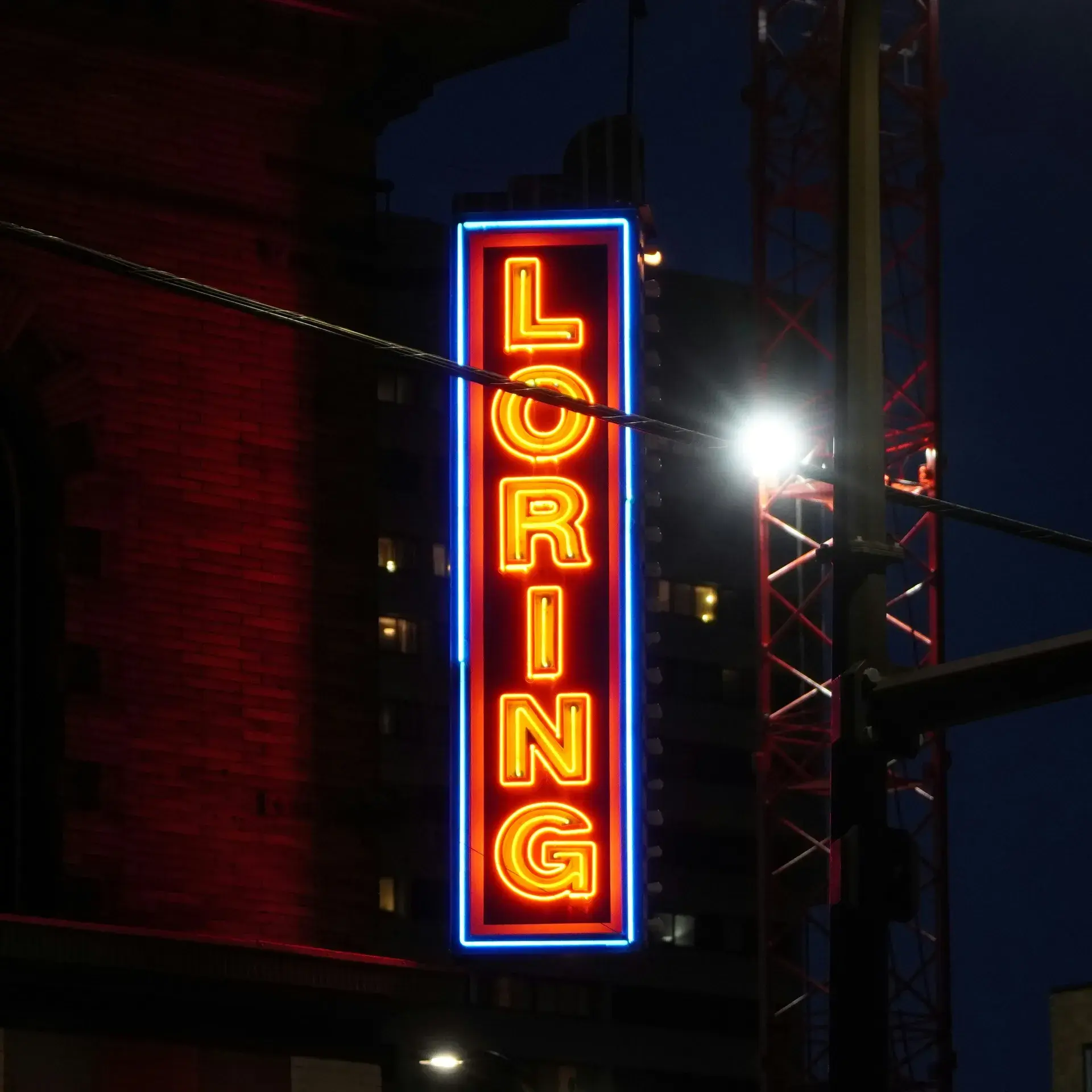
What is Loring Park, Minneapolis?
Loring Park is a compact, densely urban neighborhood at the southwestern edge of downtown Minneapolis, defined by the 34-acre park that gives it its name. Bounded roughly by Interstate 94 to the south, Highway 65 to the east, 12th Street to the northeast, Interstate 394 to the north, and Lyndale Avenue to the west, it occupies a position that is both geographically central and culturally distinctive — a residential enclave pressed against the commercial core, with a major urban park as its front yard.
The neighborhood is anchored by institutions that most cities would build entire districts around: just across Lyndale, the Walker Art Center, one of the premier modern and contemporary art museums in the country, and the Minneapolis Sculpture Garden, home to the iconic Spoonbridge and Cherry; the Basilica of Saint Mary, the first basilica in the United States; and the park itself, with Loring Lake, the Berger Fountain, and walking paths that have served Minneapolis since 1883. The Loring Greenway — a landscaped pedestrian path — connects the neighborhood directly to Nicollet Mall and the heart of downtown, a physical link that few other neighborhoods can claim.
About 9,700 people lived here at the 2020 Census, mostly in high-rise condominiums and apartment buildings that ring the park and line the surrounding streets. The housing stock skews vertical in a city that is mostly horizontal — towers from the 1960s through the 2020s stand alongside older courtyard apartments and a handful of historic brownstones and low-rise buildings that survive from the neighborhood's earlier character. The population includes young professionals, empty nesters who downsized from the suburbs, artists, LGBTQ+ community members who have called this neighborhood home for decades, and a growing number of international residents drawn to the walkability and cultural access.
Loring Park Neighborhood Sign
The sign, printed
Loring Park, Minneapolis — Key Stats (2025–2026)
- Residents (2020 Census)
- ~9,700
- Median condo sale price (2025 data)
- $225K
- Median rent, all units (2020–24 ACS)
- $1,199
- Walk Score (Oct 2026)
- 91
- Bike Score (Oct 2026)
- 86
- Transit Score (Oct 2026)
- 78
- Renter-occupied homes (2020–24 ACS)
- 68%
- Loring Park green space
- 34 acres
Loring Park History & Origins
Before it was a park, before it was a neighborhood, this land was part of the homeland of the Dakota people, whose presence on these prairies and lakeshores predated European arrival by centuries. The small lake that would become Loring Lake was one of many wetlands in the area, part of a landscape that European settlers would dramatically reshape within a single generation.
The park was established in 1883, originally called Central Park — a name that reveals the ambition Minneapolis had for itself even then. It was renamed in 1890 for Charles Morgridge Loring, the first president of the Minneapolis Park Board and the man most responsible for the city's remarkable system of parks and parkways. Loring believed that public parks were essential to urban civilization, and the park that bears his name was the first land the new park board bought. Horace Cleveland, the landscape architect who mapped out the Minneapolis system of parks and parkways, drew the park's first plan.
By the late 19th century, the neighborhood surrounding the park had developed into one of Minneapolis's most fashionable residential areas. Mansions, townhouses, and residential hotels lined the streets, and in the early 20th century the Basilica of Saint Mary — designed by Franco-American architect Emmanuel Masqueray and dedicated in 1915 — established the neighborhood's northern anchor. The Basilica was designated as the first basilica in the United States in 1926, a distinction it holds to this day.
The mid-20th century brought the disruption that reshaped so many American urban neighborhoods: the construction of Interstate 94 in the 1960s. The freeway carved through the neighborhood's southern and western edges, cost the park more of its land than any other project, and severed the park from the neighborhoods to the south. The physical and psychological scar of the freeway cannot be overstated — it turned what had been a connected urban fabric into an island.
The 1960s and 1970s brought a different kind of transformation. When urban renewal leveled downtown's Gateway District, home to some of the city's early gay bars, gay life shifted south along Hennepin Avenue, and Loring Park became a center of Minneapolis's LGBTQ+ community. Gay bars, community organizations, and social networks concentrated in and around the neighborhood. Twin Cities Pride — the annual celebration that would grow into one of the largest Pride festivals in the Midwest — began as a small picnic in the park in 1972, and the festival has made its home here for decades. This history is not incidental to Loring Park's identity. It is foundational.
The late 20th and early 21st centuries brought another wave of change: condo development. High-rise towers went up around the park, attracting a wealthier, more professionally established population alongside the artists, LGBTQ+ residents, and renters who had defined the neighborhood for decades. The Walker Art Center expanded with a dramatic new building designed by Herzog & de Meuron, completed in 2005. The Sculpture Garden was renovated and reopened in 2017. Loring Park today is the product of all these layers — Dakota homeland, Victorian park, freeway scar, queer refuge, condo boom, cultural campus.
Living in Loring Park
Living in Loring Park means living vertically in a city that mostly lives horizontally. This is not a neighborhood of front porches and backyard grills. It is a neighborhood of lobby doors and elevator rides, of balcony views and shared hallways, of the particular intimacy and anonymity that come with apartment and condo living at density. Most residents look out their windows at other buildings, at the park, at the downtown skyline — and that view, that sense of being inside the city rather than adjacent to it, is the defining experience of living here.
The park is the neighborhood's living room. In summer, it fills with runners, dog walkers, families with strollers, office workers eating lunch, yoga classes on the grass, and the occasional live music event. The Berger Fountain — a modernist water feature installed in 1975 at the park's east end — has been dry since 2020, and the Park Board is planning to rebuild it and its plaza. Loring Lake, small and shallow but genuinely lovely, reflects the skyline on calm mornings. The stone bridge over the lake's narrows is one of the most photographed spots in Minneapolis, particularly at sunset when the light catches the water and the Basilica rises behind the trees.
The LGBTQ+ community remains a visible and important part of the neighborhood's character, though the relationship has evolved. Loring Park is no longer as distinctly gay a neighborhood as it once was — the community has dispersed across Minneapolis and the metro as acceptance has broadened and as condo development has changed the neighborhood's demographics. But Pride flags fly from balconies year-round, not just in June. The park still hosts Twin Cities Pride Festival every summer, drawing hundreds of thousands of people to the neighborhood. And the cultural memory of what this neighborhood meant — as a place of refuge, visibility, and community — is carried by long-term residents who were here when it mattered most.
The neighborhood draws a mix of residents that is distinctive in Minneapolis. Young professionals who work downtown and want to walk to the office. Empty nesters from Edina and Wayzata who sold the house and moved to a condo with a park view. Artists who have held onto their apartments through decades of change. International professionals at nearby companies and hospitals. The result is a population that is more diverse in age and background than some downtown neighborhoods, but less diverse racially than neighborhoods like Whittier or Powderhorn Park.
The physical character of the neighborhood is a study in contrasts. Glass-and-steel condo towers from the 2000s and 2010s stand next to brick apartment buildings from the 1920s. A handful of historic brownstones and low-rise buildings survive on side streets, remnants of the neighborhood's earlier architectural identity. The Basilica dominates the northern skyline; the Walker Art Center's angular metallic form anchors the west, just across Lyndale. Between them, the park spreads out like a green counterargument to everything vertical around it.
Loring Park Food, Drink & Local Spots
Loring Park's dining scene is smaller and more curated than the sprawling corridors of Whittier's Eat Street or the North Loop's warehouse-district restaurants. What it lacks in volume it makes up for in quality and in the particular pleasure of walking to a good restaurant through a park. The Hennepin Avenue corridor through the neighborhood's northwest side provides the densest concentration of options, with additional spots scattered on side streets and in the ground floors of condo and apartment buildings.
Neighborhood Anchors
1368 La Salle Avenue. A craft beverage company that doubles as the neighborhood's new gathering place — award-winning beers, specialty coffees, hop waters, and adaptogen drinks in a space with open-air windows and a sidewalk patio. Food trucks and pizza round out the menu. Dogs welcome. The vibe is community-centric in a way that Loring Park needed after losing some of its dining anchors.
1110 Nicollet Mall. A downtown institution with rooftop lawn bowling, a proper pub menu, and a patio that overlooks Nicollet Mall. Close enough to Loring Park — just across 12th Street in Downtown West — to qualify as a neighborhood option, and one of the few places in Minneapolis where you can bowl on grass while drinking a pint.
Hennepin Avenue Corridor
Hennepin Avenue, which cuts through the neighborhood on its way south from downtown into Uptown, has its own cluster of restaurants, bars, and theaters. The stretch nearest Loring Park includes a mix of long-standing establishments and newer openings. The historic Hennepin Theatre District — home to the Orpheum, State, and Pantages Theatres — sits just north of the neighborhood and draws pre-show and post-show diners to nearby restaurants. This corridor is more nightlife-oriented than the streets immediately surrounding the park, with bars and late-night options that cater to theatergoers and downtown workers.
Coffee & Casual
Coffee options in Loring Park have improved as the residential population has grown. Dunn Brothers and smaller independent cafes serve the morning commuter and remote-worker crowds. The Walker Art Center's cafe, just across Lyndale, offers coffee and light fare with a side of cultural credibility. For a neighborhood this walkable, the proximity to downtown's coffee scene — a ten-minute walk via the Loring Greenway — effectively extends the options. The North Loop and its concentration of specialty roasters are within easy reach.
Events
For years the Basilica Block Party, held on the Basilica grounds, was one of Minneapolis's signature summer music festivals — a two-day outdoor concert that drew national acts and thousands of attendees to the neighborhood and raised money for the Basilica's restoration and maintenance. It moved to Boom Island Park for 2024, and in 2026 its organizers said it would not return. The park itself hosts food truck events, farmers' market pop-ups, and seasonal gatherings that give the neighborhood an event-driven energy that quieter parts of the city lack.
Parks, Culture & Outdoors in Loring Park
If most Minneapolis neighborhoods define themselves by their restaurants or their housing or their demographics, Loring Park defines itself by its cultural institutions and its green space. The park, the Basilica, and the Walker and the Sculpture Garden just across Lyndale — these are not side attractions. Everything else in the neighborhood exists in relation to them.
Loring Park (The Park Itself)
Thirty-four acres of green space on the neighborhood's west side, Loring Park has been a Minneapolis landmark since 1883. The park includes Loring Lake, a small body of water that freezes for skating in winter; the Berger Fountain, a modernist sculptural fountain that has been dry since 2020 and is slated to be rebuilt; a network of walking and running paths; mature elm and oak trees; garden beds maintained by community volunteers; a playground; basketball and tennis courts; and the kind of open green lawns that invite blankets, frisbees, and afternoon naps.
The park's design reflects its Horace Cleveland origins — curving paths, naturalistic plantings, an emphasis on scenery over structure. It feels, on a good day, like a pocket of country in the city, with the downtown skyline visible above the tree canopy as a reminder of where you actually are. The stone bridge over the lake's narrows is a beloved feature, a picturesque crossing that shows up on wedding photographs and Instagram feeds with predictable regularity.
Every June, the park hosts Twin Cities Pride Festival, one of the largest Pride celebrations in the Midwest. The festival fills the park with stages, vendors, community organizations, and crowds in the hundreds of thousands over the weekend. For the LGBTQ+ community and its allies, Pride in Loring Park is not just an event — it is a homecoming to the neighborhood that provided shelter and visibility when much of the rest of the city did not.
Walker Art Center
The Walker Art Center, at 725 Vineland Place just across Lyndale Avenue in Lowry Hill, is one of the most important modern and contemporary art institutions in the United States. On its present site since 1927, the Walker is not a dusty repository of canonical works — it is an active, sometimes provocative, always forward-looking institution that engages with visual art, performing arts, film, and design. The permanent collection includes works by Andy Warhol, Jasper Johns, Chuck Close, Kara Walker, and hundreds of other modern and contemporary artists. The temporary exhibitions are consistently ambitious.
The building itself is a landmark — the 2005 expansion by Swiss architects Herzog & de Meuron added a dramatic angular structure clad in aluminum-mesh panels that shimmer and shift in the light. Inside, the galleries are some of the finest exhibition spaces in the country. The Walker's programming extends beyond visual art to include theater, dance, music, and film screenings, making it a genuinely multidisciplinary cultural hub.
Unlike the Minneapolis Institute of Art in Whittier, the Walker charges admission (with free hours on select evenings and for members). But the Sculpture Garden, which the Walker operates in partnership with the Minneapolis Park Board, is free and open to the public year-round.
Minneapolis Sculpture Garden
The Minneapolis Sculpture Garden is an 11-acre public park adjacent to the Walker Art Center in Lowry Hill, and it is one of the largest urban sculpture parks in the country. The collection includes over 40 works by artists including Claes Oldenburg and Coosje van Bruggen (whose Spoonbridge and Cherry is the garden's — and arguably the city's — most famous artwork), Frank Gehry, Henry Moore, and many others. The garden was extensively renovated and reopened in 2017, with new works, improved paths, and a redesigned conservatory.
The garden is free, open daily, and accessible from multiple entry points along Vineland Place and Lyndale Avenue. Walking through it on a quiet morning — past monumental steel forms and whimsical pop art and the Spoonbridge reflecting the sky — is one of the great free experiences in Minneapolis. It is also, on a practical level, a park — people jog through it, walk their dogs past it, and use it as a shortcut between Loring Park and the rest of Lowry Hill. Art and daily life coexist here without pretension.
Basilica of Saint Mary
The Basilica of Saint Mary stands at 88 North 17th Street, its Beaux-Arts dome and columned facade visible from across the neighborhood. Dedicated in 1915 and designed by Emmanuel Masqueray (who also designed the Cathedral of Saint Paul across the river), it was designated the first basilica in the United States in 1926. The building is architecturally magnificent — the interior features an 82-foot-wide nave, stained glass windows, and a barrel-vaulted ceiling that draws the eye upward with the force of genuine craftsmanship.
The Basilica serves an active Catholic parish with progressive leanings by Catholic standards, and its community engagement extends well beyond Sunday Mass. The Basilica Block Party, the summer music festival that for years raised funds for building maintenance and drew national musical acts, ended after 2024. The building's restoration — an ongoing project that has run for decades — is a community effort that reflects both the building's significance and the cost of maintaining an architectural landmark more than a century old.
Loring Greenway
The Loring Greenway is a landscaped pedestrian and bicycle path that connects Loring Park to Nicollet Mall in downtown Minneapolis. Designed by M. Paul Friedberg and built in the 1970s as part of the city's Loring Park redevelopment, it was an urban greenway at a time when most new greenways were going up in the suburbs — a deliberate attempt to tie the neighborhood to the heart of downtown.
The Greenway includes gardens, fountains, public art, and seating areas along its route. It is also a commuter path — residents of Loring Park walk or bike across it every morning to reach downtown offices.
Loring Park Schools
Loring Park is not a neighborhood that most families move to for the schools — it's a downtown-edge community whose population skews toward young professionals, empty nesters, and singles. That said, families do live here, and the Minneapolis Public Schools system serves the neighborhood through its enrollment zones and open enrollment options.
Nearby Minneapolis Public Schools options for elementary-age children include Kenwood Elementary (K–5, in Kenwood, just west of Lowry Hill), and other schools are accessible through the district's open enrollment system. Middle school and high school students typically attend schools based on the MPS assignment zones or apply to magnet and specialty programs throughout the district. Assignments depend on the address, so check the district's school finder for a specific building.
The neighborhood's proximity to downtown also puts several private and charter school options within reach, including the Blake School's Northrop campus in Lowry Hill and various early childhood programs. Families who prioritize school choice tend to look at the broader Minneapolis landscape rather than limiting themselves to neighborhood assignments — the city's open enrollment system makes this feasible, and many Loring Park families take advantage of it.
Loring Park Real Estate & Housing
The housing market in Loring Park is unlike most Minneapolis neighborhoods. This is not a place of single-family homes and tree-lined residential streets. It is a vertical neighborhood — condominiums and apartments in mid-rise and high-rise buildings, with a smaller inventory of historic walk-ups, converted brownstones, and the occasional townhouse. The housing stock reflects the neighborhood's evolution: 1920s courtyard apartments, postwar mid-rises, 1970s and 1980s towers, and sleek 21st-century glass-and- steel condo buildings.
Condo Market
Condominiums dominate the ownership market: all 74 sales that Minneapolis Area REALTORS counted in Loring Park in 2025 were condos or townhomes, at a median price of $224,850 — down from $261,200 in 2021 and well below the citywide median of $350,000. The market is slow. Units spent an average of 131 days on the market, against 55 citywide, and sold for about 92 percent of their original asking price. Prices range widely — older studios and one-bedrooms in 1960s and 1970s buildings sit at the low end, offering entry-level ownership with park proximity and walkability, while updated units in newer or renovated buildings sell for more. Premium units — top-floor condos with park or skyline views, updated finishes, and in-building amenities — sit at the top of the market.
The buildings themselves vary enormously. Some of the older towers show their age — dated lobbies, deferred maintenance, special assessments that reflect years of underinvestment. Newer buildings offer the amenities that modern buyers expect: fitness centers, rooftop terraces, underground parking, concierge services. Due diligence on association finances is particularly important in Loring Park, where some older buildings face significant capital needs.
Rental Market
About 68 percent of Loring Park's homes are renter-occupied, by Census estimates — against 48 percent citywide — making it one of the more renter-heavy neighborhoods in Minneapolis. The same estimates put the median rent across all units at about $1,200 a month, below the citywide median of $1,371, with newer luxury buildings asking considerably more.
The rental market here competes directly with downtown proper and the North Loop. Loring Park's advantage is the park itself — green space at your doorstep — and slightly lower rents than the newest downtown towers. The trade-off is that some of the older rental buildings lack the amenities and finishes of newer construction.
Historic & Unique Properties
A handful of historic properties survive in Loring Park — brownstone-style buildings, early 20th-century apartment houses, and the occasional structure with architectural character that predates the high-rise era. These are increasingly rare and often sell at premiums when they come to market. The tension between preservation and development is a recurring theme: every historic building that comes down to make way for a new tower changes the neighborhood's character in a way that cannot be reversed.
Getting Around Loring Park
Loring Park is one of the most walkable neighborhoods in Minneapolis — a Walk Score of 91 reflects the reality that nearly everything you need for daily life is within a short walk. Downtown Minneapolis is a ten-minute walk via the Loring Greenway. The Walker Art Center and Sculpture Garden are just across Lyndale, at the neighborhood's western edge. Hennepin Avenue provides restaurants, bars, and services. The Basilica is a five-minute stroll. For a neighborhood this compact, the density of destinations is remarkable.
Transit is strong by Minneapolis standards. Multiple Metro Transit bus routes serve Hennepin Avenue, Lyndale Avenue, and Nicollet Mall (via the Greenway connection). The METRO Green and Blue Line light rail stations downtown are within walking distance, connecting Loring Park to the airport, Mall of America, the University of Minnesota, and Saint Paul. The Transit Score of 78 is among the highest in the city. About a third of households here have no car, by Census estimates — roughly twice the city's share — and car-free living is more practical here than in almost any other Minneapolis neighborhood.
Biking is well-supported. The Loring Greenway provides a car-free route to downtown. The network of bike lanes on surrounding streets connects to the broader Minneapolis trail system, including the Midtown Greenway (reachable via Lowry Hill East) and the Chain of Lakes. Bike-share stations are located in the neighborhood for shorter trips.
Driving is easy for those who need it — I-94 is immediately adjacent, putting downtown within minutes and MSP Airport within 15 to 20 minutes. Parking, however, is the price of density. Street parking is limited and often metered. Building parking garages are available in most condo and apartment buildings, though stalls are sometimes an additional cost. Visitors should plan to use ramps or metered spaces. If dedicated, free parking is a priority, Loring Park will disappoint you — but then, that's true of most neighborhoods worth living in.
What's Changing: The Honest Version
Loring Park is a neighborhood where the beauty and the difficulty of urban life exist in uncomfortably close proximity. The park is gorgeous; parts of it feel unsafe after dark. The condos are sleek; some of the older buildings are deteriorating. The cultural institutions are world-class; the daily reality of walking past someone sleeping on a bench on your way to the Walker is a confrontation with the city's failures that not everyone is prepared for. This honesty is not a criticism. It is a description.
Homelessness in the Park
This is the issue that dominates neighborhood conversations, and it is not simple. Loring Park's centrality, its proximity to downtown social services, its transit access, and the shelter of its mature trees and structures make it a gathering place for people experiencing homelessness. Encampments have appeared seasonally, and the park's restrooms, benches, and sheltered areas serve as de facto public infrastructure for people who have nowhere else to go.
Residents hold a range of views. Some approach the issue with compassion and support housing-first solutions. Others express frustration with the impact on the park's usability — concerns about safety, cleanliness, and the feeling that a shared public space is being lost. Most recognize that the problem is not Loring Park's to solve alone — it is a failure of regional housing policy, mental health systems, and social safety nets that shows up here because this is where the city is most visible. The Minneapolis Park Board, city government, and outreach organizations work on the issue, but progress is slow and the gap between the park's beauty and its street-level challenges remains stark.
Safety Concerns
Safety in and around Loring Park is a persistent topic. The park itself is generally safe during daylight hours when foot traffic is high. After dark, particularly in more isolated areas near the lake's edges and along less-traveled paths, comfort levels drop. Property crime — car break-ins, bike theft — is consistent with downtown-adjacent rates. Violent crime is present but not pervasive. The neighborhood is safer than its reputation in some suburban circles, but less safe than many residents wish it were.
The dynamic is complicated by the park's role as a public gathering space. Large events — Pride, concerts — draw crowds that are overwhelmingly positive but also create the logistical and safety challenges that come with density. The day-to-day calculation for most residents is straightforward: stay aware, lock your car, don't leave valuables visible, and use well-lit paths at night. This is urban living, not suburban living, and the expectations should match.
Development Pressure
Loring Park has absorbed significant development over the past two decades, and the pipeline continues. New condo and apartment towers bring density, investment, and street-level energy — but they also replace older buildings that provided more affordable housing and architectural variety. Each new glass tower changes the neighborhood's skyline and its socioeconomic profile, attracting higher- income residents while the older, more affordable buildings that once defined the neighborhood become scarcer.
The tension is familiar to anyone who has watched urban neighborhoods change: new development improves the tax base and adds housing supply, but it also raises the cost of living in the surrounding blocks. For Loring Park, where the population has historically included artists, LGBTQ+ community members, and others drawn by relative affordability and urban character, the question is whether the neighborhood can absorb growth without losing the diversity of income and identity that made it interesting in the first place.
The Park's Future
Loring Park the park is aging. Infrastructure needs — paths, lighting, the lake's shoreline, the fountain, the playground — require investment that competes with demands across the entire Minneapolis park system. The Minneapolis Park and Recreation Board has undertaken improvements, but the pace of investment has not always matched the pace of need. Community advocates push for more resources, better maintenance, and thoughtful programming that serves both residents and the broader public. The park's future depends on the city's willingness to invest in it as the essential public space it is — not a luxury amenity but a functioning piece of urban infrastructure that serves everyone from joggers to people with nowhere else to sit.
Loring Park FAQ
Is Loring Park a good neighborhood in Minneapolis?
Loring Park is one of the most walkable and culturally rich neighborhoods in Minneapolis, with immediate access to the Walker Art Center, the Sculpture Garden, Basilica of Saint Mary, and the park itself. It offers a genuinely urban lifestyle rare in the Twin Cities — high-rise living, walkable dining, and strong transit. It also has real challenges with homelessness in the park, occasional safety concerns after dark, and the noise and grit that come with living at the edge of downtown. If you want urban density and cultural access, it's outstanding. If you want quiet residential streets, it's not your place.
Is Loring Park, Minneapolis safe?
Safety in Loring Park is a nuanced conversation. The residential streets and building lobbies are generally safe. The park itself is well-used and pleasant during the day but can feel less secure after dark, particularly in isolated corners near the lake. Property crime — car break-ins, bike theft — tracks with downtown-adjacent rates. Violent crime is lower than some nearby neighborhoods but higher than suburban areas. Most residents feel comfortable here but practice the situational awareness that comes with urban living.
What is the Loring Park neighborhood known for?
Loring Park is known for the park itself (one of Minneapolis's oldest and most beautiful urban parks), the Walker Art Center and Minneapolis Sculpture Garden just across Lyndale Avenue (including the iconic Spoonbridge and Cherry), the Basilica of Saint Mary, the Loring Greenway walkway to Nicollet Mall, and its deep LGBTQ+ history — Twin Cities Pride Festival has been held in Loring Park for decades. It's also known for its high-rise skyline and as one of the most urban residential neighborhoods in Minneapolis.
Is Loring Park the gay neighborhood in Minneapolis?
Loring Park has the strongest historical claim to being Minneapolis's LGBTQ+ neighborhood. Twin Cities Pride began here with a picnic in the park in 1972, and the surrounding blocks have long been home to gay bars, community organizations, and a visible queer community. Like many urban LGBTQ+ neighborhoods nationally, it has become less exclusively identified as a gay neighborhood as the community has dispersed across the city, but the history and cultural presence remain significant. After urban renewal cleared downtown's Gateway District in the 1960s, the center of Minneapolis's gay nightlife shifted south along Hennepin Avenue toward Loring Park.
How much does it cost to live in Loring Park?
Loring Park costs less than its downtown-edge location might suggest. Census estimates put the median rent across all units at about $1,200 a month, below the citywide median of $1,371, with luxury high-rises commanding much more. Nearly everything that sells is a condo: the median sale price was $224,850 in 2025, down from $245,000 a year earlier, according to Minneapolis Area REALTORS — well below the citywide median of $350,000. Older studios sit at the low end; premium units with park or skyline views sit at the top.
What is the Walker Art Center?
The Walker Art Center is one of the most visited modern and contemporary art museums in the United States, located just west of Loring Park, across Lyndale Avenue in Lowry Hill, at 725 Vineland Place. On its present site since 1927, the Walker is known for its multidisciplinary approach — visual arts, performing arts, film, and design — and its collection includes works by Warhol, Koons, Hockney, and many others. The adjacent Minneapolis Sculpture Garden, operated jointly with the Minneapolis Park Board, is one of the largest urban sculpture parks in the country and home to the Spoonbridge and Cherry, arguably the most photographed artwork in Minnesota.
What is the Loring Greenway?
The Loring Greenway is a landscaped pedestrian and bicycle path that connects Loring Park to Nicollet Mall in downtown Minneapolis. Designed by M. Paul Friedberg and built in the 1970s as part of the city's Loring Park redevelopment, it was an unusually urban greenway for its time — a deliberate attempt to tie the neighborhood to the heart of downtown. The Greenway includes gardens, fountains, and public art along its route.
What is the Basilica of Saint Mary?
The Basilica of Saint Mary, located at 88 North 17th Street on the northern edge of Loring Park, was the first basilica established in the United States (designated in 1926). The Beaux-Arts building, dedicated in 1915, is one of the most architecturally significant churches in Minnesota. It serves an active Catholic parish and was long home to the Basilica Block Party, a summer music festival that its organizers ended after the 2024 edition.
Can you swim in Loring Lake?
No. Loring Lake is a small, shallow ornamental lake in the center of Loring Park. It is not designated for swimming and water quality would not support it. There is a fishing pier on its south side, and it freezes for ice skating in winter (when conditions allow). It is a scenic focal point of the park rather than a recreational water body.
Where exactly is Loring Park in Minneapolis?
Loring Park is located at the southwestern edge of downtown Minneapolis. The neighborhood is bounded roughly by Interstate 94 to the south, Highway 65 to the east, 12th Street to the northeast, Interstate 394 to the north, and Lyndale Avenue to the west. It sits between downtown proper and the Lowry Hill and Lowry Hill East neighborhoods, making it a transitional zone between the commercial core and the residential neighborhoods to the south and west.
Is Loring Park walkable?
Extremely. Loring Park has a Walk Score of 91, one of the highest in Minneapolis. The Loring Greenway provides a direct pedestrian connection to Nicollet Mall and downtown. Hennepin Avenue offers restaurants, theaters, and services within a short walk. The Walker Art Center, Sculpture Garden, and Basilica are all immediately accessible on foot. Grocery options have improved with the addition of nearby stores, though a full supermarket within the neighborhood itself remains limited — most residents walk or drive to options in adjacent areas.
What Makes Loring Park Irreplaceable
There are newer neighborhoods in Minneapolis, safer ones, ones with better grocery stores and more parking and fewer uncomfortable conversations about who public space belongs to. Loring Park is not competing with those places. What it offers is something that cannot be replicated in a suburb or manufactured in a master-planned development: a real urban park surrounded by real urban life, where the Walker Art Center sits a short walk from the Basilica of Saint Mary, and where Pride flags fly from condo balconies in June and ice skaters circle the lake in January against a backdrop of downtown towers. It is a place where the city feels most like a city.
The neighborhood has genuine problems — a park that serves as both refuge and contested ground, development pressure that threatens the architectural variety of its streets, the perpetual tension between those who want urban life polished and those who understand that polish is not the point. But the people who choose Loring Park choose it because they want to live at the center of things, not at the edge. They want to walk to a world-class museum, hear the Basilica bells on Sunday morning, watch the skyline light up from their windows at night. They want the mess and the beauty tangled together, because that is what a city actually is.

From the shop
Take the Loring Park sign home.
Loring Park — Minneapolis Neighborhood Sign Print
Keep exploring