Minneapolis Neighborhood
Downtown West
The commercial heart of Minneapolis — where the skyway system connects eighty blocks of office towers and retail, Nicollet Mall tries to remember what a great American pedestrian street feels like, Target Corporation runs its empire from a glass headquarters, and the question of whether a downtown built for office workers can survive when the offices are half-empty is being answered in real time.
№ 19 of 87 · Central community · Last updated: October 2026 · A complete neighborhood guide
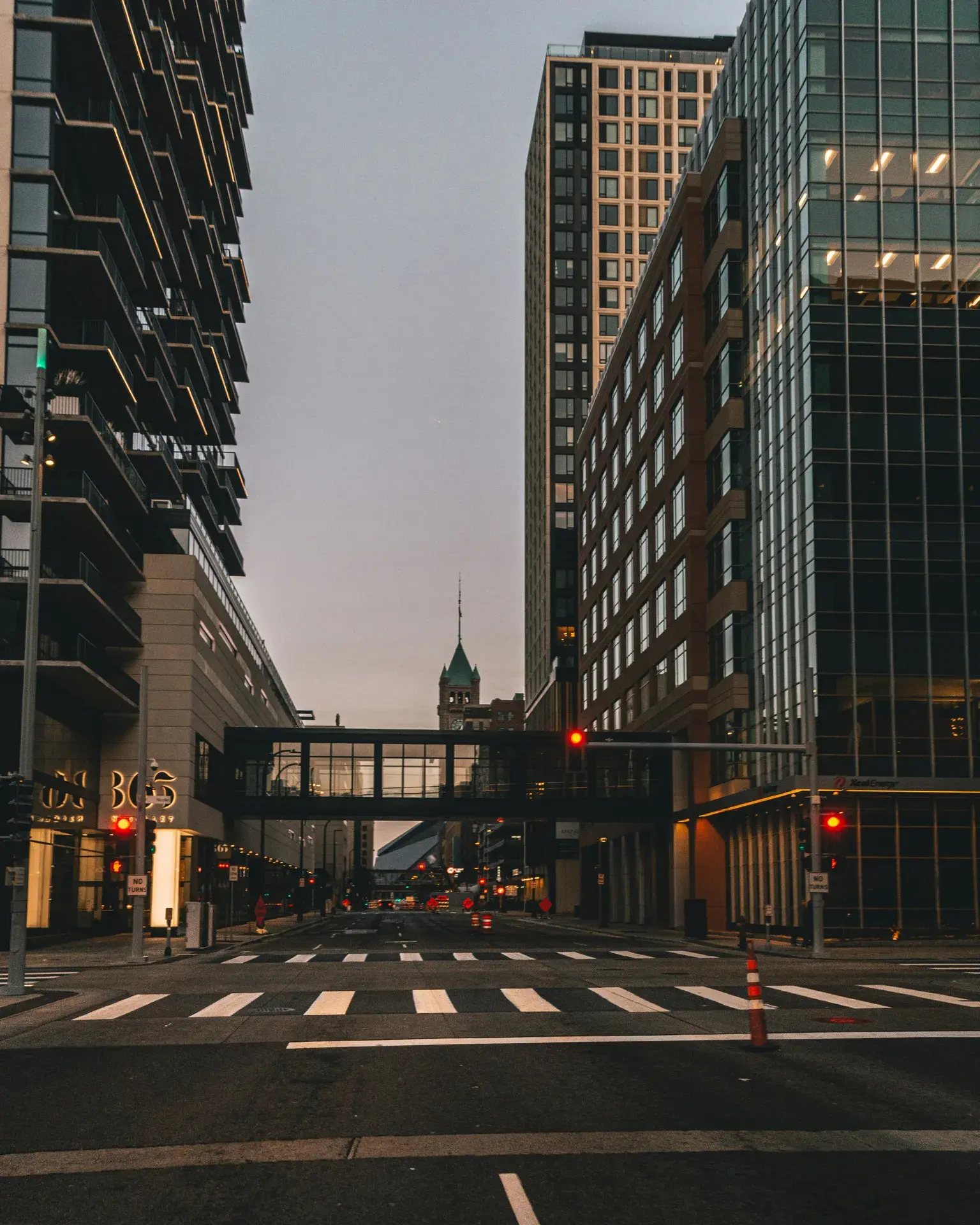
At 5:15 on a Tuesday afternoon in January, the skyway system is doing what it was built to do. It is minus-twelve degrees outside — the kind of cold where exposed skin hurts within seconds — and approximately zero people are walking on Nicollet Mall. But nine feet above street level, behind the glass, thousands of office workers are moving through the enclosed bridges that connect eighty blocks of downtown Minneapolis, passing Starbucks locations and shoe-shine stands and sandwich shops without ever touching the outside air. A man in a suit is eating a burrito on a skyway bench. A woman in scrubs is walking fast toward the parking ramp, phone to her ear. At the Crystal Court in the IDS Center, the atrium is full of people who have no particular reason to be there except that it is warm and bright and indoors. And on the street below, a single bus rolls down Nicollet, its headlights cutting through the steam rising from the grates, utterly alone.
What is Downtown West, Minneapolis?
Downtown West is the commercial core of Minneapolis — the part of downtown where the office towers are tallest, the sidewalks are widest, and the skyway system is densest. It occupies the western and central portion of downtown, roughly bounded by the Mississippi River, Washington Avenue North, and Twins Way to the north, Portland and 5th Avenues to the east, and 12th Street along the south and west. Nicollet Mall — the twelve-block pedestrian and transit street that serves as Minneapolis's nominal main street — runs through its center. The IDS Center, at 57 stories the tallest building in the state, anchors the skyline. Target Corporation's global headquarters occupies a massive campus toward the southern end of Nicollet Mall.
This is where Minneapolis does its business — or at least, this is where Minneapolis used to do its business full-time and now does it three or four days a week. The neighborhood was built for and by the office economy: the towers, the skyways, the lunch restaurants, the parking ramps, the hotels, the convention infrastructure. It was designed for daytime population, and for decades it delivered. The post-pandemic shift to hybrid and remote work has disrupted that equation fundamentally, and Downtown West is still figuring out what it is when the offices are not full. But it is also a place where about 9,000 people live — in condos, apartments, and a few converted office buildings — and those people have staked their daily lives on the proposition that the center of the city is worth inhabiting, not just commuting to. The North Loop is trendier. Downtown East has more of the river. But Downtown West has the density, the transit, and the skyways — and in a Minnesota winter, that combination is worth more than charm.
Downtown West Neighborhood Sign
As far as we can tell, Downtown West doesn’t have a neighborhood welcome sign — at least, nobody has documented one that we can find. If you’ve seen one, tell us where it is — we’d love to be wrong about this.
Downtown West, Minneapolis — Key Stats (2025–2026)
- Residents (2020 Census)
- ~9,000
- Median condo sale price (2025 data)
- $263K
- Year the IDS Center opened
- 1972
- IDS Center — tallest building in Minnesota
- 57 stories
- Minneapolis Skyway System total length
- 9.5 miles
- Light rail lines (Blue & Green)
- 2 lines
- Walk Score (Oct 2026)
- 93
- Transit Score (Oct 2026)
- 87
Downtown West History & Origins
Downtown West's story is the story of Minneapolis as a commercial city. While Downtown East was built on flour mills and waterpower, the western half of downtown grew up around retail, banking, and the railroad. By the early 20th century, Nicollet Avenue had established itself as the city's premier shopping street — department stores like Donaldson's and Dayton's drew shoppers from across the region, and the surrounding blocks filled with hotels, theaters, and office buildings that served a booming city.
Dayton's — which George Draper Dayton started in 1902 as a single store at the corner of Nicollet and 7th — would become the anchor of downtown retail for most of the 20th century. The Dayton family's influence on Minneapolis is difficult to overstate: they built the department store into a regional powerhouse, pioneered the enclosed shopping mall (Southdale, 1956), and eventually grew the company into Target Corporation, which remains headquartered in Downtown West today. The lineage from a single dry-goods store on Nicollet to a Fortune 500 company employing thousands in the same neighborhood is one of the more remarkable corporate stories in American retail.
The mid-20th century brought the skyway system — Minneapolis's most distinctive and controversial urban infrastructure. The first skyway bridge was built in 1962, connecting the Northstar Center to the Northwestern National Bank Building. Its champion, the developer Leslie Park, wanted to shore up the downtown retail core as business drifted to the suburbs, and office workers soon found that the bridges also kept them out of the cold. Over the following decades, the system expanded to connect roughly eighty blocks of downtown, creating an enclosed, climate-controlled city above the street. It worked — too well, some argued. The skyways pulled foot traffic off the sidewalks, hollowed out street-level retail, and created a two-tiered downtown: warm and bustling above, cold and empty below.
The IDS Center, opened in 1972, became the literal and symbolic center of Downtown West. Designed by Philip Johnson and John Burgee, the 57-story tower took the Foshay Tower's place as the tallest building in Minneapolis. Its Crystal Court — a soaring glass atrium at street level — became the social heart of downtown, a public living room where office workers ate lunch, teenagers loitered, and everyone gathered to get out of the cold. For decades, the Crystal Court was the closest thing Minneapolis had to a town square.
The 1990s and 2000s saw Downtown West shift from a primarily commercial district to a mixed-use neighborhood. Residential development — condo conversions of old office buildings and new apartment towers — brought a growing permanent population. After decades in which Minneapolis routinely tore down its old theaters, the city bought and restored the State, the Orpheum, and the Pantages on Hennepin Avenue. Target Center (home of the Timberwolves and Lynx) kept sports anchored in the core. But the old department stores are gone — Dayton's became Marshall Field's became Macy's, and even Macy's closed its downtown store. The retail identity that built Downtown West has largely evaporated, and the neighborhood is still searching for what replaces it.
Living in Downtown West
Living in Downtown West is an exercise in cognitive dissonance. You live in the most connected, most urban place in Minnesota — and some evenings you walk down Nicollet Mall and see almost nobody. The neighborhood was engineered for a daytime population of 150,000 office workers, and when those workers go home — or, increasingly, never come in at all — the infrastructure feels oversized for the people who remain. This is not a dead downtown. It is an underperforming one. And the difference matters if you're deciding whether to live here.
The people who thrive in Downtown West are the ones who have made peace with its rhythms. Weekday lunchtimes are busy. Thursday and Friday evenings have energy. Saturday nights on Hennepin Avenue are genuinely alive, especially around First Avenue and the theater district. Sunday mornings are a ghost town. Winter weekdays hum inside the skyways; summer weekdays hum on the patios. You learn to read the neighborhood's schedule the way a farmer reads weather.
The residential pockets are scattered rather than concentrated. Along Marquette and 2nd Avenue south, newer apartment towers have created a small residential cluster. The Soo Line Building offers loft-style living in a converted historic structure. On the southwestern edge, near Loring Park, residential buildings benefit from the greenery and relative quiet of that transition zone. The Hennepin Avenue corridor has apartments above retail, though the quality varies. What you will not find is a cohesive neighborhood feel — the kind of block-by-block community identity that characterizes places like Whittier or the North Loop. Downtown West is a commercial district with residents, not a residential neighborhood with commercial amenities. That distinction shapes everything about living here.
The skyway system is both the great advantage and the great distortion. In winter, it is genuinely life-changing — you can walk from your apartment to your office to a restaurant to a gym to a grocery store without going outside, a feat that no other city in America makes possible at this scale. But the skyways also mean that the street below is often empty, that the ground-floor retail is struggling, and that the public realm of Downtown West exists on two levels that don't always talk to each other. It is possible to live in Downtown West for weeks in January without spending more than ninety seconds outdoors. Whether that sounds like heaven or hell tells you whether this neighborhood is for you.
Downtown West Food, Drink & Local Spots
Downtown West's food scene is split between two economies that operate on different schedules. The weekday lunch economy serves office workers — fast-casual spots, skyway food courts, sandwich shops, and the kind of restaurants that do 80 percent of their business between 11:30 and 1:00. The evening and weekend economy serves residents, theatergoers, and people coming downtown for a night out. The best restaurants in the neighborhood operate in both modes; the weakest depend entirely on one. The post-pandemic reduction in office foot traffic has been brutal for lunch-only spots. Closures have been real, vacancies are visible, and some blocks of the skyway feel noticeably emptier than they did in 2019.
The Anchors
801 Hennepin Avenue. A polished, white-tablecloth steakhouse in the LaSalle Plaza building. Dry-aged steaks, an extensive wine list, and the kind of dark-wood-and-leather atmosphere that has served corporate Minneapolis for decades. Not innovative, but reliably excellent for what it is — and still one of the best business dinner spots in the city.
80 South 9th Street. A beloved Minneapolis institution known for its brunch — particularly the lemon-ricotta hotcakes and the huevos rancheros — and its subterranean location below street level. The vibe is funky and independent in a neighborhood that doesn't have enough of either. Cash-only for years, it has finally embraced cards. Weekend brunch lines are real.
701 1st Avenue North. Not a restaurant, but the most important cultural institution in Downtown West and arguably in Minneapolis. The club where Prince filmed Purple Rain, where every major touring band has played, and where the Minneapolis music scene still lives. The exterior stars — each one bearing the name of a favorite from the club's past or present — are a public artwork in their own right.
219 3rd Avenue North, just across Washington Avenue in the North Loop. A bar and grill that has been serving burgers, steaks, and strong drinks since 1906. Not trendy, not trying to be — just a solid, unpretentious spot in a part of downtown that could use more of them. The patio is one of the better outdoor drinking spots downtown in summer.
1110 Nicollet Mall. A British-themed pub with the best rooftop lawn bowling green in Minneapolis — which is to say, the only rooftop lawn bowling green in Minneapolis. Fish and chips, a huge beer list, and a patio that fills up the moment temperatures break fifty degrees. A Nicollet Mall institution.
Also Worth Knowing
The skyway food courts were once a genuine asset — a network of lunch options that made downtown's winter livable. Many have been hit hard by reduced office traffic, and some have closed or consolidated. What remains is uneven — a few excellent vendors surrounded by empty storefronts. The Target headquarters campus has its own food amenities, but those serve employees rather than the public. For everyday groceries, the downtown Target at 900 Nicollet Mall is the primary option — a solid urban Target with a grocery section, though not a full-service supermarket. Serious grocery shopping usually means the Lunds & Byerlys on Hennepin, just across 12th Street in Loring Park, or a trip to the Wedge Co-op on Lyndale in Whittier.
Parks, Culture & Outdoors in Downtown West
Downtown West is not where you go for nature. The neighborhood is almost entirely built environment — towers, parking ramps, plazas, and the glass-enclosed skyway bridges that define the skyline at the second-story level. What green space exists is concentrated at the edges, particularly along the river to the north and the southern border, where the neighborhood transitions toward Loring Park. The cultural institutions, however, are among the best in the city.
Loring Park (Adjacent)
Loring Park itself is technically its own neighborhood, but it functions as Downtown West's backyard. The 34-acre park — with its lake, walking paths, gardens, and the Berger Fountain — is a five-minute walk from Nicollet Mall and provides the green relief that the commercial core desperately needs. The Loring Greenway, a landscaped pedestrian corridor, connects Nicollet Mall to the park, and a footbridge carries on from the park to the Walker Art Center and the Minneapolis Sculpture Garden. Residents of Downtown West's southwestern blocks have functionally the same park access as Loring Park residents.
Hennepin Theatre District
The Hennepin Avenue Theatre District is one of the most significant concentrations of historic theaters in the Midwest. The Orpheum Theatre (1921), the State Theatre (1921), and the Pantages Theatre (1916) — all restored by the city in the 1990s and early 2000s and now run by the nonprofit Hennepin Arts — host touring Broadway shows, concerts, comedy, and special events. These are genuinely beautiful spaces — ornate, gilded, built for spectacle in an era when theaters were designed to make audiences feel like they were somewhere important. Walking into the Orpheum for a touring production of a Broadway show is one of the best cultural experiences available in Minneapolis.
Target Center
Target Center, home of the Minnesota Timberwolves (NBA) and Minnesota Lynx (WNBA), sits at the northwestern edge of Downtown West near the border with the North Loop. The arena hosts approximately 150 events per year — basketball games, concerts, family shows, and conventions. It is not architecturally distinguished, but it is functionally important: it keeps professional sports anchored in the downtown core and generates the foot traffic that supports nearby restaurants and bars. The Lynx, in particular, have been one of the great success stories in professional women's sports, and their games bring a passionate and engaged crowd downtown.
First Avenue
First Avenue is more than a music venue — it is a cultural institution that has shaped Minneapolis's identity as a music city for over fifty years. Originally a Greyhound bus depot, the building at 701 1st Avenue North has been a music venue since 1970. Prince made it the set and setting of Purple Rain, and the 1984 film put the club — and Minneapolis — on the global map. The venue and its smaller attached room, 7th Street Entry, continue to book an eclectic mix of touring acts, local bands, and DJs. The black exterior walls, covered in stars bearing the names of the club's favorite artists, past and present, are one of the most recognizable facades in the city.
Downtown West Schools
Downtown West has essentially no K-12 schools within its boundaries. This is a commercial district, and school infrastructure was never part of its design. Families with school-age children — a small minority of the neighborhood's population — access Minneapolis Public Schools through the district's citywide enrollment system. Options elsewhere in the city include Whittier Elementary, Kenwood Elementary, and various magnet and charter programs. Assignment depends on address, so check the district's school finder for a specific building.
The practical reality is that very few families with children choose Downtown West as a place to raise them. The neighborhood lacks playgrounds, youth programming, and the family-oriented infrastructure that residential neighborhoods provide. The demographic skews young professionals, empty nesters, and singles. If schools are a primary factor in your housing decision, this is not your neighborhood — but you probably already knew that.
Downtown West Real Estate & Housing
Downtown West's housing stock is almost entirely condominiums and rental apartments, with a few converted historic buildings offering loft-style living. There are no single-family homes and no traditional duplexes. The housing market here is closely tied to the health of downtown as a whole — when offices are full and the commercial core is thriving, demand for downtown housing rises; when offices empty out and the streets feel quiet, demand softens. The post-pandemic period has been a mixed bag: the median condo sale price fell from $251,250 in 2021 to $216,750 in 2022, then recovered to $273,000 in 2024 before slipping to $262,500 in 2025, according to Minneapolis Area REALTORS.
That 2025 median sits below the $350,000 citywide figure, and units took 134 days on average to sell, against 55 citywide. The highest-end units — the Four Seasons residences at RBC Gateway — can exceed $1,000,000. Nearly two-thirds of homes are rented, and the median rent across all units is about $1,700 a month by Census estimates, with newer buildings commanding premiums for amenities like fitness centers, rooftop decks, and coworking spaces.
The Conversion Question
One of the most significant trends in Downtown West is the conversion of underperforming office buildings to residential use. With office vacancy rates elevated and some buildings struggling to attract tenants, several property owners have explored or begun conversions. This is harder than it sounds — office floor plates don't always translate well to residential layouts, and the economics of conversion are complicated by building systems, codes, and financing. But the conversions that have happened are adding housing supply in locations that are already fully served by transit and infrastructure, which is the smartest kind of infill development a city can do. If this trend accelerates, it could fundamentally reshape Downtown West from a nine-to-five district into a genuine 24-hour neighborhood.
Getting Around Downtown West
Downtown West is, by any objective measure, the most connected neighborhood in Minnesota. Its Walk Score of 93 (tied with Lowry Hill East) and Transit Score of 87 are the highest in Minneapolis. The Blue Line and Green Line light rail both serve multiple stops within the neighborhood — Nicollet Mall station, Government Plaza, and Warehouse District/ Hennepin Avenue are all within the boundaries. Dozens of Metro Transit bus routes converge downtown. Target Field Station, just across the neighborhood's northern edge in the North Loop, serves as a major transit hub.
The skyway system adds a dimension of connectivity that no other American city can match. During business hours, it functions as a parallel pedestrian network — climate-controlled, grade-separated, and connected to virtually every major building in the neighborhood. After business hours and on weekends, some skyway sections close, which can be frustrating for residents who rely on them. The system's hours and accessibility have been a topic of ongoing debate between property owners, the city, and advocates for public space.
By car, Downtown West has easy access to I-94, I-394, and I-35W. Parking is expensive, and event-day rates can be punishing. Street parking is metered and limited. If you own a car and live downtown, you will pay for it in both money and frustration. The smartest residents either go car-free or keep a car for weekend and suburban trips while walking and transiting for everything else.
Cycling infrastructure exists but is less developed than in some neighboring areas. Bike lanes on various downtown streets provide connections, and bike-share stations are common. The nearby Loring Greenway and the riverfront trails are accessible by bike. Winter cycling is practiced by a dedicated minority.
What's Changing: The Honest Version
Downtown West is at an inflection point that will determine its identity for the next generation. The forces acting on the neighborhood — remote work, retail transformation, the housing crisis, public safety, and climate adaptation — are all converging at once, and the outcomes are not yet clear. What follows is an honest accounting of the tensions that shape the neighborhood in 2026.
The Office Vacancy Crisis
This is the big one. Downtown West was built for office workers, and office workers are not coming back five days a week. Office vacancy in downtown Minneapolis stood at about 31 percent at the end of the third quarter of 2025, according to the brokerage Colliers. Some older buildings are effectively stranded — too expensive to maintain at current occupancy, too costly to convert, and facing a market where tenants demand newer, higher-quality space. The ripple effects hit everything: the lunch restaurants that depended on the midday rush, the retailers that needed foot traffic, the parking ramps that charged $20 a day. The city is losing property tax revenue as office valuations decline. There is no quick fix. The office market will eventually reach a new equilibrium, but it will be smaller than before, and the surplus space will need to become something else — housing, labs, maker space, or simply empty buildings waiting for demolition and replacement.
Nicollet Mall's Identity Crisis
Nicollet Mall was supposed to be Minneapolis's great public street — a pedestrian-first corridor lined with retail, dining, and civic life. The $50 million reconstruction completed in 2017 was meant to revitalize it. Instead, the renovation coincided with a period of retail decline, pandemic disruption, and reduced office foot traffic that left the mall with visible vacancies. The physical infrastructure is fine — the street itself looks good — but the storefronts are not all filled, and the pedestrian traffic is not what it needs to be. Seasonal activations like Holidazzle bring temporary life. The city and downtown business groups are working on longer-term strategies. But Nicollet Mall's future depends on solving the broader challenge of what draws people downtown when they no longer have to be there.
Public Safety and Homelessness
Visible homelessness and public safety concerns are part of daily life in Downtown West. The skyway system, transit stations, and public spaces serve as shelter for people without housing, particularly in winter. The city has invested in outreach, shelter capacity, and supportive housing, but the need exceeds the supply. For residents and workers, the experience ranges from routine encounters that require basic awareness to occasional incidents that feel genuinely unsafe. The perception of safety affects downtown's ability to attract residents, businesses, and visitors — a feedback loop that makes the problem harder to solve. Honest assessment: Downtown West is not dangerous for most people most of the time, but it is not as comfortable as it was a decade ago, and pretending otherwise does not help anyone.
The Residential Pivot
The most hopeful trend in Downtown West is the gradual shift from a commercial monoculture to a mixed-use neighborhood with a genuine residential population. Office-to-residential conversions, new apartment construction, and investments in street-level amenities are all moving in the right direction. The logic is sound: if fewer people commute to downtown, more people need to live there to sustain the restaurants, retail, and cultural institutions that make the neighborhood viable. The question is whether the conversion can happen fast enough and at a price point that attracts a diverse population — not just luxury renters, but the mix of incomes and backgrounds that makes a neighborhood a neighborhood. Downtown West is not there yet. But the trajectory is right.
Downtown West FAQ
Is Downtown West a good place to live in Minneapolis?
Downtown West is ideal for people who want maximum urban convenience — walkability, transit access, restaurants, nightlife, and cultural institutions all within immediate reach. It is the most connected neighborhood in the state by virtually every metric. However, it is also the commercial core, which means it empties out on weeknight evenings and weekends more than a residential neighborhood would. The post-pandemic period has been challenging, with lower office occupancy, some retail vacancies, and visible homelessness. It suits young professionals, committed urbanists, and people who genuinely want to live in the center of things — not people looking for a quiet residential experience.
Is Downtown West, Minneapolis safe?
Safety in Downtown West is a nuanced picture. The neighborhood has high foot traffic during the day, extensive surveillance, and a strong police presence. However, like downtowns across America, it experienced elevated property crime, car break-ins, and occasional violent incidents between 2020 and 2023. By 2025–2026, conditions have improved, but certain blocks — particularly around transit stations and the Hennepin Avenue corridor late at night — require awareness. The skyway system is generally safe during business hours but has been a focus of concern during off-hours. Most residents report feeling safe during the day and exercising caution after dark.
What is the Minneapolis Skyway System?
The Minneapolis Skyway System is a network of enclosed, climate-controlled pedestrian bridges connecting buildings across approximately 9.5 miles of downtown. It is the largest contiguous skyway system in the world. Built primarily between the 1960s and 1990s, it allows workers and residents to move between office buildings, hotels, parking ramps, retail, and restaurants without going outside — a significant advantage during Minnesota's winters. Critics argue the skyways have hollowed out street-level retail and created a privatized version of public space. Supporters counter that they make downtown viable in a climate that regularly hits minus-20 degrees. Both sides are right.
What is Nicollet Mall?
Nicollet Mall is a twelve-block pedestrian and transit-only street running through the heart of Downtown West from Washington Avenue to Grant Street. Designed by Lawrence Halprin and completed as a transit mall in 1967, it has undergone multiple renovations, most recently a $50 million reconstruction completed in 2017. The mall is home to major retailers (though many have departed in recent years), restaurants, the IDS Center, Target headquarters, and the seasonal Holidazzle festival. It is supposed to be Minneapolis's great public street — the equivalent of State Street in Chicago or the 16th Street Mall in Denver — but has struggled with retail vacancies and reduced foot traffic since the pandemic.
How much do condos cost in Downtown West?
Condo prices in Downtown West vary by building and location. The median condo sale price was $262,500 in 2025, down slightly from $273,000 in 2024, according to Minneapolis Area REALTORS — below the $350,000 citywide median and far below Downtown East's. At the top end, the Four Seasons residences at RBC Gateway can exceed $1,000,000. Nearly two-thirds of homes are rented, and the median rent across all units is about $1,700 a month by Census estimates, above the city's $1,371.
What is the IDS Center?
The IDS Center is the tallest building in Minnesota — a 57-story, 792-foot office tower designed by Philip Johnson and John Burgee, opened in 1972. Its Crystal Court — a glass-enclosed atrium at street level — was a pioneering example of indoor public space and remains a central node in the skyway system. The building's blue-tinted glass and notched profile are the defining feature of the Minneapolis skyline. While primarily an office building, it has ground-floor retail and food options and serves as a landmark that residents and visitors use for orientation.
Can you live in Downtown West without a car?
Absolutely — Downtown West is the best neighborhood in Minnesota for car-free living. The Walk Score of 93 and Transit Score of 87 reflect the reality: groceries, dining, entertainment, transit, and employment are all accessible on foot or by train. The Blue and Green light rail lines serve multiple stops within the neighborhood. Bus routes connect to every part of the metro. The skyway system allows car-free living even in the dead of winter. The main limitation is access to suburban destinations — occasional rideshare or car rental may be necessary for big-box shopping or visiting friends in the outer suburbs.
What happened to retail on Nicollet Mall?
Nicollet Mall has experienced significant retail attrition over the past decade. The 2017 closure of Macy's in the old Dayton's flagship, the departure of several national chains, and the pandemic-era reduction in office foot traffic have left visible vacancies. Some ground-floor spaces have been filled by new restaurants and local businesses, but the mall has not returned to its pre-pandemic vitality. The city and downtown business organizations continue to work on activation strategies, but the fundamental challenge — a retail street that depends on office workers who now work from home two or three days a week — has not been solved.
Where exactly is Downtown West in Minneapolis?
Downtown West occupies the western and central portion of downtown Minneapolis, roughly bounded by the Mississippi River, Washington Avenue North, and Twins Way to the north, Portland and 5th Avenues to the east, and 12th Street along the south and west. It includes Nicollet Mall, the office tower core along Marquette and 2nd Avenue, the Hennepin Avenue Theater District, and the western blocks leading toward Loring Park. It is the commercial center of the city — the part of downtown where most of the office space, major hotels, and corporate headquarters are concentrated.
Is Downtown West good for nightlife?
Downtown West has the densest concentration of nightlife in Minneapolis. The Hennepin Avenue corridor — particularly between 5th and 10th Streets — is home to most of the city's major music venues, bars, and late-night establishments. First Avenue and 7th Street Entry are legendary music venues. The strip also includes a range of bars from craft cocktail spots to dive bars to high-volume dance clubs. The scene skews younger on weekend nights, particularly on Hennepin between 6th and 9th. If nightlife is important to you, Downtown West delivers. If quiet evenings are important to you, choose your block carefully.
What Makes Downtown West Irreplaceable
Downtown West is not a neighborhood that inspires love at first sight. It does not have the riverfront romance of Downtown East, the foodie charm of the North Loop, or the greenery of Loring Park. What it has is the thing that makes a city a city — the density of people, commerce, culture, and institutions that only happens when everything is stacked on top of everything else in the same few blocks. The IDS Center, Nicollet Mall, First Avenue, the skyways, the office towers, Target headquarters, the Hennepin Theatre District — this is where Minneapolis concentrates its urban energy, for better and worse.
The neighborhood is in a genuinely uncertain moment. The post-pandemic reshuffling of how and where people work has hit Downtown West harder than any other neighborhood in the city, and the outcome is not yet clear. But downtowns have survived recessions, riots, white flight, and urban renewal before. The bones here — the transit infrastructure, the cultural institutions, the sheer concentration of built environment — are strong. Downtown West will not look the same in ten years as it does today. But it will still be the center. There is only one center, and this is it.

Keep exploring