Minneapolis Neighborhood
Stevens Square - Loring Heights
One of the densest neighborhoods in Minneapolis — a narrow strip of century-old apartment buildings stacked on top of each other, where the rent is still (relatively) cheap, Loring Park is your backyard, downtown is a ten-minute walk, and the question of whether affordability can survive proximity to everything is answered a little differently every year.
№ 74 of 87 · Central community · Last updated: October 2026 · A complete neighborhood guide
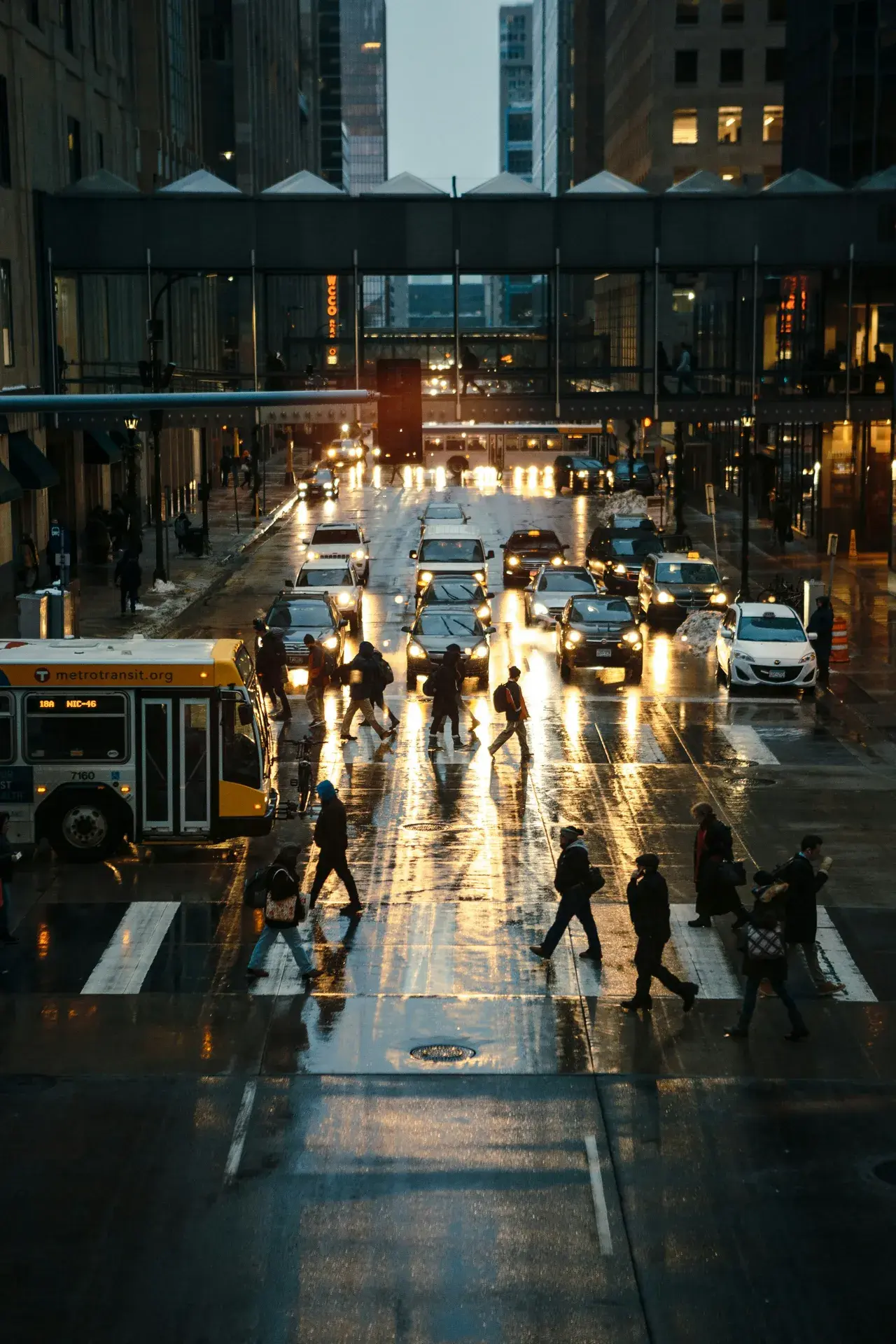
Stevens Square is a dozen blocks of apartment buildings end to end — fewer, depending on where you draw the lines — and it packs people in at a density matched in Minneapolis only by the Wedge, just across Lyndale. On a warm Saturday afternoon in June, you can feel the density. Every stoop has someone sitting on it. Every balcony has a person reading or smoking or staring at their phone. The sidewalks along 2nd Avenue and 3rd Avenue are full — not busy in the way that downtown is busy, with people moving through, but full in the way that a place is full when everyone lives on top of everyone else and goes outside when the weather finally allows it. A woman is walking three dogs at once, navigating around a kid on a scooter and a man carrying groceries up the steps of a brick walk-up that looks exactly like every other brick walk-up on the block because most of them went up in the same building boom more than a century ago, for the office workers and salespeople of a growing downtown. Some things change. Some things don't.
What is Stevens Square - Loring Heights, Minneapolis?
Stevens Square - Loring Heights is the smallest neighborhood in Minneapolis by area and one of the two densest — a strip of century-old apartment buildings three or four blocks deep and about a dozen long, packed between Loring Park to the north and Franklin Avenue to the south, I-35W to the east and Lyndale Avenue to the west. The neighborhood is almost entirely residential, mostly rental, and almost entirely composed of three- to six-story brick and frame apartment buildings, many of them more than a century old. About 4,100 people lived here at the 2020 Census, a population density of roughly 22,000 per square mile — higher than the citywide density of Chicago or San Francisco, and wildly out of character for a Midwestern city.
The neighborhood functions as downtown Minneapolis's affordable annex. It has long served this role — built originally for the office workers and salespeople of a growing downtown — and it continues to serve it today, albeit under increasing pressure. The rents are among the lowest in the central city. The walk to Nicollet Mall takes ten minutes. Loring Park, with its lake and its connection to the Walker Art Center, is just across I-94. For people who want urban living on a budget — first-apartment renters, students, service workers, immigrants, artists, anyone who prioritizes location over finishes — Stevens Square has been delivering that for more than a century. The Loring Park neighborhood to the north is more polished. Whittier to the south has more food and retail. But Stevens Square has the density, the price, and the location — and for the right person, that combination is enough.
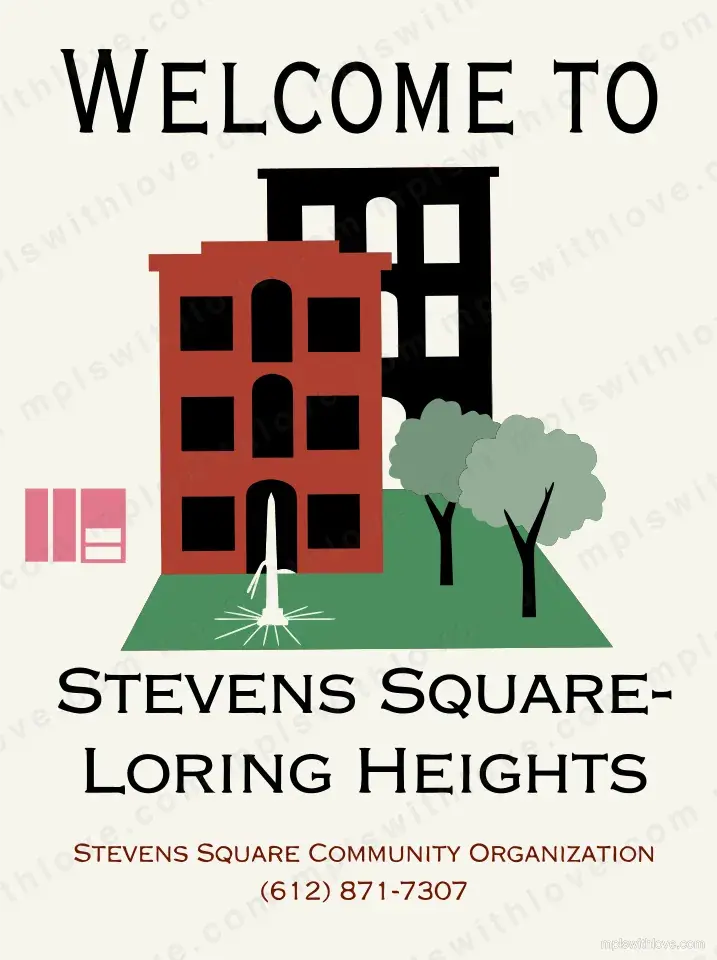
Stevens Square Neighborhood Sign
Stevens Square - Loring Heights, Minneapolis — Key Stats (2025–2026)
- Residents (2020 Census)
- ~4,100
- Population density — among the highest in Minneapolis
- ~22,000/sq mi
- Median rent, all units (2020–24 ACS)
- $1,115
- Renter-occupied homes (2020–24 ACS)
- 65%
- Era when most housing units were built (SSCO)
- Pre-1939
- Walk to Nicollet Mall
- 10 min
Stevens Square History & Origins
Stevens Square takes its name from Colonel John H. Stevens, who arrived at St. Anthony Falls in 1849 and built the first wood-frame house on the west bank of the Mississippi, in what would become Minneapolis. His house stood just above the falls, in what is now downtown, and it was later moved more than once and now sits in Minnehaha Park. The small park at the neighborhood's center — Stevens Square Park — was bought by the park board in 1907 and named for him in 1908.
The neighborhood developed rapidly in the early 20th century as Minneapolis boomed. The proximity to downtown made the area attractive for apartment construction — its first tenants were largely middle-class office workers and salespeople, many of them single women, who could walk to work from here. Developers built apartment buildings at a pace and density unusual for Minneapolis, creating the compressed urban fabric that defines the neighborhood today. The buildings were modest — brick exteriors, small units, shared hallways, minimal ornamentation — but they were solid, and they were close to everything. By 1923, the park board was describing the area as a densely populated apartment district.
The mid-20th century brought decline. Suburbanization pulled middle-class residents outward. The construction of I-94 along the neighborhood's northern edge severed the connection to Loring Park and downtown, isolating the neighborhood behind a wall of freeway infrastructure. Buildings deteriorated. By the 1990s, Stevens Square had a reputation for crime and crumbling infrastructure — the kind of neighborhood that Minneapolis residents drove through quickly or avoided entirely.
The turnaround came with investment from the city's Neighborhood Revitalization Program and the work of an unusually active corps of volunteers through the Stevens Square Community Organization (SSCO), founded in 1975. The neighborhood never fully gentrified — the buildings are too old and too modestly built to attract the kind of renovation investment that transforms a neighborhood overnight — but conditions improved. The rents stayed relatively low. The density persisted. And gradually, Stevens Square settled into its current identity: one of the cheapest places to live near downtown Minneapolis that is also, against the odds, a functioning neighborhood.
Living in Stevens Square
Living in Stevens Square is living in a neighborhood that does not pretend to be anything other than what it is — an extremely dense collection of old apartment buildings where the rent is cheap, the walls are thin, the laundry is in the basement, and the walk to downtown takes ten minutes. The buildings range from well-maintained to borderline neglected. The best landlords keep their buildings clean, respond to maintenance requests, and take pride in their properties. The worst let things slide until the city forces a correction. As a prospective tenant, doing your homework on a specific building matters more here than in most neighborhoods — the difference between a good Stevens Square apartment and a bad one is enormous, even if the rents are similar.
The resident mix reflects the neighborhood's affordability. Young professionals in their first or second apartment. Students at nearby colleges and the University of Minnesota. Immigrants and refugees. Service workers who staff the downtown hotels and restaurants. Artists and musicians who need cheap rent more than they need granite countertops. Longtime residents who have lived in the same building for decades. The diversity is economic as much as racial — this is a neighborhood where a barista, a social worker, a nursing student, and a retired janitor might all live in the same building, because the rent is what they can all afford.
The social fabric is thinner than in neighborhoods with homeowners and families. Turnover is high — many residents stay for a year or two before moving on. The neighborhood does not have the block-party energy of South Minneapolis or the community-institution depth of Northeast. What it has is proximity and accessibility — you are close to everything, the bus comes every ten minutes, Loring Park is right there, and you do not need a car. For people who are building their lives and do not yet have the income for the neighborhoods they will eventually move to, Stevens Square is where you start. And some people discover, after starting here, that they never want to leave.
Stevens Square Food, Drink & Local Spots
Stevens Square has almost no restaurants or commercial establishments within its boundaries — it is a residential neighborhood, full stop. The food scene here is the food scene of the neighborhoods that surround it. Eat Street (Nicollet Avenue through Whittier) is a five-minute walk south. Lyndale Avenue's restaurants in Lowry Hill East are a ten-minute walk west. Downtown is ten minutes north. The advantage of Stevens Square's central location is that you are close to all of these without being in any of them — you get the food without the noise and the bar traffic.
Within Reach
Nicollet Avenue between Grant Street and 29th Street — known locally as Eat Street — is one of the most diverse and concentrated dining corridors in the Twin Cities. Vietnamese pho, Ethiopian injera, Mexican tacos, Japanese ramen, Somali restaurants, and everything in between. Nicollet runs right through Stevens Square, so residents are never far from it. It is the neighborhood's de facto food scene.
The blocks around Loring Park — including restaurants along Harmon Place and 1st Avenue — offer several dining options that are walkable from Stevens Square. These tend to be slightly more upscale than Eat Street, catering to the theater and Walker Art Center crowd.
2105 Lyndale Avenue South, just south of Franklin on the Whittier side of Lyndale. The Wedge is one of the best natural foods co-ops in the Midwest — a member-owned grocery with excellent produce, bulk foods, local products, and a prepared foods section. A ten-minute walk from Stevens Square.
Stevens Square has several small corner stores and convenience shops that serve the immediate neighborhood — milk, bread, snacks, household basics. These are not destination shops, but they are the kind of hyperlocal retail that dense urban neighborhoods generate and depend on.
Also Worth Knowing
The grocery situation in Stevens Square is functional but not ideal. There is no full-service supermarket within the neighborhood. The Wedge Co-op is the closest quality option. The downtown Target has a grocery section. Aldi and Cub Foods on Lake Street are accessible by bus. Residents who cook regularly develop routines — Wedge for produce, Aldi for staples, corner store for emergencies — that work well enough once you learn the rhythm.
Parks, Culture & Outdoors in Stevens Square
Stevens Square's outdoor and cultural assets are almost entirely borrowed — the neighborhood is so small and so dense that there is not room for much within its boundaries. But what it borrows from its neighbors is world-class.
Loring Park
Loring Park is the primary outdoor amenity for Stevens Square residents — a 34-acre urban park with a lake, walking and running paths, the Berger Fountain, gardens, and year-round programming. In summer, the park hosts music festivals, movie screenings, and the Loring Park Art Festival. In winter, the frozen lake and snow-covered paths provide quieter recreation. The park sits just across I-94 from Stevens Square, and most residents can reach it within a ten-minute walk. It is, for practical purposes, the neighborhood's backyard — and it is one of the best backyards in the city.
Walker Art Center & Sculpture Garden
The Walker Art Center — one of the most important contemporary art museums in the country — and the adjacent Minneapolis Sculpture Garden (home of the iconic Spoonbridge and Cherry) are accessible from Stevens Square through Loring Park and over the Irene Hixon Whitney Bridge, a pedestrian bridge that connects the park to the Vineland Place cultural campus. The walk takes approximately fifteen minutes. The Sculpture Garden is free and open daily. The Walker's exhibitions, film screenings, and performing arts programming are among the best in the Midwest. Having this caliber of cultural institution within walking distance of an apartment that rents below the city median is one of the quietly remarkable things about living in Stevens Square.
Stevens Square Park
Stevens Square Park — the small park at the center of the neighborhood — is modest: a few benches, some trees, a small playground. It does not compare to Loring Park in scale or amenities. But it serves as the neighborhood's geographic and social center, a place where residents encounter each other and where the community organization holds events. On a warm evening, the park is full of people from the surrounding buildings doing what people in dense neighborhoods have always done — sitting outside because their apartments are small and the evening is nice.
Stevens Square Schools
Stevens Square has no schools within its boundaries — the neighborhood is too small and too densely built for school infrastructure. Families with school-age children access Minneapolis Public Schools through the district's citywide enrollment system. Whittier Elementary, a few blocks south, is one of the nearest MPS elementary schools. Assigned schools depend on the address, so check the district's school finder for a specific building.
The neighborhood's demographic skews younger adults without children, so the school question is less relevant for most residents than in family-oriented neighborhoods. Families with children do live in Stevens Square — particularly in the affordable housing stock — but they are a small minority: only about one household in twenty has children, by Census estimates. The density and the building types (small apartments, limited outdoor space) are not optimized for family life, and most families with the means to choose move to neighborhoods with more space and stronger school options.
Stevens Square Real Estate & Housing
Stevens Square's housing market is mostly rental. About two-thirds of its homes are renter-occupied, by Census estimates, against under half citywide. The housing stock is dominated by older apartment buildings — brick and frame construction, much of it from the early 20th century — with small units, modest finishes, and the kind of character that comes from a hundred years of continuous habitation. These are not luxury apartments. They are functional, sometimes charming, and often in need of maintenance that they may or may not be getting.
Rents are among the lowest in the central city: Census estimates put the median at about $1,115 a month across all units, against $1,371 citywide. The variation from building to building is significant — a well-maintained building with a responsive landlord might charge more for a one-bedroom that is a far better value than a cheaper unit in a neglected building. Research the building, not just the rent.
The Ownership Question
Homeownership in Stevens Square almost always means a condo. Twenty-eight homes sold in 2025, nearly all of them condos or townhouses, at a median of $150,000 — down from $175,750 in 2021, according to Minneapolis Area REALTORS. These can represent extraordinary value for the location — in Loring Park and Downtown West, condos sold for medians of about $225,000 and $262,500 that year. The trade-offs are older buildings, potentially high HOA fees relative to the unit value, a slow market (138 days on the market in 2025, by the REALTORS' measure), and the uncertainty of owning in a building where most units are rentals. For first-time buyers on a budget, it is worth investigating. For anyone expecting appreciation or luxury finishes, it is not.
Getting Around Stevens Square
Stevens Square's location makes getting around easy by almost any mode. Downtown is a ten-minute walk north. Eat Street is five minutes south. The Wedge Co-op is ten minutes west. You can get through daily life on foot here — this is not a neighborhood that requires a car for routine errands.
Transit service is strong. Multiple bus routes run along Nicollet Avenue, Lyndale Avenue, and the cross-streets. The Route 18 on Nicollet provides frequent north-south service between downtown and South Minneapolis. The Route 4 on Lyndale connects to Uptown and beyond. The nearest light rail stations — Nicollet Mall on the Blue and Green Lines — are approximately a twenty-minute walk or a short bus ride. For regional trips, the transit hub at Target Field is accessible via downtown.
Cycling is practical and popular. The neighborhood's grid streets and proximity to bike infrastructure make it easy to get around on two wheels. Bike lanes on nearby streets connect to the Midtown Greenway, the Chain of Lakes trails, and the broader city trail network. Bike-share stations are within easy reach.
Car ownership is less common here than in most Minneapolis neighborhoods — about four in ten households have no car, by Census estimates, against about one in six citywide — and the infrastructure reflects that. Street parking is available but can be tight given the density. Many older buildings do not have off-street parking. If you own a car, you will compete for spots. If you do not own a car, you will not miss one.
What's Changing: The Honest Version
Stevens Square is a neighborhood where the tensions are quieter than in places like Elliot Park or Downtown West, but no less real. The forces acting on the neighborhood are the same ones acting on affordable urban neighborhoods across the country — and the outcomes matter for the people who can least afford alternative options.
Affordability Under Pressure
Stevens Square's affordability is its defining feature and its greatest vulnerability. As downtown housing costs rise and the appeal of walkable urban living grows, the neighborhood's low rents attract more attention — from prospective tenants and from investors. Building sales, renovations, and rent increases are gradually pushing prices upward. The neighborhood is not yet unaffordable — the rents remain low by central-city standards — but the trajectory is clear. Every building that gets renovated and re-rented at higher prices removes a unit from the affordable stock. Some units carry rent subsidies, but most of the neighborhood's affordability is a function of building age and condition, and both of those things change.
Building Quality and Landlord Accountability
The quality of housing in Stevens Square varies enormously by building and by landlord. Some buildings are well-maintained, with responsive management and regular upgrades. Others are neglected — deferred maintenance, slow repair response, pest issues, and the accumulated wear of a century of use. The Stevens Square Community Organization has been aggressive about pushing the city to enforce building codes and hold landlords accountable, and these efforts have produced real improvements. But the fundamental challenge persists: the buildings are old, the margins are thin, and some landlords prioritize cash flow over maintenance. Tenants in Stevens Square need to know their rights and be willing to use them.
Safety and Quality of Life
Crime in Stevens Square is higher than the city average, particularly property crime. The density, the transient population, and the proximity to downtown all contribute. Car break-ins, bike theft, and package theft are common complaints. Violent crime is less frequent but not absent. The neighborhood has improved significantly since its worst years in the 1990s, and community-policing efforts have helped. But it remains a neighborhood where awareness matters — lock your car, lock your bike, know your surroundings, and get to know your neighbors.
The Density Question
In an era when much of Minneapolis is debating whether to allow more density — duplexes, triplexes, apartment buildings in formerly single-family zones — Stevens Square has been dense for over a century. The neighborhood is, in some ways, a proof of concept: you can build a dense, walkable, affordable urban neighborhood in the Midwest, and it can function. The lessons of Stevens Square — what works (proximity, transit, affordability) and what doesn't (deferred maintenance, inadequate green space, thin social fabric) — are relevant to every Minneapolis neighborhood that is grappling with growth. Stevens Square didn't choose to be one of the densest neighborhoods in the city. But it has been at it for more than a century, and there is something to learn from that.
Stevens Square FAQ
Is Stevens Square a good neighborhood in Minneapolis?
Stevens Square is a good neighborhood for a specific kind of person — someone who values affordability, walkability, and proximity to downtown over polish, quiet, or space. It is one of the two densest neighborhoods in Minneapolis, nearly tied with Lowry Hill East, with a housing stock dominated by older apartment buildings that offer relatively low rents for the location. It is walkable to downtown, adjacent to Loring Park, and well-served by transit. It is also gritty, sometimes loud, and not as well-maintained as neighborhoods with higher property values. If you are on a budget and want urban living without suburban compromises, Stevens Square delivers. If you want a neighborhood that looks good on Instagram, look elsewhere.
Is Stevens Square, Minneapolis safe?
Stevens Square has higher-than-average crime rates for Minneapolis, driven by its density, its transient population, and its proximity to downtown. Property crime — car break-ins, bike theft, package theft — is common. Violent crime occurs but is concentrated in specific blocks and often involves people who know each other. The neighborhood has an active community organization (Stevens Square Community Organization) that works on safety issues, and most residents report that basic urban awareness — locking up, being alert at night, knowing your surroundings — is sufficient for day-to-day safety. It is not the safest neighborhood in the city, but it is not the most dangerous either.
Why is Stevens Square so dense?
Stevens Square's density is a product of its history. The neighborhood was built up in the early 20th century as an apartment district for downtown office workers and salespeople, many of them single women — by 1923, the park board was describing it as a densely populated apartment district. The housing stock was never replaced with single-family homes or suburban-style development, so the original density persists. About two-thirds of its homes are renter-occupied, by Census estimates, and the older apartment buildings — typically three to six stories, brick or frame construction — pack a lot of units into a small area.
How much does it cost to live in Stevens Square?
Stevens Square is one of the most affordable neighborhoods within walking distance of downtown Minneapolis. Census estimates put the median rent across all units at about $1,115 a month, below the citywide $1,371 and below Loring Park and Whittier next door, though Elliot Park and Ventura Village run lower still. Rents vary with the building's condition and amenities, and newer or renovated buildings command premiums. Homeownership options are limited — the neighborhood is mostly rental — but the condos that do come on the market sell at prices that look startlingly low compared to downtown or the North Loop: the median sale was $150,000 in 2025, according to Minneapolis Area REALTORS.
Is Stevens Square close to Loring Park?
Yes. Stevens Square - Loring Heights borders Loring Park directly. The park — with its lake, walking paths, Berger Fountain, and seasonal events — is functionally the neighborhood's primary green space and recreational amenity. Most residents of Stevens Square are within a ten-minute walk of Loring Park, which also connects via the Irene Hixon Whitney Bridge to the Walker Art Center and the Minneapolis Sculpture Garden. This adjacency is one of the neighborhood's most significant assets.
What is Loring Heights?
Loring Heights is the smaller, slightly more upscale portion of the Stevens Square - Loring Heights neighborhood, occupying the blocks closest to Loring Park and I-94. It has some of the same older apartment building stock as Stevens Square proper but tends toward slightly higher rents and slightly better-maintained buildings, owing to its more immediate proximity to the park. The two areas are officially one neighborhood, and most residents use the names interchangeably or simply say 'Stevens Square.'
Where exactly is Stevens Square in Minneapolis?
Stevens Square - Loring Heights is a small neighborhood immediately south of downtown Minneapolis, roughly bounded by I-94 / Loring Park to the north, I-35W to the east, Franklin Avenue to the south, and Lyndale Avenue to the west. It is only three or four blocks deep and about a dozen long — one of the smallest neighborhoods in the city by area — but its density makes it feel larger than it is. It sits between Loring Park to the north and Whittier to the south, with Lowry Hill East (the Wedge) to the west.
Can you walk to downtown from Stevens Square?
Absolutely. Downtown Minneapolis — specifically Nicollet Mall and the commercial core — is approximately a ten-minute walk from Stevens Square. This walkability is one of the neighborhood's primary advantages and a key reason people choose to live here despite the trade-offs in building quality and neighborhood polish. Many residents commute to downtown jobs on foot year-round.
What is the Stevens Square Community Organization?
The Stevens Square Community Organization (SSCO) is the neighborhood's resident-run advocacy group. It works on issues including safety, housing, land use, and quality of life. SSCO has been particularly active on issues related to building maintenance, landlord accountability, and the concentration of problem properties in the neighborhood. It holds regular meetings and serves as the primary channel between residents and city government. For a neighborhood of this size, SSCO is unusually active and effective.
Is Stevens Square a good first apartment neighborhood?
Stevens Square is arguably the best first-apartment neighborhood in Minneapolis for someone who wants to live near downtown on a budget. The rents are among the lowest in the central city. The walkability means you can get by without a car. The transit connections are strong. You are ten minutes from downtown and Loring Park, and a short bus ride from everywhere else. The trade-offs are real — the buildings are old, the neighborhood is gritty, and you will need to exercise urban awareness — but for a young person starting out, the value proposition is hard to beat.
What Makes Stevens Square Worth Knowing
Stevens Square is not a neighborhood that gets written about in glossy magazines or featured in relocation guides aimed at high-income transplants. It is too small, too dense, too old, and too rough around the edges for that kind of attention. What it is, quietly and persistently, is one of the most functional urban neighborhoods in Minneapolis — a place where working people have lived within walking distance of downtown for more than a century, where the buildings are old enough to have character and cheap enough to be accessible, where the park is right there and the bus comes every ten minutes.
The threat to Stevens Square is not neglect — the neighborhood has survived decades of that. The threat is success. As downtown housing prices rise and the appeal of walkable urban living grows, Stevens Square's affordability becomes both its greatest asset and its greatest vulnerability. Every building renovation that raises rents, every condo conversion that removes a rental unit, every dollar of new investment that makes the neighborhood more desirable also makes it less accessible to the people who made it work in the first place. Stevens Square will survive. Whether it survives as an affordable, dense, genuinely urban neighborhood — or becomes another polished district priced for people who could live anywhere — depends on choices being made right now.

From the shop
Made for people who love it here.
From Minneapolis, With Love - Tote Bag
Keep exploring